
Introduction
Welcome to the final lesson in our module on Hellenistic philosophy. Over the past several lessons, you have explored the three major schools of this era: Epicureanism, Stoicism, and Pyrrhonian Skepticism. You've analyzed their core ethical and physical theories, from the Stoic concept of living according to nature to the Skeptic's powerful method of suspending judgment.
A common thread running through these schools is the pursuit of a specific kind of happiness: ataraxia, or tranquility. Each philosophy offers a unique prescription for freeing the soul from disturbance and achieving a state of inner peace.
Today, your learning outcome is to compare these Stoic, Epicurean, and Skeptic accounts of achieving tranquility (ataraxia). We will synthesize what you've learned by placing these three distinct "therapies for the soul" side-by-side, examining their differing diagnoses of what disturbs us and their contrasting methods for achieving a tranquil life.
1. Ataraxia: The Shared Goal
Before comparing the paths, let's solidify our understanding of the destination. Ataraxia is more than just feeling good; it's a state of profound imperturbability or freedom from disturbance. The Hellenistic schools saw this as the highest form of happiness, a significant shift from the Aristotelian focus on eudaimonia as virtuous activity.
To explore this concept, let's turn to a lecture by the philosopher Myles Burnyeat.
In this video, 'Happiness and Tranquility', Professor Myles Burnyeat explains the Hellenistic conception of happiness as tranquility and contrasts it with Aristotle's view.
Please watch from 04:41 to 10:04. Focus on: The story of Pyrrho on the ship and the pig, which serves as a model for ataraxia. How both Epicurus and the Skeptics identify happiness with tranquility and freedom from emotional disturbance. The contrast with Aristotle's conception of eudaimonia, which is based on activity rather than a psychological state.
As you saw, the ideal state is one of unshakable calm, like Pyrrho's pig munching away during a storm. The core question for all three schools, then, is: how do we get there? Let's examine their divergent answers.
2. The Three Paths to Tranquility
While the goal is shared, the methods for reaching it are fundamentally different. Think of each school as offering a different algorithm for debugging the human psyche. The Stoics and Epicureans are dogmatists—they believe that tranquility is achieved by accepting a specific, true theory about the world. The Skeptics, in contrast, argue that it's precisely this kind of dogmatic belief that causes disturbance.
The renowned scholar of Hellenistic philosophy, A. A. Long, provides an excellent overview of these competing schools. We will use clips from his interview to frame our comparison.
The Epicurean Path: Limiting Desire Through Knowledge
The Epicureans diagnose our primary disturbances as the fear of the gods and the fear of death. Their cure is a dose of scientific materialism (atomism) combined with a disciplined management of our desires.
Stoics vs. Skeptics vs. Epicureans | AA Long on Hellenistic Philosophy
Professor Long explains the Epicurean path to happiness, which is often misunderstood as simple hedonism. It's actually a sophisticated system for eliminating anxiety.
Please watch these two segments from the interview: 34:42 to 39:00: Focus on the definition of Epicurean happiness: pleasure as the absence of pain and, crucially, freedom from anxiety (ataraxia). Note how their physics (atomism) is designed to eliminate the fears of divine intervention and death. 52:00 to 54:30: Focus on the classification of desires (natural/necessary, natural/unnecessary, etc.). Understand that the path to tranquility involves actively limiting desires to the bare minimum to avoid the pain of unfulfilled wants.
In short, the Epicurean method is:
- Diagnose the Disturbance: Fear (of death, of gods) and the pain of unsatisfied desires.
- Apply the Remedy:
- Knowledge: Understand atomistic physics to see that the gods are uninvolved and death is mere annihilation, and thus nothing to fear.
- Practice: Limit your desires to only those that are natural and necessary (e.g., for basic food, shelter, and friendship).
- Achieve the Result: A stable, "catastematic" pleasure—the tranquility of a life free from fear and want.
The Stoic Path: Aligning Judgment with Nature
The Stoics locate the source of disturbance not in external events, but in our judgments about them. Their solution is to train the mind to distinguish what is in our control from what is not, and to align our will with the rational order of the cosmos.
Stoics vs. Skeptics vs. Epicureans | AA Long on Hellenistic Philosophy
Next, Professor Long outlines the Stoic prescription for happiness. Pay attention to how their concept of 'living in agreement with nature' forms the basis of their ethics.
Please watch from 20:02 to 32:32. This segment covers several key aspects of the Stoic path: The idea of living in agreement with both external nature (the deterministic cosmos) and our own inner nature (reason). The core doctrine that virtue is the only good, and externals (health, wealth, etc.) are 'indifferents'. How this understanding allows the Stoic to remain tranquil even in the face of misfortune.
As you'll recall from our lesson on Epictetus (and as covered in the IEP article LINK), the practical Stoic method is to "make proper use of impressions."
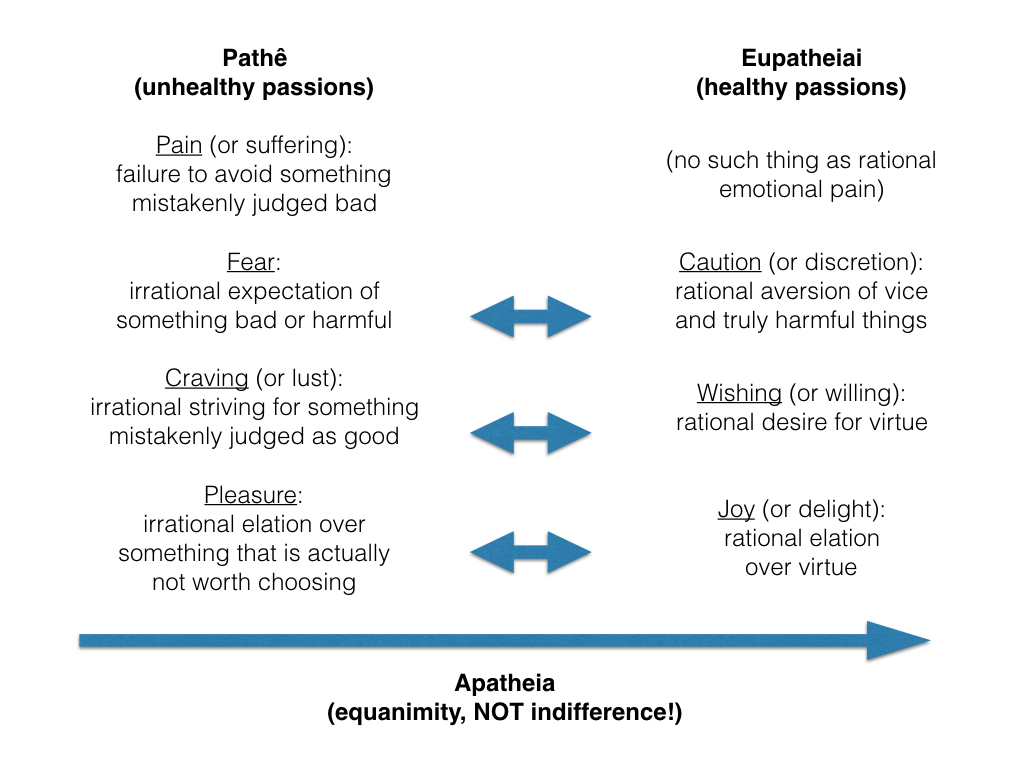
The Stoic method can be summarized as:
- Diagnose the Disturbance: False judgments that mistake indifferent external things (like health, reputation, or wealth) for being truly good or bad.
- Apply the Remedy:
- Knowledge: Understand that only virtue is good and only vice is bad. Everything else is indifferent.
- Practice: Constantly police your judgments. When an impression of something "bad" arises (e.g., "I've lost my job, this is a disaster"), pause and correct it: "Losing my job is an indifferent external event. It is not in my control and is not truly bad. How I respond with virtue is in my control and is good."
- Achieve the Result: Ataraxia and apatheia—a state of imperturbability that comes from knowing that nothing truly bad can happen to your inner self (your character).
The Skeptic Path: Attaining Peace Through Doubt
As you saw in the last lesson, the Pyrrhonian Skeptic offers a radical alternative. They observe that it is the conflicting claims of the dogmatists (like the Stoics and Epicureans) that create intellectual anxiety. The cure is not to find the correct dogma, but to suspend judgment on all of them.
Stoics vs. Skeptics vs. Epicureans | AA Long on Hellenistic Philosophy
Finally, Professor Long explains the Skeptic's surprising path to tranquility. This will be a good review of the concepts from our previous lesson, now placed in direct comparison with the other schools.
Please watch from 58:45 to 01:04:30. Focus on: The use of 'modes' to challenge dogmatic claims and produce equipollence (equal weight). The move from equipollence to epoché (suspension of judgment). The key idea that ataraxia is the consequence of suspending judgment, not its initial goal.
The Skeptic method is:
- Diagnose the Disturbance: The anxiety and intellectual turmoil caused by unresolved philosophical disagreements and the rash desire to assent to a belief.
- Apply the Remedy:
- Practice: For any dogmatic claim, find or construct an opposing argument of equal persuasive force (equipollence). Use systematic tools like Agrippa's Trilemma.
- Suspend Judgment: Unable to decide between the competing claims, withhold assent (epoché).
- Achieve the Result: Ataraxia follows "as a shadow follows a body"—an unexpected peace that descends once you give up the stressful and futile quest for certainty.
3. A Head-to-Head Comparison: Knowledge vs. Doubt
The sharpest contrast is between the dogmatists and the skeptics. For Epicurus, tranquility comes from knowledge (of atomic physics). For the Pyrrhonist, it comes from doubt (about all such theories).
Professor Burnyeat explores this "family feud" directly.
In this final clip, Professor Burnyeat frames the disagreement between Epicurus and Pyrrho as a debate over the best way to achieve tranquility: through knowledge or through doubt.
Please watch from 22:33 to 30:31. Notice how he structures the core disagreement: Epicurus: Tranquility comes from knowledge. We must study natural philosophy to banish fears. Pyrrho: Tranquility comes from doubt. The question 'What is the nature of things?' is unanswerable, so we should stop trying and give up the futile effort of decision.
4. Summary and Synthesis
We can now consolidate our comparison into a structured table. This format helps clarify the distinct logical structures of each school's approach to achieving ataraxia.
| Dimension | Epicureanism | Stoicism | Pyrrhonian Skepticism |
|---|---|---|---|
| Source of Disturbance | Fear of death & gods; pain of unsatisfied, unnatural desires. | False judgments about external events; believing "indifferents" are good or bad. | The anxiety of holding dogmatic beliefs and the turmoil of philosophical conflict. |
| Proposed Remedy | Knowledge & Limitation: Study physics to eliminate fear; limit desires to what is natural and necessary. | Rational Re-evaluation: Distinguish what is in your control from what is not; assent only to correct judgments. | Suspension of Judgment: For any claim, find an opposing claim of equal strength and withhold assent from both. |
| Role of Reason | A tool to calculate pleasures/pains and understand the atomic truth of the world. | The divine spark within; the faculty by which we align ourselves with the rational cosmos. | A tool used to dismantle all dogmatic claims, including its own, leading to its own suspension. |
| Attitude to Externals | Pursue simple pleasures; avoid politics and social competition that lead to anxiety. | Engage with the world and fulfill your duties, but remain internally detached from outcomes. | Follow custom and appearances without holding any underlying belief about their truth or value. |
| Nature of Tranquility | A stable, positive pleasure that is the default state once fear and pain are removed. | The byproduct of a virtuous life lived in agreement with nature; a state of rational calm. | An accidental discovery; the peace that follows after giving up the stressful search for truth. |
This reference image provides a helpful, high-level overview of these schools and their conception of happiness.

Conclusion
In this lesson, you have compared the three major Hellenistic paths to tranquility. Though they shared the goal of ataraxia, their methods were profoundly different, representing a rich debate about the nature of a good human life.
Key Takeaways:
- Epicureans sought tranquility by eliminating fear and limiting desire through a dogmatic belief in atomism.
- Stoics sought tranquility by re-training their judgments to align with a dogmatic belief in a rational, providential cosmos.
- Skeptics found tranquility by suspending all judgment, rejecting the very dogmatism that the other two schools relied upon.
You have now completed the module on Hellenistic Philosophy, having traced the development of these powerful and enduring ethical systems. We have seen how philosophy during this period became intensely practical, offering concrete strategies for navigating the challenges of life.
Our next module will mark a significant shift in our journey through "World Philosophy." We will move from the Mediterranean world to explore the rich and distinct philosophical traditions of Africa, beginning with an analysis of the concept of Ma'at in ancient Egyptian thought.
Can't find a good explanation? Sign up and we'll make it for you
Sign up