
Introduction
Welcome to your next lesson on Hellenistic philosophy. In our previous session, you explored the foundations of Epicureanism, seeing how its atomistic physics provided the groundwork for an ethics aimed at achieving tranquility (ataraxia). We established that for Epicurus, the soul is a physical entity that dissolves upon death. This metaphysical claim has a profound ethical purpose: to eliminate the fear of death, which he saw as the greatest obstacle to a happy life.
Today, we will directly confront that fear by focusing on one of the most famous arguments in the history of philosophy. Your learning outcome is to analyze the Epicurean argument that death is nothing to us from Epicurus' 'Letter to Menoeceus'. We will move beyond simply stating the argument to dissecting its logical structure, examining its core premises, and evaluating its strength against potential objections. This exercise will draw upon the skills in argument reconstruction you developed in the first module.
To begin, let's look at how this specific argument fits into the broader Epicurean system.
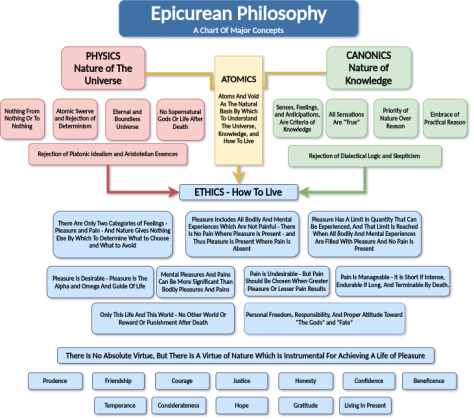
The Argument in Epicurus's Own Words
The best way to begin our analysis is by engaging directly with the primary text. Epicurus lays out his argument concisely in his letter to his student, Menoeceus.
This is a translation of Epicurus's 'Letter to Menoeceus'. Reading his words directly will give you a feel for his style and the precise way he formulates his reasoning. We will focus on the most crucial paragraph for our topic.
Please read paragraph [3] of the letter. It begins with 'Become accustomed to the belief that death is nothing to us.' As you read, try to identify the two central claims that form the foundation of his conclusion.
Now that you've read the original passage, let's watch a short video that breaks down the argument into its core components and clarifies its implications.
Epicurus Towards Death: Letter to Menoeceus
This video, from the YouTube channel Maieutics, provides a clear and focused explanation of the argument you just read. It will help solidify your understanding of the argument's basic structure.
Watch the video from 02:18 to 03:52. Pay close attention to: The two key components of Epicurus's argument. The distinction between the state of being dead (which Epicurus discusses) and the process of dying. The reason why Epicurus considers the fear or anticipation of death to be an 'unnecessary pain.'
As you've seen, the argument is elegantly simple. It rests on two powerful premises:
- The Sensation Premise: All good and bad consist in sensation (or sense experience). For something to be bad for you, you must be able to experience it as bad.
- The Privation Premise: Death is the deprivation of all sensation.
From these, the conclusion follows: since you cannot experience death, death cannot be bad for you. It is, therefore, "nothing to us." As Epicurus famously puts it: "while we exist, death is not present, and when death is present, we do not exist."
Reconstructing and Analyzing the Argument
Your preference for a rigorous, text-driven approach makes this an excellent opportunity to formally reconstruct the argument. This allows us to check its logical validity before we assess the truth of its premises.
The following essay provides an excellent model for this, along with a deep analysis of the argument's finer points.
Essay on Epicurean Conceptions of Death
This essay by Eddie Ryan provides a clear reconstruction of Epicurus's argument in a standard premise-conclusion format, which will be familiar from our first module. It then moves into a sophisticated analysis of the argument's most challenging aspects.
Please read the first half of the essay, up to and including the formal reconstruction of the argument. You can stop where it says, 'This argument is valid and takes the hypothetical syllogism form.' Focus on: How the author breaks down the argument into two stages: death causes no distress when present, and it should cause no distress when absent (in anticipation). The formal reconstruction itself. Notice how it captures the logic you've already seen in a step-by-step format.
The formal reconstruction in the essay presents the argument's valid logical structure. The conclusion C) Death is nothing to us necessarily follows if all the premises (P1-P4) are true.
This brings us to the core of philosophical analysis: are the premises true? A critic won't attack the logic, but the assumptions that the logic is built upon.
Evaluating the Premises: Objections and Epicurean Replies
Many people find Epicurus's argument logically clever but emotionally unconvincing. The feeling that death is a bad thing is very powerful. Let's analyze the most common objections. These objections typically challenge the premises of the argument, especially the idea that something can't be bad for you if you don't experience it.
We will continue with the same essay, which does an excellent job of articulating these objections and then providing robust Epicurean counter-arguments.
Essay on Epicurean Conceptions of Death
We will now read the second half of the essay. This section directly engages with the most common and intuitive objections to Epicurus's position. Understanding these replies is key to appreciating the internal consistency of the Epicurean worldview.
Read the rest of the essay, starting from the paragraph that begins, 'Though I believe this argument to be sound, premises two and three seem the most objectionable...' As you read, focus on how the Epicurean responds to these three major objections: The Deprivation Objection: Isn't death bad because it deprives me of the future pleasures I would have had? The Relational Harm Objection: What about the distress my death will cause my loved ones? Isn't that a bad thing that stems from my death? The 'Death as a Good' Objection: If someone is suffering terribly, isn't death a good thing (a relief), rather than 'nothing'?
As you can see, the strength of the Epicurean position lies in its coherence. The replies to these powerful objections consistently circle back to the core principles we've discussed:
- The goal of life is not the endless accumulation of pleasures but the stable state of ataraxia. Once you understand this, the craving for an infinite lifespan (and the fear of it ending) becomes an "unnecessary pain."
- Poverty, and even the grief of others, are not considered inherent evils. They only cause distress if one has the wrong beliefs about what is truly necessary for a good life.
- Death cannot be a "good" relief for the same reason it cannot be a "bad" event: the subject no longer exists to experience anything at all.
This rigorous defense reveals that to accept Epicurus's conclusion about death, one must also accept his very specific definitions of harm, pleasure, and the ultimate goal of life. A modern philosopher might challenge those definitions—for instance, by arguing for a different account of harm, like the "deprivation account"—but within the Epicurean system, the argument is remarkably robust.
Conclusion
In this lesson, we have conducted a deep analysis of Epicurus's argument that death is nothing to us. We moved from reading the primary text to deconstructing the argument's logic and evaluating its premises in the face of significant objections.
Here are your key takeaways:
- The Core Argument: The argument rests on two pillars: that all good and evil lie in sensation, and that death is the annihilation of sensation. Therefore, death can be neither good nor evil for the one who has died.
- The Fear of Anticipation: Epicurus argues that it is irrational to be pained by the anticipation of something that will cause no pain when it arrives. The fear of death is an "empty pain" based on a false belief.
- Logical Structure: When formally reconstructed, the argument is logically valid. Its soundness depends entirely on the truth of its premises.
- Analyzing the Premises: The most potent objections challenge the "Sensation Premise" by suggesting that death is bad because it deprives us of future goods. The Epicurean defense requires a commitment to the entire ethical system, particularly the idea that ataraxia (tranquility), not the maximization of experiences, is the highest good.
You've now examined the Epicurean path to tranquility, which involves a specific understanding of physics and a rational management of desires to eliminate fear.
In our next lesson, we will turn to the second major Hellenistic school, the Stoics. You will see that they also sought tranquility but proposed a very different path to achieve it—one based not on managing pleasure, but on understanding virtue and accepting what lies outside our control. We will begin by exploring their foundational ethical principle: the distinction between what is "up to us" and what is not.
Can't find a good explanation? Sign up and we'll make it for you
Sign up