
Introduction
Welcome to your next lesson on Hellenistic philosophy. In our last session, we established the cornerstone of Stoic ethics: the strict distinction between what is "up to us" (our judgments, choices, desires) and what is "not up to us" (externals like health, wealth, and reputation). You learned that for Epictetus, freedom and tranquility are found only by focusing our concern on what we can absolutely control—our own faculty of choice, or prohairesis.
This raises a crucial question: If our happiness depends solely on making the right choices, how do we know which choices are right? The Stoic answer is the famous and often-misunderstood directive: live according to nature.
Today, you will reconstruct the Stoic account of what it means to live according to nature, drawing primarily on the teachings of Epictetus in his Discourses. By the end of this lesson, you will be able to explain the different layers of meaning in this concept and how they form a coherent guide for life.
1. What "Nature" Do We Live According To?
Before diving into the Stoic texts, it's important to clear away common modern assumptions about the word "nature." The Stoics did not mean returning to a pre-technological wilderness, indulging our primal instincts, or simply buying "all-natural" products. Their concept was far more specific and philosophical.
The following video lecture provides an excellent overview of the historical development of this idea within Stoicism and discusses some of the common confusions surrounding it.
Stoicism and "In Accordance With Nature" | A Center for Ethics and Entrepreneurship Lecture
Dr. Gregory B. Sadler's lecture, 'Stoicism and "In Accordance With Nature"', directly addresses the central question of our lesson. It's a great starting point for seeing why this concept requires careful definition.
Please watch from 11:13 to 19:57. Focus on these two key areas: Modern Interpretations (11:13 - 16:51): Pay attention to the different—and often conflicting—meanings we might assign to 'nature' today. This helps clarify what the Stoics didn't mean. Historical Development (16:51 - 19:57): Note how the doctrine evolved from Zeno to Cleanthes and Chrysippus. The key development is the distinction between the 'common nature of the universe' and the 'specific nature of the human being'.
As the video highlighted, the Stoic concept of "nature" is not singular but twofold. To live according to nature is to live in harmony with both:
- Universal Nature: The rational, ordered, and providential structure of the entire cosmos, which the Stoics identified with God, or Logos.
- Human Nature: Our specific nature as creatures endowed with reason and an innate sociability.
Let's explore these two dimensions in more detail.
2. Reconstructing the Two-Fold Account
"Living according to nature" means simultaneously accepting our place in the grand cosmic order and perfecting our own unique human capacities.
-
Living according to Universal Nature means accepting fate. It involves recognizing that everything outside our direct control—illness, fortune, the actions of others, even death—is part of a larger rational plan. We don't have to like these events, but we must accept them as necessary parts of a whole that is ultimately good. The goal is to wish for things to happen as they do, not as we would prefer. Epictetus puts it this way:
"Remembering then this disposition of things, we ought to go to be instructed, not that we may change the constitution of things... but in order that, as the things around us are what they are and by nature exist, we may maintain our minds in harmony with the things which happen." (Discourses, 1.12.17)
-
Living according to Human Nature means perfecting our reason and fulfilling our obligations to others. Unlike other animals, our nature is to be rational and social. Therefore, acting "naturally" means acting logically, justly, and with concern for our fellow humans. This involves performing our kathēkonta, or "appropriate actions," based on our social roles: as a parent, child, friend, or citizen.
The following reading explains how these two aspects work together.
Epictetus | Internet Encyclopedia of Philosophy
The Internet Encyclopedia of Philosophy provides a clear explanation of what 'following nature' meant for Epictetus, with helpful quotes from his works.
Please read section 'g. On Living in Accord with Nature.' Focus on how Epictetus applies the concept in two ways: Responding appropriately in social situations (like dealing with a difficult brother), which relates to human nature. Accepting what fate brings (like the annoyances at the public baths), which relates to universal nature.
This dual account gives us a complete ethical guide. On one hand, we accept what we cannot change (Universal Nature). On the other, we strive to act with excellence in the domain we can control (Human Nature).
3. A Rigorous Reconstruction: "Nature" vs. "The Nature of Things"
Given your interest in a rigorous, text-driven approach, we can refine our understanding further. Some scholars argue that to truly grasp Epictetus, we must make a subtle but crucial distinction between "Nature" (physis) and "the Nature of things" (physis again, but used in a technical sense).
This argument provides a powerful way to reconstruct Epictetus's account and connects this lesson directly to our previous one.
- Nature (N): The all-encompassing universe. In this sense, it's impossible not to act "according to Nature," because everything that happens, from a virtuous act to a vicious one, is part of the cosmos.
- The Nature of Things (NOT): This refers to the fundamental structure of reality as it is accessible to a rational mind. And what is that structure? It is precisely the dichotomy of control we studied last time—the unalterable division of the world into things that are up to us (proairetic) and things that are not (aproairetic).
According to this interpretation, "living according to nature" really means living according to the Nature of Things. It means respecting this fundamental division in reality in every judgment and choice you make. When you desire something outside your control, you are attempting to violate the Nature of Things, which inevitably leads to contradiction and unhappiness.
The following scholarly text presents this argument and its powerful implications.
[PDF] "Nature" and the "Nature of Things" in the Stoic Philosophy of Epictetus
This paper by Franco Scalenghe offers a precise, logical reconstruction of Epictetus's philosophy based on the distinction between 'Nature' and the 'Nature of things.' This fulfills the demand for a deep, argument-focused analysis.
Please read the 'Conclusion' section (pages 279-281). It proceeds in a step-by-step manner (a-f) that should resonate with your analytical background. Focus on: How 'Proairesis' (b) allows a human being to recognize 'the Nature of things' (c). How 'the Nature of things' is defined as the bipartition between what is and is not in our power. The final point (f) that unhappiness is a 'contradiction' that arises from violating this fundamental structure of reality.
This interpretation elegantly synthesizes what we've learned. "Living according to nature" is not a vague appeal to the cosmos; it is the rigorous, moment-to-moment practice of aligning your will with the fundamental, unchangeable structure of reality—the division between what you can and cannot control.
As Epictetus states, the work of a virtuous person is simply "the use of the impressions in accord with the nature of things" (Discourses III,3,1).
4. Practice and Self-Coherence
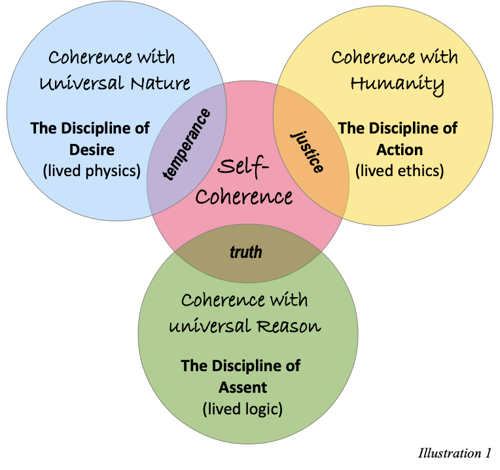
So, how does a Stoic put this into practice? Epictetus outlines three fields of study, or disciplines, which train the aspiring philosopher to live according to nature.
- The Discipline of Desire: Concerns our desires and aversions. It trains us to desire only what is up to us (virtue) and to be averse only to what is up to us (vice), thereby aligning us with Universal Nature by accepting all externals.
- The Discipline of Action: Concerns our impulses to act. It trains us to act for the common good, fulfilling our social roles with justice and kindness, thereby aligning us with our Human Nature.
- The Discipline of Assent: Concerns our judgments about impressions. It is the foundational discipline, training us to see things clearly and avoid false judgments, thereby aligning us with the Nature of Things (the dichotomy of control).
This diagram provides a helpful visual summary of how these practices lead to a coherent, virtuous life.
Conclusion
In this lesson, we have reconstructed the Stoic account of "living according to nature." You have moved from a general understanding to a precise, textually-grounded reconstruction of this central ethical principle.
Here are the key takeaways:
- Two-Fold Meaning: "Living according to nature" involves both accepting the rational order of the Universal Nature (fate) and perfecting our own specific Human Nature as rational, social beings.
- A Rigorous Definition: A deeper analysis reveals that for Epictetus, this means living according to the Nature of Things—the unalterable division of reality into what is and is not in our power.
- Connection to Previous Lesson: This provides the "why" for the dichotomy of control. We respect that division not arbitrarily, but because it is the fundamental structure of reality accessible to our reason.
- Practical Application: The three disciplines (Desire, Action, and Assent) are the practical exercises for training oneself to live in this harmonious, coherent way.
You now have a solid grasp of the ethical frameworks of both the Epicureans and the Stoics. In our next lesson, we will turn to the third major Hellenistic school, Pyrrhonian Skepticism. While the Stoics built an intricate system to achieve tranquility, the Skeptics argued that true peace of mind comes not from finding the right answers, but from suspending judgment on whether any such answers can be found at all.
Can't find a good explanation? Sign up and we'll make it for you
Sign up