
Hello again. You have now used Buildroot to create, customize, and boot a small gateway prototype, including both writable ext4 and immutable SquashFS root filesystems. That experience is important evidence: Buildroot made the system visible and approachable, and it supported rapid experimentation with a small, appliance-like image.
This lesson turns that prototype experience into an engineering decision. Rather than asking which build system is “better,” you will write an Architecture Decision Record (ADR) for the intended product: an AM62x-based automotive or industrial edge gateway expected to be maintained for roughly ten years. The decision must account for more than initial image size or first-build speed: hardware variants, OTA updates, security evidence, vulnerability response, SDKs, supplier handover, reproducibility, and the cost of maintaining engineering knowledge.
An ADR is a decision with a memory
An Architecture Decision Record is a short, version-controlled document that explains:
- What was decided
- Why the decision was necessary
- Which alternatives were considered
- Which trade-offs were accepted
- What consequences and follow-up obligations now exist
An ADR is not a product brochure, a tool comparison copied from the Internet, or a permanent claim that the selected technology is ideal. It records a decision made under stated constraints, using the evidence available at that time.
For an embedded product, this matters especially when a decision outlives the original team. Six years from now, a new engineer should be able to answer questions such as:
- Why does the gateway use Yocto rather than the quicker Buildroot prototype?
- Was Buildroot rejected because it is technically incapable, or because the product lifecycle needs different governance?
- Which needs are mandatory for the initial release, and which are expected later?
- What maintenance practices must exist for the decision to remain valid?
- Under what circumstances should the team reconsider?
In automotive work, this is close to an engineering safety case or design rationale: the key is not to predict every future change, but to make the assumptions and responsibilities inspectable.
Decision context for this gateway
Use the following baseline assumptions for the ADR in this lesson:
| Dimension | Gateway assumption |
|---|---|
| Product | Industrial or automotive edge gateway |
| Hardware | AM62x-class ARM64 SoC, CAN-FD, Ethernet, persistent flash or eMMC |
| Lifecycle | Ten years of maintenance, security updates, and controlled releases |
| Product evolution | Initial board plus likely board revisions, feature variants, and possibly another SoC generation |
| Update model | Authenticated image-based A/B updates are the intended production model |
| Security direction | Verified boot, read-only system content, signed updates, SBOMs, CVE review, release evidence |
| Teams | BSP, platform, application, validation, and eventually external or separate application developers |
| Early-stage reality | Team is still learning embedded Linux; host resources are constrained to 16 GB RAM and limited SSD space |
Notice a subtle point: A/B image updates do not automatically require Yocto. Buildroot can support a robust image-based update architecture. The decision turns on the combined lifecycle requirements, not on any single feature.
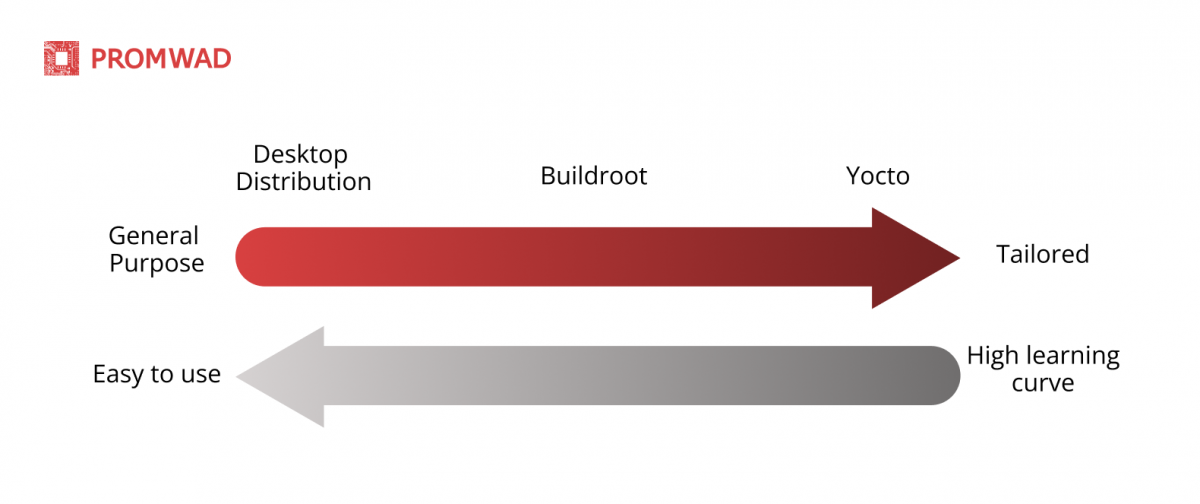
The visual captures a real trade-off, but an ADR must go further. A steep learning curve can be justified if it reduces long-term change cost across products and teams. Conversely, a feature-rich system can be unjustified complexity for one stable, tightly bounded appliance.
Compare the architectures before comparing features
Buildroot and Yocto can both generate a Linux image containing a kernel, bootloader, root filesystem, libraries, and gateway application. Their most important difference is what they treat as the central engineering artifact.
- Buildroot centers on a selected system configuration. It uses Kconfig and Make to build a toolchain or consume an external one, build selected components, and assemble a root filesystem image.
- Yocto Project, through OpenEmbedded and BitBake, centers on metadata-driven distribution construction. Recipes describe components; layers separate concerns such as the BSP, distribution policy, and product software; BitBake executes a task graph and can reuse valid task outputs through shared state.
This difference influences daily work. Buildroot encourages a compact, coherent configuration for an appliance. Yocto encourages explicit separation of ownership and policy across a product family.
Buildroot vs Yocto: Differences for Your Daily Job - Luca Ceresoli, AIM Sportline
Watch “Buildroot vs Yocto: Differences for Your Daily Job” from The Linux Foundation. Luca Ceresoli focuses on practical differences in project setup, customization, and incremental-build behavior rather than presenting a simplistic winner.
Watch project setup to contrast Buildroot’s configuration-centred workflow with Yocto’s multiple repositories and layers. Then watch customization models, focusing on Yocto layers and recipe appends versus Buildroot’s br2-external approach. Finish with dependency tracking to see why Yocto’s task hashes and Buildroot’s stamp-based rebuilding lead to different operational costs.
The video’s key message is not that Yocto is inherently more professional. It is that its mechanisms address a different coordination problem. Buildroot’s br2-external pattern can keep project-specific packages, board definitions, overlays, and scripts outside upstream Buildroot. That is clean and sufficient for many products. But it is less naturally decomposed into independent, composable policy domains than a mature Yocto layer stack.
The boundary that matters: configuration versus policy
Consider a gateway family with two product variants:
- A standard gateway with CAN-FD, dual Ethernet, and secure remote management.
- A higher-end gateway that adds cellular connectivity, edge analytics, and a different carrier board.
Both products should share core policies: security hardening, systemd service conventions, licensing processes, package versions, release metadata, and OTA behavior. They should differ only where hardware or product capability genuinely differs.
A disciplined Yocto architecture can express those responsibilities separately:
| Metadata area | Typical responsibility |
|---|---|
| SoC vendor BSP layer | SoC boot flow, kernel baseline, vendor firmware, machine support |
| Board layer | Carrier-board device tree, pinmux, board-specific boot configuration |
| Distribution layer | C library, init system, hardening defaults, package format, release policy |
| Product layer | Gateway services, CAN configuration, firewall policy, image and packagegroups |
| Application layers | Product applications and their dependencies, potentially maintained by distinct teams |
This separation does not prevent errors. Layers can conflict, overrides can obscure provenance, and a poorly governed Yocto workspace can become harder to understand than a Buildroot configuration. The benefit only appears when ownership boundaries, compatibility rules, review standards, and release baselines are enforced.
Read the Yocto Project’s official overview to distinguish its actual building blocks from common shorthand such as “Yocto Linux.” This will give the ADR precise language for layers, recipes, policy, packages, SDKs, and build outputs.
In Section 3.1, read the core-component explanation. Focus on the distinct roles of recipes, classes, and configuration data. Then read Section 3.2, beginning with the layer rationale; note that layers are a logical separation mechanism, not merely directories. Continue in Section 3.3, especially subsections 3.3.2 “Metadata, Machine Configuration, and Policy Configuration,” 3.3.4 “Package Feeds,” 3.3.5.5 “Image Generation,” and 3.3.5.6 “SDK Generation.” Locate the discussion beginning the three layer inputs. Focus on how the BSP, distro, and software layers divide responsibility, and on the fact that Yocto can produce package feeds and SDKs even when the fielded product uses only full-image updates.
Evaluate a ten-year lifecycle, not a first demo
A useful ADR makes the criteria explicit. For this gateway, score neither tool as universally good or bad. Assess the consequences of each choice against the product’s expected operating model.
| Criterion | Buildroot assessment | Yocto assessment | Importance for this gateway |
|---|---|---|---|
| Initial bring-up | Usually faster to learn, configure, and inspect | More host setup, metadata, and terminology to learn | High in the prototype phase |
| Small, fixed image | Strong default fit; minimal dependencies are easy to preserve | Fully possible, but requires intentional image and feature policy | Medium |
| Single-board appliance | Excellent when scope is stable and full-image replacement is acceptable | Often more machinery than needed | Medium |
| Multi-board or multi-SKU reuse | Possible with disciplined defconfigs and external trees, but custom conventions carry more of the burden | Layer model explicitly supports BSP, board, distro, and product separation | High |
| Incremental team builds | Simple local workflow; rebuild behavior is generally easier to reason about | Shared-state cache and task signatures can reduce rebuild time at scale, but require cache infrastructure and debugging skill | High |
| Application-developer SDK | Can use external or Buildroot-generated toolchains | Standard SDK and eSDK are integrated outputs of the build system | Medium to high |
| Runtime package feeds | Not the normal Buildroot model | Supports RPM, DEB, or IPK package generation and feeds | Medium; not required for the intended A/B strategy |
| Image-based A/B OTA | Strong fit; simple appliance model pairs naturally with complete image replacement | Also strong; can build the images and metadata needed by an A/B framework | High |
| SBOM, licensing, CVE evidence | Achievable, but the team must assemble and enforce more of the process | Richer metadata and established classes support systematic evidence generation | High |
| Vendor ecosystem for AM62x | Available, but vendor support may emphasize another system | Strong ecosystem pattern for SoC vendor BSP layers and product layers | High |
| Long-term release governance | Viable with excellent internal discipline | Provides structured mechanisms, but still requires governance and upgrade planning | Very high |
| Learning and onboarding cost | Lower at first | Higher; requires BitBake, layers, overrides, task signatures, caches, and release compatibility knowledge | High |
Two corrections to common assumptions are worth making.
“Buildroot is only for hobby projects”
Incorrect. Buildroot can produce compact, well-controlled products and is widely used in industrial systems. It can build a toolchain, kernel, bootloader, and root filesystem, and it supports reproducible configuration when teams pin source revisions and preserve their build inputs. A gateway with a stable board, a small team, image-based updates, and constrained storage can be an excellent Buildroot product.
The risk is not technical incapability. The risk is that a ten-year program accumulates product variants, security fixes, supplier changes, and ownership boundaries faster than the team’s Buildroot conventions mature.
“Yocto is automatically secure and reproducible”
Also incorrect. Yocto provides mechanisms that support control, but no mechanism substitutes for process.
A Yocto image can still be insecure if:
- sources are not pinned and mirrored;
- layers are not version-locked and reviewed;
- developer-specific changes live in
local.conf; - CVE reports are ignored or treated as automatic vulnerabilities;
- signing keys are handled outside a controlled release process;
- artifact provenance and test evidence are not retained;
- a layer upgrade is attempted without regression and compatibility testing.
Treat Yocto as a framework for making desired engineering policies executable and inspectable. It does not create those policies on its own.
Build performance: distinguish first build from organizational throughput
On the current 16 GB Ubuntu host, the practical experience of the two systems will differ sharply.
Buildroot usually offers a quicker path to a first bootable image and a smaller conceptual surface area. This has been valuable in the preceding labs: you could directly inspect output/target, package gateway-agent, and choose ext4 or SquashFS without having to first design a distribution.
A clean Yocto build for an AM62x target can be demanding in CPU, memory, storage, and download volume. On the current laptop, uncontrolled parallelism and insufficient free space can turn the learning experience into slow, opaque failures. That is a real cost and belongs in the ADR.
However, a ten-year product is not maintained through clean builds on one laptop. It is maintained by engineers and CI systems rebuilding selected changes over years. Yocto’s shared-state system works at task granularity. BitBake computes task signatures from relevant metadata, task code, and dependencies. If a valid cached task result exists, BitBake can restore it rather than execute the task again. This makes a properly managed shared download cache, shared-state mirror, and hash-equivalence service valuable organizational infrastructure.
The distinction is:
- Buildroot optimization question: How quickly can this configuration produce a fresh system image?
- Yocto optimization question: How can a fleet of developers and CI workers reuse valid outputs while rebuilding only the consequences of an actual change?
For a small isolated product, the first question may dominate. For a maintained gateway family with regular CVE remediation and CI, the second increasingly dominates.
Do not claim a universal build-time winner in the ADR. Record the decision as a lifecycle conclusion: Yocto’s caching complexity is accepted because the organization expects repeated builds across people, branches, variants, and releases. Later, you will configure conservative thread counts and external cache locations specifically for the 16 GB host.
Updates: package management is optional, release discipline is not
A frequent comparison says: “Yocto supports package management; Buildroot produces an image.” This is true as a general architectural distinction but does not decide the gateway’s update strategy.
The planned production gateway will use:
- authenticated boot artifacts;
- immutable system content;
- redundant A/B root filesystem slots;
- a persistent data partition;
- a signed, atomic update bundle;
- bootloader-controlled rollback if the updated slot does not become healthy.
That is an image-based update model. Both Buildroot and Yocto can provide the root filesystem images consumed by such an updater. In fact, for a tightly scoped appliance with only A/B updates, Buildroot’s image-first model can be very attractive.
Why still prefer Yocto for the gateway program? Because secure update delivery is only one lifecycle concern. A release must also answer:
- Exactly which source revisions, patches, BSP metadata, and compiler versions produced this image?
- Which packages and licenses are included?
- Which CVEs were evaluated and what was their disposition?
- Which board and product variants receive the update?
- Which SDK allows an application team to reproduce a build against the platform ABI?
- Which policy changes affect every variant?
- Can release evidence be regenerated or independently audited years later?
Package feeds can remain disabled in production. The use of Yocto does not commit the device to field-installed RPM, DEB, or IPK packages. For this gateway, they are most useful as build-time artifacts and optional diagnostic tools, not as the primary OTA mechanism.
Turn the comparison into a decision
The following is a worked ADR suitable for your private implementation repository. Adapt product names, release branches, and organizational ownership once the actual board and vendor BSP release are selected.
A common repository location is:
docs/adr/0001-build-system-selection.md
Use a sequential number, never reuse it, and preserve superseded decisions rather than deleting them.
ADR-0001: Select Yocto Project as the production build framework
Status: Accepted
Date: 2025-XX-XX
Decision owners: Platform/BSP Lead, Product Security Lead, Gateway Software Lead
Scope: Production software platform for the AM62x automotive/industrial edge-gateway family
Context
The gateway requires a custom embedded Linux distribution for an AM62x-class ARM64 platform. The product must support CAN-FD and Ethernet gateway functions, an immutable system image, verified boot, authenticated A/B updates, persistent operational data, security hardening, and a ten-year maintenance lifecycle.
The expected program includes an initial board, board revisions, product variants, coordinated BSP and application development, supplier component updates, vulnerability management, licensing review, release evidence retention, and eventual SDK support for application development.
A Buildroot prototype has demonstrated rapid creation of a small image, custom application packaging, and both ext4 and SquashFS root filesystem generation. The prototype validates the appliance-style model but does not itself establish the governance needed for a long-lived product family.
Decision drivers
The build framework shall support:
- Clear separation between SoC or vendor BSP support, board support, distribution policy, gateway product software, and optional product variants.
- Reproducible release builds with recorded source revisions, layer revisions, configuration, artifacts, and checksums.
- A sustainable workflow for security updates, SBOM and license evidence, CVE review, and patch traceability.
- Generation of production images suitable for signed A/B update bundles and read-only system operation.
- SDK generation for application developers without requiring each developer to operate the complete platform build environment.
- Shared source and build-output caches for developer and CI throughput.
- A feasible adoption plan for a team initially new to Linux-host and Yocto workflows.
Considered options
Option A: Buildroot with a controlled external tree
Buildroot would be maintained with pinned upstream revisions, a project br2-external tree, board defconfigs, package definitions, root filesystem overlays, post-build scripts, external source mirrors, and project-defined processes for SBOMs, CVE disposition, release manifests, SDK use, and image signing.
Advantages
- Faster initial bring-up and lower entry barrier.
- Direct Make and Kconfig workflow.
- Well suited to compact, fixed-purpose, full-image-update appliances.
- Lower build-system complexity for a single stable board and small team.
- Proven suitable for the prototype phase and future narrow-scope tools.
Disadvantages
- Product, board, and policy reuse across variants relies more heavily on local conventions.
- Package-feed, SDK, compliance, and lifecycle evidence workflows require more project-specific integration.
- Long-term consistency depends strongly on maintaining internal conventions as team composition changes.
- Scaling BSP customization and product variation can become difficult to review and reason about.
Option B: Yocto Project with OpenEmbedded metadata and a layered product architecture
Yocto will use a release-compatible Poky and OpenEmbedded-Core baseline, an AM62x vendor BSP layer, a private board layer, a private distribution layer, and private product/application layers. Production images will remain image-based and will integrate with the selected A/B update framework.
Advantages
- Explicit layering maps to the expected separation between vendor BSP, board, distribution policy, and product software.
- BitBake task signatures and shared-state caching support repeatable incremental builds across developer and CI environments.
- Standard SDK and extensible SDK workflows support application development.
- Recipe metadata, package outputs, license data, CVE tooling, and build manifests provide a stronger foundation for release evidence.
- Fits the expected vendor ecosystem and product-family evolution.
- Supports small immutable images and image-based A/B updates without requiring target-side package management.
Disadvantages
- Higher learning curve and more complex debugging model.
- Larger host storage, memory, and initial setup requirements.
- Layer priority, overrides, and release compatibility can create subtle integration failures.
- Requires deliberate cache infrastructure, version locking, CI, and metadata governance to gain its intended benefits.
Decision
Select Yocto Project as the production build framework for the AM62x gateway family.
Retain Buildroot as a prototype, training, and rapid bring-up tool where its small conceptual footprint provides value. Do not ship the Buildroot prototype as the production gateway platform unless the product scope is formally reduced and this ADR is revisited.
The production platform will use image-based A/B updates rather than target-side package installation as the normal field-update mechanism. Yocto package generation is retained for build composition, dependency analysis, SDK generation, and release traceability; it does not imply runtime package management on deployed gateways.
Rationale
The gateway’s ten-year lifecycle, planned security requirements, expected hardware and product variation, and need for reproducible release evidence outweigh the cost of Yocto’s additional build-system complexity.
Buildroot remains technically viable for a single-purpose gateway on stable hardware. It is not selected because the expected product lifecycle requires stronger separation of concerns and more systematic support for cross-team development, release governance, SDKs, security maintenance, and auditable software composition.
Consequences
Positive consequences
- Machine-specific changes can be isolated from distribution and gateway-product policy.
- The program can establish one security and release policy across multiple gateway variants.
- Standardized SDKs can be generated for application teams.
- CI can use shared downloads and shared-state caches to avoid repeatedly rebuilding unchanged tasks.
- Release artifacts can be associated with locked layer revisions, source revisions, manifests, SBOMs, test evidence, and update bundles.
Negative consequences and accepted costs
- Engineers must learn BitBake metadata, task execution, layers, overrides, and cache behavior.
- The build host and CI infrastructure need significantly more disk space and memory planning than the Buildroot prototype.
- The project must control Yocto release upgrades, vendor-layer compatibility, and local-layer quality.
- A poorly governed layer stack can be harder to maintain than a well-governed Buildroot external tree.
Required follow-up actions
- Select a supported Yocto release and compatible AM62x vendor BSP baseline.
- Create separate private repositories or clearly governed directories for the board, distribution, product, and security-sensitive metadata.
- Define a layer ownership and code-review policy.
- Configure external download and shared-state cache locations suitable for the 16 GB development laptop and CI.
- Record layer revisions, build configuration, artifact hashes, and test results for every release candidate.
- Define the production image layout, A/B update backend, and signing boundary without storing private keys in the build repository.
- Add CVE review, SBOM generation, license reporting, secret scanning, and reproducibility checks to CI.
- Revisit this ADR if the product is reduced to one stable board, a small software scope, a short lifecycle, and full-image updates only.
Decision review triggers
Review this decision if any of the following occurs:
- the gateway becomes a single-board product with no expected variants and a lifecycle under five years;
- the team cannot sustain the required Yocto release, cache, CI, and layer-governance practices;
- the selected SoC vendor no longer maintains a viable Yocto BSP;
- a supplier or regulatory requirement introduces a different certified platform constraint;
- measured development throughput or artifact reproducibility fails the program’s stated targets.
Why this is a defensible decision rather than a tool preference
The ADR’s conclusion is deliberately nuanced:
- Buildroot is not rejected because it cannot make a secure gateway. It can produce the kernel, bootloader, read-only root filesystem, and images needed for verified boot and A/B updates.
- Yocto is not selected because runtime package feeds are mandatory. The target update model remains signed whole-image replacement.
- Yocto is selected because the product program needs a maintainable metadata architecture and evidence workflow over time.
This is the reasoning that should stand up in a design review. If someone says “Buildroot is simpler,” agree with the observation but return to the decision driver: simplicity on day one is not the same as lower total system cost over ten years.
The following comparison is a compact reference when reviewing the ADR with stakeholders:
Yocto vs Buildroot for Production BSPs: A Practical Comparison | Glossary | Conclusive Engineering
Read this practical comparison as a cross-check for the ADR, especially its distinction between small, appliance-style products and multi-SKU, policy-governed platforms. Treat its matrix as a prompt for project-specific evidence rather than as a substitute for your decision rationale.
Begin with “Yocto vs. Buildroot: How Each System Works,” from the Yocto architecture, then read the corresponding Buildroot discussion through the Buildroot architecture. Focus on what each system makes easy by default. Then read the comparison table under “Yocto and Buildroot: Which Should You Use?” and the numbered decision framework. In particular, use the selection questions to check whether your ADR has explicitly addressed variants, update strategy, compliance, team structure, and lifecycle horizon.
Make the ADR operational
An ADR that never changes the repository or workflow is only documentation. The chosen direction should now affect how you structure work.
For the Buildroot prototype, keep a clear boundary:
gateway-buildroot-prototype/
    configs/
    board/
    package/gateway-agent/
    external/
    docs/
For the future production Yocto platform, the conceptual structure should make ownership visible:
gateway-yocto/
    sources/
        poky/
        meta-ti-or-vendor/
        meta-gateway-board/
        meta-gateway-distro/
        meta-gateway-product/
    build/
    docs/
        adr/
        release-evidence/
The exact repository strategy can vary. A mono-repository may simplify controlled releases; multiple repositories may better reflect supplier ownership and access control. The non-negotiable point is that private signing materials, production provisioning instructions, and unreleased security configurations remain outside any public showcase repository.
For your public portfolio later, publish the sanitized rationale, not sensitive implementation details:
- the ADR, with product-specific secrets and supplier restrictions removed;
- a generic layered architecture diagram;
- Buildroot prototype lessons and measured image data;
- a high-level explanation of why the production architecture moved to Yocto;
- reproducible public build instructions for a non-sensitive QEMU or evaluation-board configuration.
Do not publish private keys, signing scripts containing credential paths, eFuse programming values, production partition offsets, unredacted vulnerability reports, or proprietary vendor artifacts.
Key takeaways
You have converted the Buildroot prototype into an architecture decision rather than treating it as a dead-end exercise.
- Buildroot is a strong choice for compact, single-purpose, stable appliances, especially when full-image updates are sufficient and the team values fast bring-up and straightforward configuration.
- Yocto introduces substantial complexity, but its layers, task-based caching, package metadata, SDK generation, and policy separation can lower lifecycle risk for a multi-variant gateway maintained over a decade.
- Neither build system inherently provides security, reproducibility, compliance, or good OTA behavior. Those outcomes require controlled source inputs, release governance, testing, signing, and retained evidence.
- For the planned AM62x automotive or industrial gateway, the decision is to adopt Yocto for production while retaining the Buildroot work as a valuable prototype and learning artifact.
- A good ADR also records the costs of the decision, required follow-up actions, and conditions that would justify revisiting it.
This concludes the Buildroot prototype module. Next, you will begin the Yocto foundation work by identifying the roles of the Yocto Project, Poky, OpenEmbedded-Core, BitBake, recipes, machines, distributions, and layers—the vocabulary and architecture needed to implement the decision you have just made.
Can't find a good explanation? Sign up and we'll make it for you
Sign up