
Hello! Welcome to the fifth module of our course.
In the previous module, we did a deep dive into sequence modeling, culminating in assembling a full Transformer architecture. You now have a solid understanding of how models can learn to transform one sequence into another, a crucial concept in tasks like machine translation and, as we'll see later, speech recognition.
Now, we pivot from transformation to generation. Your goal of becoming an audio researcher and developer involves not just understanding speech (STT) but also synthesizing it (TTS). This requires a firm grasp of generative models, which are designed to create new, realistic data from scratch. This module will build that foundation.
Your learning outcome for this lesson is to: Explain the core principles of Generative Adversarial Networks (GANs), including the generator, discriminator, and adversarial loss.
We will unpack the elegant and powerful idea behind GANs: two neural networks locked in a competitive game, pushing each other to improve until one can generate incredibly realistic data.
1. The Core Idea: An Adversarial Game
The central concept of a GAN is an adversarial process between two neural networks: a Generator and a Discriminator.
- The Generator (G): Think of this as a forger or a counterfeiter. Its job is to create fake data (e.g., images, audio) that looks completely real. It takes a random noise vector as input and tries to transform it into a sample that could have come from the real dataset.
- The Discriminator (D): This is the detective or art expert. Its job is to distinguish between real data (from your training set) and fake data produced by the Generator. It is essentially a binary classifier.
These two networks are trained simultaneously in a zero-sum game:
- The Generator creates a batch of fake samples.
- The Discriminator is shown a mix of these fake samples and real samples from the dataset and tries to label them correctly.
- The Generator is penalized if the Discriminator successfully identifies its creations as fake. It uses this feedback to get better at fooling the Discriminator.
- The Discriminator is penalized for misclassifying real as fake, or fake as real. It uses this feedback to get better at telling them apart.
This process continues, with both networks getting progressively better. The Generator's outputs become more and more realistic until, ideally, the Discriminator is unable to do better than random guessing.
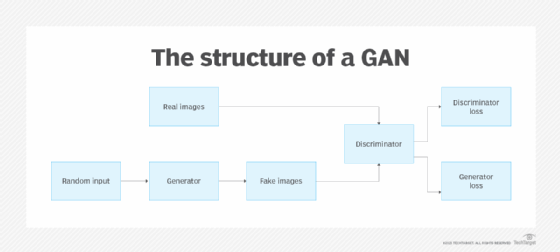
To see this concept explained, the following short video provides a great high-level introduction.
Generative Adversarial Networks | Tutorial with Math Explanation and PyTorch Implementation
This video from ExplainingAI introduces the fundamental goal of generative models and explains the adversarial relationship between the generator and discriminator in a GAN.
Please watch the video from the beginning to 04:52. Focus on understanding: The overall goal of a generative model. The specific roles of the Generator and the Discriminator. The intuition behind how their competition leads to the generator producing better and better samples.
2. The Mathematical Formulation: A Minimax Game
This adversarial process is formalized as a minimax game, described by a single value function, . The Discriminator tries to maximize this function, while the Generator tries to minimize it.
The value function is:
Let's break this down. Remember that is the Discriminator's output—the probability that sample is real. is the Generator's output from a random noise vector .
-
The Discriminator's Goal (
max D):- Term 1: : For real data , the Discriminator wants to maximize , driving it towards 1. Maximizing achieves this.
- Term 2: : For fake data , the Discriminator wants to minimize , driving it towards 0. This makes close to 1, thus maximizing its logarithm.
-
The Generator's Goal (
min G):- The Generator only influences the second term. It wants to minimize the value function. It does this by making the Discriminator's output for fake data, , as high as possible (close to 1). When approaches 1, approaches 0, and approaches , minimizing the function.
This objective function is clever because it's precisely the binary cross-entropy loss in disguise. The Discriminator is simply a binary classifier being trained to minimize its classification error, which is equivalent to maximizing .
To solidify your understanding of this crucial formula, please review the following materials.
20.1. Generative Adversarial Networks - Dive into Deep Learning
The article from "Dive into Deep Learning" provides a clear, concise mathematical formulation for the objectives of both the discriminator and the generator.
Read the section (it is untitled but follows the "Discriminator" section) that introduces the mathematical objective functions. Pay attention to equations (20.1.1) through (20.1.4), which formulate the losses for D and G and combine them into the final minimax objective.
The next video provides another excellent walkthrough of the math, explicitly connecting the value function to binary cross-entropy.
The Math Behind Generative Adversarial Networks Clearly Explained!
This segment from the Normalized Nerd channel clearly demonstrates how the GAN value function is derived directly from the binary cross-entropy loss function.
Watch from 04:51 to 08:25. The key takeaway is seeing the step-by-step derivation that shows the GAN objective is not an arbitrary formula, but a natural extension of a standard classification loss.
3. The Training Algorithm
In practice, we can't solve the minimax problem all at once. Instead, we use an iterative, alternating training process:
-
Train the Discriminator:
- Sample a mini-batch of real data points from the dataset.
- Sample a mini-batch of noise vectors and generate fake data points .
- Freeze the Generator's parameters.
- Update the Discriminator's parameters by performing gradient ascent on the value function , or more simply, by performing gradient descent on its binary cross-entropy loss.
The discriminator loss is effectively:
loss_real + loss_fake. -
Train the Generator:
- Sample a new mini-batch of noise vectors .
- Freeze the Discriminator's parameters.
- Update the Generator's parameters by performing gradient descent on the value function .
The generator loss aims to make the discriminator classify its fake samples as real.
A Practical Change to the Generator's Loss
There's a subtle but important issue with the Generator's objective. When training begins, the Generator is bad and produces obvious fakes. The Discriminator learns quickly and assigns very low probabilities () to them.
The original generator loss, minimizing , has very small gradients in this region (a problem known as gradient saturation). This means the generator learns very slowly when it needs to learn the most.
The Solution: Instead of minimizing the probability of the sample being fake, the Generator is trained to maximize the probability of the sample being real.
- Original goal:
- Practical goal: (or )
This modified objective has the same goal but provides much stronger gradients early in training.
The following video segments clearly explain the training loop and this crucial modification to the generator's loss.
Generative Adversarial Networks | Tutorial with Math Explanation and PyTorch Implementation
These sections from the ExplainingAI video detail the alternating training algorithm and the practical reason for modifying the generator's loss function.
Please watch from 04:52 to 12:19. Focus on: (04:52 - 08:51) How the minimax objective translates into separate binary cross-entropy losses for the discriminator and generator. (08:51 - 10:20) The explanation of why the generator's loss is modified to use log(D(G(z))) to avoid weak gradients. (10:20 - 12:19) The step-by-step training algorithm, showing how D and G are updated in an alternating fashion.
4. Convergence and Equilibrium
Theoretically, what is the end goal of this game? The training process should converge to a Nash Equilibrium. At this point:
- The Generator's data distribution, , perfectly matches the real data distribution, . The generated samples are indistinguishable from real ones.
- The Discriminator, unable to find any difference, can only guess. Its output for any sample (real or fake) is .
The original GAN paper proved that the minimax objective, at its optimum, minimizes the Jensen-Shannon Divergence (JSD) between the real and generated data distributions. JSD is a way of measuring the similarity between two probability distributions. The minimum value of JSD is 0, which occurs only when the two distributions are identical ().
Given your interest in the underlying mathematics, the following resource provides the derivation for the optimal discriminator and shows how this leads to the minimization of the JSD.
The Mathematics of GANs - Master Data Science
This article from Master Data Science provides a detailed mathematical derivation of the optimal GAN solution. It's an excellent resource for understanding the theory of why GANs work.
Please read section 4. Optimal Solution of GAN. Follow the derivations for: Theorem 1: Finding the formula for the optimal discriminator, D*(x). Theorem 2: How substituting D*(x) back into the value function V(D, G) transforms the objective into the Jensen-Shannon Divergence (JSD) between the real and generated distributions.
Conclusion
In this lesson, we have laid the theoretical groundwork for Generative Adversarial Networks. You've learned about the fundamental components and the game-theoretic dynamic that drives the learning process.
Key Takeaways:
- GANs consist of two competing networks: a Generator that creates data and a Discriminator that classifies data as real or fake.
- The training process is an adversarial game where the Generator tries to fool the Discriminator, and their competition leads to increasingly realistic generated data.
- This game is formalized as a minimax objective function, which is equivalent to training a binary classifier (the Discriminator) against an adversary (the Generator).
- The Generator's loss is practically modified from to to provide stronger gradients during training.
- The theoretical optimum of the GAN objective is reached when the generated data distribution matches the real data distribution, minimizing the Jensen-Shannon Divergence between them.
Preview of the Next Lesson:
While the principles we discussed are general, the specific neural network architectures used for the Generator and Discriminator are critical for success. In our next lesson, we will explore Deep Convolutional Generative Adversarial Networks (DCGANs). This will be our first look at a concrete, effective GAN architecture and will serve as a bridge from theory to practice, preparing us to eventually consider GANs for audio generation.