
Hello! Welcome to your next lesson on the subtle but powerful ways our choices are shaped by their presentation.
In our last lesson, we discussed how default options act as powerful nudges by leveraging our tendency to follow the path of least resistance. We've seen how framing information as a gain versus a loss can change our preferences, and how pre-setting a choice can guide our behavior.
Today, we will explore another fascinating principle of choice architecture: the decoy effect. You will learn how adding a third, strategically designed option can surprisingly—and predictably—shift your preference between the original two choices. This is a technique you have certainly encountered in subscription models, product pricing, and even coffee shop menus.
By the end of this lesson, you will be able to explain the decoy effect and the critical role of an "asymmetrically dominated" option in making it work.
1. A Tale of Two Subscriptions
To see the decoy effect in action, there's no better place to start than with a famous real-world example from The Economist magazine, as investigated by behavioral economist Dan Ariely.
Are we in control of our decisions? | Dan Ariely
In this segment from his talk 'Are we in control of our decisions?', Dan Ariely breaks down a perplexing pricing structure he found on The Economist's website and puts it to the test with his students. Pay close attention to how the choice set changes and how that impacts the decisions people make.
Please watch from 00:12:45 to 00:14:31. Notice how the 'useless' option isn't actually useless at all.
As Ariely demonstrated, the results are striking:
- With the decoy: 16% chose the web-only option, and 84% chose the print & web combo.
- Without the decoy: 68% chose the web-only option, and 32% chose the print & web combo.
The presence of the "Print-Only" option—which nobody wanted—dramatically shifted preference toward the more expensive combo deal. Why? Because it gave people a simple point of comparison. The combo deal at $125 looked like a fantastic bargain compared to the print-only option at the same price. The decoy made the decision feel easy and smart.
2. Deconstructing the Decoy Effect
This phenomenon is formally known as the decoy effect or attraction effect. It occurs when a person's preference for one of two options changes when a third, asymmetrically dominated option is introduced.
Let's break down that key term: asymmetrically dominated.
An option is asymmetrically dominated when it is clearly inferior to one option (the target) but not clearly inferior to the other (the competitor).
Consider this simple pricing structure:
| Option | Price | Features |
|---|---|---|
| A: Competitor | $10 | 1 Feature |
| B: Decoy | $18 | 3 Features |
| C: Target | $20 | 5 Features |
Here, Option B is the decoy.
- It is dominated by the Target (C), which is only slightly more expensive but offers significantly more features. The comparison is easy: C is clearly better than B.
- The relationship is asymmetrical because the Decoy (B) is not clearly dominated by the Competitor (A). The decoy is more expensive but has more features.
The decoy's role is to be a point of comparison that makes the target look great, not to be chosen itself. To dive deeper into the psychology, the following article provides an excellent explanation.
Decoy Effect: steer preferences smartly - Learning Loop
The article 'Decoy Effect: steer preferences smartly' from Learning Loop provides a clear definition and explores the psychological principles behind why this works.
Please read from the beginning of the article down to the section titled 'Designing products with the Decoy Effect'. Focus on the explanations of 'Asymmetrical Dominance', 'context-dependent choice', and the 'contrast effect'.
To summarize the psychology at play:
- We rely on relative comparisons: We don't evaluate options in a vacuum. We find it much easier to compare options than to judge their absolute value. The decoy provides a simple, favorable comparison for the target.
- It simplifies justification: The decoy effect makes our choice feel rational and easy to justify. Choosing the target over the decoy is a clear win, which increases our confidence in choosing the target over the competitor as well.
- It exploits System 1 thinking: As we discussed in the first module, our brain prefers shortcuts. The decoy creates a mental shortcut: "This option is clearly better than that one, so it must be the smart choice."
3. Visualizing the Decoy in Action
Given your background in design, you'll appreciate how this is visually applied in pricing displays. These examples make the abstract concept very concrete.
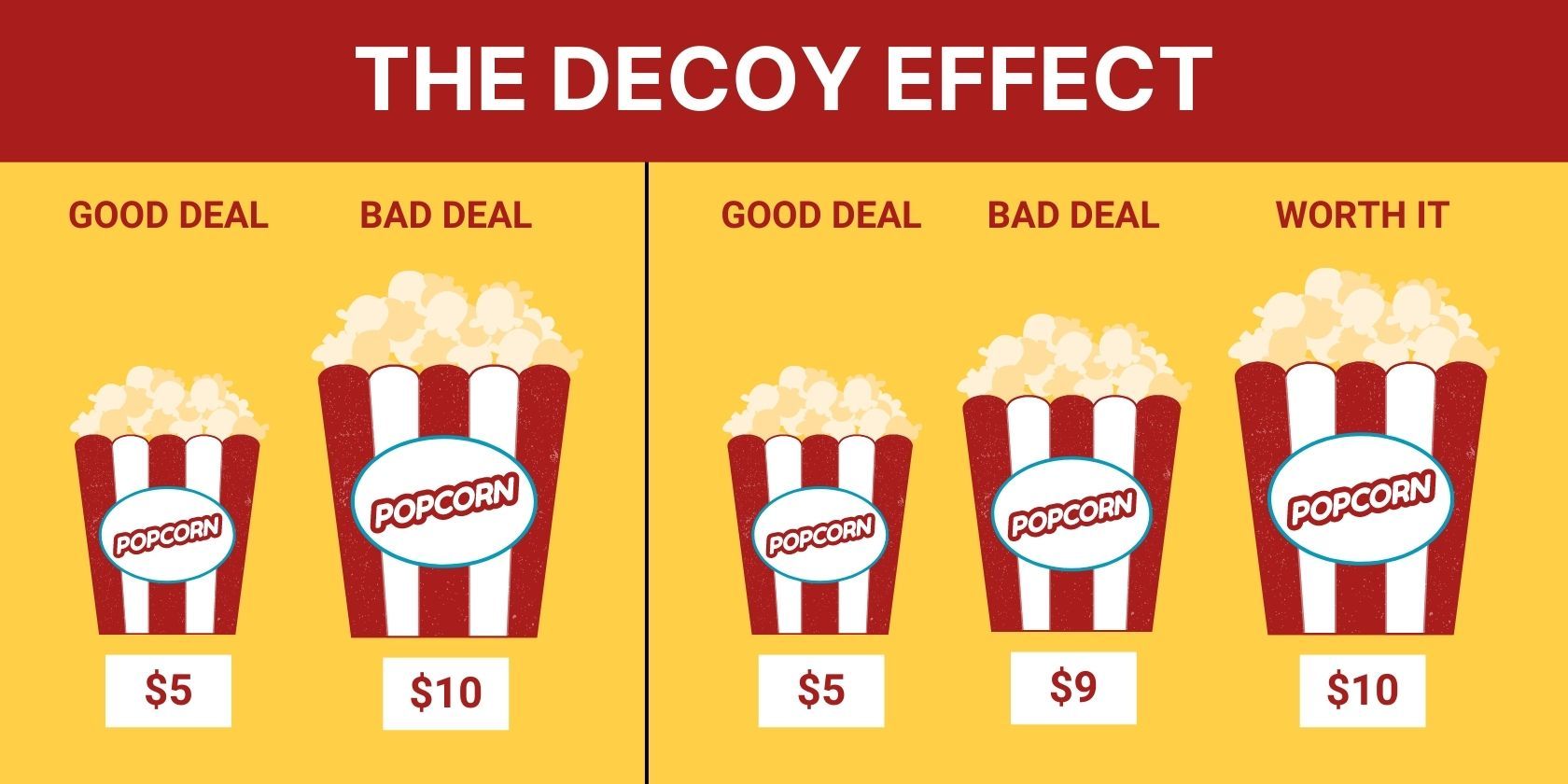
Here's another one:
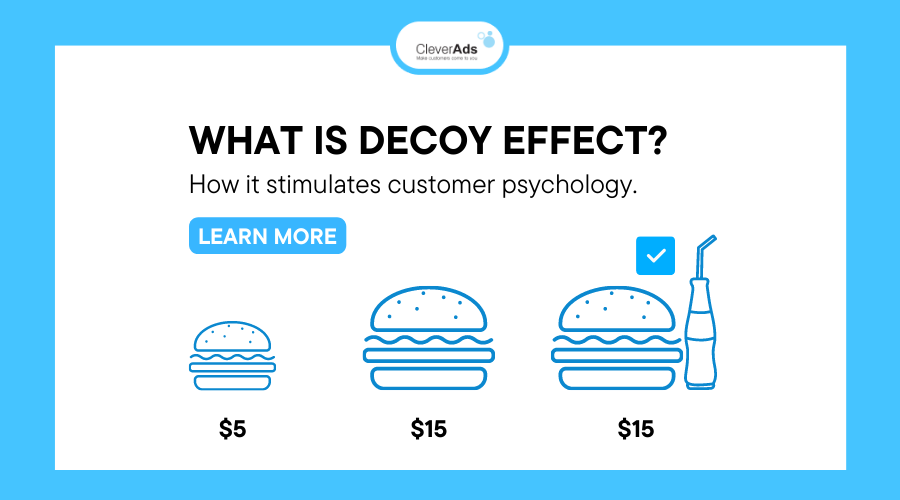
In both cases, the decoy exists solely to make one of the other options—the target—look more attractive.
4. Strategic Application in Product Design
As a product designer, you can use the decoy effect to guide users toward a particular choice, often to simplify their decision or to highlight a high-value option. There are two common strategies.
- Pushing users to the middle option: A very expensive premium option can act as a decoy to make the standard "middle" option seem like the most sensible, balanced choice.
- Pushing users to the premium option: A decoy that is priced similarly to the premium option but is clearly inferior (like The Economist example) makes the premium option look like a fantastic deal.
This is a powerful tool in your toolkit for designing pricing pages, feature comparisons, and subscription tiers. For practical guidance on how to implement this, the following reading is very useful.
Decoy Effect: steer preferences smartly - Learning Loop
Let's return to the 'Decoy Effect' article to focus on its practical application.
Please read the section 'Designing products with the Decoy Effect'. It offers actionable steps, such as understanding your audience and keeping the choice set simple.
5. Ethical Considerations: Persuasion vs. Manipulation
The power of the decoy effect brings with it a significant ethical responsibility. When does guiding a user's choice cross the line into manipulating it for business gain at the user's expense?
The key distinction lies in transparency and user value. An ethical use of the decoy effect helps a user navigate a complex choice and feel confident in their decision, while an unethical use deceives them into a choice that isn't in their best interest.
Decoy Effect: steer preferences smartly - Learning Loop
Finally, it is crucial to consider the ethical dimension of this psychological principle. This section of the article provides an excellent set of guidelines.
Please read the section 'Ethical recommendations'. Focus on the best practices listed, such as being transparent, fair in pricing, and focusing on customer benefits.
A well-designed decoy should clarify value, not obscure it. The goal is to facilitate better decision-making, not to exploit cognitive biases for a short-term win that erodes user trust.
Conclusion
Today, we've unpacked the decoy effect, a subtle yet powerful tool in choice architecture that you'll now be able to spot everywhere.
Key Takeaways:
- The decoy effect is a cognitive bias where adding a third, asymmetrically dominated option can shift preference between two original options.
- The decoy works because our brains prefer making relative comparisons rather than absolute judgments, and it provides an easy, favorable comparison for the target option.
- In product design, this is commonly used in pricing tables and subscription tiers to make a target option seem more valuable or sensible.
- Using this effect comes with ethical responsibilities. It should be used to provide clarity and decision support for the user, not to manipulate them into choices that don't serve their interests.
Next Up
So far in this module, we've explored how framing, defaults, and decoys can influence choice. In our next lesson, we'll put these principles into practice. You will be tasked with redesigning a call-to-action (CTA) or pricing display, applying what you've learned about gain/loss framing and anchoring to create a more effective design.
Can't find a good explanation? Sign up and we'll make it for you
Sign up