
Hello again. Last lesson connected the laws of definite and multiple proportions to a powerful inference: matter behaves as if it is built from discrete, countable units. Carbon monoxide and carbon dioxide, for example, differ by a whole-number change in the amount of oxygen associated with a fixed amount of carbon.
Dalton’s contribution was to organize such experimental regularities into a compact explanatory framework. In this lesson, you will learn to state the central claims of Dalton’s atomic theory, distinguish the claims from the evidence they explain, and use water as a concrete example. Plan for about 35–40 minutes.
From measured patterns to a theory of matter
A scientific theory does more than repeat observations. The observations available to Dalton included conserved mass and fixed, simple composition ratios. His theory proposed an underlying particle-level structure that would make those observations expected rather than accidental.
Dalton’s atomic theory is usually presented in five connected postulates. Some sources list six because they separate “atoms are indivisible” from “atoms are not created or destroyed in chemical changes.” The five-postulate version groups these ideas in a way that emphasizes the larger structure of the theory.
Dalton’s Atomic Theory | Don't Memorise
Watch “Dalton’s Atomic Theory” from Sri Chaitanya Academy NEET for a compact visual walk-through of the postulates. Notice that this presentation lists six points because it separates claims that many textbooks group together.
Begin at the postulates. Follow the examples involving generic elements, water, and carbon dioxide. As you watch, sort the six stated points into three ideas: what atoms are, how elements and compounds are composed, and what happens in a chemical change.
One important historical discipline is needed here: first learn what Dalton claimed, in the form that made sense given the evidence available around 1807. Whether every part of the theory remains correct is a separate question, and it is the focus of the next lesson.
The five central claims
Here is the canonical five-part statement of Dalton’s theory.
2.1 Early Ideas in Atomic Theory - Chemistry 2e | OpenStax
Read the postulates in OpenStax Chemistry 2e. This is the core source for the historical claims and gives their standard five-part formulation.
In Section 2.1, locate the paragraph beginning “The Aristotelian view of the composition of matter held sway for over two thousand years.” Read the five postulates, including the explanatory paragraph beneath them. For each numbered postulate, identify whether it concerns atoms in general, elements, compounds, or chemical change.
1. All matter is composed of atoms
Dalton proposed that matter is made of exceedingly small particles called atoms. In his formulation, an atom is the smallest unit of an element that can take part in a chemical change.
This was not merely the vague claim that materials contain “tiny pieces.” Dalton treated atoms as real explanatory units: countable entities whose combinations account for measured mass relationships.
Historically, Dalton also regarded atoms as indivisible. That detail belongs to his original theory, although later evidence changed the modern view of atomic internal structure. For now, retain the precise historical meaning: an atom could not be split by ordinary chemical processes.
2. Each element consists of one kind of atom
An element is a substance made from one type of atom. Thus, a pure sample of oxygen contains oxygen atoms, while a pure sample of hydrogen contains hydrogen atoms.
Dalton further claimed that all atoms of a given element have the same characteristic mass and the same chemical properties. This lets the word element refer to a stable category: every oxygen atom behaves as oxygen in chemical reactions, rather than as an arbitrary kind of particle.
3. Atoms of different elements differ
Atoms belonging to different elements have different characteristic properties and masses. Hydrogen atoms are therefore distinct from oxygen atoms; copper atoms are distinct from chlorine atoms.
Claims 2 and 3 work together:
| Question | Dalton’s answer |
|---|---|
| What makes all samples of one element belong to that element? | They consist of one characteristic kind of atom. |
| Why are two elements chemically different? | Their atoms differ in mass and properties. |
This distinction is fundamental. An element is not defined by its color, physical state, or source. Oxygen gas and liquid oxygen are still the same element because they involve the same kind of atom.
4. Compounds contain atoms in small whole-number ratios
A compound contains atoms of two or more different elements combined in a fixed ratio of small whole numbers. “Whole number” means a count such as , , or , not a fractional count such as .
For water, the ratio is two hydrogen atoms for every one oxygen atom:
The subscripts express a number ratio of atoms, not a mass ratio. Two hydrogen atoms have a total relative mass of about units, while one oxygen atom has a relative mass of about units. Thus the hydrogen-to-oxygen atom ratio in water is , whereas the corresponding mass ratio is approximately , or .
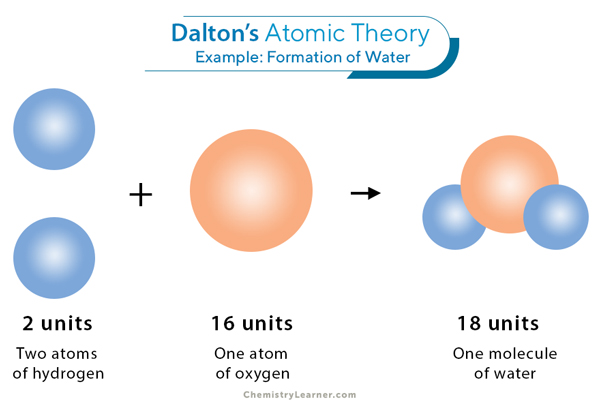
The diagram is a conceptual accounting model, not a literal depiction of every step in water’s formation. Its important message is that the product contains the same atoms, merely grouped differently.
This postulate explains both laws from the previous lesson:
- Definite proportions: Every unit of a given compound has the same atom ratio, so all pure samples have the same composition by mass.
- Multiple proportions: The same two elements can form distinct compounds with different small whole-number atom ratios. Carbon monoxide has a carbon-to-oxygen ratio, while carbon dioxide has a ratio.
5. Chemical changes rearrange atoms; they do not create or destroy them
In an ordinary chemical reaction, atoms change partners and arrangements, but the number of atoms of each element remains constant. This directly gives a particle-level explanation of conservation of mass.
Using the water diagram, the accounting is straightforward:
| Before the chemical change | After the chemical change |
|---|---|
| 2 hydrogen atoms | 2 hydrogen atoms |
| 1 oxygen atom | 1 oxygen atom |
The substances before and after differ because their atoms are connected or grouped differently. Yet the atomic inventory is unchanged. Since the same atoms remain present, their total mass remains present as well, provided all reactants and products are counted.
Seeing the theory as one connected explanation
It is easy to memorize five isolated sentences and miss what made Dalton’s proposal scientifically important. The claims reinforce one another.
Suppose a chemist finds that a pure compound always has a fixed elemental mass composition. Dalton’s theory explains this by saying that every unit of that compound contains the same types and numbers of atoms. If a second compound made from the same elements has a different composition, the theory explains that difference through a different whole-number ratio of atoms. Finally, because reactions only rearrange these atoms, the total mass remains conserved.
The theory can therefore be organized around three questions:
| Question about matter | Dalton’s claim |
|---|---|
| What is matter made of? | Extremely small atoms. |
| What are elements and compounds? | Elements contain one kind of atom; compounds contain different kinds in fixed whole-number ratios. |
| What happens in a chemical reaction? | Atoms are rearranged, not created or destroyed. |
This organization also prevents a common confusion: atoms are not the same thing as elements, and elements are not the same thing as compounds.
- An atom is an individual unit in the model.
- An element is matter consisting of one type of atom.
- A compound is matter containing atoms of different elements in a fixed ratio.
Water is a compound because it contains hydrogen and oxygen. Hydrogen by itself is an element; oxygen by itself is an element.
What Dalton’s theory does and does not claim
A careful statement of a theory should avoid adding claims that do not follow from it.
Dalton’s theory does claim that compounds have fixed atom ratios. It does not claim that compounds made from the same elements must be identical. Carbon monoxide and carbon dioxide are different compounds precisely because their carbon-to-oxygen ratios differ.
Likewise, the theory explains why an ordinary chemical reaction conserves mass. It does not mean that the visible material must look the same before and after a reaction. Hydrogen and oxygen can produce water, which has strikingly different properties from either element, because chemical identity depends on atomic composition and arrangement.
For this point in the course, use the following compact recall statement:
Matter consists of atoms. Each element has its own characteristic kind of atom. Atoms of different elements combine in fixed small whole-number ratios to form compounds. In chemical changes, atoms are rearranged rather than created or destroyed.
That version combines the second and third postulates for easier recall while preserving all five central ideas.
Key takeaways
Dalton’s atomic theory gave a particle-level explanation for the quantitative laws of chemical combination.
Its central claims are:
- Matter is composed of extremely small atoms.
- Each element consists of a characteristic type of atom.
- Atoms of different elements differ in mass and properties.
- Compounds contain atoms of different elements in fixed, small whole-number ratios.
- Chemical changes rearrange atoms without creating or destroying them.
Water illustrates two claims at once: it has a fixed ratio of hydrogen atoms to oxygen atoms, and its formation conserves the total inventory of those atoms.
Next, you will assess Dalton’s postulates against later evidence, separating the ideas that remain central to modern atomic theory from those that required revision.
Can't find a good explanation? Sign up and we'll make it for you
Sign up