
Hello again. In the previous lesson, you saw why modern atomic theory differs from ancient atomism: it is anchored in quantitative, repeatable evidence. One of the earliest and most important pieces of that evidence is the law of conservation of mass.
This lesson makes that law visible at the particle level. You will learn to read a chemical reaction as a reshuffling of a fixed collection of atoms: bonds change, substances change, but the atoms themselves do not appear or disappear. Plan for about 35–40 minutes.
A chemical reaction is not matter vanishing or appearing
A chemical reaction produces new substances. Methane can burn; hydrogen and oxygen can form water; copper can react with oxygen to form a black solid. These changes may look dramatic, especially when heat, light, smoke, or gas are involved.
At the atomic scale, however, the central event is simpler:
Chemical reactions break some connections between atoms and form new connections between the same atoms.
The starting substances are reactants. The new substances formed are products. The individual atoms in the reactants are redistributed among the products.
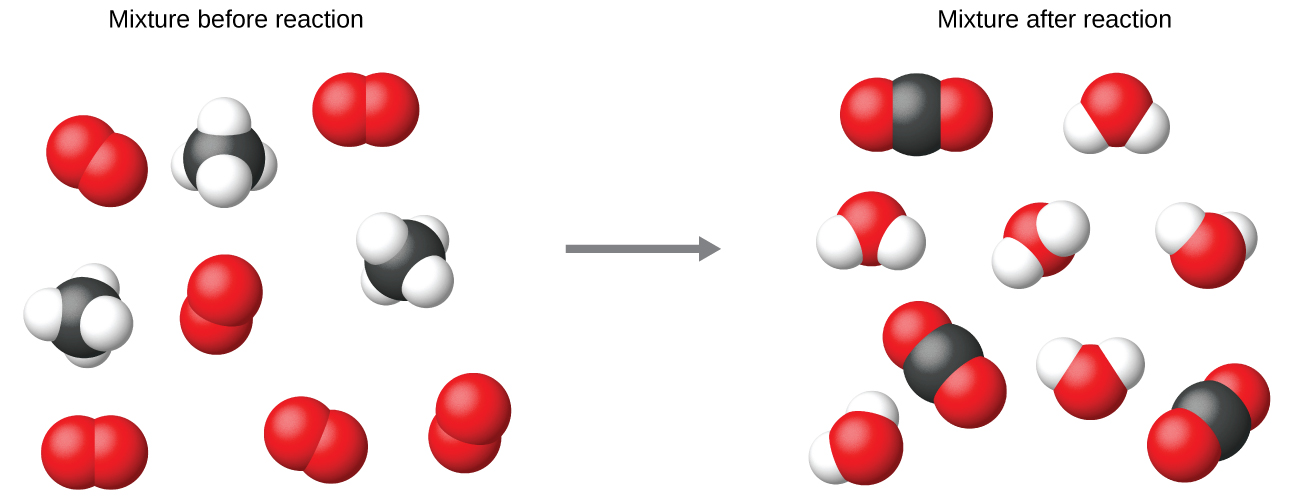
In this particle diagram, the colors represent elements:
- black spheres: carbon atoms
- white spheres: hydrogen atoms
- red spheres: oxygen atoms
Notice what changes in the diagram: which atoms are bonded to one another. Carbon atoms begin bonded to hydrogen atoms in methane; afterward, each carbon is bonded to two oxygen atoms in carbon dioxide. Hydrogen atoms end up bonded to oxygen in water.
Notice what does not change: the inventory of atoms.
| Atom type | Before reaction | After reaction |
|---|---|---|
| Carbon | 3 | 3 |
| Hydrogen | 12 | 12 |
| Oxygen | 12 | 12 |
This is a particle-level representation of conservation of mass. Since the reaction contains the same individual atoms before and after, the total mass stays the same.
Dalton’s key claim and its consequence
Dalton’s atomic theory supplied a microscopic explanation for a macroscopic measurement: when chemists carefully weigh all substances involved in an ordinary chemical reaction, total mass remains constant.
2.1 Early Ideas in Atomic Theory - Chemistry - OpenStax
Read the selected passages from OpenStax to connect Dalton’s atomic claim directly to conservation of mass and to see how particle counts test a proposed reaction diagram.
On the page’s numbered list of Dalton’s postulates, begin with item 5, “Atoms are neither created nor destroyed,” and read the postulate and explanation through the paragraph that links it to constant total mass. Then find Example 2.1, “Testing Dalton’s Atomic Theory.” Read the worked particle count. Focus on its method: count every type of atom on each side rather than judging only by how many molecules you see.
The logic is worth stating carefully:
- Each atom present before a chemical reaction remains present afterward.
- Atoms may be connected into different molecules or larger structures.
- Because the collection of atoms is unchanged, their total mass is unchanged.
This does not mean the substances retain their properties. Methane and oxygen differ sharply from carbon dioxide and water. Their atoms are simply arranged differently, and arrangement matters enormously in chemistry.
Reading methane combustion as an atom inventory
The particle image represents methane combustion. Its balanced chemical equation is:
Read this equation from left to right:
- One methane molecule reacts with two oxygen molecules.
- The products are one carbon dioxide molecule and two water molecules.
The equation is not a claim that one object mysteriously turns into several objects. It is a compact atom inventory.
Count the atoms on the reactant side
For :
- 1 carbon atom
- 4 hydrogen atoms
For :
- 2 oxygen molecules
- each molecule has 2 oxygen atoms
- total: 4 oxygen atoms
So the complete reactant inventory is:
| Element | Number of atoms |
|---|---|
| Carbon | 1 |
| Hydrogen | 4 |
| Oxygen | 4 |
Count the atoms on the product side
For :
- 1 carbon atom
- 2 oxygen atoms
For :
- 2 water molecules
- each has 2 hydrogen atoms and 1 oxygen atom
- total: 4 hydrogen atoms and 2 oxygen atoms
The complete product inventory is therefore:
| Element | Number of atoms |
|---|---|
| Carbon | 1 |
| Hydrogen | 4 |
| Oxygen | 4 |
Each element has the same atom count on both sides. The equation is balanced.
At a symbolic level, the total mass before and after can be represented as:
The reaction does not need to preserve the number of molecules, the shapes of molecules, or the kinds of substances present. It must preserve the atoms. Mass conservation follows from that preservation.
Coefficients count particles; subscripts define them
To represent rearrangement correctly, distinguish two kinds of numbers in a chemical formula.
A subscript is part of a substance’s identity. In , the subscript 2 says that one oxygen molecule contains two oxygen atoms. In , the subscript 2 says that each water molecule contains two hydrogen atoms.
A coefficient applies to the entire formula. In , the coefficient 2 says there are two water molecules.
Thus:
contains 4 hydrogen atoms and 2 oxygen atoms in total.
When balancing or interpreting a reaction, you may change coefficients, because you are changing the number of particles involved. You must not change subscripts, because that would describe a different substance rather than the same substance in a different amount.
For example, changing into would replace water with hydrogen peroxide. It would not balance a water reaction; it would change what material is being discussed.
A reliable way to inspect any particle diagram or equation is to use this five-part check:
- Identify each element, usually from labels, symbols, or sphere colors.
- Count the atoms in one particle of each substance.
- Multiply by any coefficient or by the number of drawn particles.
- Total each element separately on the reactant and product sides.
- Compare the two inventories. Every element must have equal counts on both sides.
If an image shows fewer oxygen atoms after the reaction than before, it does not represent an ordinary chemical reaction accurately. It depicts oxygen atoms disappearing. If it shows extra carbon atoms in the products, it depicts carbon atoms being created.
Why mass can seem not to be conserved
Conservation of mass applies when you account for the whole system: every reactant and every product.
Burning wood provides a familiar source of confusion. After a fire, the ash weighs much less than the original wood. It may look as though mass vanished. But ash is not the only product. Much of the original material has become gases and fine particles that spread into the surroundings. Oxygen from the air also participated in the reaction.
To test conservation properly, one would need to include:
- the original wood,
- the oxygen consumed from the air,
- the ash,
- all gaseous products, smoke, and particles released.
The mass of the ash alone is not the mass of the entire reaction system.
Chemical reactions | Middle school chemistry | Khan Academy
Watch “Chemical reactions” from Khan Academy for a concise visual explanation of reactants, products, atom rearrangement, and the reason gases can make mass appear to decrease in an open container.
Watch reactants and conserved mass. Pay particular attention to the distinction between mass actually disappearing and gaseous products escaping the portion of the system being weighed.
This distinction is important: a measurement can fail to include all matter involved, but that does not mean the law has failed.
For the reactions considered in ordinary chemistry, conservation of mass is explained by conservation of atoms. Later in the course, nuclear transformations will require a more refined discussion because the nucleus itself can change. For now, keep the scope clear: in a chemical reaction, atoms are rearranged, not created or destroyed.
From a drawing to a scientific explanation
Particle diagrams are models. They are simplified: atoms are not literally colored hard spheres, and molecules are not motionless. But the models preserve the feature that matters for this learning goal: they let us track the identity and number of atoms.
A strong explanation of conservation of mass should therefore include all three levels:
- What we measure: the total mass of a closed reaction system is the same before and after reaction.
- What happens microscopically: atoms break old bonds and form new bonds.
- Why the measurement makes sense: the same atoms, with the same total mass, are present before and after the rearrangement.
The methane diagram makes that explanation concrete. Three methane molecules and six oxygen molecules do not “become nothing.” Their carbon, hydrogen, and oxygen atoms are reassigned into carbon dioxide and water molecules. The products are new substances, but the atom inventory remains fixed.
Key takeaways
A chemical reaction is a rearrangement of particles.
- Reactants are the starting substances; products are the substances formed.
- Chemical bonds can break and form, producing molecules with new structures and properties.
- In an ordinary chemical reaction, atoms are not created or destroyed.
- A balanced particle diagram or chemical equation has the same number of atoms of each element on both sides.
- Because the same atoms remain in the system, total mass is conserved.
- Apparent mass loss often means that gases or other products escaped measurement in an open system.
Next, you will build on this particle-accounting method to examine the law of definite proportions and the law of multiple proportions—the measured mass patterns that gave strong evidence that matter is made of discrete units.
Can't find a good explanation? Sign up and we'll make it for you
Sign up