
Welcome back. Last lesson established that a personality score is an estimate with measurement error: reliability asks whether the estimate is consistent enough to interpret. This lesson takes the next step. Even a highly reliable measure can consistently assess the wrong thing. A ruler will give very consistent finger-length measurements, but finger length is not thereby a measure of self-esteem.
We will learn how to evaluate a construct-validity argument for a personality measure: whether the total evidence supports interpreting its scores as the trait it claims to measure. We will use Big Five measures as the running case, while keeping the method applicable to any personality inventory.
Construct validity is an argument, not a badge
A construct is an abstract psychological attribute used to organize observations: extraversion, conscientiousness, attachment anxiety, or impulsivity. It is not directly observable in the way height is. Researchers therefore define the construct theoretically, write items or develop observations intended to capture it, and then examine whether the resulting scores behave as that theory predicts.
Construct validity is the degree to which scores can justifiably be interpreted as representing the intended construct. It is not a single coefficient, nor a permanent property stamped onto a questionnaire. It is an accumulating argument based on several kinds of evidence, in particular for a particular population and use.
Reliability and Validity of Measurement – Research Methods in Psychology – 2nd Canadian Edition
Read the validity section from Research Methods in Psychology – 2nd Canadian Edition. It gives the core distinction from the prior lesson: reliability contributes to validity, but cannot establish it by itself.
Begin with the opening “Validity” section. Read the reliability-versus-validity distinction. Then read the short sections “Face Validity” and “Content Validity,” focusing on why an instrument can look plausible yet still fail to cover its construct. Continue through “Criterion Validity” and “Discriminant Validity.” In the criterion section, follow the discussion of expected correlations, including the difference between concurrent and predictive evidence. In the final section, read the explanation of discriminant validity. As you read, ask of each evidence type: What result would support the intended interpretation, and what alternative explanation would remain?
The word argument matters. Suppose a questionnaire called the “Authentic Extraversion Index” has a high internal-consistency coefficient and yields similar scores two weeks later. It is reliable. But perhaps every item asks about enjoying parties. The scale might consistently measure party enjoyment rather than broad extraversion. Or it might mostly measure current social opportunity: people with active friend groups may score high even if their underlying disposition is not especially extraverted.
A construct-validity argument asks whether rival interpretations like these are less plausible than the intended one.
A practical chain of reasoning
To evaluate a personality measure, work through these questions:
-
What exactly is the claimed construct?
Do not accept a label such as “leadership personality” or “empath” without a conceptual definition. Is it a broad trait, a narrow facet, a temporary state, a preference, a symptom, or a mixture? -
Does the content represent that construct adequately?
The items should sample relevant parts of the definition, without omitting major parts or adding irrelevant material. -
Do item responses show the expected structure?
Items designed to assess the same trait should generally cluster together, and they should be distinguishable from items intended to assess other traits. -
Does the score relate to other measures and outcomes in theoretically predicted ways?
It should show meaningful associations with closely related constructs and appropriate outcomes, while remaining distinguishable from different constructs. -
Does the evidence hold beyond the original development sample?
A measure intended for broad use needs evidence across relevant groups, languages, contexts, and time periods.
Reliability remains a prerequisite throughout. A highly noisy score cannot generate a convincing validity pattern. But reliability by itself completes none of the other steps.
Start with the trait map: content and face validity
A personality measure needs a clear target. Broad traits are not one behavior; they are patterns made up of related tendencies. For example, a Big Five model treats extraversion as broader than simply “likes being around people.” It can include sociability, assertiveness, activity, positive emotionality, and excitement seeking.
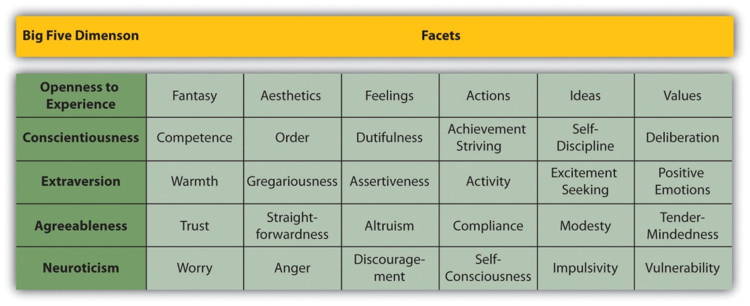
The Big Five dimensions and facets table supplies a useful audit tool. If an inventory says it measures conscientiousness but its items all concern keeping a tidy room, then it may cover orderliness while neglecting other relevant facets such as self-discipline, dutifulness, deliberation, and achievement striving. That is a threat to content validity, sometimes called construct underrepresentation.
The opposite problem is construct-irrelevant variance: score variation caused by content that should not be central to the construct. Imagine an “openness” scale dominated by statements about attending museums or knowing classical music. It may partly reflect education, income, cultural exposure, or the social status associated with particular tastes—not just openness to experience.
A content review should therefore ask:
| Question | What stronger evidence looks like | Warning sign |
|---|---|---|
| Is the construct defined? | A precise description of the trait and its boundaries | A flattering or vague label, such as “true self” |
| Are central facets represented? | Items sample several theoretically relevant facets | One familiar behavior stands in for a broad trait |
| Is irrelevant content minimized? | Items target dispositions rather than obvious demographic opportunity or desirability | Score may mainly reflect culture, status, literacy, or temporary circumstance |
| Are item meanings understandable to the intended group? | Cognitive testing and adaptation evidence where needed | Idioms, norms, or contexts make items mean something different across groups |
Face validity is more superficial. It asks whether items appear, on their face, to measure their claimed trait. “I enjoy being the center of attention” has plausible face validity for an extraversion-related facet. Face validity can matter for clarity and respondent engagement, but it is weak evidence: people’s intuitions can be mistaken, and some valid scales use indirect item patterns.
Most importantly, a test’s apparent plausibility is not evidence that it identifies a hidden essence. Labels can make an ordinary mixture of preferences sound more profound than the items justify.
Test the structure: do the items organize as the theory predicts?
After content design comes structural validity. Researchers commonly use factor analysis to examine whether the correlations among items reveal the expected pattern of underlying dimensions.
The basic intuition is simple. If several items all tap a common tendency, people’s responses to them should tend to vary together. A person who endorses items about planning ahead, finishing tasks, and following through might also tend to endorse other conscientiousness items. In a factor analysis, such items should show substantial loadings on the intended factor.
For a Big Five measure, structural evidence is stronger when:
- items intended for a given trait cluster primarily on that trait’s factor;
- items do not load just as strongly on a different trait, known as a cross-loading;
- the proposed structure can be reproduced in a new sample;
- the item pattern fits the conceptual content of the trait, rather than merely maximizing a statistical index.
Structural evidence has limits. A factor is a model of patterns in a dataset, not a physical entity discovered inside a person. Different item pools can produce somewhat different factor solutions, and correlated traits may naturally yield some overlap. Therefore, a researcher should not demand perfectly isolated factors. The question is whether the structure is sufficiently coherent and replicable for the intended interpretation.
The Big Four scale-development study below illustrates both the process and the importance of negative findings. Its researchers began with an oversized item pool, used factor analysis and item-content review to refine it, and then found that their item bank did not adequately support a broad Openness scale. A validity-oriented conclusion is sometimes not “the scale works,” but “this construct is not represented well enough by these items.”
Development and Validation of Big Four Personality Scales for the ...
This research article provides a concrete example of scale development and critical interpretation. Focus on how evidence is built through item structure, content review, replication, and the recognition that one intended trait—Openness—was not adequately captured.
In “Scale Development,” read from the scale-development rationale. Then continue through the subsection “Scale Honing,” focusing on how weak factor markers, cross-loadings, redundant wording, and gaps in content led researchers to remove items. Next, in the discussion section following the validity findings, read the subsection “Openness.” Read the account of the failed Openness scale. Notice the appropriate scientific restraint: lowering selection thresholds did not turn weak evidence into a valid broad-trait measure.
One caution when reading scale-development research: a measure can appear especially successful in the dataset used to select its best-performing items. This is why cross-validation matters. The final scale should be tested in fresh samples that did not determine which items were retained.
Look for a predicted pattern, not one impressive correlation
A serious construct-validity argument evaluates a nomological network: a pattern of predicted relations among the new score, related measures, distinct measures, observer ratings, and relevant behaviors. The key word is pattern.
Convergent validity: agreement where theory expects it
Convergent validity is evidence that a new measure is substantially associated with other measures of the same or closely related construct.
For example, a new conscientiousness scale should correlate positively with established conscientiousness inventories. A new measure of antagonism should correlate negatively with measures of agreeableness, because these capture opposing poles of related interpersonal tendencies.
But convergence needs careful interpretation:
- A positive correlation alone is not enough. We need to know how strong it is, whether it replicates, and whether alternative explanations are plausible.
- Two self-report scales may correlate partly because both are completed by the same person in the same setting. This is shared-method variance: a common response style, current mood, or desire to look good can inflate agreement.
- Agreement with an established instrument is only as persuasive as the validity evidence for that established instrument. Two measures can converge on the same narrow or biased content.
Using multiple methods helps. A self-report extraversion scale and ratings from knowledgeable peers do not need to correlate perfectly. Each source observes a person from a different vantage point. Still, meaningful agreement is more informative than agreement between two nearly identical self-report questionnaires.
Discriminant validity: separation where theory expects it
Discriminant validity asks whether the scale remains distinct from constructs it should not merely duplicate. A conscientiousness score may show some relationship with achievement striving, but it should not correlate so strongly with intelligence, social desirability, or extraversion that the labels become interchangeable.
The goal is not zero correlations. Psychological constructs are often genuinely related. For instance, neuroticism and depression-related symptoms should have some association. What matters is relative evidence: a measure of neuroticism should generally relate more strongly to other neuroticism measures than to theoretically more distant constructs.
This comparative logic is stronger than asking, “Is the correlation statistically significant?” With a very large sample, even a tiny correlation can be statistically significant. Evaluate:
- the size and direction of the association;
- whether it matches a prediction stated in advance;
- whether its relation with the target construct is stronger than relations with plausible alternatives;
- whether the design avoids using the same narrow item content or response method on both measures.
Research Methods - Chapter 03 - Convergent and Divergent Validity (4/5)
Watch “Research Methods – Convergent and Divergent Validity (4/5)” from Waytopia: Psychology for a concise visual explanation of why convergence and divergence must be evaluated together.
Watch the overview to frame convergent and divergent validity as complementary evidence. Then watch convergent evidence, noting why multiple ways of measuring aggression should show some agreement. Finish with divergent evidence, focusing on the distinction between related traits and the same trait measured twice.
Criterion-related validity: links to relevant outcomes
A personality measure can also be evaluated against criteria: outcomes it should relate to if the interpretation is correct.
- Concurrent validity examines a relevant criterion measured around the same time. A self-report of sociability could be compared with peer reports or observed interaction behavior.
- Predictive validity examines a later outcome. A conscientiousness score might predict some later pattern of punctuality or task completion.
Here, too, avoid a simplistic rule that a “valid” personality scale must strongly predict any desirable life outcome. Personality is one influence among many. Job performance, academic performance, health, and relationship outcomes also depend on ability, opportunity, incentives, structural conditions, skills, and immediate situations. A modest but replicable association may still be theoretically meaningful; an inflated claim that a trait score determines an individual’s future is not.
Criterion evidence is most informative when the criterion is:
- relevant to the defined trait;
- measured independently of the questionnaire;
- assessed in a way that does not simply repeat the same self-report bias;
- interpreted with the actual effect size, not only whether it reached statistical significance.
Read a validity study critically
The following results would form a stronger validity argument for a new “Conscientious Action Scale”:
| Evidence | Hypothetical finding | Interpretation |
|---|---|---|
| Content coverage | Items sample organization, responsibility, persistence, and deliberation | Supports representation of a broad conscientiousness construct |
| Structural evidence | Intended items form a coherent factor in new samples | Supports the proposed score structure |
| Convergence | Correlates strongly with established conscientiousness measures | Supports a common trait interpretation |
| Discrimination | Correlates more weakly with extraversion and verbal ability | Helps show it is not just sociability or ability |
| Cross-method evidence | Moderately agrees with peer ratings and behavioral task-completion records | Reduces concern that the score is only self-presentation |
| Prediction | Modestly predicts later completion of agreed tasks, after relevant controls | Supports a theoretically relevant behavioral link |
No individual row settles the matter. Conversely, one bad result does not automatically invalidate a scale; it may reveal a boundary condition, a flawed criterion, or a need to refine the trait definition. The task is to assess the coherence and independence of the total evidence.
The Big Four study’s validity results provide an applied example. It reports strong convergence between its scales and conceptually corresponding Big Five scales, with convergent correlations stronger than discriminant correlations. It also examines agreement between self-reports and peer ratings.
Development and Validation of Big Four Personality Scales for the ...
Return to the same article to examine reported validity results rather than only the scale-building process. The goal is not to memorize the correlations, but to evaluate what claims they support and what they cannot establish.
In “Validity”, subsection “Derivation Samples,” read the convergent and discriminant findings. Focus on the comparison: correlations with conceptually matching Big Five measures were stronger than nonmatching correlations. Then read the paragraph beginning the self peer evidence. Ask why self-peer agreement can provide useful multi-method support without being expected to equal one. Finally, consult the subsection “Validation Samples” just above that paragraph to see why findings in adolescent, patient, and college samples matter for generalizability.
There is an important limitation to identify. The researchers selected initial items partly because they correlated with existing Big Five measures. That makes later convergence with those measures less surprising, especially in the derivation sample. The study is more persuasive where it tests the final scale in independent validation samples, uses different methods such as peer reports, and shows the expected contrast between matching and nonmatching traits. Even then, the evidence supports a qualified statement about the scores’ interpretation in the studied samples. It does not prove that the scale reveals a complete or immutable personality.
A compact evaluation template
When you encounter an online quiz, commercial assessment, or journal article, use this brief template before accepting its personality claims:
- Claim: What trait does the test say it measures, and is that trait defined?
- Content: Do the items cover the construct’s important facets? What is omitted or unnecessarily included?
- Reliability: Are scores sufficiently consistent for this intended use?
- Structure: Do analyses support the intended dimensions in fresh, relevant samples?
- Convergence: Does the measure agree with credible measures of the same construct, ideally across methods?
- Discrimination: Is it distinguishable from traits, moods, response styles, or demographic circumstances that could explain the score?
- Criterion links: Does it relate to relevant observed outcomes, without exaggerated prediction claims?
- Scope: Who was studied, and does evidence support using the test with the population and purpose at hand?
The final question is particularly important for personality measurement. A scale validated among university students completing an English-language online survey is not automatically validated for employment selection, clinical assessment, adolescents, another language group, or high-stakes institutional decisions.
Key takeaways
Construct validity concerns whether personality-test scores can be interpreted as representing the trait named by the test. It is an argument built from converging evidence, not a label earned by a plausible name, a polished report, or reliability alone.
Strong evaluation considers:
- content validity: whether the items adequately represent the defined trait;
- structural validity: whether item patterns fit the proposed dimensions;
- convergent validity: whether the score relates to measures of the same or closely related constructs;
- discriminant validity: whether it remains distinct from different constructs and shared-method artifacts;
- criterion-related validity: whether it has theoretically appropriate links to relevant independent outcomes;
- replication and generalizability: whether the evidence persists across new samples, methods, and appropriate contexts.
A defensible conclusion uses calibrated language: “This measure has some supporting validity evidence for this interpretation in these samples,” rather than “this test proves what a person truly is.”
Next, the course shifts from measurement quality to personality theory. You will compare dimensional trait models, such as the Big Five, with categorical personality typologies—and examine why a continuous trait profile is not the same thing as a psychological type.
Can't find a good explanation? Sign up and we'll make it for you
Sign up