
Welcome back!
In our last lesson, we developed a rich picture of the Muisca world—a society with a nuanced hierarchy, a brilliant agricultural system, and an economy built on redistribution and prestige. We saw how their entire social and economic system, from their raised fields to the tamsa feasts, was designed for social cohesion and stability.
Today, we narrate the story of the cataclysm that shattered this world. Our goal is to recount the story of Gonzalo Jiménez de Quesada's arrival and the founding of Santa Fe de Bogotá as the capital of the New Kingdom of Granada. This is a tale of ambition, endurance, and brutal conflict. Think of it as a historical case study of a massive, violent disruption that would lead to a complete and permanent "redesign" of the Bogotá savanna's social and urban landscape.
The Man and the Myth: Quesada's Quest
The story of Bogotá's founding begins with one man's pursuit of a myth. The Spanish, having established footholds on the Caribbean coast, were captivated by tales of El Dorado, a land of unimaginable wealth hidden deep in the continent's interior. The Muisca's reputation for masterful goldwork had fueled these legends.
The man tasked with finding this treasure was Gonzalo Jiménez de Quesada, a lawyer turned conquistador.
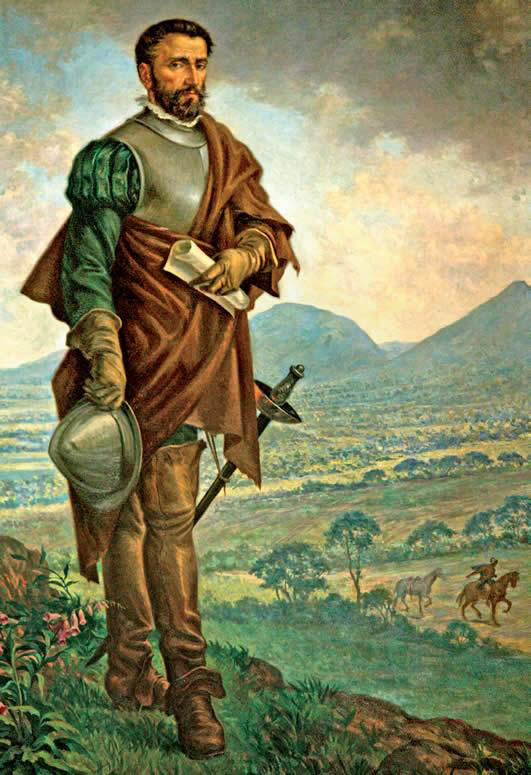
His expedition was not a glorious march but a brutal struggle for survival. To understand the desperation and sheer force of will that brought the Spanish to the Muisca heartland, let's watch a short segment detailing their journey.
The Muisca: Legends of Gold (subtitulos en español)
The video 'The Muisca: Legends of Gold' provides a vivid account of Quesada's expedition. It details the incredible hardships his men faced and the crucial discovery that pushed them onward.
Please watch from 26:29 to 28:52. Pay attention to the starting point of the expedition (Santa Marta), the immense challenges they faced, and the dramatic reduction in their numbers. What clue ultimately led them into Muisca territory?
As you saw, Quesada's expedition was a near-total failure before it even began. He set out from Santa Marta in 1536 with around 800 men. By the time they stumbled upon Muisca territory in early 1537, only about 180 had survived the swamps, disease, and starvation of the journey up the Magdalena River. The discovery of high-quality salt cakes and cotton was the key that unlocked the path to the civilization of "The Salt People" we discussed in our last lesson. They had arrived.
The Clash of Worlds
The arrival of this small, haggard band of Spaniards would spell the end of the Muisca confederation. What followed was a swift and brutal campaign that demonstrated a profound clash of worldviews, particularly regarding wealth and power.
The video you just watched continues with the story of this confrontation.
The Muisca: Legends of Gold (subtitulos en español)
Let's continue with 'The Muisca: Legends of Gold' to see how the encounter unfolded. This section covers the key events, from the initial contact to the tragic end of the Muisca leadership.
Watch from 28:52 to 32:05. As you watch, trace the sequence of events involving the Muisca leaders: What happens to Tisquesusa, the Zipa of Bacatá? How do the Spanish deal with the Zaque of Hunza (Tunja)? What is the fate of Sagipa, Tisquesusa's successor, after he allies with the Spanish?
The events unfolded with ruthless speed:
- The Fall of the Zipa: The Spanish marched on Bacatá, the capital of the southern Muisca. The Zipa, Tisquesusa, chose to flee rather than confront the invaders directly. He was later killed in a skirmish, his death unceremoniously discovered by the Spanish only after the fact.
- The Subjugation of the Zaque: Quesada then turned north to Hunza (modern Tunja), the seat of the Zaque. He captured the ruler, Quemuenchatocha, and plundered his city.
- Alliance and Betrayal: Tisquesusa's nephew, Sagipa, was chosen as the new Zipa. In a strategic move, he allied with Quesada to defeat the Muisca's traditional enemies, the Panches. But the alliance was short-lived. Quesada, hungry for the treasure Tisquesusa had supposedly hidden, demanded Sagipa produce it. When Sagipa could not, he was brutally tortured to death.
This final act is tragically symbolic. The Spanish, driven by a concept of accumulating private wealth, could not comprehend the Muisca's redistributive system of tamsa. They believed a leader must have a personal hoard of gold, while for Sagipa, a leader's power came from giving it away. He likely couldn't produce the treasure because, in the Muisca system, it didn't exist in the way the Spanish imagined.
The Founding of a Capital
With the Muisca leadership dead or subjugated, Quesada moved to formalize his control. He chose a spot at the foot of the mountains, near the Zipa's former recreational village of Teusaquillo, to establish a new city.
The founding of Bogotá actually happened in two stages, a process you might recognize from product development: a quick initial prototype followed by a more formal, "legal" launch.
Bogota's birthday celebrations and a bit of history
The article 'Bogota's birthday celebrations and a bit of history' from the blog Uncover Colombia clearly lays out the two key dates in the city's foundation.
Please read the section titled 'The founding of Bogota'. Focus on the two distinct events that mark the city's creation: the establishment of the military camp and the later legal foundation. Note the original name and how it evolved.
As the article explains:
- August 6, 1538: This was the de facto founding. Quesada established a military camp with 12 thatched huts and a small chapel, where the first mass was held. He named it Nuestra Señora de la Esperanza (Our Lady of Hope). This was the initial foothold, the "MVP" of the future capital.
- April 27, 1539: This was the de jure, or legal, founding. With the authority of the Spanish crown, the city was officially established and renamed Santa Fe.
The name would later become Santa Fe de Bogotá to distinguish it from other cities named Santa Fe, combining the Spanish name with the local indigenous name for the region, derived from Bacatá. This act of naming was itself a powerful symbol of the new order: a Spanish city physically and linguistically layered on top of the Muisca world.
Test your understanding!
From a user experience and strategic design perspective, why was it so important for the Spanish to build their capital city, Santa Fe, directly on or near the site of the former Muisca political center, Bacatá?
Show answer
Building on the site of the old capital was a powerful act of psychological and political dominance. It sent a clear message to the surviving Muisca population that their power structure had been completely replaced. It was a physical manifestation of the "regime change." Strategically, the location was already proven to be a good one, likely with access to water, resources, and established trails. It was less about starting from scratch and more about taking over and redesigning an existing, high-value location.
Just as Quesada was consolidating his conquest, a dramatic twist occurred. Two other Spanish expeditions, led by Nikolaus Federmann from the east (modern-day Venezuela) and Sebastián de Belalcázar from the south (from Quito), arrived on the savanna. Instead of fighting for the prize, the three conquistadors peacefully negotiated and agreed to return to Spain to allow the King to settle the claim. This remarkable meeting sealed the fate of the region, and Quesada's new city was designated the capital of the newly declared New Kingdom of Granada.
Conclusion
In this lesson, we have traced the violent and rapid series of events that led to the end of the Muisca confederation and the birth of Bogotá.
Here are the key takeaways:
- A Brutal Expedition: Gonzalo Jiménez de Quesada led a desperate expedition from the coast, overcoming immense hardship to reach the Muisca territory in search of gold.
- The Conquest of the Muisca: Through a combination of force and betrayal, the Spanish quickly decapitated the Muisca leadership, killing the Zipa Tisquesusa and his successor Sagipa, as well as the Zaque of Hunza.
- The Founding of Santa Fe de Bogotá: Quesada founded a new capital on August 6, 1538, near the old Muisca centers of power. It was named Santa Fe and would become the administrative heart of the New Kingdom of Granada.
- A Strategic Center: The unexpected arrival of two rival conquistadors confirmed the strategic importance of the Bogotá savanna, cementing Santa Fe's role as the dominant city in the region.
We have now witnessed the destruction of one world and the foundation of another. The Muisca's decentralized confederation was replaced by a centralized Spanish capital. In our next lesson, we will analyze the "user interface" of this new colonial world. We'll deconstruct the visual and social design of colonial Bogotá, looking at the Spanish grid plan, the central role of the Plaza de Bolívar, and the rigid new social hierarchy that was imposed on its inhabitants.
Can't find a good explanation? Sign up and we'll make it for you
Sign up