
Hello. In the previous lesson, you learned that fractions are quantities measured in equal-sized parts, and you practised the four operations on fractions and mixed numbers. This lesson changes the notation, not the quantity: a fraction, decimal, and percentage can name the very same rational number.
These translations are indispensable in later percentage work, finance, probability, data displays, and programming. By the end of the lesson, you should be able to move confidently among all three forms, simplify fractions where appropriate, and distinguish exact recurring values from rounded approximations.
One number, three representations
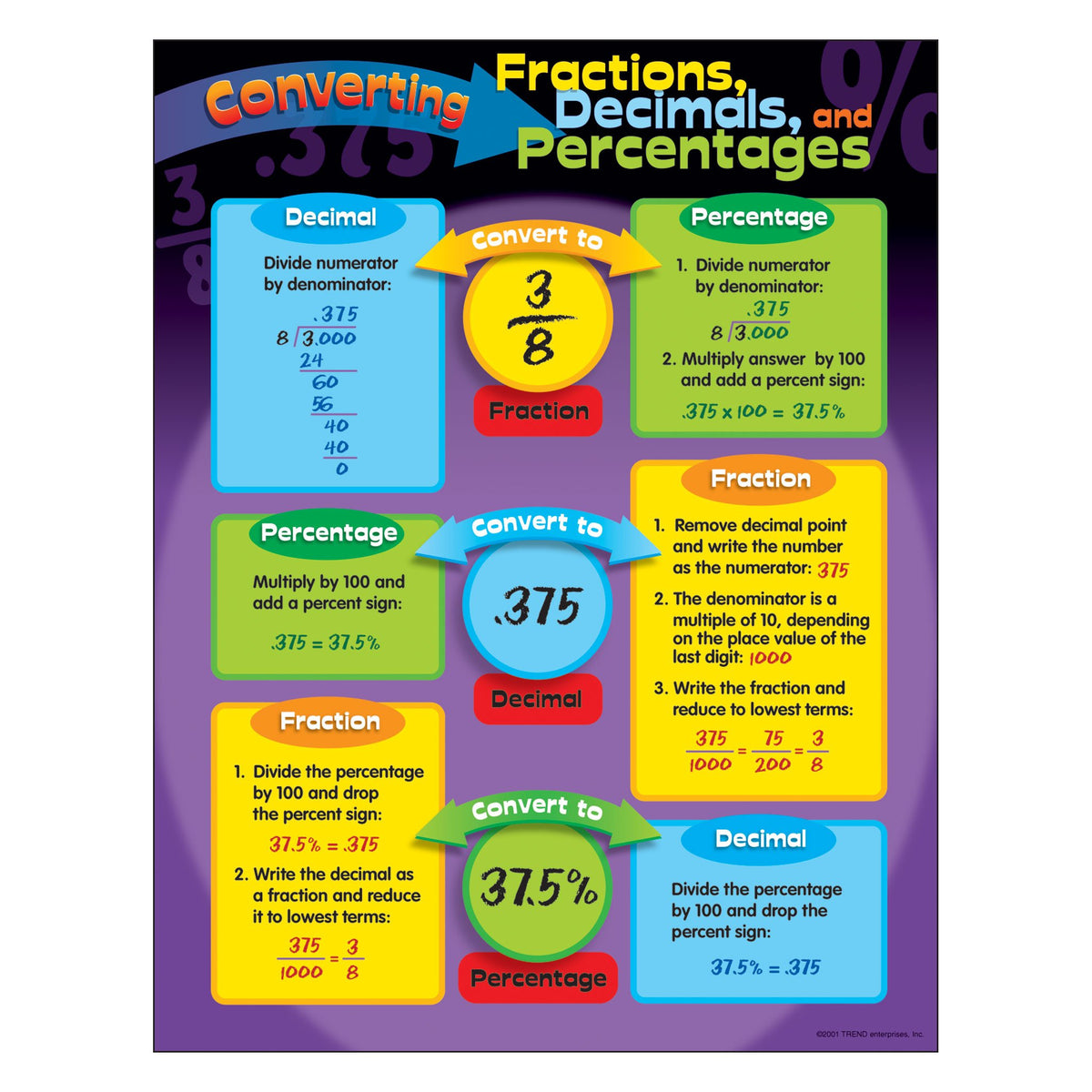
Consider the quantity “three eighths.” It can be written in three equivalent ways:
All three symbols locate the same point on a number line. They simply emphasize different ideas:
- A fraction expresses a quantity as a ratio of integers.
- A decimal expresses the quantity using place value in base ten.
- A percentage expresses the quantity per hundred.
The key definition is:
So:
The percent sign is not decoration. It means “divide by .” This is why confusing with changes the value by a factor of .
A percentage is not necessarily between and . For example:
Values above occur naturally when a quantity is greater than the reference whole. Negative percentages are also mathematically valid:
The conversion system
Rather than memorising unrelated tricks, build everything from place value and “per hundred.”
| Starting form | Target form | Meaningful method |
|---|---|---|
| Fraction | Decimal | Divide numerator by denominator |
| Decimal | Fraction | Use the last decimal place to choose a denominator of , , , and so on; then simplify |
| Decimal | Percentage | Multiply by |
| Percentage | Decimal | Divide by |
| Percentage | Fraction | Write the percentage number over , then simplify |
| Fraction | Percentage | Make a denominator of when convenient, or divide first to get a decimal and then multiply by |
The familiar “move the decimal point two places” shortcut is useful, but it should be understood as multiplication or division by :
so
Likewise,
so
Fractions, Decimals and Percentages | Conversions | Grade 5 Crossover | GCSE Maths Tutor
Watch Fractions, Decimals and Percentages | Conversions by The GCSE Maths Tutor for a compact walkthrough of the central conversion methods. The examples reinforce that percent means “per hundred,” rather than being a separate kind of number.
Watch decimal conversions to follow 0.42 as both a percent and a simplified fraction. Then watch the reverse conversion for 35\%. Finish with fraction conversions, focusing on the reason for making a denominator of 100 when that is convenient.
Decimals and fractions: place value gives the denominator
A terminating decimal has a final digit. Its last place tells you the denominator before simplification.
For example, ends in the thousandths place:
Now simplify:
The zero between the decimal point and the matters. It tells us that has zero tenths, four hundredths, and six thousandths. It is not equal to :
A decimal with a whole-number part can be written as a mixed number or an improper fraction. For instance:
Equivalently,
Both fractional forms are exact; which is more useful depends on the context.
Trailing zeros do not change a decimal’s value:
This follows because:
Fractions to decimals
To convert a fraction to a decimal, divide the numerator by the denominator:
Sometimes an equivalent fraction with a power-of-ten denominator is quicker:
For a fraction such as , long division gives:
Then its percentage form follows directly:
so
Recurring decimals are exact rational numbers
Not every fraction becomes a terminating decimal. For example:
The bar means that the repeats forever:
This is still an exact value, not an approximation. In fact, a rational number’s decimal representation always terminates or eventually repeats.
The converse is also true: an eventually recurring decimal is rational. You can see why by converting a repeating decimal into a fraction algebraically. Let
Because two digits repeat, multiply by :
Subtract the first equation from the second:
Thus,
so
Therefore:
When a recurring decimal is converted to a percentage, it remains recurring:
If a context asks for a rounded percentage, state that it is approximate:
to one decimal place.
Do not write an equals sign between an exact recurring value and a rounded value. They are close, but not identical.
Converting Between Fractions, Decimals, and Percents | A Mini Course | Math with Mr. J
In Converting Between Fractions, Decimals, and Percents, Math with Mr. J demonstrates long division for a fraction that produces a recurring decimal. This is useful for separating an exact recurring representation from a rounded estimate.
Watch recurring division. Follow how the repeated remainder in \frac{5}{12} produces repeated decimal digits, and notice the distinction between writing the recurring decimal exactly and rounding it.
Percentages are fractions with denominator
The direct route from a percentage to a fraction begins with the definition:
Then reduce it:
So the complete equivalence is:
For a percentage containing a decimal, first preserve its meaning as “per hundred”:
Clear the decimal by multiplying the numerator and denominator by :
Thus:
For percentages greater than , the same rule applies:
A useful check is conceptual: must be greater than one whole, so a decimal such as cannot be correct.
Fractions to percentages
When the denominator can easily become , use equivalent fractions. For example:
Therefore:
But forcing a denominator of is not always the cleanest method. For , division is more efficient:
Then:
If a whole-percent estimate is requested, write:
The fraction, the recurring decimal, and the recurring percentage are exact. The rounded whole percent is approximate.
A reliable error-checking routine
Use these checks before accepting a conversion.
1. Preserve the size of the number
For a positive proper fraction:
the decimal must lie between and , and the percentage must lie between and .
For example:
Writing or would make the value ten times too large.
2. Keep leading zeros visible
Write decimals less than with a leading zero:
rather than
This makes the decimal point easier to see and reduces transcription errors. In particular:
not . The decimal is:
3. Simplify fractions, but not percentages
A fractional answer is normally left in simplest form:
The percentage itself does not need “simplifying.” It already communicates “45 per hundred.”
4. Use equality only for exact values
These are exact:
This uses approximation because rounding has occurred:
5. Perform a round-trip check
A quick way to verify a conversion is to return to the original form by another route. For example:
Or:
If your return conversion does not recover the original number, locate where a factor of or was lost.
For your notebook error log, add conversion-specific categories:
- incorrect decimal place value;
- multiplied or divided by in the wrong direction;
- omitted a needed zero;
- did not simplify the fraction;
- treated a rounded result as exact;
- assumed every percentage lies between and .
Key takeaways
A fraction, decimal, and percentage can be different names for one rational number.
- A percent means per hundred:
- Convert a terminating decimal to a fraction by using its final place value as the denominator, then simplify.
- Convert a fraction to a decimal by dividing numerator by denominator.
- Convert a decimal to a percentage by multiplying by ; convert a percentage to a decimal by dividing by .
- Make a denominator of when it is convenient, but use division when it is not.
- Recurring decimals and recurring percentages are exact representations of rational numbers; rounded forms require .
- Percentages may be negative or greater than .
Next, you will classify numbers as natural, integer, rational, irrational, or real. The distinction between terminating or recurring decimals and non-recurring decimals will be especially important there.
Can't find a good explanation? Sign up and we'll make it for you
Sign up