
Welcome to the first lesson of our second module, "Advanced Algorithmic Patterns: Heaps and Searching." In the previous module, we explored powerful in-place array manipulation techniques like Cyclic Sort. Now, we shift our focus to problems that involve finding the "best" or "most significant" items in a collection, often without needing to sort the entire dataset.
Today, we will tackle the Top K Elements pattern. This is a fundamental pattern for any engineer working with large amounts of data, whether it's for identifying trending products on an e-commerce site, top-scoring players in a game, or the most frequent error messages in a log stream. The ability to do this efficiently is a hallmark of scalable system design. Our goal is to understand how to use a heap (also known as a priority queue) to find the 'Top K' elements in O(N log K) time, a significant improvement over naive sorting methods, especially when K is much smaller than N.
1. The Problem: Finding the Best Without Sorting Everything
Imagine you have a massive array of numbers and you need to find the top 10 largest. A straightforward approach would be to sort the entire array in descending order and then pick the first 10 elements.
This works, but it's inefficient. Sorting takes O(N log N) time, where N is the total number of elements. If you have a billion items and only need the top 10, you're doing a tremendous amount of unnecessary work sorting the other 999,999,990 items. This becomes even more problematic with streaming data, where you can't even store the entire dataset to sort it.
The Top K Elements pattern provides a much more efficient solution using a heap.
2. The Heap-Based Solution: Keeping Only What Matters
A heap is a specialized tree-based data structure that satisfies the heap property. For our purposes, we'll focus on the min-heap, where the parent node is always smaller than or equal to its children. This means the smallest element in the heap is always at the root, accessible in O(1) time.
This might seem counter-intuitive: why use a min-heap to find the largest elements? The core idea is to maintain a heap of size K that stores the K largest elements found so far. The root of this min-heap will be the smallest of these K elements. This root acts as a threshold.
Here's the algorithm:
- Create a min-heap of size
K. - Iterate through the input elements.
- For each new element, compare it to the root of the heap (the smallest of our current "top K").
- If the heap isn't full yet (fewer than
Kelements), just add the new element. - If the heap is full and the new element is larger than the root, it means the new element belongs in the top
Kset, and the current root does not. So, we remove the root and insert the new element. - If the new element is smaller than or equal to the root, we do nothing. It's clearly not one of the top
Kelements.
- If the heap isn't full yet (fewer than
After iterating through all N elements, the heap will contain the K largest elements from the entire dataset.
Let's visualize this process for finding the top 3 largest elements in an array.
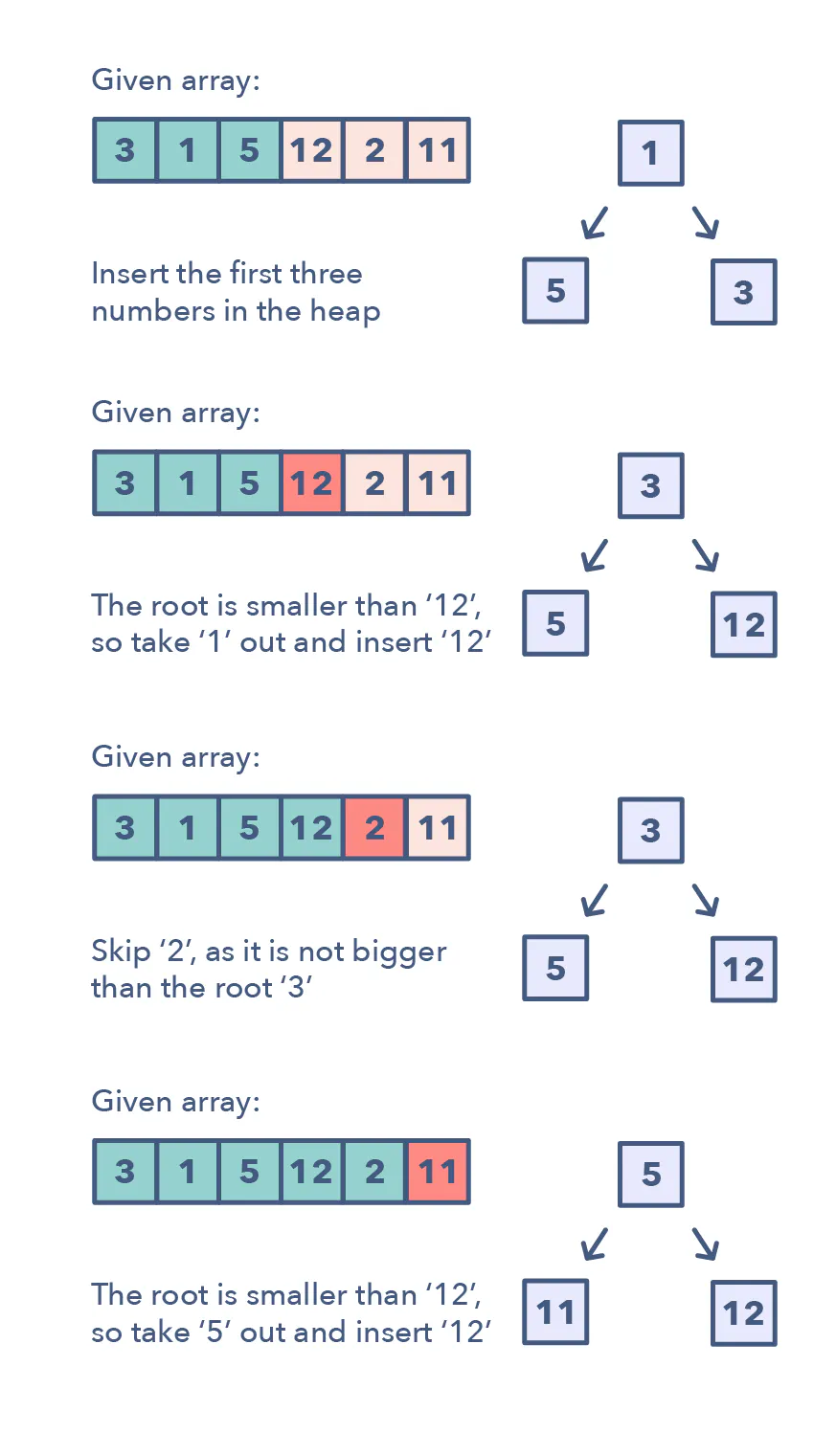
When an element is inserted by replacing the root, the heap property might be violated. The heap must then be "re-heapified" by sifting the new root down to its correct position.

The following article provides a superb explanation of this entire process, complete with Go code that you should find very familiar.
How to Find the Top-K Items: Heap and Streaming Approaches in Go
This article from freeCodeCamp explains the Top-K problem, contrasts the naive sorting approach with the efficient min-heap method, and provides a full implementation in Go.
Read the article from the beginning, focusing on these sections: The Naive Approach: Understand why O(N log N) is suboptimal. What is a Min-Heap?: Grasp the core concept of the min-heap and the sift-down process. How it works for Top-K: Internalize the algorithm's logic. Implementing a Min-Heap in Go: Study this entire subsection carefully. Pay close attention to how the IntHeap type implements Go's container/heap interface and how the topK function uses it to solve the problem.
3. Application: Top K Frequent Elements
A very common interview variant of this pattern is finding the "Top K Frequent Elements." The logic is nearly identical, but with an important preparatory step: first, you must count the frequencies of all elements in the input. A hash map is perfect for this.
Once you have the frequencies, the problem becomes "find the K elements with the highest frequencies," which is exactly the Top K pattern we just learned.
- Count Frequencies: Iterate through the input array and store the frequency of each number in a hash map. This takes
O(N)time. - Find Top K Frequencies: Iterate through the hash map's key-value pairs (element, frequency). Use the min-heap approach to find the
Kelements with the highest frequencies. This will takeO(U log K)time, whereUis the number of unique elements.
The total time complexity is O(N + U log K). Since U is at most N, this is often simplified to O(N log K). The space complexity is O(U) for the hash map and O(K) for the heap, totaling O(U + K).
The following video gives a quick, clear overview of solving this specific problem.
Top K Elements in 6 minutes | LeetCode Pattern
This video from AlgoMasterIO applies the Top K pattern directly to the "Top K Frequent Elements" problem.
Watch the segment from the problem explanation to the complexity analysis. The presenter walks through the two-step process: counting frequencies with a hash map, then using a min-heap to find the top K.
4. Scalability, Streaming, and Interview Insights
The real power of the heap-based approach shines in scalable systems. Because the heap's memory usage is bounded at O(K), you can process a virtually infinite stream of data to find the Top K elements without running out of memory. This is called an "online" algorithm.
The resources we've used provide excellent discussions on these practical considerations, which are crucial for both system design and interview performance.
How to Find the Top-K Items: Heap and Streaming Approaches in Go
Let's revisit the freeCodeCamp article to focus on the scalability aspects.
Read the sections: Streaming / Online Top-K: This connects the algorithm directly to processing large-scale, unbounded data streams. Notice the Go code for the streaming version is almost identical to the batch version. Distributed systems: This part gives a glimpse into how this pattern extends to a distributed environment, a key concept in modern system design.
Finally, being able to articulate these trade-offs and handle variations is key in an interview.
Top K Frequent Elements | Software Interviews
This resource from Software Interviews is a goldmine of practical advice for discussing this problem in an interview context.
Quickly review the following short sections on the page: Key Insights Interview Tips Follow-up Questions Common Mistakes & Concept Explanations This will prepare you to discuss the solution intelligently, covering trade-offs, edge cases, and potential follow-ups.
Conclusion
Today we've added the Top K Elements pattern to your toolkit. It's a highly efficient method for selection and frequency problems that is especially powerful when dealing with large datasets or data streams, making it a staple of scalable system components and a favorite in technical interviews.
Key Takeaways:
- Problem: Find the
Klargest/smallest or most/least frequent items in a collection. - Inefficient Solution: Sorting the entire collection (
O(N log N)). - Efficient Solution: Use a heap of size
K. To find the topKlargest items, use a min-heap. To find the topKsmallest items, use a max-heap. - Complexity: The heap-based approach has a time complexity of
O(N log K)and a space complexity ofO(K), making it ideal whenKis much smaller thanN. - Scalability: The pattern's bounded memory usage makes it perfect for processing unbounded data streams ("online" processing).
In our next lesson, we will continue exploring the power of heaps by learning the K-way Merge pattern, which is used to efficiently merge multiple sorted lists—a common task in distributed systems where data is often sorted in parallel on different machines before being combined.