Hello! Welcome to your next lesson in designing high-load distributed systems.
Introduction
In our previous lesson, we established the importance of strategic Domain-Driven Design (DDD), focusing on how to decompose a large business domain into distinct Bounded Contexts. This is the first, crucial step in taming complexity and laying the groundwork for a scalable, maintainable architecture. We saw that a bounded context is the boundary within which a specific domain model and its ubiquitous language are consistent.
Now, we zoom in from the strategic (the "macro" view of system decomposition) to the tactical (the "micro" view of modeling within a single bounded context). This lesson addresses the learning outcome: Design aggregates within a bounded context to enforce transactional consistency boundaries.
An Aggregate is one of the most critical tactical patterns in DDD. It is a cluster of domain objects that can be treated as a single unit. The primary purpose of an aggregate is to enforce invariants—business rules that must always be true—within a transactional boundary. Mastering aggregate design is key to ensuring data integrity and managing concurrency in any non-trivial application, especially in the high-load environments you're familiar with.
Today, we will cover:
- The definition and rules of the Aggregate pattern.
- How to determine aggregate boundaries based on business invariants.
- Common pitfalls, such as designing aggregates that are too large.
- The relationship between aggregates and transactional consistency.
1. The Core Idea: What Is an Aggregate?
At its heart, an aggregate is a consistency boundary. It groups entities and value objects that must be consistent with one another into a single, manageable unit. To ensure this consistency, DDD prescribes a set of strict rules for interacting with aggregates.
Let's start with a foundational reading that defines the key concepts of invariants and aggregates.
7. Aggregates and Consistency Boundaries
This chapter from the book 'Cosmic Python' provides a clear and concise introduction to aggregates. It explains why we need them and defines their core purpose.
Please read the sections titled 'Invariants, Constraints, and Consistency' and 'What Is an Aggregate?'. Focus on the definitions and the distinction between an invariant and a constraint. The shopping cart example provides a good initial mental model.
From the reading, let's distill the fundamental rules of the Aggregate pattern:
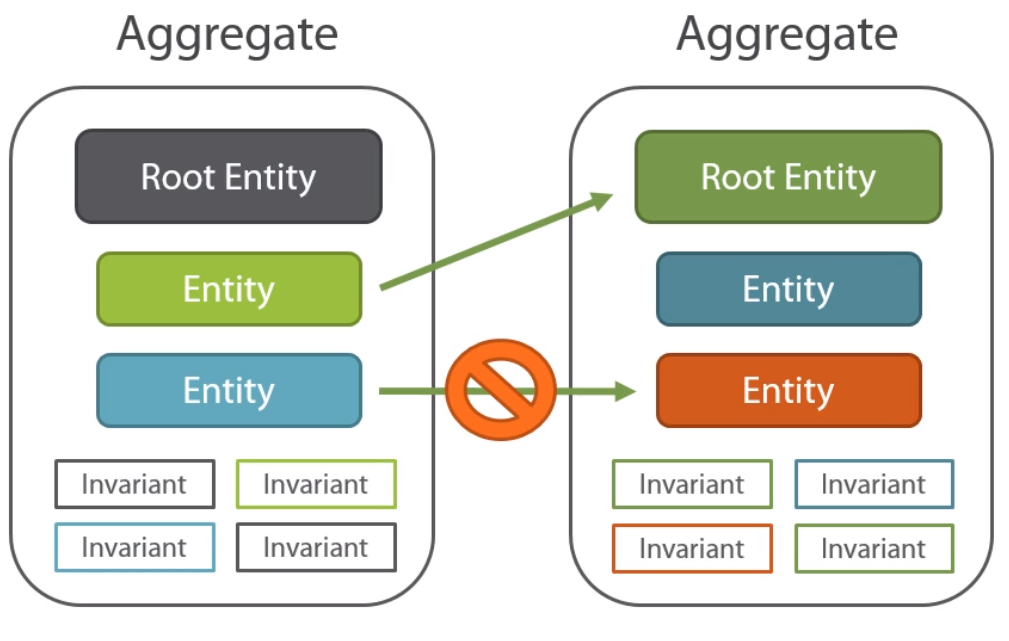
- The Aggregate Root: Each aggregate has a single entry point, an entity called the Aggregate Root.
- Encapsulation: The aggregate root is responsible for maintaining the integrity of the entire aggregate. All other objects inside the aggregate boundary are hidden from the outside world.
- Reference by Identity: External objects are only allowed to hold a reference to the aggregate root. They cannot hold direct references to any other entity within the aggregate. This prevents bypassing the root and violating its invariants.
- Transactional Boundary: Any operation that modifies an aggregate is a single, atomic transaction. When you commit a change, the entire aggregate must be in a consistent state.
This image clearly illustrates the reference rule:
To see this in a practical context, let's watch a short clip that defines an aggregate using a credit card example, which directly connects the concept to invariants and concurrency.
Aggregates: An In-depth Examination by Thomas Coopman Gien Verschatse - DDD Europe
This segment from the 'Aggregates: An In-depth Examination' talk by DDD Europe provides a succinct and effective introduction to the concept.
Watch the section 'Introduction to Aggregates: Invariants and Concurrency' (01:26 - 03:24). Notice how the speakers define an aggregate as a 'unit of consistency and concurrency'.
2. The Golden Rule: Design Boundaries Around True Invariants
The most challenging part of aggregate design is determining its size and boundary. The guiding principle is this: the boundary of an aggregate encloses the business rules (invariants) that must be 100% consistent at the end of a single, atomic transaction.
This requires distinguishing between two types of business rules.
DDD Beyond the Basics: Mastering Aggregate Design
This article, 'DDD Beyond the Basics: Mastering Aggregate Design,' does an excellent job of clarifying a crucial distinction for aggregate design.
Please read the section 'Business Invariants are not all the Same.' Focus on the difference between 'true invariants (atomic)' and 'eventual' invariants. This is the key to designing small, effective aggregates.
As the article explains:
- True/Atomic Invariants: These rules cannot be violated, even for a moment. For example, "the total of an order's line items must equal the order's total amount" or "a credit card's balance cannot exceed its limit." These invariants must be enforced within a single aggregate and a single transaction.
- Eventual Invariants: These rules can be temporarily out of sync, as long as they are eventually reconciled. For example, "when all items in an order are shipped, the order status becomes 'Shipped'." The shipping status and the order status don't need to be updated in the same atomic transaction. This consistency can be achieved across different aggregates, often via asynchronous events.
This distinction is your primary tool for keeping aggregates small. If a rule can be eventually consistent, the objects it governs likely belong in separate aggregates.
Let's see a masterclass in applying this principle. The following video walks through a design process where initial assumptions about an aggregate boundary are challenged and refined by digging into the true invariants.
Aggregates: An In-depth Examination by Thomas Coopman Gien Verschatse - DDD Europe
Returning to the access control system case study, the speakers demonstrate how to use example mapping to discover the real business rules and define the correct aggregate boundary.
Please watch the following segments: Initial Domain Exploration (05:50 - 07:27): Understand the basic concepts of the access control domain. Avoiding Premature Conclusions (09:00 - 10:08): Note the warning against immediately labeling complex entities as aggregates. Refining Boundaries with Example Mapping (11:35 - 15:51): This is the most critical part. Pay close attention to how the examples reveal that the initial assumption ('Zone' is the aggregate) is wrong because the true invariant ('you can't get trapped') spans a larger context than a single zone.
This process of challenging assumptions is vital. A common mistake is to model aggregates based on real-world object composition, but as the video shows, the transactional consistency boundary is what truly matters.
3. Common Pitfall: The "God" Aggregate Modeled After the UI
One of the most frequent mistakes in aggregate design is creating enormous aggregates that mirror a screen in the user interface. A UI view often composes data from multiple, distinct business contexts. Forcing all that data into a single aggregate creates a maintenance nightmare and tight coupling between contexts.
Your experience in building high-load systems has likely shown you the dangers of unnecessary coupling. Let's examine a classic example of this anti-pattern.
Mauro Servienti - Talk Session: All Our Aggregates Are Wrong
In his talk 'All Our Aggregates Are Wrong,' Mauro Servienti explains the 'shopping cart' problem, a perfect example of how modeling the UI leads to a flawed, monolithic aggregate.
Please watch these two sections: The Problem with Traditional Shopping Cart Aggregate (02:12 - 10:20): Observe how a single ShoppingCart aggregate becomes coupled to Sales, Warehouse, and Shipping, creating a 'distributed monolith' where autonomy is lost. Redefining the Shopping Cart (10:20 - 13:41): Understand the solution: the 'shopping cart' doesn't exist as a single aggregate. Instead, each bounded context (Sales, Shipping, etc.) owns its own small, focused model related to the user's selection.
This video powerfully illustrates a point from our last lesson: different bounded contexts have different models of the same conceptual "thing." The Sales context cares about price and quantity. The Shipping context cares about delivery estimates. The Warehouse context cares about inventory levels. Trying to unify these into a single ShoppingCart aggregate is a violation of these context boundaries and leads to a system that is difficult to change and scale.
The correct approach is to have small, focused aggregates within each bounded context (e.g., a SalesOrder aggregate in Sales, an InventoryItem aggregate in Warehouse) and compose the UI from these separate sources at runtime.
4. Practical Implementation: Repositories and Concurrency
Now that we have the design principles, let's briefly touch on two practical implementation details that enforce the aggregate rules in code.
-
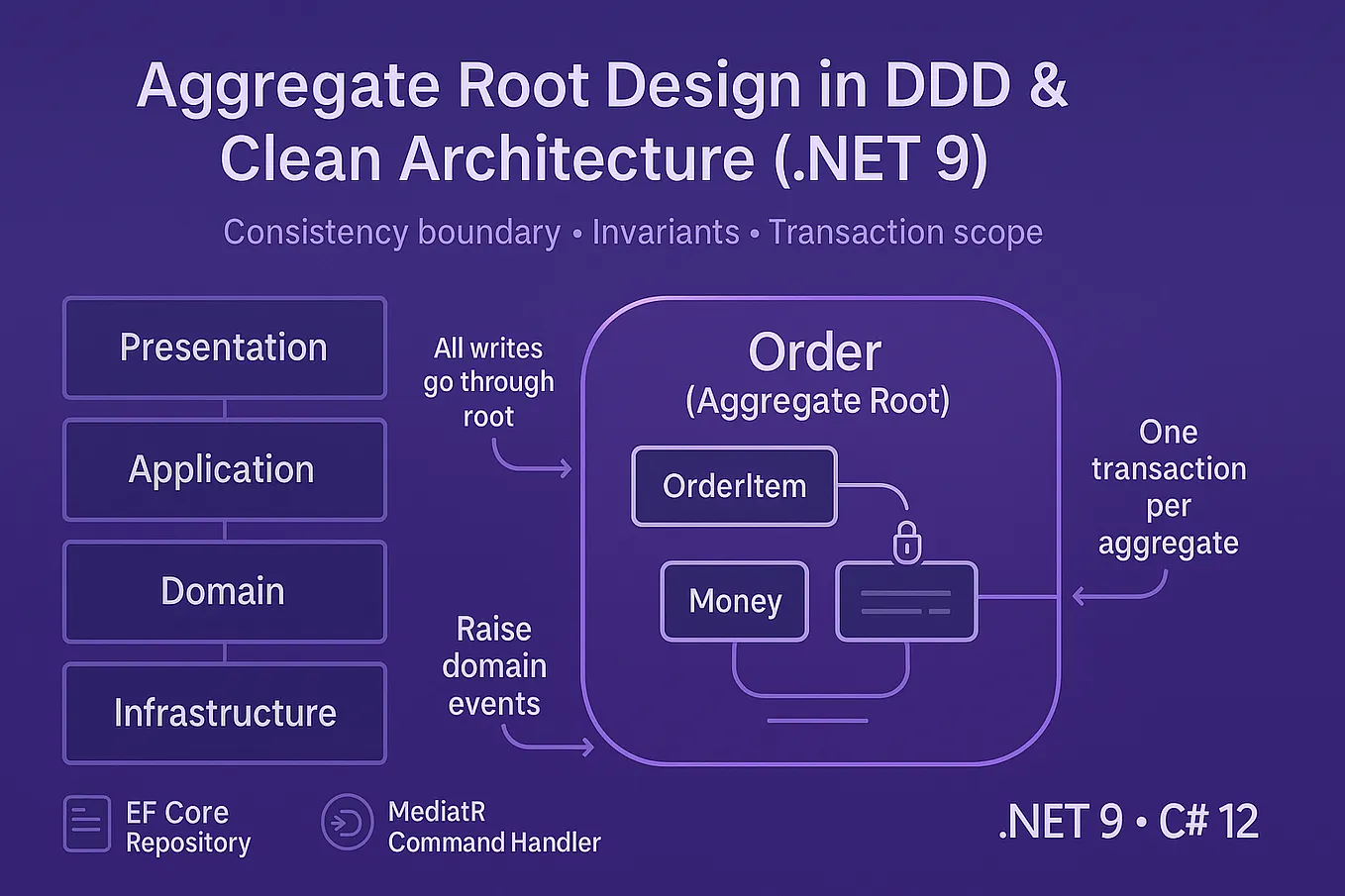
One Repository per Aggregate: To enforce the rule that the aggregate root is the only entry point, we use the Repository pattern. A repository's job is to abstract data persistence. In DDD, you should only have repositories for aggregates. You would have a
ProductRepository, but not aBatchRepositoryifBatchis an internal part of theProductaggregate. This prevents other parts of the system from loading and modifying internal components directly. -
Enforcing Atomicity with Concurrency Control: In a high-load system, multiple requests might try to modify the same aggregate simultaneously. How do we guarantee that only one succeeds and the aggregate's invariants are protected? While pessimistic locking (
SELECT FOR UPDATE) is an option, a common and often more performant approach in distributed systems is Optimistic Concurrency Control.
7. Aggregates and Consistency Boundaries
Let's return to the 'Cosmic Python' chapter for a practical look at how to implement this. Given your background, the concept of using version numbers for concurrency control should be quite familiar.
Please read the section 'Optimistic Concurrency with Version Numbers.' Focus on the sequence diagram and the explanation of how a version number is used to prevent concurrent updates from corrupting the aggregate's state.
By including a version number in the aggregate and checking it during the UPDATE operation, the database ensures that only the first transaction to commit will succeed. Subsequent transactions attempting to commit with the old version number will fail, forcing the application layer to retry the operation with the newly updated data. This mechanism is a cornerstone of maintaining consistency without the heavy performance cost of long-lived locks.
Conclusion
In this lesson, we've delved into the tactical DDD pattern of Aggregates, the primary tool for enforcing consistency within a bounded context.
Key Takeaways:
- Aggregates are transactional consistency boundaries. They group objects that must be kept consistent within a single atomic operation.
- The size of an aggregate is determined by its true invariants—rules that must be enforced atomically. Rules that can be eventually consistent should be handled between separate aggregates.
- Design small aggregates. This is a guiding heuristic. When in doubt, prefer smaller aggregates and eventual consistency. This maximizes concurrency and scalability.
- Avoid modeling UI views. A large aggregate that serves a complex UI is an anti-pattern that creates tight coupling between bounded contexts.
- The aggregate's integrity is protected by two key rules: external objects can only reference the aggregate root, and there should be one repository per aggregate.
- Optimistic concurrency control (e.g., using version numbers) is a practical and performant way to enforce aggregate consistency in concurrent environments.
Preview of the Next Lesson
We've now covered how to partition a system into Bounded Contexts (strategic design) and how to ensure consistency within those contexts using Aggregates (tactical design).
In the next lesson, "Apply Clean Architecture layers and dependency rules to structure the code within a service or bounded context," we will examine how to organize the code inside a service that implements a bounded context. We'll see how patterns like Clean Architecture provide a robust structure for separating concerns and how our domain model, including aggregates, fits neatly into its core.