
Hello! Welcome to the next lesson in our module, "Preksha Dhyaan: The Path of Perception."
In our last session, we established the crucial foundation of Preksha Dhyaan by learning to apply Kayotsarga. Through this practice of relaxation with self-awareness, you began training your mind to remain alert and observant while the body achieves a state of deep stillness. You've taken the first step in differentiating the observer (consciousness) from the observed (the body).
Today, we build directly on that foundation. With the body stabilized, we can now turn our attention to a more subtle and dynamic object: the breath. This lesson is dedicated to the learning outcome: Apply shwas preksha (breath awareness) meditation.
We will explore why the breath is such a powerful tool in this tradition, learn the specific techniques for its perception as taught by Acharya Mahapragya, and conduct a practice session. This skill is central to steadying the mind and is a key component in our journey toward bringing conscious awareness into states of rest.
1. Why the Breath? The Bridge to Consciousness
Before we begin the practice, it's essential to understand why the breath is chosen as a primary object of meditation in Preksha Dhyaan. It's more than just a simple anchor; it's considered a bridge between the gross physical world and the subtle inner world of consciousness.
The following reading from the core text on this topic explains the unique role of the breath. It connects the physical act of breathing to prana (vital energy) and explains why this process is the perfect gateway for an inward journey.
Preksha Dhyana Perception of Breathing
This reading, 'Preksha Dhyana: Perception of Breathing,' explains the philosophical and practical reasons for choosing the breath as the object of perception.
Please read the sections titled 'Breathing : Philosophical Version' and 'Why Breath Is Chosen ?'. You can find this starting on page 16 and continuing to page 22. Focus on these key ideas: The connection between breath, vital energy (prana), and the soul/consciousness. How breath is a 'tourist' that travels both the external and internal worlds. The unique characteristic of breath being both an autonomic (automatic) and a voluntarily controlled function, which makes it a trainable link to our inner systems.
As you read, you'll see that by associating the mind with the breath, we are not just calming our thoughts. We are harnessing a fundamental life process to guide our awareness from the external world to the subtle vibrations of our inner self.
2. The Technique of Shwas Preksha
Shwas Preksha means "perception of breath." It is a systematic method for observing the breath without interference, allowing it to steady the mind. The practice, as we will learn it, involves two main phases: establishing deep, rhythmic breathing, and then focusing perception on specific points.
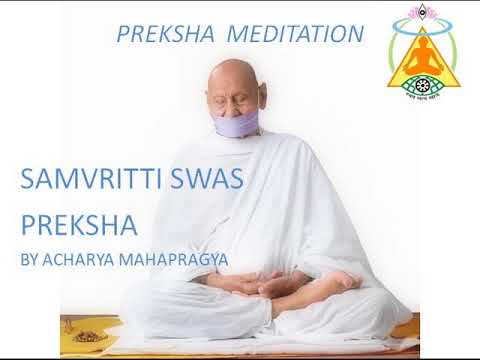
Step 1: Establishing Deep Breathing (Dirgha Svasa)
Before you can passively perceive the breath, it is helpful to regulate it. Normal breathing is often shallow and irregular. Dirgha Svasa (deep/long breath) is the practice of complete breathing, which ensures you are using your full lung capacity. This has the dual benefit of calming the nervous system and generating vital energy.
The technique for Dirgha Svasa or "Complete Breathing" is detailed in the following resource.
Preksha Dhyana Perception of Breathing
To practice Shwas Preksha effectively, we first learn the mechanics of 'Complete Breathing.' This section from the same text breaks down the process.
First, read the section 'Complete Breathing Technique' on pages 33-35. It describes how to practice lying down and explains the three phases of inhalation involving the diaphragm, ribs, and collar bones. Then, read the section 'Third Step of Preksa Meditation' and focus on part A, 'Deep Breathing,' on pages 40-41. This section provides the practical exercise steps.
Step 2: Applying Perception
Once your breathing is deep, slow, and rhythmic, you can begin the actual perception practice. This is where you anchor your awareness. The practice typically progresses through two points of focus:
-
Perception at the Navel: Direct your full attention to the abdominal area. With your mind's eye, observe the expansion of the abdomen as you inhale and its contraction as you exhale. Your mind should be focused solely on this rhythmic movement.
-
Perception at the Nostrils: After a few minutes, shift your attention from the navel to the point where your nostrils meet the upper lip. Here, the perception becomes more subtle.
- Feel the sensation of the cool air entering your nostrils as you inhale.
- Feel the sensation of the warm air leaving your nostrils as you exhale.
- Maintain total awareness of each incoming and outgoing breath at this specific point.
The key is to remain an impartial witness. You are not thinking "I am breathing in" or "I am breathing out." You are simply experiencing the direct sensations of the breath.
3. Practical Application: A Guided Practice
Now, let's put this into practice. Find a quiet place where you can sit or lie down undisturbed for 15-20 minutes. A sitting posture is traditional, but if you are feeling restless, you can start by lying down as you did for Kayotsarga.
- Posture and Relaxation: Settle into your chosen posture. Take a few moments to perform a quick Kayotsarga, consciously relaxing your body from head to toe. Ensure your spine is straight but not rigid.
- Establish Deep Breathing: Begin the Dirgha Svasa you just learned. For 2-3 minutes, focus on making your breath slow, deep, and silent.
- Focus on the Navel (5 minutes): Shift your complete attention to your navel region. Perceive the abdomen rising with each inhalation and falling with each exhalation. Let this be your entire world. If your mind wanders, gently guide it back to the sensation of this movement.
- Focus on the Nostrils (5-10 minutes): Now, move your focus to the entrance of your nostrils. Become aware of the touch of the breath. Perceive the coolness of the in-breath and the warmth of the out-breath. Stay with this subtle sensation.
- Handling Distractions: Your mind will inevitably wander. This is normal. The practice is not to have a perfectly still mind, but to notice when it has wandered and gently bring it back. As taught in Preksha Dhyaan, observe the thought without judgment or engagement, like a cloud passing in the sky, and then return your focus to the breath.
To help you experience the rhythm and focus of this type of meditation, here is a guided practice. While it's a general breath awareness meditation, the core mechanics of anchoring to the breath and handling wandering thoughts are directly applicable.
13-minute meditation: Anchoring and breath awareness
This 13-minute guided meditation from the Living Better channel will walk you through the core components of breath awareness. Use it to feel the mechanics in a guided setting.
Follow along with the video. Pay close attention to these parts: Posture & Initial Focus (0:00 - 2:08): The video starts with instructions on posture and bringing initial awareness to the breath, just as we discussed. Focusing on Sensations (5:05 - 8:10): Here, the guide directs you to feel the physical sensations of breathing, first generally and then specifically at the abdomen, using it as an 'anchor.' This corresponds directly to our practice of perception at the navel. Handling a Wandering Mind (8:10 - 11:46): This part explains the process of noticing your mind has wandered and gently escorting it back to the breath. This is the essence of training your awareness.
Test your understanding!
During your practice, you likely noticed that thoughts arose and pulled your attention away from the breath. According to the principle of Preksha Dhyaan, what is the correct way to respond to these thoughts?
A) Try to forcefully stop the thought as soon as it appears.
B) Get annoyed with yourself for losing focus.
C) Calmly observe the thought without getting involved, and then gently redirect your attention back to the breath.
D) Follow the thought to see where it leads, since it might be important.
Show answer
The correct answer is C). The core principle of Preksha Dhyaan is impartial perception (preksha). You treat thoughts just like any other phenomenon: you watch them arise and pass away without attachment or aversion. The practice is in the gentle, persistent returning of your awareness to the chosen object (the breath).
Conclusion
In today's lesson, you have learned and applied Shwas Preksha, a cornerstone of Preksha Dhyaan. You've moved from the stillness of the body to the subtle, rhythmic anchor of the breath, training your mind to be focused, alert, and impartial.
Key Takeaways:
- Shwas Preksha is the practice of perceiving the breath to stabilize the mind and journey inward.
- The breath is used because it is a bridge between the body and consciousness, linked to vital energy (prana), and is both an automatic and controllable process.
- The technique involves establishing deep, rhythmic breathing (Dirgha Svasa) and then focusing perception on the movement of the navel or the sensation at the nostrils.
- The correct attitude toward distractions is one of impartial observation, not suppression or frustration.
This practice directly enhances your ability to concentrate and remain aware, skills that are indispensable for your ultimate goal of bringing consciousness to sleep.
Preview of the Next Lesson:
Having focused our awareness on the single point of the breath, we are now ready to broaden our perceptive field. In the next lesson, we will apply sharira preksha (body perception) meditation. We will learn to sweep our awareness through the entire body, not for relaxation as in Kayotsarga, but to perceive the subtle sensations and vibrations within, further sharpening our capacity for perception.