
Introduction
Welcome to the first lesson of our module on composition. So far, you've built a solid foundation in music theory and the technical operation of Ableton Live. Now, it's time to merge those skills and begin the creative process of writing music. Our goal for this lesson is to compose and record a compelling 8-bar chord progression in a minor key. This is the harmonic engine that will drive your entire track, and it's a fundamental skill for creating the emotive, evolving soundscapes characteristic of progressive house and the deadmau5 style.
We will start by revisiting the diatonic chords of a minor scale, a concept from our first module. Then, we'll construct a basic progression and progressively layer on complexity and emotional depth using techniques like chord extensions, inversions, and specific voicings that are hallmarks of the genre. By the end of this lesson, you will have created a rich, 8-bar harmonic loop in Ableton Live that will serve as the foundation for the basslines and melodies we'll be adding in the lessons to come.
From Theory to Practice: Building Your Progression
A chord progression is essentially a sequence of chords that creates a sense of movement, tension, and release in music. In electronic music, especially progressive house, this is often a loop of 4 or 8 bars that repeats and evolves. We'll build our progression systematically, starting from the simplest form and adding layers of sophistication.
1. The Foundation: Diatonic Chords in a Minor Key
Let's start by setting up our workspace. Open Ableton Live, create a new MIDI track, and load a simple piano instrument (the "Grand Piano" preset in Ableton's Core Library will work perfectly). We'll work in the key of A minor, which uses only the white keys on the piano, making it easy to visualize.
In Module 1, we learned that each note of a scale can be the root of a chord, resulting in a set of seven "diatonic" chords that naturally sound good together. For a quick refresher on this foundational concept, the following video provides a clear and concise overview.
How to Create EMOTIONS with CHORD PROGRESSIONS
Watch this segment from the EDM Tips video "How to Create EMOTIONS with CHORD PROGRESSIONS".
Focus on the first part, from the start to the end of the Triads section. Pay close attention to how the presenter explains choosing a scale and identifying the diatonic chords using Roman numerals.
The diatonic chords in A natural minor are:
- i: A minor (Am)
- ii°: B diminished (Bdim)
- III: C major (C)
- iv: D minor (Dm)
- v: E minor (Em)
- VI: F major (F)
- VII: G major (G)
For now, we will avoid the diminished chord (ii°) as it can be tricky to use, and focus on the other six.
2. Crafting a Core Progression
A very common and effective progression in progressive house is i - VI - III - VII. In our key of A minor, this translates to:
Am - F - C - G
Let's program this into Ableton. Create an 8-bar MIDI clip on your piano track. In the piano roll, draw the four chords, each lasting for one bar (a full 4/4 measure). Then, copy and paste this 4-bar sequence to fill the entire 8-bar clip. At this point, you should have a simple, repeating progression of basic triads.
The following video demonstrates a similar process of laying down a basic chord structure in the piano roll.
How to write Progressive House Chords and Melody from Scratch
Watch this clip from the Production Music Live channel. While they use a slightly different chord progression, the process is the same.
Observe how they lay out a basic 4-chord structure over several bars, starting around the progression creation section. This will give you a clear visual of programming a sequence of simple chords.
Adding Depth and Color
Your progression is structurally sound, but it likely sounds a bit plain. To achieve the rich, emotive quality we're after, we need to add complexity. We'll do this using two key techniques: extensions and inversions.
Extensions: Adding More Notes
Extensions are notes added to a basic triad to give it more color. The most common extension is the 7th. Adding a 7th note from the scale to each chord will instantly make the progression sound more sophisticated and emotional.
- Am becomes Am7 (A-C-E-G)
- F becomes Fmaj7 (F-A-C-E)
- C becomes Cmaj7 (C-E-G-B)
- G becomes G7 (G-B-D-F) or Gmaj7 (G-B-D-F#), though staying within the A minor scale's notes, G major (G-B-D) is the standard diatonic VII chord. Adding its 7th (F) creates a G7.
Since your background is in quantitative fields, you might appreciate that building chords can be thought of as a formula based on semitone intervals. For example, a minor triad is Root, +3 semitones, +4 semitones.
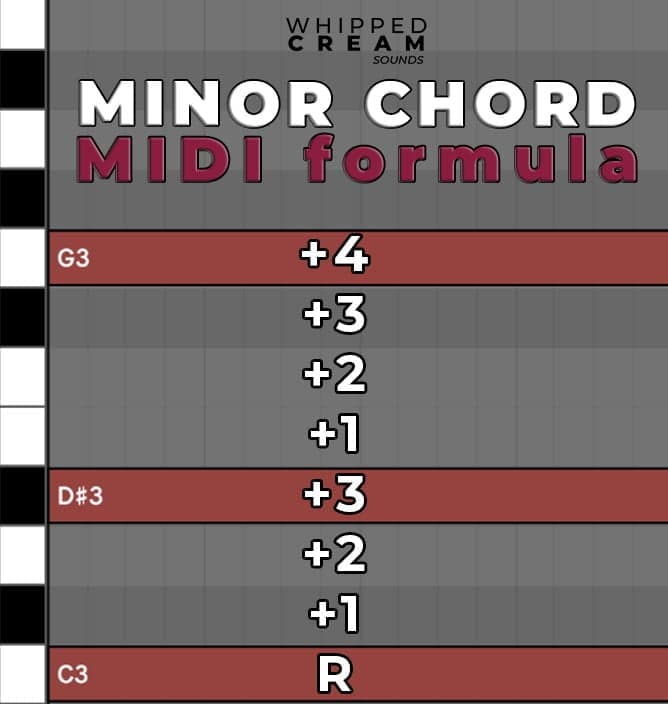
The following reading explains how to expand on this formulaic approach to build more complex chords like 7ths and 9ths, which are essential for the progressive house sound.
Progressive House Chords - Improve Your Progressions ...
This article from Audible Genius provides a systematic method for enhancing chord progressions, which should align well with a technical approach.
Read the section on adding extensions for color. Then, focus on "Method 2" in the how to build section, which uses MIDI formulas—a very direct and efficient way to construct chords in the piano roll.
Go back to your 8-bar loop and transform your triads into 7th chords using the notes of the A minor scale.
Inversions: Creating Smooth Voice Leading
Right now, your chords might be "jumping" up and down the keyboard. This can sound disjointed. Inversions solve this by re-ordering the notes of a chord to create smoother transitions. An inversion simply takes one of the notes in a chord (usually the root or fifth) and moves it up or down an octave. The goal is to minimize the movement between chords, often by keeping one or two "common tones" between them.
This process is less about a strict formula and more about optimizing the "path" of the notes, an idea that might resonate with your engineering background.
How to write Progressive House Chords and Melody from Scratch
Let's return to the Production Music Live video.
Watch the section on inversions and finding common notes, from the start of the inversions section to finding common notes. The visual demonstration in Ableton's piano roll is particularly valuable here. Notice how inverting the chords makes the progression flow more smoothly.
Practical Task:
Adjust your 8-bar progression. Use inversions to connect the chords more smoothly. For example, the C in your Am7 chord (A-C-E-G) is also in your Fmaj7 chord (F-A-C-E). Try to arrange the notes so that this C stays in the same octave, creating a smooth "voice" that carries through the change.
The deadmau5 Touch: Wide Voicings and Borrowed Chords
Now let's elevate the progression to something closer to your goal. deadmau5's music is known for its massive, atmospheric, and harmonically interesting progressions.
Wide Voicings and Bass
Instead of clustering all the notes of a chord together in one octave, spread them out. This is called open or wide voicing. A common technique is:
- Keep the main chord (the triad or 7th) in the mid-range (around C3-C5).
- Take the root note of the chord and place it one or two octaves lower. This forms your bass note.
This simple technique immediately makes your progression sound bigger and more professional. The article you read earlier discusses this.
Progressive House Chords - Improve Your Progressions ...
Revisit the Audible Genius article.
Read section 4, on adding bass notes. Focus on the "Double Octave" technique, which is a powerful and straightforward way to establish a solid low-end foundation for your chords.
Harmonic Surprise: Borrowed Chords
deadmau5 often introduces harmonic interest by "borrowing" a chord from a different but related key. This breaks the diatonic pattern in a way that is unexpected yet pleasing, creating a signature emotional effect.
For instance, in our i-VI-III-VII progression (Am-F-C-G), all chords are diatonic to A minor. To add a twist, in the second half of the 8-bar loop (bars 5-8), you could change the final G major chord to a G minor chord. While G minor is not in the key of A minor, it can create a subtle, melancholic shift.
A fantastic example of this is analyzed in the following video, which deconstructs a progression in B minor that uses borrowed chords to achieve a sound highly reminiscent of the deadmau5 track "Cascades".
How to Create EMOTIONS with CHORD PROGRESSIONS
Let's go back to the EDM Tips video one last time.
Watch the final section on nostalgia, from the final chord progression example. The presenter explicitly builds a deadmau5-style progression, explaining how borrowed chords (like using a B major chord in the key of B minor) are used to create a specific nostalgic emotion. This is a direct insight into the techniques you're aiming to master.
Final Task:
Refine your 8-bar progression into its final form.
- Apply wide voicings. Take the root notes of your chords (A, F, C, G) and move them down one or two octaves to create a distinct bass part.
- Create an 8-bar structure. Make the second half of your loop (bars 5-8) slightly different from the first. You could change the inversion of a chord, alter the rhythm slightly, or try swapping one chord for a "borrowed" one.
- Record. Ensure your final 8-bar loop is saved in your Ableton project.
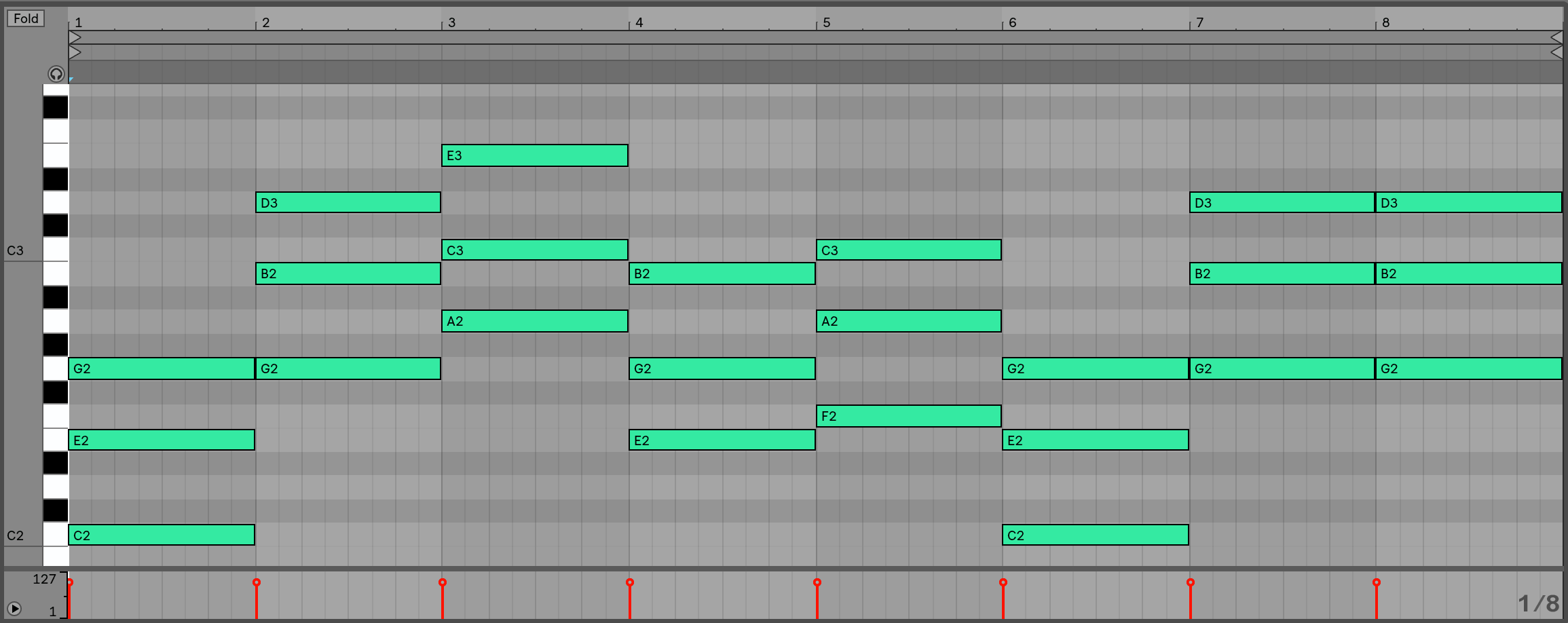
Your finished product in the piano roll might look something like this, with notes spread across several octaves to create a full, rich sound.
Conclusion
In this lesson, you've taken a significant step from theory to practice. You started with the fundamental building blocks of a minor key and systematically constructed a rich, emotive, and compelling 8-bar chord progression.
Here are the key takeaways:
- Foundation: Compelling progressions are built on a solid diatonic foundation. The
i-VI-III-VIIpattern is a powerful starting point in a minor key. - Color and Flow: Extensions (like 7ths) add emotional depth, while inversions create smooth, professional-sounding transitions between chords.
- Power and Space: Wide voicings, especially separating the bass note from the main chord, create a massive, atmospheric sound typical of progressive house.
- Interest: Introducing variation over an 8-bar loop, potentially with a "borrowed" chord, keeps the listener engaged and is a key technique in the deadmau5 style.
You now have a harmonic foundation ready. In our next lesson, we will build upon this work by composing a rolling 16th-note bassline designed to complement the chord progression and kick drum pattern you will eventually create. Your chord progression will be the guide that dictates which notes the bassline can play.
Can't find a good explanation? Sign up and we'll make it for you
Sign up