
Hello. In this part of the course, the central task is not merely to recognize that an automated AST result is unusual, but to choose a defensible next test. A questionable result may reflect a preparation error, a mixed culture, an instrument or panel limitation, an incorrect interpretation rule, or a biologically genuine but uncommon resistance mechanism. The appropriate response depends on the question you need to answer.
By the end of this lesson, you should be able to distinguish the roles of repeat testing, an alternative method, a reference method, and molecular confirmation, and select among them in a way that protects both patient care and the credibility of the laboratory report.
First: define the discrepancy and stabilize the case
A “questionable automated result” is broader than a genotype–phenotype conflict. It includes any result that is analytically doubtful or biologically implausible enough to affect reporting. Common triggers include:
- An automated MIC conflicts with a rapid molecular resistance marker.
- The phenotype conflicts with known intrinsic resistance or expected organism–drug patterns.
- A result is near a breakpoint and changes the clinical category.
- The profile is internally discordant, such as susceptible extended-spectrum cephalosporins with carbapenem resistance in an Enterobacterales isolate.
- The organism is recovered from a serious infection and the result has treatment or infection-control consequences.
- The instrument generates an expert-rule alert, an off-scale MIC, or a result outside the platform’s validated organism–drug claims.
Before choosing a confirmatory method, perform a brief pre-analytical and interpretive triage. This is not “extra testing”; it is the basis for deciding whether extra testing is meaningful.
- Hold the questionable final result according to laboratory policy. If an initial result has already been released, escalate promptly to the supervisor, microbiologist, and clinical team as appropriate.
- Review purity and identity. Examine the purity plate and all colony morphologies. Confirm identity from a pure colony if needed. A molecular marker detected directly from blood-culture broth may belong to a different organism in a mixed culture.
- Review test integrity. Check inoculum preparation, colony age, panel/card selection, incubation or instrument flags, reagent and panel lot, QC status, maintenance records, and transcription or interface errors.
- Verify interpretation. Confirm the organism identification, antimicrobial agent, AST method, breakpoint standard and version, and any intrinsic-resistance or expert-system rule that applies.
This initial review often determines the best next action. For example, if an isolate has been interpreted using an obsolete breakpoint, the remedy is not automatically another AST run. The MIC may be reproducible, while the category is wrong because the interpretive rule is outdated.
Read this Journal of Clinical Microbiology review by Yee, Dien Bard, and Simner for a practical framework for genotype–phenotype discrepancies. It emphasizes why pure isolation, method review, and a written discrepancy procedure must come before reflexively ordering more assays.
In the section “WHAT CAN LABORATORIES DO TO RESOLVE DISCREPANCIES?”, begin with the paragraph starting the need to weigh further testing. Continue through the troubleshooting discussion ending with prior patient reports. Focus on the authors’ sequence: pure culture and confirmed identification first, then repeat testing, a reference AST method, or a mechanism-specific assay when justified.
Four options, four different questions
The most useful distinction is this:
Do not select a test because it is available. Select it because it answers the unresolved question.
| Option | Primary question answered | Typical use | Important limitation |
|---|---|---|---|
| Repeat testing | Was the initial result reproducible when set up correctly? | Possible inoculum, handling, panel, or random analytical error | Repeating the same system does not independently exclude a systematic platform bias |
| Alternative method | Does a different analytical principle support the result? | A result near a breakpoint; a questionable automated category; a suspected platform limitation | An alternative method is not necessarily a reference method |
| Reference method | What is the standardized phenotypic result under reference conditions? | High-consequence, unusual, off-scale, or clinically pivotal result | Requires validated expertise, appropriate QC, and may add turnaround time |
| Molecular confirmation | Is a specific resistance determinant present in the pure isolate? | Infection-control implications, epidemiology, mechanism clarification, targeted gene discrepancy | A gene’s presence does not always prove expression or predict the exact MIC |
1. Repeat testing: assess reproducibility
Repeat testing is usually the first analytical intervention when there is a plausible technical explanation. It is appropriate when the original run may have been affected by:
- Inoculum density or suspension-preparation error
- Colonies taken from a mixed or marginally pure culture
- Aged colonies, delayed panel inoculation, or incorrect panel selection
- A transient instrument flag or loading problem
- A single unexpected category without a strong mechanistic contradiction
A useful repeat is not simply pressing “rerun.” It should be an independent re-preparation:
- Select well-isolated colonies from a verified pure subculture.
- Prepare a fresh standardized suspension.
- Use a new panel or card.
- Confirm that QC and relevant lot records are acceptable.
- Re-identify the isolate if the phenotype makes the identification doubtful.
If the repeat produces the expected phenotype and the first result is not reproduced, the laboratory can investigate the initial technical cause and report the supported result according to its procedure. If the same unusual result is reproduced, that finding becomes more credible—but it is not necessarily fully confirmed. Two identical results from the same automated system can share the same systematic limitation.
2. Alternative method: seek analytical independence
An alternative method changes the way the phenotype is measured. Depending on the organism–drug combination and local validation, this might be disk diffusion, gradient diffusion, a different automated platform, or a manual broth method.
Use an alternative method when the key question is: “Is the automated platform’s category plausible?” It is especially useful if the result lies near a breakpoint, if an instrument’s expert system has suppressed or modified a result, or if a particular drug–organism pair is known to be challenging for that system.
However, “different” does not mean “definitive.” Disk diffusion and gradient strips are valuable comparative methods, but each has its own inoculum, medium, endpoint, and breakpoint limitations. A disk method may not be available for a particular agent; a gradient strip can also show trailing growth or endpoint ambiguity. Therefore, an alternative result should be evaluated in light of the method’s validated claims and current CLSI or EUCAST guidance.
3. Reference method: establish the standardized phenotype
A reference AST method is selected when the phenotype itself must be resolved with the highest available standardization. For many antibacterial MIC questions, reference broth microdilution is the relevant reference method. It uses defined inoculum, medium, antimicrobial concentrations, incubation conditions, and MIC endpoint rules.
Reference testing is particularly justified when:
- The antimicrobial is a last-line or clinically critical agent.
- The result determines whether an isolate is categorized as multidrug resistant or carbapenem resistant.
- Automated and alternative methods disagree.
- A result is unusual enough to have infection-control or public-health implications.
- The platform is known to have limitations for the organism–drug combination.
- The MIC is close to a clinically important breakpoint and a different category would alter therapy.
Reference does not mean infallible. AST has inherent biological and analytical variation, commonly within one doubling dilution for MIC testing. The reference method must still be performed by trained personnel with valid QC and interpreted with the current organism–drug–method breakpoint table. Its strength is that it reduces uncertainty from proprietary algorithmic interpretation and provides a standardized phenotype against which automated results can be judged.
4. Molecular confirmation: establish a determinant, not susceptibility by itself
Molecular testing is most useful when the laboratory needs to know whether a specific mechanism is present. Examples include targeted detection of mecA or PBP2a in staphylococci, van genes in enterococci, or carbapenemase genes in Gram-negative organisms.
Molecular confirmation is particularly valuable when it affects:
- Infection prevention and control, such as identifying a potentially transmissible carbapenemase.
- Public-health referral or surveillance requirements.
- Mechanistic interpretation, such as distinguishing carbapenemase activity from porin loss combined with AmpC production.
- A direct genotype–phenotype discrepancy, when a molecular assay’s target is expected to correlate strongly with resistance.
But molecular data have strict interpretive limits:
- A negative gene result does not establish susceptibility; the mechanism may be absent from the assay’s target menu.
- A detected gene may be nonfunctional, poorly expressed, truncated, or present in another organism in a mixed specimen.
- Molecular detection from direct specimen testing may not reliably link the gene to the recovered colony type.
- Molecular results do not replace a valid phenotypic MIC when treatment decisions require actual susceptibility.
For this reason, molecular confirmation is often performed in parallel with reference AST or a phenotypic mechanism assay, rather than as a replacement for them.
Choosing the pathway in practice
The following rule set is useful for presentation slides and routine bench reasoning.
Choose repeat testing when the problem may be technical
A repeat is the best first choice when purity is confirmed but there is evidence of setup variation, an isolated unexpected result, a borderline inoculum, a possible handling issue, or a single instrument flag. It asks whether the original result can be reproduced.
Choose an alternative method when you need an independent comparison
Use an alternative validated method if the main concern is platform-specific performance. For example, if an automated MIC is unexpectedly resistant and a disk diffusion method is validated for the organism–drug pair, the disk result can help determine whether the automated category is credible.
Choose a reference method when the MIC itself is decisive
Move directly to a reference method when the clinical consequences are high, the automated result is unusual and reproducible, or results from different methods conflict. For a questionable carbapenem, cefepime, colistin, or other clinically consequential result, a reference broth microdilution method may be more informative than repeatedly running the same automated panel.
Choose molecular confirmation when mechanism or transmission matters
Use targeted molecular testing when a specific determinant would change infection-control action, clarify a discordance, or guide referral. Molecular tests are also useful when a phenotypic enzyme assay is positive but a routine molecular panel is negative, suggesting a rare or off-panel mechanism.
For carbapenemase investigations, a phenotypic carbapenemase activity assay such as mCIM or Carba NP occupies an important middle position. It does not provide a full MIC profile like reference broth microdilution, and it does not identify a particular gene like molecular testing. Instead, it asks whether the isolate is producing a functional carbapenemase. This can clarify whether a detected carbapenemase gene is expressed.
A Gram-negative discrepancy example
The image below summarizes a targeted approach to discordant molecular and phenotypic findings in Gram-negative organisms.
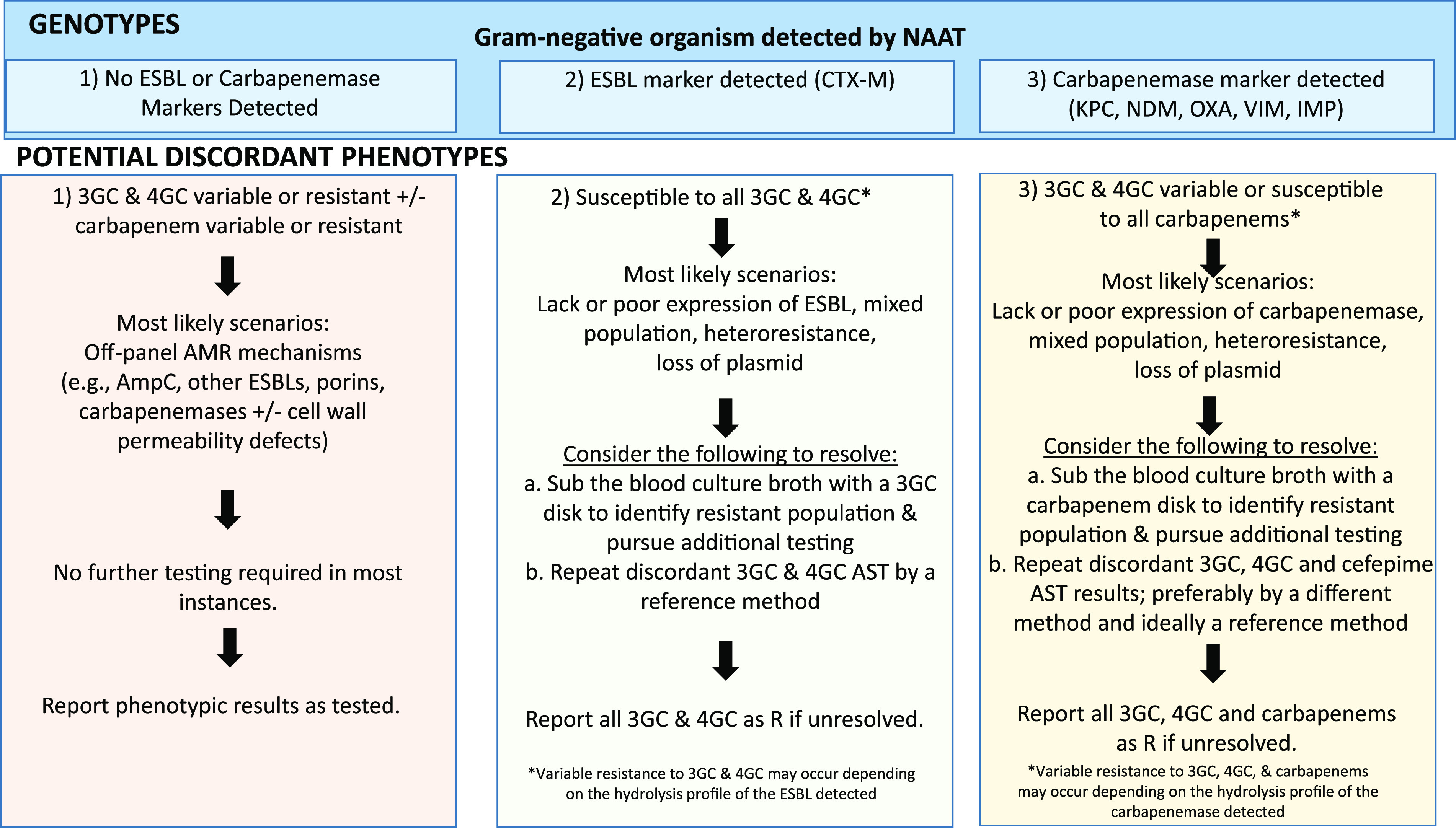
Notice two features of the workflow:
- The absence of a marker is not automatically a discrepancy. A Gram-negative isolate may resist cephalosporins or carbapenems through mechanisms not included on the molecular panel, such as AmpC activity combined with porin alteration or efflux.
- Marker-positive apparent susceptibility has higher stakes. If a CTX-M marker is detected while third- or fourth-generation cephalosporins appear susceptible, or if a carbapenemase marker is detected while carbapenems appear susceptible, the workflow recommends recovering possible resistant subpopulations, repeating AST, and using a reference method for the discordant drugs.
This approach appropriately gives greater weight to unresolved high-risk resistance discrepancies. Local policy and current standards govern final reporting, but a common conservative principle is to avoid reporting a clinically important agent as susceptible when a credible resistance determinant remains unexplained.
2022 AST Case Studies | News | CLSI
Read CLSI’s Serratia case to see how a reproducible but unusual phenotype should not be dismissed as automation error. It illustrates the complementary roles of repeat AST, a targeted molecular or immunoassay panel, and a phenotypic carbapenemase assay.
In “What’s Wrong with This Picture? Case 2,” read from the initial investigation. Track the order of reasoning: purity review and MALDI-TOF identification, review of technical and QC evidence, a targeted carbapenemase immunoassay, then Carba NP. Ask which uncertainty each step resolves.
Case synthesis: Serratia marcescens with an unusual beta-lactam phenotype
In the CLSI case, Serratia marcescens was susceptible to extended-spectrum cephalosporins but resistant to ertapenem and meropenem. This profile is unusual enough to require investigation because it could represent panel contamination, setup error, a mixed culture, or a genuine carbapenem resistance mechanism.
The laboratory did not immediately assume the automated result was wrong. It first checked purity and reconfirmed identification by MALDI-TOF. It reviewed operator, platform, and QC information, reducing the likelihood of a technical explanation. It then used a targeted immunoassay for common carbapenemases, which was negative, followed by Carba NP, which demonstrated carbapenemase activity. Repeat AST reproduced the original phenotype.
Each method answered a different question:
| Question | Chosen action | Meaning of the result |
|---|---|---|
| Was another organism present? | Purity-plate review and repeat identification | The isolate was a pure S. marcescens culture |
| Was the result likely a one-off technical event? | Review setup, instrument performance, and QC; repeat AST | The unusual phenotype was reproducible |
| Was a common, high-priority carbapenemase present? | Targeted immunoassay | Common tested targets were not detected |
| Was functional carbapenemase activity present? | Carba NP | Carbapenemase activity was demonstrated |
| What mechanism best explains the phenotype? | Integration of organism identity, AST pattern, and enzyme testing | An SME carbapenemase was considered likely |
The lesson is not that every unusual result requires extensive molecular characterization. The lesson is that the test selection followed the uncertainty. Because the phenotype was reproducible and had major therapeutic and infection-control implications, a simple repeat alone was insufficient. Conversely, the common negative molecular targets did not disprove carbapenemase production, because their panel did not include every possible mechanism.
Documentation and reporting while confirmation proceeds
A good discrepancy process is visible in the record. Document:
- The original organism identification, MICs, categories, instrument flags, and panel or card lot.
- Purity-plate findings and any repeat identification.
- QC status and relevant equipment or reagent review.
- The reason for repeat, alternative, reference, or molecular testing.
- The method, date, result, and interpretation of each follow-up assay.
- The final adjudication and any report amendment, comment, or clinician notification.
For high-consequence discrepancies, communicate early with the antimicrobial stewardship team and infection prevention personnel according to local policy. A temporary statement such as “susceptibility testing in progress” may be safer than a premature susceptible result. If a previously released report must be corrected, direct clinician notification and documentation of that communication are essential.
Key takeaways
A questionable automated result does not have one universal confirmatory test.
- Repeat testing evaluates reproducibility and likely technical variation.
- An alternative method provides an independent analytical comparison, but is not automatically definitive.
- A reference method is appropriate when the standardized phenotypic MIC is clinically decisive or methods disagree.
- Molecular confirmation establishes the presence of a targeted resistance determinant, but cannot by itself establish expression, MIC, or susceptibility.
- First verify purity, identity, QC, data transfer, and current breakpoint interpretation.
- For serious or unexplained discrepancies, hold or qualify reporting as directed by laboratory policy, investigate systematically, and communicate promptly.
The next lesson applies this decision framework to Gram-positive resistance phenotypes, focusing on how to select confirmatory testing for methicillin resistance in staphylococci and vancomycin resistance in enterococci.
Can't find a good explanation? Sign up and we'll make it for you
Sign up