
Welcome back. In the last lesson, you made a flexible weekly schedule: fixed commitments first, then specific study blocks, buffers, and backup time. That schedule becomes much easier to use when each block contains an action you can actually begin—not a huge label such as “English coursework” or “revise science.”
This lesson is about turning a large assignment or revision topic into small, concrete next actions. By the end, you should be able to look at something overwhelming, identify what “finished” means, split it into sensible stages, and choose a first action that fits one of your planned study blocks.
A big task is usually a project, not a task
Some schoolwork looks like one item on a to-do list but is secretly many jobs bundled together.
- “Complete geography project”
- “Revise algebra”
- “Do English essay”
- “Prepare for biology test”
None of these tells you what to do when you sit down. They are projects: work that needs several sessions and several decisions. A useful task is small enough to complete in one sitting—often around 15–45 minutes for an ordinary school-day block.
For example, compare these:
| Too vague to start | Concrete next action |
|---|---|
| Revise maths | List the algebra topics on the test, using the revision checklist |
| Work on English essay | Highlight the command word, word count, and deadline on the assignment sheet |
| Do science homework | Answer questions 1–4 on the worksheet and mark them |
| Finish history project | Find two reliable sources for the first section and save their links |
| Study French | Learn the meanings of ten words from this week’s vocabulary list |
The point is not to make every task tiny for no reason. The point is to remove the moment where you sit down and think, “Okay, but what do I actually do first?”
The Amazing Marvin guide makes the same useful distinction: a task is something you can do more or less in one sitting; anything spanning several sessions should be treated as a project and broken down.
How to break down large projects & tasks into bite-sized tasks | Amazing Marvin
Read this guide from Amazing Marvin for a practical method of turning an intimidating project into actions you can begin immediately.
Start in “How to break down a large task into small tasks.” Read the parts called “Define: project or task?”, “Break a large project into milestones”, “List out the steps”, “Break multi-step tasks into single-step tasks”, and “Break long stretches of work into smaller sessions.” In the middle sections, follow the brainstorm method. Then focus especially on the advice to use specific verbs and on time boxing for work that still feels too large.
A task does not need to be perfectly planned before you can start. If you genuinely do not know what an assignment expects, your next action is not “do the assignment.” It is something such as:
- “Read the task sheet and write down three things I need to produce.”
- “Ask my teacher which case study I should use.”
- “Find the success criteria in Google Classroom.”
- “Make a list of questions I need answered before I can begin.”
Getting clarity is real progress.
First, work out what “done” means
Before creating steps, inspect the assignment brief or revision target. Large work becomes manageable once you know its boundaries.
For an assignment, pull out:
- The final product: an essay, presentation, poster, practical write-up, model, video, worksheet, or something else.
- The question or command word: for example, explain, compare, analyse, evaluate, or design.
- The required content: sources, quotations, topics, case studies, calculations, sections, or practical evidence.
- The constraints: deadline, word count, length, format, named software, and whether it is individual or group work.
- How it will be judged: marks, rubric, checklist, teacher examples, or success criteria.
For a revision topic, define “done for now” rather than pretending you can “finish all revision.” It might mean:
- “I can name the five required topics and know which one is weakest.”
- “I have completed one focused set of questions on simultaneous equations.”
- “I have made a one-page summary of the causes of World War I.”
- “I have checked which biology definitions I cannot yet explain.”
Watch the opening planning stages in this video. It models the quick scan that should happen before you begin writing or researching.
How to write an Assignment in Seven easy steps! 💻
In “How to write an Assignment in Seven easy steps!”, Groobles Media shows how to extract the important information from an essay task before starting the work.
Watch record critical facts for the due date, length, command words, and style requirements. Continue with map the structure to see how an opening, body sections, and conclusion can become separate parts of a writing assignment. Use the method, not the video’s exact writing advice, for whatever subject you are doing.
Here is a made-up example:
English assignment: Write 800 words answering: “How does the writer present conflict?” Use at least three quotations. Due in 12 days.
“Write essay” is too broad. A clearer definition of done is:
An 800-word answer with an introduction, three analytical paragraphs using quotations, a conclusion, and a final proofread, submitted by the deadline.
That sentence gives you something to plan backwards from.
Create stages before listing every tiny action
A stage is a meaningful chunk of the project. It helps you see the shape of the work without trying to plan every minute immediately.
For the English example, the stages might be:
- Understand the question and success criteria.
- Choose and organise evidence.
- Plan the argument and paragraph order.
- Write a rough draft.
- Improve, proofread, and submit.
For a revision topic such as “GCSE maths algebra,” stages could be:
- Identify the exact algebra skills required.
- Gather notes, examples, and questions.
- Practise one skill at a time.
- Check mistakes and revisit weak skills.
- Complete a mixed practice set.
A stage is not yet necessarily a calendar task. “Choose evidence” could take several short sessions. The stages simply stop the project being one massive, blurry object.
The assignment-planning guide from Algonquin College Library recommends listing the stages needed to complete an assignment and giving each one its own completion deadline.
Subject Guides: Student Survival Guide: Planning an Assignment
This short guide from Algonquin College Library gives a straightforward assignment-tracker approach: understand the brief, list the stages, and set mini-deadlines before the final due date.
Read “How do you plan an assignment?” and then the “Breaking Down Assignments” section through “Instructions for filling out the assignment tracker template.” First note the advice in the planning principles. Then read the full numbered tracker instructions, especially the directions to list stages and set dates; the final two steps are mini-deadlines and checking off. Treat the guide’s time estimates as a rough example rather than a rule for every school assignment.
Plan backwards, with room for problems
Start with the real deadline, then choose earlier checkpoints. Do not put the first draft on the due date; that leaves no space for feedback, a technical problem, or discovering that a section needs rewriting.
For the essay due on Friday:
| Checkpoint | Latest sensible time |
|---|---|
| Submit final version | Friday morning |
| Final proofread and format check | Thursday |
| Improve the draft using success criteria | Wednesday |
| Complete rough draft | Tuesday |
| Make paragraph plan and choose quotations | Sunday |
| Understand the question and gather materials | Saturday |
These are not promises that every stage will take exactly one day. They are guideposts. If one takes longer, use the backup block from your weekly schedule rather than panicking and abandoning everything else.
Turn each stage into startable actions
Now take one stage and ask: What would I physically do first?
A strong next action normally has five features:
| Feature | What it means | Example |
|---|---|---|
| A specific verb | It names an observable action. | Highlight, list, compare, solve, draft, check |
| One clear target | It states exactly what you will act on. | Three quotations from Chapter 4 |
| A limit | It has a realistic amount of work or time. | 20 minutes; questions 1–5; 150 words |
| A resource | You know what to open or collect. | Assignment sheet, textbook, worksheet, laptop |
| A stopping point | You can tell when the task is complete. | Three quotations are copied with page numbers |
Let’s turn the stage “choose and organise evidence” into actions:
| Weak wording | Better action |
|---|---|
| Research quotations | Re-read the extract and highlight five lines linked to conflict |
| Plan body paragraphs | Put three selected quotations into a table with a point for each |
| Start writing | Draft the first paragraph using quotation 1 and 2 |
| Improve essay | Check whether each paragraph explains how the quotation supports the argument |
Notice that “research quotations” hides several decisions. The better version tells you where to look, what to collect, and when to stop.
Use a limit when the work could expand forever
Some actions are real but still endless: reading, researching, revising notes, or drafting. Give them a boundary.
Instead of:
- “Research climate change”
- “Read science textbook”
- “Write coursework”
- “Revise chemistry”
use a numerical or time limit:
- “Spend 25 minutes finding two sources on coastal erosion; save the links.”
- “Read pages 42–45 and list four key terms.”
- “Draft 200 words explaining the first design choice.”
- “Complete six balancing-equation questions and check them.”
A limit protects your schedule and gives you a clear stopping point. You can make another action later if more is needed.
Revision topics need actions too
Revision timetables can be useful, but a subject label alone is still vague. The three-week GCSE Maths Revision Timetable shows a sensible pattern of spreading different activity types across several weeks: review, worked examples, skills worksheets, applied questions, and exam questions. To make a timetable usable day to day, add the exact topic and output to each box.
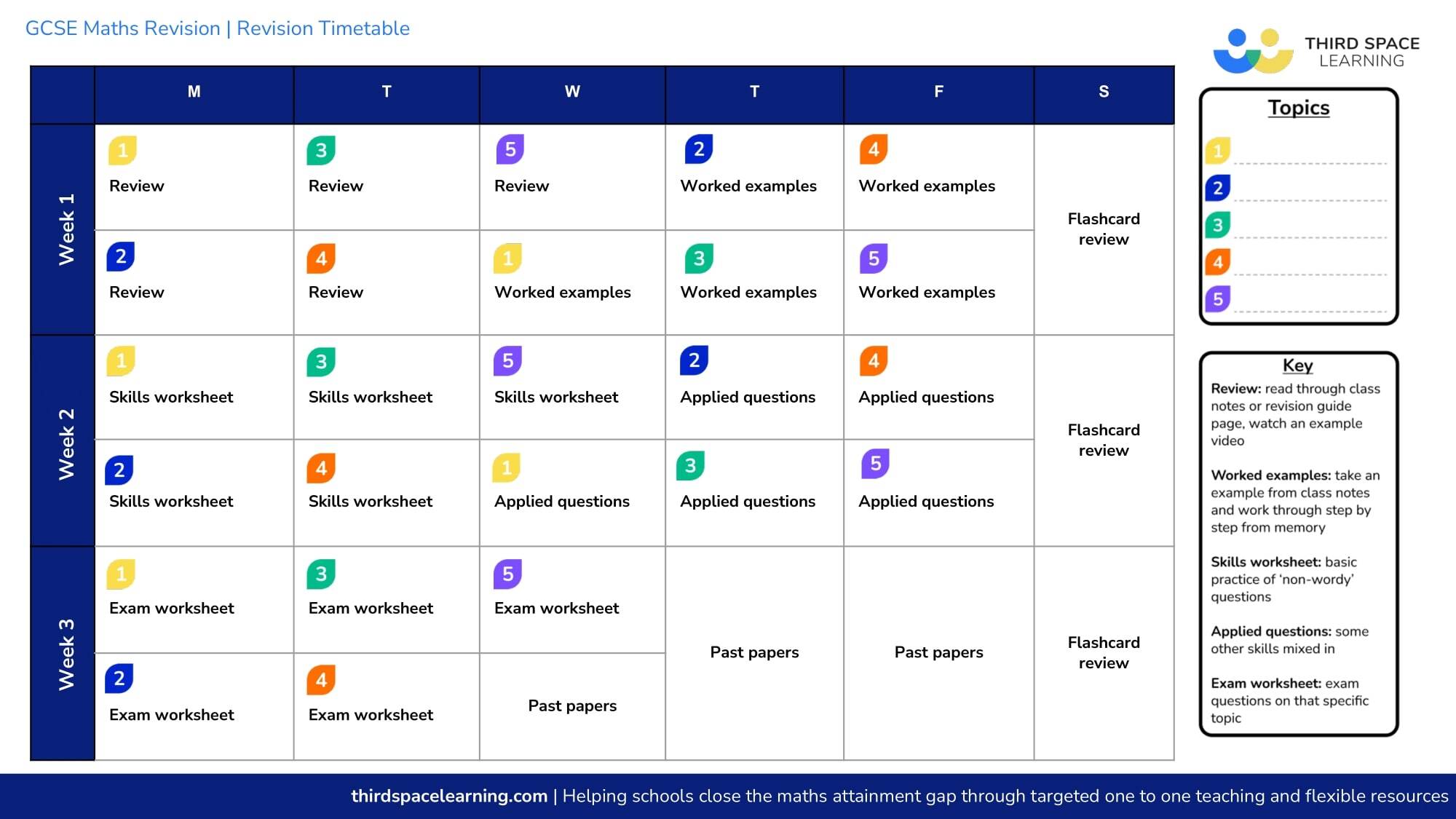
For example, “Thursday: Maths worked examples” becomes:
- “Watch and annotate two worked examples on solving simultaneous equations.”
- “Cover the solution and solve one similar simultaneous-equations question.”
- “Write one note explaining the step I got wrong.”
Likewise, “Revise Cold War” could become:
- “List the six Cold War events named on the revision checklist.”
- “Read the Berlin Blockade page and write three causes in my own words.”
- “Place the Berlin Blockade, Cuban Missile Crisis, and Prague Spring on a timeline.”
- “Answer one ‘Explain why’ question on the Cuban Missile Crisis.”
- “Check my answer against the class success criteria and circle one improvement.”
You do not have to map every revision session for the whole term today. Make sure you can always see the next two or three actions for the topic you are currently studying.
Build your own action ladder
Choose one large item from your captured task list. Pick something real: coursework, an upcoming test, a project, or a topic you keep putting off.
Write this on paper, in your notes app, or beside your weekly calendar:
| Planning prompt | Your notes |
|---|---|
| Project or topic | |
| Due date or test date | |
| “Done” means… | |
| Stage 1 | |
| Stage 2 | |
| Stage 3 | |
| First next action | |
| What I need ready | |
| Stopping point | |
| Estimated time | |
| When I will do it |
Aim for a first action you could begin with almost no extra thinking. For example:
First next action: Open the geography task sheet, highlight the required case study and deadline, then write a three-bullet checklist of what the final presentation must include.
Resources: Task sheet, highlighter, notebook.
Stopping point: I have a three-bullet checklist.
Time: 15 minutes.
Schedule: Monday, 4:30–4:45.
Put only that first action—or perhaps the first two—into this week’s study blocks. You are not failing to plan if later actions change. You are making the plan flexible enough to respond to what you learn while doing the work.
If the first action still makes you want to avoid it, shrink it once more. “Open the assignment sheet and read the first half” is a completely valid start when motivation is low.
Key takeaways
Large assignments and revision topics are usually projects, not single tasks. To make them manageable:
- Define what the finished piece of work needs to look like.
- Split the project into a few meaningful stages.
- Set mini-deadlines before the actual deadline.
- Turn the current stage into actions with a specific verb, target, limit, resource, and stopping point.
- Keep the next two or three actions visible, rather than trying to predict everything.
- Put the first concrete action into a focused block on your weekly schedule.
Next, you will make one of those blocks even easier to start by planning a 30-minute study session with a specific output, the resources you need, and a clear stopping point.
Can't find a good explanation? Sign up and we'll make it for you
Sign up