
Welcome to the first module of your SEO course. Over the next four lessons, you will establish a trustworthy measurement baseline for the service-business website: first define what SEO success means, then verify a conversion event, segment performance, and turn the findings into a concise scorecard.
For a Marketing Manager, an SEO report needs to answer more than “Are rankings improving?” It needs to show whether organic search is creating the kinds of enquiries the business can realistically turn into customers. This lesson builds the structure that makes that possible: an SEO KPI tree linking search visibility, organic sessions, qualified leads, and commercial outcomes.
Start with the business result, not the SEO metric
A KPI tree is a hierarchy of measures that works backward from the outcome the business wants. Its purpose is to prevent a familiar reporting failure: presenting a rising line for impressions, rankings, or sessions as success when lead quality or revenue is flat.
For a lead-generation service business, the ultimate result will usually be one or more of the following:
- Revenue from customers associated with organic search
- Closed-won customers
- Qualified sales pipeline or estimated pipeline value
- Cost to acquire a customer, including SEO investment
- Profitability or payback period, when sufficiently reliable commercial data exists
Revenue is often delayed. A visitor may discover a service page today, request a consultation next week, and become a customer months later. So the tree must include leading indicators that you can act on now, without confusing them with the final result.
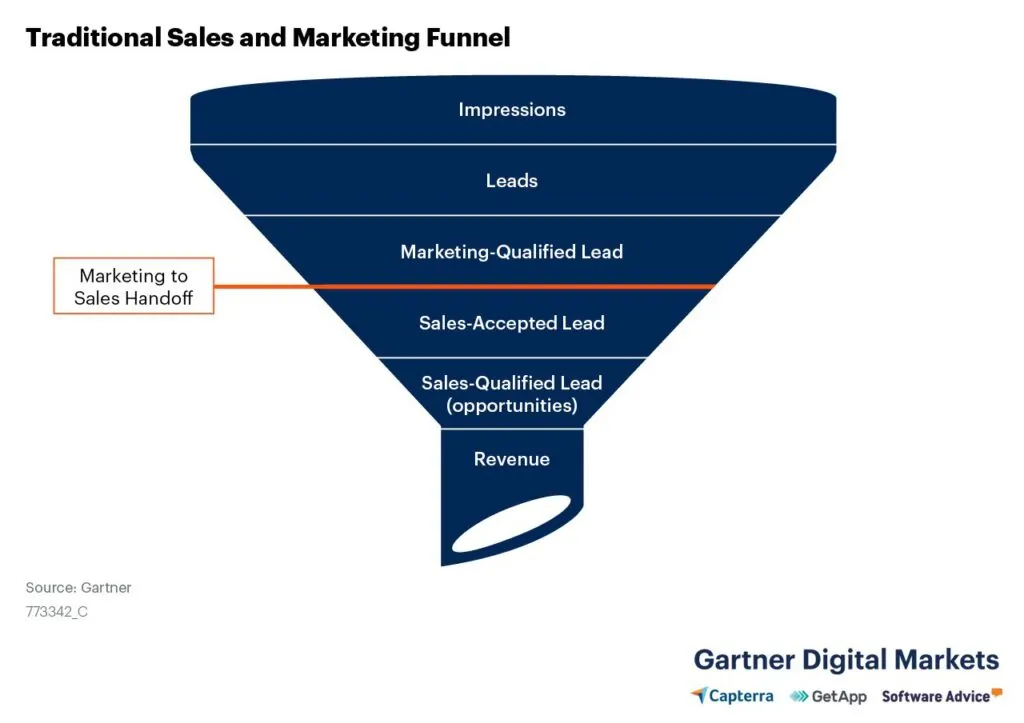
The traditional sales and marketing funnel below is useful because it shows the key distinction between early marketing signals and the sales handoff. But it is incomplete as an SEO management model: it does not identify whether the searcher had commercial intent, whether the lead fits the business, or which pages and queries produced it.
A stronger reporting principle is:
SEO activity and visibility are explanations for business results, not substitutes for them.
Read the conceptual foundation in the following article before designing your own tree.
B2B SEO KPIs: Measure Pipeline and Revenue, Not Rankings
Read Ivan Getmanov’s framework for separating commercial outcomes, conversion quality, search visibility, and technical delivery. It provides a useful model for avoiding a rankings-first SEO dashboard.
Begin with the opening discussion, from why flat reporting fails, and note the difference between a pipeline metric, a revenue metric, and a delivery metric. Then read the section “Rankings are useful, but they are not the goal,” focusing on the role of rankings as diagnostic evidence rather than the goal. In “Build a KPI tree,” read from the worked tree example. Pay particular attention to the order: commercial objective, conversion measures, visibility, then delivery measures.
The four layers of a lead-generation SEO KPI tree
For this website, use four layers. The layers are connected, but they are not interchangeable.
| KPI layer | Core question | Suitable examples for this site | Main data source |
|---|---|---|---|
| Business outcomes | Is organic search creating commercial value? | Organic-sourced pipeline value, closed customers, revenue, customer acquisition cost | CRM, sales records, finance data |
| Qualified leads | Are organic visitors becoming viable prospects? | Sales-qualified leads, accepted consultations, qualified quote requests, lead-to-opportunity rate | CRM, GA4 with offline event import where available |
| Organic sessions and conversions | Are the right visitors taking meaningful actions? | Organic sessions, form submissions, phone enquiries, booking requests, organic conversion rate | GA4 |
| Search visibility | Are potential buyers discovering the right pages? | Non-brand clicks, impressions, click-through rate, query visibility by service and market | Google Search Console; Ahrefs or Semrush |
| Delivery and technical health | Are we improving the conditions for future results? | Priority pages indexed, internal links added, page experience issues resolved | Search Console, Semrush, crawl tools |
The first four are the essential chain for this lesson. Delivery and technical health matter, but they sit beside and beneath the commercial chain as controllable inputs. Publishing ten pages, acquiring links, or fixing crawl errors can be excellent work; none is proof that the business has acquired qualified demand.
1. Business outcomes: choose a credible north-star KPI
Select one primary commercial outcome for the next 90 days. Avoid a broad phrase such as “grow SEO.” Better options are specific and measurable:
- Increase organic-sourced qualified pipeline for a priority service.
- Increase sales-qualified leads from non-brand organic search in a target country.
- Increase closed customers from organic search for a high-margin service.
- Increase the value of organic-influenced opportunities, if the buying journey is long and multi-touch.
For a service business with limited CRM integration, qualified leads may be the most reliable short-term north star. Revenue can remain an executive outcome that you track quarterly while the underlying measurement matures.
Two attribution definitions should be explicit in the tree:
- Organic-sourced: organic search was the first recorded acquisition channel, or the lead’s first known visit came from organic search.
- Organic-influenced: organic search appeared somewhere in the recorded journey before the lead became an opportunity or customer.
Do not combine these in one number without labeling it. They answer different questions. Sourced leads help estimate acquisition; influenced leads help show SEO’s role in longer, non-linear journeys.
2. Qualified leads: define “qualified” operationally
A form submission is not necessarily a qualified lead. Someone may submit from an unsupported country, request a service you do not offer, have an unrealistic budget, or be a job seeker or vendor. The business needs a definition sales and marketing both accept.
A practical qualification rule for a multi-location, international service business might require some combination of:
- The prospect requests a service the company actively sells.
- The prospect is in a served country or can be served remotely.
- The request comes from a plausible customer profile rather than spam, recruitment, partnership, or supplier outreach.
- The prospect has a credible need, timeline, and/or budget according to the sales team’s criteria.
Your exact rule should reflect the real sales process. The important distinction is that the qualification status must be applied after the inquiry reaches the business, ideally in the CRM.
Google Analytics 4 has recommended lead-funnel event names that match this logic.
[GA4] Recommended events - Analytics Help
Google’s Analytics Help page lists recommended GA4 event names for an online-to-offline lead funnel. Use it to separate a website enquiry from the later sales qualification and customer stages.
In the section “For lead generation,” read the lead event table. Focus on the distinction among generate_lead, qualify_lead, working_lead, and close_convert_lead. These describe business states; only use them when the corresponding status is genuinely known.
For the tree, map those events conceptually:
| Customer state | What it means | Recommended GA4 event, if implemented |
|---|---|---|
| Raw inquiry | A visitor submits a contact, quote, or consultation form | generate_lead |
| Qualified lead | Sales or marketing confirms that the inquiry meets agreed criteria | qualify_lead |
| Disqualified lead | The inquiry cannot become a customer, with a recorded reason | disqualify_lead |
| Sales in progress | A representative is actively working the lead | working_lead |
| Customer | The lead becomes a customer | close_convert_lead |
You may not currently have all of these events available in GA4. That is fine. A KPI tree is both a reporting model and a gap analysis. If you can measure form submissions but cannot yet identify qualification, write that limitation plainly and include “CRM qualification status linked to source/medium” as a measurement improvement.
3. Organic sessions and meaningful conversion actions
Organic sessions are the bridge between search discovery and lead generation. They tell you whether people reached the website through organic search. But a session is not automatically valuable; it must be interpreted with the landing page, country, service, and conversion behavior.
Your core calculations are:
The third metric is especially useful because it prevents traffic growth from hiding deteriorating quality.
Suppose a service page gains 1,000 additional organic sessions. If it produces 20 extra enquiries but only one is qualified, the search growth may be reaching the wrong audience or creating a poor expectation about the service. Conversely, a lower-traffic location page that produces fewer raw enquiries but a high qualification rate may deserve more investment.
Keep only actions that represent genuine value in your main conversion reporting. A scroll, generic click, or page view may be useful diagnostic data, but it should not be treated as a lead.
SEO Analytics: How To Track & Analyze Your SEO Campaign
Watch “SEO Analytics: How To Track & Analyze Your SEO Campaign” by John Reinesch for a practical explanation of limiting conversion reporting to meaningful actions and then prioritizing conversions over traffic metrics.
Watch event tracking to see why meaningful actions such as form submissions and booking clicks should be explicitly tracked and carefully designated as conversions. Then watch KPI priorities, focusing on the recommended order of conversion measures, organic clicks, sessions, impressions, and branded versus non-branded search performance.
4. Search visibility: measure discovery among likely buyers
Visibility is not simply “average position for all keywords.” An average can conceal the difference between ranking highly for an informational, low-value query and appearing for a service query from a likely buyer.
For this business, define visibility slices around commercial reality:
- Service: each priority service or service cluster
- Market: country, language, or physical location
- Intent: informational, comparison, service-led, price-related, emergency, or local-intent queries
- Brand status: branded and non-branded queries separately
- Landing page: the specific service or location page receiving clicks
The practical visibility measures are:
Track non-brand clicks and impressions for priority service-market combinations. Also track the count of priority queries that rank in a useful range, such as positions 4–10 or 11–20, but treat rank as diagnostic context rather than the outcome.
For example, “non-brand clicks to the international [Service A] page from the United Kingdom” is a decision-ready metric. “Average rank across every keyword in Semrush” generally is not.
Build the first version of your KPI tree
Use a spreadsheet, FigJam, Miro, or a single slide. Start with one priority service and one target market rather than trying to represent every service and country at once. You will make the model scalable after it works for a representative case.
Here is a template appropriate for the website’s lead-generation goal:
| Layer | KPI | Definition and segmentation | Cadence | Owner / source |
|---|---|---|---|---|
| Business outcome | Organic-sourced qualified pipeline | Sum of estimated or CRM-recorded opportunity value where organic search is the first known channel; filter to priority service and market | Monthly; quarterly decision review | Sales/CRM |
| Business outcome | Organic-influenced closed customers | Count or revenue of customers with organic search recorded in their journey | Quarterly, if sales cycle is long | Sales/CRM |
| Qualified leads | Organic qualified leads | Leads accepted against the agreed qualification rule; record disqualification reason when rejected | Monthly | CRM, GA4 if imported |
| Qualified leads | Qualification rate | Qualified organic leads divided by organic generated leads | Monthly | CRM and GA4 |
| Sessions and conversion | Organic generated leads | Contact forms, quote requests, consultation bookings, and verified phone leads from organic search | Weekly and monthly | GA4 |
| Sessions and conversion | Organic session-to-lead rate | Organic generated leads divided by organic sessions | Monthly | GA4 |
| Visibility | Non-brand clicks and impressions | Google Search clicks and impressions for priority service queries, segmented by country and landing page | Weekly trend; monthly review | Search Console |
| Visibility | Priority-query visibility | Rankings and SERP presence for an agreed keyword set, separated by service, intent, and country | Monthly | Ahrefs or Semrush; Search Console |
| Delivery health | Priority page eligibility | Indexation, canonical status, crawlability, and important template issues for pages needed to generate leads | Weekly while fixing issues | Search Console, Semrush |
A worked example
Assume the website’s priority is consultation leads for Service A in a target country.
Your tree can read:
- Commercial objective: Increase qualified consultation pipeline for Service A in the target country from organic search.
- Business result: Organic-sourced qualified pipeline value; eventually, closed-won revenue.
- Lead quality: Number of accepted/qualified Service A consultations; organic qualification rate; disqualification reasons.
- On-site conversion: Organic Service A sessions; consultation requests; session-to-lead conversion rate.
- Search visibility: Non-brand clicks, impressions, CTR, and priority-query visibility for Service A in the target country.
- SEO delivery inputs: Service-page content improvements, internal links, indexability, local trust signals, and relevant authority.
- Search visibility: Non-brand clicks, impressions, CTR, and priority-query visibility for Service A in the target country.
- On-site conversion: Organic Service A sessions; consultation requests; session-to-lead conversion rate.
- Lead quality: Number of accepted/qualified Service A consultations; organic qualification rate; disqualification reasons.
- Business result: Organic-sourced qualified pipeline value; eventually, closed-won revenue.
Notice the logic: delivery supports visibility; visibility supports visits; visits create opportunities to convert; conversion quality determines whether sales receives viable leads; qualified leads create pipeline and revenue. Each layer has a different owner, system, and review cadence.
Build rules that make the tree credible
As you create yours, apply these rules:
-
Use one unambiguous commercial objective.
“Increase SEO traffic” is an activity goal. “Increase qualified organic leads for [service] in [market]” is a business-connected objective. -
Define every metric before reporting it.
Write the formula, data source, inclusion rules, exclusions, and segment. For example, specify whether “organic” means GA4’s Organic Search channel group and whether brand queries are included. -
Segment before you aggregate.
A combined international total can hide a high-performing country beneath a weak one. Maintain at least service, country/location, landing-page, and brand/non-brand views. -
Do not promise perfect attribution.
Cookie consent, cross-device behavior, phone calls, offline conversations, and long sales cycles all create uncertainty. State the attribution rule and use it consistently. -
Treat ranking and technical metrics as diagnostic.
They belong in the tree because they help explain change and guide action. They do not replace qualified leads or revenue. -
Use leading and lagging review windows.
Review delivery and visibility weekly or monthly. Review qualified leads monthly. Review revenue or closed customers monthly or quarterly, depending on the sales cycle.
Your 30-minute working output
Create a one-page KPI tree for one priority service, one country or location, and one primary lead action on the real website.
Include:
- A single commercial objective for the next 90 days
- One primary business KPI and one secondary business KPI
- Your written definition of a qualified lead
- The primary lead action, such as quote request, contact form, consultation booking, or verified call
- Three visibility measures, including non-brand clicks or impressions
- At least two required segments: service and country/location
- The named data source for each layer: Search Console, GA4, CRM, Ahrefs, or Semrush
- One current measurement limitation or assumption
A concise final statement might look like this:
“For [Service] in [Market], SEO success means increasing qualified organic consultation requests and their resulting pipeline value. We will monitor non-brand search visibility and organic sessions as leading indicators, form submissions as generated leads, CRM acceptance as qualification, and organic-sourced pipeline as the commercial outcome.”
Do not worry if the CRM data is incomplete. Mark the current state honestly. In an interview case study, identifying a measurement gap and proposing a sensible remedy is stronger than presenting a precise-looking number with an unclear definition.
Key takeaways
An SEO KPI tree turns SEO from a list of isolated channel metrics into a measurable growth system.
- Begin with a commercial objective, usually qualified pipeline, customers, or revenue.
- Separate raw leads from qualified leads using an agreed business definition.
- Use organic sessions and meaningful conversion actions to understand the on-site bridge from discovery to enquiry.
- Measure visibility by priority service, market, intent, and landing page—not by an undifferentiated average rank.
- Keep delivery and technical measures as leading indicators, not claimed business impact.
- Label organic attribution clearly as sourced or influenced, and state any data limitations.
Next, you will audit one primary lead-conversion event to confirm that it is recorded correctly and can genuinely be attributed to organic search in the available analytics setup.
Can't find a good explanation? Sign up and we'll make it for you
Sign up