
Hello, and welcome to this focused stem-cell exam sprint. This module has two goals: first, to distinguish the major stem-cell categories precisely; then, to apply those distinctions to a fertility-regeneration scenario. Today establishes the comparison framework you will need for that application.
By the end of this lesson, you should be able to construct and explain a table comparing embryonic stem cells (ESCs), induced pluripotent stem cells (iPSCs), and germline stem cells (GSCs) by origin, potency, self-renewal, differentiation range, uses, and limitations.
Start with the two defining stem-cell properties
A stem cell is not simply “a cell that can become something else.” It has two linked properties:
- Self-renewal: it can divide while maintaining a stem-cell population.
- Differentiation: it can produce more specialized descendants.
These properties are separate. A cell can self-renew extensively but have a narrow developmental range. Germline stem cells are the key example: they maintain a reproductive-cell lineage but do not normally produce unrelated tissues such as neurons, liver cells, or muscle.
A-Level Biology - Stem Cells - Types & Potency | Uses in Research & Medicine (2026/27 exams)
Watch “A-Level Biology - Stem Cells - Types & Potency | Uses in Research & Medicine” by Cognito for a compact visual grounding in the two defining properties of stem cells, the meaning of potency, and the basic idea of iPSCs.
In the opening section, watch stem cell basics to distinguish self-renewal from specialization. Continue with potency classes, focusing on why pluripotent and unipotent describe differentiation range, not whether a cell is or is not a stem cell. Then watch iPSCs for the core contrast between reprogrammed adult cells and embryo-derived cells.
Potency: how wide is the cell’s developmental range?
Potency means the range of specialized cell types that a stem cell can generate.
- Pluripotent cells can form essentially all cell types of the body, including derivatives of the three embryonic germ layers: ectoderm, mesoderm, and endoderm. They do not form an entire organism, because they do not generate the extraembryonic structures needed for that.
- Multipotent cells can make several related cell types within a tissue or lineage. Blood-forming stem cells, for example, generate the different types of blood and immune cells.
- Unipotent cells produce one specialized lineage, while retaining self-renewal. Germline stem cells are usually classified this way because they sustain the sperm or egg lineage.
A frequent exam error is to treat potency as a ranking of “goodness.” It is not. Broad potency is useful for making many tissues in the laboratory, but narrow potency can be biologically safer and more appropriate for maintaining a particular tissue.
Embryonic stem cells: pluripotent cells from the blastocyst
Embryonic stem cells are derived in the laboratory from the inner cell mass of a very early embryo, at the blastocyst stage. The blastocyst has an outer layer, which contributes to supporting structures such as the placenta, and an inner cell mass, which gives rise to the body’s tissues.
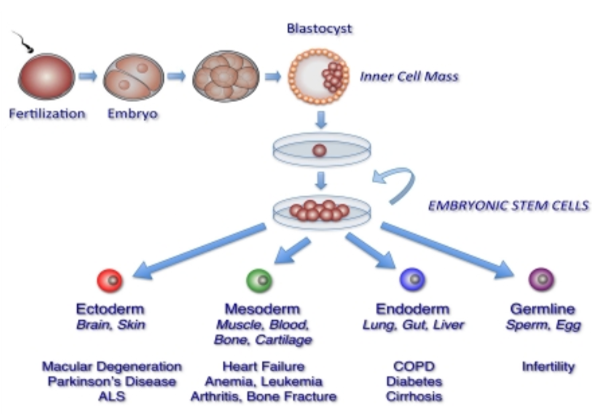
The central advantage of ESCs is their combination of pluripotency and very extensive self-renewal in suitable culture conditions. Researchers can expand a well-characterized ESC line, freeze samples, and share it across laboratories. That makes ESCs valuable for reproducible developmental research and for producing large numbers of cells for experiments.
Types of stem cells and their uses | EuroGCT
Read EuroGCT’s “Types of Stem Cells and Their Uses” to connect origin, potency, long-term culture, applications, and practical limits across all three categories.
Begin in the section “Embryonic stem cells.” Read the ESC definition and origin, noting the blastocyst stage and the meaning of pluripotency. Continue from “Not every experiment using ESCs requires a new blastocyst” through ESC culture, research uses, and limitations. Then read the full “Induced Pluripotent Stem Cells (iPSCs)” section, especially the reprogramming and patient-specificity discussion. Finish with “Tissue-specific (adults) stem cells,” reading the explanation of restricted adult stem-cell potency and its germline example.
ESC applications and limits
ESCs can be used to:
- investigate how tissues develop;
- model disease in cells grown in the laboratory;
- test whether a candidate drug helps or harms a particular cell type;
- create specialized cells that might eventually be used in cell-replacement therapies.
Their main limitations are not just ethical. It is also difficult to make pluripotent cells differentiate completely, consistently, and safely into the intended cell type. A transplant preparation contaminated with undifferentiated pluripotent cells can form unwanted tissue growths. In addition, an ESC line generally comes from someone other than the patient, so immune compatibility can be an issue in transplantation.
Ethical concerns arise because deriving a new ESC line involves the use of a human blastocyst. This issue is distinct from the scientific question of whether an already established cell line can be maintained and studied.
Induced pluripotent stem cells: a differentiated cell reset to pluripotency
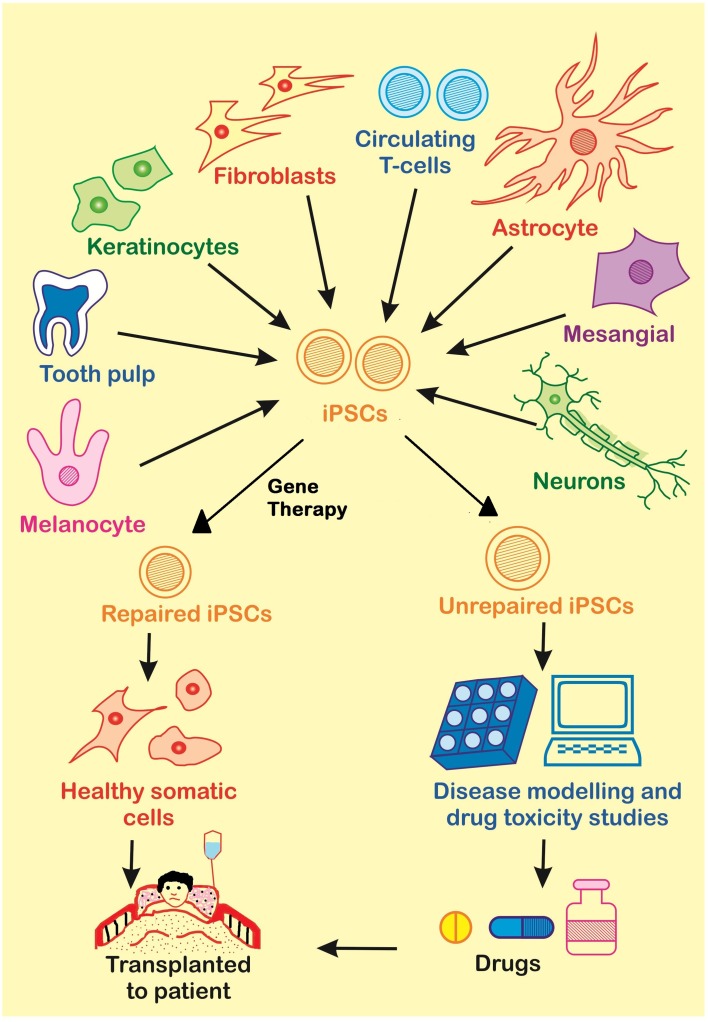
An iPSC begins as a specialized somatic cell, such as a skin fibroblast or blood cell. In the laboratory, scientists expose the cell to reprogramming factors that reset its gene-expression program toward a pluripotent state. The resulting iPSC resembles an ESC in its capacity for self-renewal and broad differentiation, but it has a radically different origin.
The phrase induced pluripotent captures the distinction:
- Induced means the state is produced experimentally.
- Pluripotent means the reprogrammed cells can, in principle, produce derivatives of the body’s major tissue lineages.
The most important practical attraction is that iPSCs can be made from a particular patient. This enables a laboratory model that carries that person’s disease-associated genetic background. Researchers can turn patient-derived iPSCs into relevant cells, or small tissue models called organoids, then study disease mechanisms or test drugs.
A patient’s own iPSCs may also reduce the risk of immune rejection after transplantation. But “patient-derived” does not mean automatically safe, cheap, or ready for treatment. The cells must be reprogrammed, expanded, checked for abnormalities, differentiated into the right mature cells, purified, and tested.
Stem Cell Basics | STEM Cell Information
Use the NIH Stem Cell Information overview to sharpen the distinction between origin, self-renewal, potency, and realistic research applications.
In Section I, read the origin comparison between inner-cell-mass-derived ESCs and reprogrammed iPSCs. In Section II, read the self renewal explanation; pay attention to the different possible outcomes of one stem-cell division. Then read the potency and differentiation discussion, including the role of surrounding signals. Finally, in the applications material, read disease modeling and tissue engineering, distinguishing established research uses from future therapeutic possibilities.
Why iPSCs do not simply replace ESCs
iPSCs avoid the need to derive cells from a blastocyst, but they have their own limitations:
- Reprogramming can be incomplete or variable. Some cells may retain molecular features of their tissue of origin.
- Genetic and epigenetic quality must be checked. Cell culture and reprogramming can select for abnormal cells.
- Tumor risk remains relevant. Like ESCs, iPSCs are pluripotent and divide extensively; residual undifferentiated cells are unsafe in a transplant.
- Manufacturing is demanding. A personalized cell product requires time, quality control, and substantial resources.
Thus, the appropriate comparison is not “ESCs are unethical, iPSCs are therefore ideal.” It is that the two are pluripotent platforms with different sources, ethical profiles, technical risks, and strengths.
Germline stem cells: lineage maintenance rather than broad tissue production
Germline stem cells are stem cells committed to the reproductive lineage. Their role is to maintain the supply of gametes:
- Spermatogonial stem cells in testes self-renew and give rise to sperm over a male’s reproductive life.
- Stem-cell-like populations proposed in ovaries have been investigated in fertility research, but the existence and normal role of functional ovarian germline stem cells in adult humans remain scientifically debated.
For the purpose of a basic comparison, germline stem cells are considered unipotent: they self-renew but are restricted to the sperm or egg lineage. This contrasts strongly with ESCs and iPSCs, which are pluripotent.
Their normal behavior also depends heavily on a stem-cell niche: the local tissue environment that supplies physical contacts, signaling molecules, nutrients, and regulatory cues. Removing or culturing germline stem cells outside that niche can alter their survival and behavior. This dependence will matter in the next lesson.
Potential uses of germline stem-cell research include understanding infertility, preserving fertility before treatments that damage reproductive tissue, and investigating ways to restore gamete production. These are scientifically and clinically more constrained than broad pluripotent-cell applications. Germline interventions also deserve special caution because changes affecting gametes could be inherited by future generations.
Exam-ready comparison table
Use the table below as a model. In an exam, the strongest answers make each row internally consistent: the origin explains the potency, which helps explain both the application and the limitation.
| Feature | Embryonic stem cells (ESCs) | Induced pluripotent stem cells (iPSCs) | Germline stem cells (GSCs) |
|---|---|---|---|
| Origin | Derived from the inner cell mass of a preimplantation blastocyst | Specialized somatic cells, such as skin or blood cells, experimentally reprogrammed to a stem-cell-like state | Reproductive lineage, classically spermatogonial stem cells in testes; ovarian GSC claims require careful interpretation |
| Potency | Pluripotent | Pluripotent | Usually unipotent |
| Self-renewal | Extensive; can be maintained for long periods in appropriate laboratory culture | Extensive after successful reprogramming; can be expanded in culture under appropriate conditions | Self-renew in their normal reproductive niche to sustain the germline, but are more difficult and restricted to culture |
| Differentiation potential | Can generate derivatives of all major body cell lineages, including ectoderm, mesoderm, and endoderm | Broadly ESC-like potential to generate major body cell lineages, subject to successful differentiation protocols | Generates gametes within its lineage: sperm for established male GSCs; egg-lineage claims in adult ovaries remain more uncertain |
| Major applications | Developmental biology, disease modeling, drug testing, generation of specialized cells for regenerative-medicine research | Patient-specific disease models, drug testing, organoids, gene-correction research, and potential personalized cell therapy | Infertility research, fertility preservation, study of gamete development, and possible future reproductive therapies |
| Principal limitations | Ethical concerns regarding blastocyst source; immune mismatch in non-patient-specific use; ensuring controlled differentiation and avoiding tumor formation | Reprogramming variability; possible genetic or epigenetic abnormalities; tumor risk; costly and complex quality control | Very limited differentiation range; rarity and niche dependence; challenging culture; major ethical and safety implications for heritable changes; uncertainty around adult human ovarian GSCs |
A concise way to memorize the three rows is:
- ESC: embryo-derived, pluripotent, powerful but ethically and immunologically complicated.
- iPSC: reprogrammed somatic cell, pluripotent, patient-specific in principle but technically demanding.
- GSC: reproductive-tissue stem cell, self-renewing but lineage-restricted, relevant to gametes and fertility rather than general tissue replacement.
How to build the table rather than memorize isolated facts
When revising, reconstruct the comparison in three passes.
First, write the source of each cell type: blastocyst, reprogrammed body cell, or reproductive lineage. Second, assign potency: ESC and iPSC are pluripotent; GSC is unipotent. Third, derive the rest logically:
- Pluripotency supports broad disease modeling and tissue-generation research, but requires stringent control of differentiation.
- Patient-derived iPSCs support personalized modeling and may improve immune matching, but reprogramming introduces quality-control burdens.
- Germline restriction limits use for general regenerative medicine, yet makes GSCs directly relevant to sperm, eggs, and fertility.
This reasoning approach is more robust than trying to remember six unrelated facts per cell type.
The central distinction is now clear: ESCs and iPSCs are pluripotent platforms with different origins, whereas germline stem cells are self-renewing but normally restricted to the reproductive lineage. Across all three, self-renewal does not guarantee unlimited or safe therapeutic use; the cells’ source, potency, culture behavior, and biological context determine their realistic applications and risks.
Next, we will use this table in a simplified fertility-regeneration scenario. The focus will shift from classification to reasoning about the germline stem-cell niche, ovarian function, targeted genome manipulation, feasibility, and biological risk.
Can't find a good explanation? Sign up and we'll make it for you
Sign up