
Hello! Welcome to the final lesson in our module on Auditing and Optimizing Solana Programs.
In our last session, we focused on identifying and refactoring specific high-cost operations like logging, PDA derivation, and the default Borsh deserialization. You learned how to use zero-copy as a powerful tool to reduce the overhead of reading account data.
Today, we'll elevate that thinking. Instead of just tweaking operations, we will focus on the foundational elements that dictate performance: the data itself. The learning outcome for this lesson is to optimize a program's compute usage by refining data structures and serialization methods. We will explore how thoughtful design of your account structs and serialization logic can lead to significant performance gains, making your programs cheaper for users and more resilient to network congestion.
The Philosophy of Data-Centric Optimization
On Solana, every byte and every CPU cycle counts. The fees users pay are directly tied to the compute units (CUs) your program consumes. In the last lesson, we were like mechanics tuning an engine; today, we're the engineers designing the engine block itself for maximum efficiency.
Why is this so important? As a quick reminder, compute usage isn't just an abstract number. It's a core part of the transaction fee structure.
Everything you need to know about Solana transactions!
To reinforce the connection between compute and cost, let's watch a short segment from the video 'Everything you need to know about Solana transactions!'.
Watch the section on transaction fees from 06:44 to 07:47. Note the 'dynamic compute fee' which depends on how much computation you're doing. Then, jump to the clip from 13:45 to 14:01, which explicitly states that exceeding the compute unit limit is a reason for transaction failure.
This establishes our goal: by refining our data structures and serialization, we can directly reduce the dynamic compute fee and lower the risk of transaction failure, creating a better experience for our users.
1. Refining Data Structures: Designing for Efficiency
In the previous lesson, you saw how using smaller data types (e.g., u8 vs. u64) reduces CU cost. Now, let's think about the structure of the account itself. The key is to design data structures that are not only compact but also have a predictable, machine-friendly memory layout.
Zero-Copy as a Design Constraint
We previously introduced zero-copy as a way to avoid the expensive copy step inherent in Borsh deserialization. But zero-copy is more than just a drop-in replacement; it's a design philosophy that forces you to think about memory layout.
To use #[account(zero_copy)], a struct must have a known, fixed size and memory representation. This is why Anchor applies #[repr(C)] under the hood, ensuring the struct layout in Rust matches a standard C struct layout. This has a critical implication: you cannot use dynamically-sized types like Vec<T> or String in a zero-copy account.
Let's explore this limitation and its benefits.
The article 'Optimizing Solana Programs' from Helius discusses the trade-offs of zero-copy. Understanding these is key to refining your data structures.
Please read the subsection 'Trade-offs and Considerations' within the 'Zero-Copy Deserialization' section. Focus on the point about compatibility and which data structures are unsuitable for zero-copy.
This constraint forces you to use fixed-size arrays (e.g., [u8; 64] for a name) instead of a String. While this feels restrictive compared to typical web development, it yields tremendous performance benefits:
- No (De)Serialization Overhead: The program can read/write fields by calculating a simple memory offset, which is extremely fast.
- Predictable Sizing: The space required for the account is known at compile time, simplifying rent calculations and memory management.
Your background in electronics provides a great parallel here. Think of a zero-copy struct like a hardware register map. Each field has a fixed offset and a fixed size. Accessing a field is as direct and efficient as flipping a specific set of bits in a register, whereas using Borsh with a Vec is like asking a memory management unit to find and allocate a new block of memory, copy data into it, and then give you a pointer. The former is orders of magnitude more efficient.
Refinement Strategy:
- Default to fixed-size types: When designing account structs, challenge every use of a dynamic type. Can that
Stringbe a[u8; 32]? Can thatVec<Pubkey>be an array[Pubkey; 10]if you know the maximum number of keys? - Embrace
zero-copy: Start your design process with the assumption that your accounts will bezero-copy. This will guide you toward more efficient data layouts from the beginning.
2. Refining Serialization Methods: Custom Implementations
Zero-copy is a huge step forward, but what if you need to squeeze out even more performance? The next level of optimization is to write your own custom serialization and deserialization logic. This means moving away from Anchor's abstractions and closer to Native Solana programming.
Why Write Custom Logic?
Anchor's default Borsh serialization is a general-purpose tool. It's designed to handle a wide variety of data structures safely. This generality comes with some overhead. By writing your own logic, you can create a highly specialized routine that does only what is absolutely necessary for your specific data structure.
This moves us further down the optimization path we saw in the last lesson.
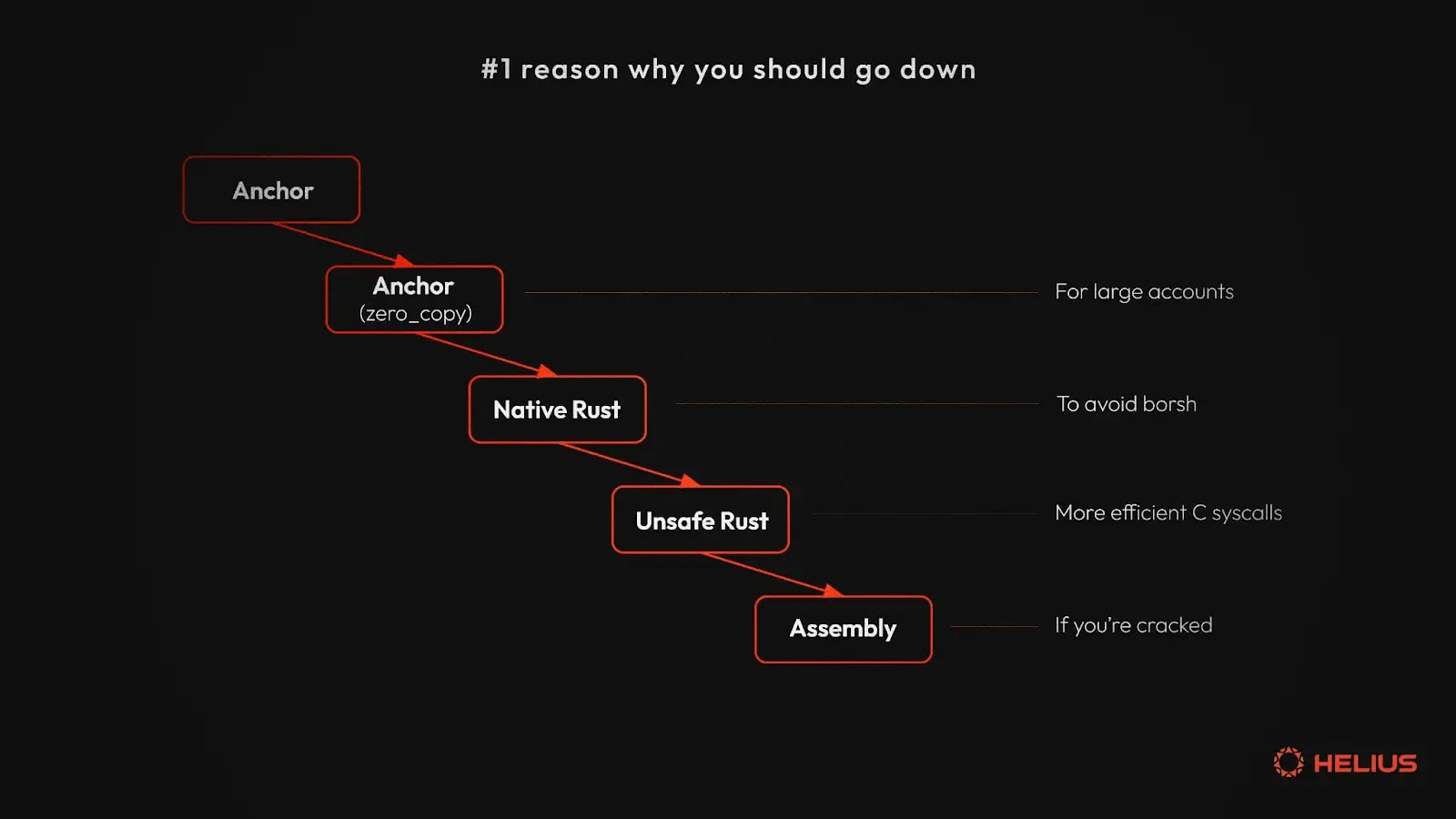
Let's examine what this custom logic looks like in practice.
The Helius article 'Optimizing Solana Programs' demonstrates this perfectly. It implements a native Rust counter program with its own serialization methods, bypassing Borsh entirely.
Please read the subsection '3. Custom Serialization' within the 'Using Native Rust' section. Study the impl Counter block carefully. Notice how simple it is: it just copies bytes directly to and from the data slice using .to_le_bytes() and u64::from_le_bytes().
The core of the custom implementation you just reviewed is:
// Custom Serialization
fn serialize(&self, data: &mut [u8]) -> ProgramResult {
    // ... size check ...
    data[..8].copy_from_slice(&self.count.to_le_bytes()); // u64 is 8 bytes
    Ok(())
}

// Custom Deserialization
fn deserialize(data: &[u8]) -> Result<Self, ProgramError> {
    // ... size check ...
    let count = u64::from_le_bytes(data[..8].try_into().unwrap());
    Ok(Self { count })
}
This code is hyper-specific to the Counter struct. It knows the count is a u64 and is located in the first 8 bytes. It doesn't need to handle enums, strings, vectors, or any other complex types, so it avoids all the logic that a generic library like Borsh would include. The result is a smaller, faster program.
Test your understanding!
You've used zero-copy for a complex account, but your measurements show that even with zero-copy, the instruction that initializes it is still too expensive. You suspect that the overhead of the AccountLoader and its safety checks might be the cause.
When would it be appropriate to consider moving from Anchor's #[account(zero_copy)] to a fully custom serialization/deserialization implementation in native Rust? What are the main trade-offs?
Show answer
It's appropriate to consider a custom implementation when:
- You have measured: You have concrete data showing that (de)serialization is still a significant bottleneck even with
zero-copy. Optimization without measurement is premature. - You need absolute minimum CU: Your program is part of a high-frequency trading bot, an arbitrage strategy, or another application where every microsecond and compute unit counts.
- You are hitting instruction limits: Your logic is complex, and you need to free up every possible CU to avoid exceeding the 200k CU limit per instruction.
Main Trade-offs:
- Pro: Maximum performance and minimum compute usage. You have full control.
- Con (major): You lose Anchor's safety guarantees. You are now responsible for manually handling security checks (signer, mutability, ownership, etc.), which Anchor does automatically. This dramatically increases complexity and the risk of introducing security vulnerabilities. It's a significant engineering effort.
The Proof: Real-World Impact
These optimization techniques are not just theoretical. They are used in production to build highly efficient protocols. A prime example is the difference between the standard SPL Token program and optimized alternatives.
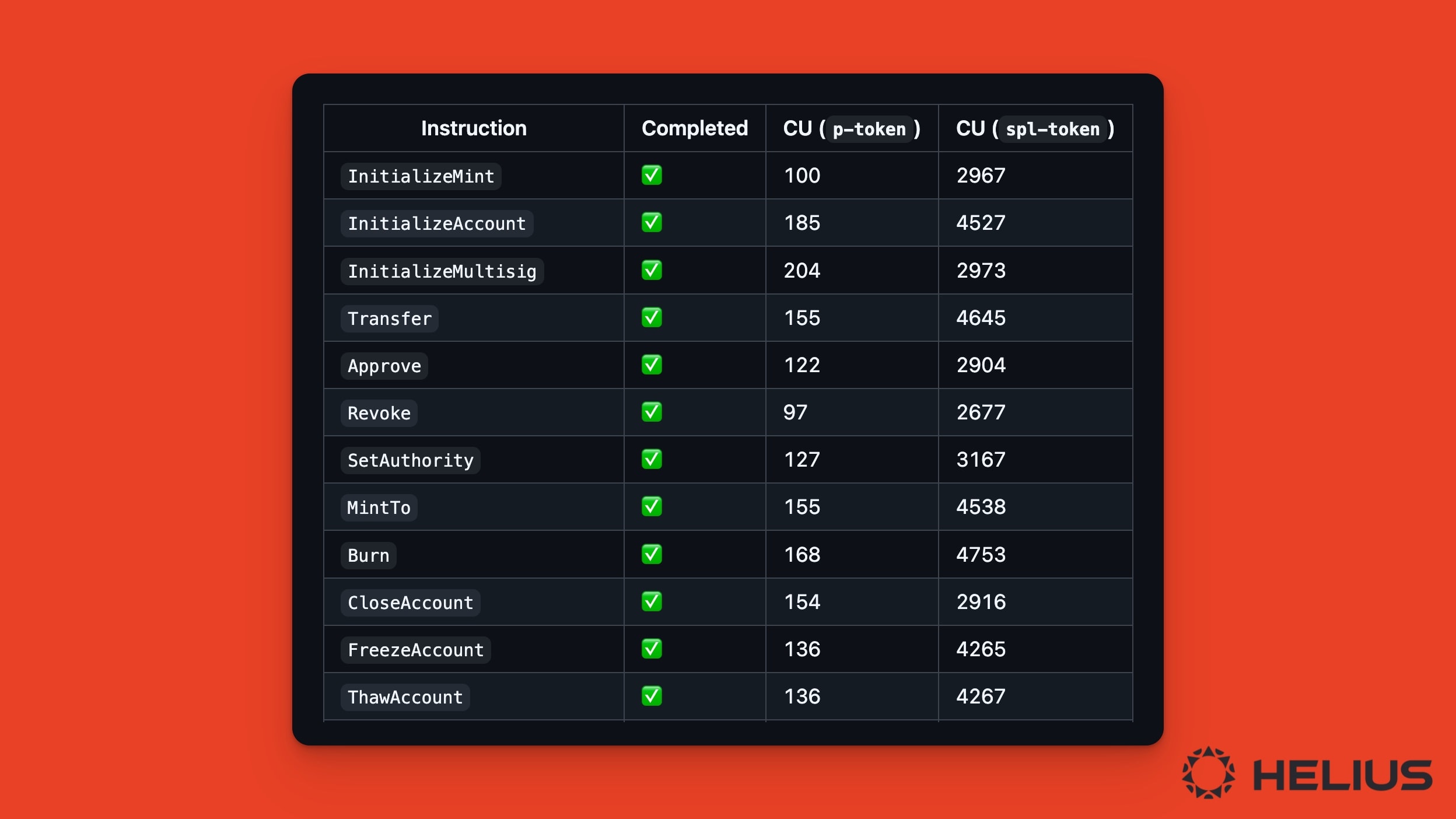
Look at the Transfer instruction. The optimized version uses ~5,000 CU, while the standard one uses over 11,000 CU. This massive difference is achieved precisely through the methods we've discussed:
- Highly refined, compact data structures.
- Optimized serialization logic that minimizes overhead.
This demonstrates that the architectural choices you make about your data can have a greater impact on performance than micro-optimizing the logic itself.
Conclusion
In this lesson, we completed our journey into Solana program optimization by focusing on the core building blocks of your program: its data. You've learned that performance isn't just about fast algorithms; it's about efficient data representation.
Key Takeaways:
- Design for Efficiency: The structure of your on-chain accounts is a primary driver of compute usage.
- Use Zero-Copy as a Constraint: Embrace the limitations of
zero-copy(no dynamic types) to guide you toward fixed-size, predictable, and highly performant data layouts. - Implement Custom Serialization for Peak Performance: For the most demanding applications, bypassing framework abstractions like Borsh and writing your own serialization logic offers the ultimate level of control and efficiency.
- Data Refinement Has Real-World Impact: As shown by optimized token programs, these techniques can cut compute usage by more than 50%, leading to cheaper transactions and a better user experience.
Preview of the Next Module
This concludes our module on Auditing and Optimizing Solana Programs. You are now equipped with the knowledge to measure, analyze, and improve the on-chain performance of your code.
In our next module, Client-Side Development with @solana/web3.js, we will switch gears. We'll move from the on-chain world of Rust programs to the off-chain world of frontend applications. You'll learn how to use your extensive web development experience to build interfaces that connect to the Solana network, fetch account data, and construct and send transactions to the programs we've been learning to build.
Can't find a good explanation? Sign up and we'll make it for you
Sign up