
Welcome back. In the previous lesson, you used a causal diagram to distinguish a protocol’s service from its risks, dependencies, and loss bearers. We now apply that same discipline to Exponent—not as a lending pool or a yield vault, but as market infrastructure for trading future yield on Solana.
This lesson explains the central institutional proposition: Exponent connects the providers of yield-bearing assets with investors who want to take or hedge interest-rate exposure, and with liquidity providers who make those rate trades executable. By the end, you should be able to describe where the underlying yield comes from, what Exponent itself contributes, and why all three participant groups are needed for a functioning market.
The core idea: Exponent turns variable yield into tradable rate exposure
A yield-bearing asset produces an uncertain stream of future returns. For example, a liquid staking token may earn staking rewards, while a lending receipt asset may earn borrower interest. The precise return can change over time as validator performance, borrowing utilization, incentive programs, or market conditions change.
That variability is useful to some investors and undesirable to others:
- A treasury may prefer a known yield over a defined period rather than fluctuating staking returns.
- A yield-focused trader may want concentrated exposure to whether future yield exceeds market expectations.
- A market maker may see an opportunity to quote both sides of that rate market and earn trading fees while actively managing inventory.
- An asset issuer may want its yield-bearing asset to have an additional distribution and liquidity channel.
Exponent is the infrastructure that makes these objectives meet in a common market.
Read Exponent’s primary explanation of yield markets to establish the instruments and rate exposures before considering the participant ecosystem.
In the “How It Works” and “Key Concepts” sections, begin with the market overview. Then read the explanation beginning the PT and YT split. Focus on the difference between a variable underlying yield, a fixed maturity, and the market-implied rate used to price each side.
The key transformation is yield stripping. For a specified maturity, a yield-bearing asset is represented through two distinct claims:
- A Principal Token (PT) represents the right to redeem one unit of the underlying asset at maturity. Buying it below par embeds a fixed return in units of that underlying asset.
- A Yield Token (YT) represents the yield generated by the associated underlying exposure until maturity.
Conceptually:
This identity is the economic foundation of the exchange. The two claims together represent the underlying asset; separating them lets the market price principal and future yield independently.
For an institutional conversation, be precise about what “fixed” means. A PT holder can lock a return in units of the referenced underlying asset if the token is held to maturity. That is not automatically the same as a fixed dollar return. If the underlying asset is an LST, for example, the investor still has exposure to the value and operational risks of that LST unless it is separately hedged or converted.
Three participant groups, one rate market
Exponent’s role becomes clearer when we distinguish the three essential groups rather than referring vaguely to “users.”
| Participant | Primary objective | What it contributes | What it receives |
|---|---|---|---|
| Yield issuer / asset issuer | Extend the utility and distribution of a yield-bearing asset | A yield source that can be integrated into a market | Rate-market access and a potential liquidity/distribution channel for its asset |
| Rate taker | Lock, hedge, acquire, or trade yield exposure | Capital and a view on future rates or yield | PT or YT exposure at a market-implied rate |
| Liquidity provider / market maker | Make execution available and monetize market making | Tradable liquidity and two-sided quotes | Trading fees, subject to inventory and active-management risks |
| Exponent | Provide issuance, settlement, and trading infrastructure | The contracts and venues that create and exchange rate instruments | Protocol-level role in enabling the market, rather than originating the underlying yield |
1. Yield issuers provide the source of yield
A yield issuer in this context is the protocol or asset provider behind a yield-bearing asset. It might be a liquid staking provider, a lending protocol, a stablecoin strategy, or a tokenized real-world-asset product.
This role is not necessarily equivalent to a legal issuer of a traditional security. The practical question is: which protocol or asset produces the underlying cash-flow-like yield that the market will separate and trade?
For instance, if a liquid staking token is integrated:
- the liquid staking system remains responsible for producing its underlying staking yield;
- Exponent does not create those staking rewards;
- Exponent creates infrastructure through which market participants can separate and trade the principal and future-yield components of that asset.
That distinction prevents a common diligence error. A high implied rate in an Exponent market is not a promise by Exponent that the underlying source will deliver that yield. It is a market price for exposure to future yield over a defined remaining term.
2. Rate takers express a view or change a portfolio’s exposure
A rate taker accepts the rate currently offered by the market—or places an order at a specified rate—to obtain a desired exposure. “Taker” here does not only mean someone submitting a market order. More broadly, it means someone choosing a side of the interest-rate market rather than continuously supplying two-sided liquidity.
There are two principal expressions:
- A buyer of PT gives up the uncertain future yield from the underlying in exchange for a known maturity payoff in underlying units. Economically, this is similar to converting a floating-rate exposure into a fixed-rate exposure for the remaining term.
- A buyer of YT pays an upfront price for the future variable yield. The position benefits if realized yield and applicable incentives exceed the market-implied yield paid at entry.
The implied APY is therefore not simply the current displayed APY of the underlying asset. It is the rate embedded in the market price of the PT/YT pair for the time remaining to maturity. It reflects the market’s collective expectations, demand for fixed yield, demand for variable yield, liquidity conditions, and risk premium.
A useful short formulation is:
The underlying APY describes what the asset is currently generating; the implied APY is the rate at which the market is willing to exchange future variable yield for principal exposure today.
The following short video uses Pendle, another fixed-maturity yield protocol, to reinforce this general PT/YT vocabulary. Its interface and execution design should not be treated as evidence about Exponent; use it only for the transferable instrument intuition.
Chapter 3: What is Yield Token (YT)
Watch “Chapter 3: What is Yield Token (YT)” from Pendle for a concise visual explanation of a YT’s claim on future yield and the distinction between underlying and implied APY.
Watch the YT definition to see how a YT isolates the yield generated by a base asset. Continue with the rate distinction, focusing on why a current underlying APY and a market-implied APY answer different questions.
3. Liquidity providers make a rate market usable
PT and YT may be economically coherent without being practically tradable. An allocator who wants to purchase a large PT position needs an executable quote. A YT holder who wants to reduce exposure before maturity needs a realistic exit route. This is the role of liquidity providers and professional market makers.
They supply capital to the exchange layer, make markets in PT/YT exposure, and earn trading fees when users swap. In exchange, they accept active risk:
- inventory can become concentrated in PT or YT as other participants trade;
- implied-rate movements change the value of that inventory;
- thin liquidity can make rebalancing costly;
- liquidity may need to be actively placed or repositioned around the rate levels at which trading occurs.
So an LP is not merely a passive depositor collecting a stated yield. In a rate market, the LP helps absorb differences in timing and opinion between PT buyers, YT buyers, and sellers of either instrument.
Exponent’s architecture: issuance, exchange, and managed products
Exponent’s documentation describes three layers. For the current objective, the first two establish its role as a yield exchange; the third shows how that infrastructure can later be packaged into managed strategies.
Read Exponent’s architecture overview to connect the asset issuer, rate traders, and liquidity providers to specific protocol layers.
In “Protocol Architecture,” read the three-layer architecture. Then move to the “Flow Example” and follow steps 1 through 4, from asset integration through market making. Notice that the underlying asset enters at the issuance layer, while traders and liquidity providers meet at the exchange layer.
The issuance layer: Exponent Core
The issuance layer is where a supported yield-bearing asset is stripped into PT and YT for a defined maturity. This layer handles the lifecycle of those claims: minting, redemption, merging, and yield distribution.
Its economic function is to turn a yield-bearing asset into standardized maturity-specific instruments. Without that standardization, there is no clean object for an exchange to list or a market maker to quote.
The exchange layer: Rate CLMM and Rate Order Book
The exchange layer brings rate takers and liquidity providers together. Exponent provides two purpose-built execution paths:
- Rate CLMM, a concentrated-liquidity market maker designed for rate instruments;
- Rate Order Book, an on-chain venue for precise rate quoting and larger trades in suitable markets.
The essential point is that Exponent organizes liquidity around implied-rate exposure, not only around ordinary token spot-price exposure. A user is not simply deciding whether SOL will rise or fall. They are choosing whether to own principal or future yield at a quoted implied APY for a particular maturity.
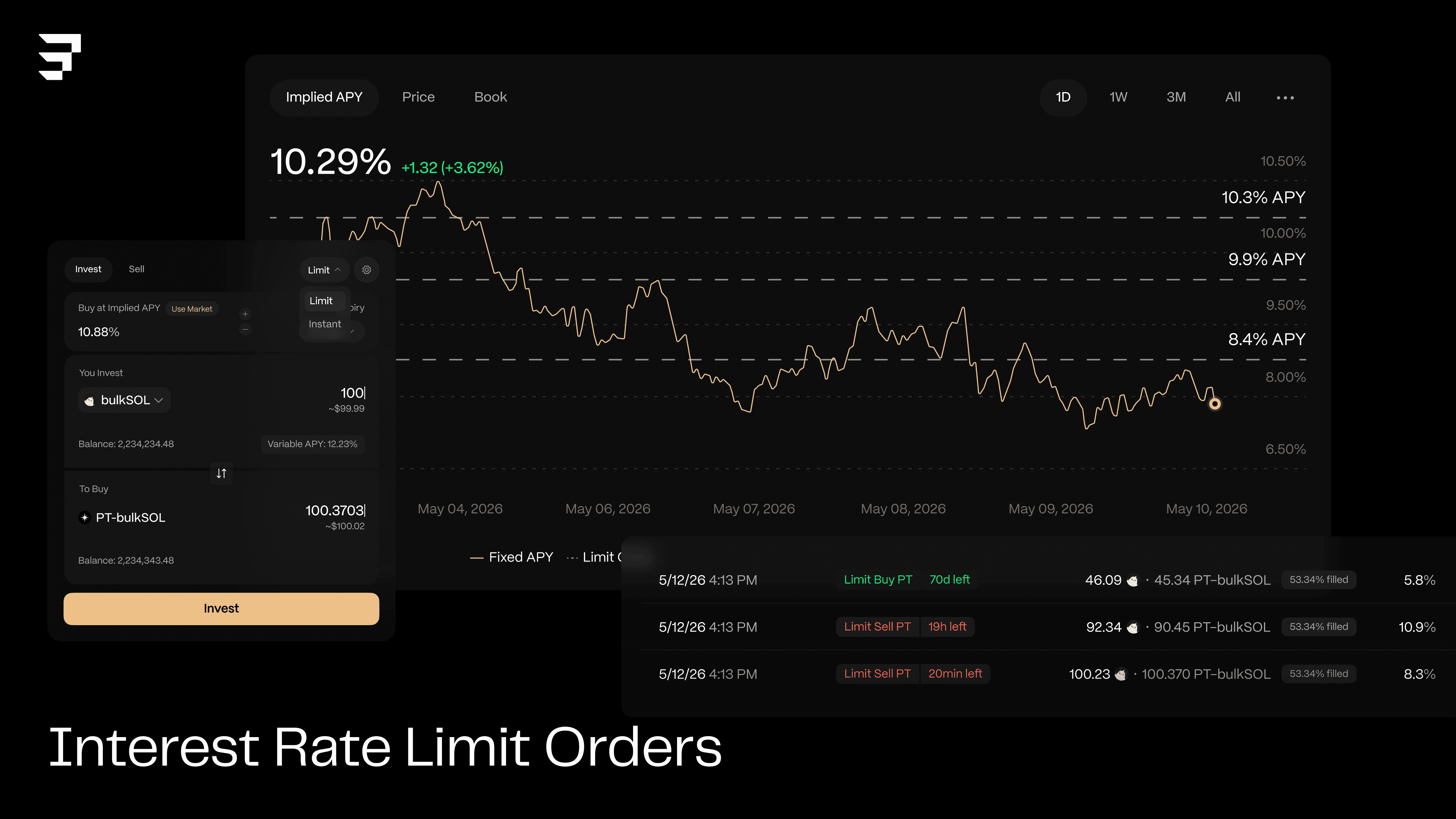
The order-book route is particularly relevant when a participant values rate precision. A limit order may not fill, but it allows the investor or market maker to state a desired implied-rate level. By contrast, an instant order prioritizes immediate execution against available liquidity and can face price impact when liquidity is limited.
The managed-product layer: Strategy Vaults
Strategy Vaults sit on top of the issuance and exchange layers. They allow professional managers to use Exponent’s rate instruments within on-chain policy constraints. This layer can make the underlying infrastructure more accessible to participants that prefer a managed mandate rather than direct PT, YT, or liquidity-provider positions.
For now, treat vaults as users of Exponent’s market infrastructure, not as a replacement for it. Their return and risk profile depends on the strategy they deploy, the instruments they hold, their fees, and their policy constraints.
How the three sides connect in practice
Consider a simplified market based on a yield-bearing Solana asset, such as an LST. The following sequence describes the economic system without assuming that every participant takes every action directly.
-
A yield-bearing asset is integrated.
The asset issuer or associated protocol supplies the base yield source. That yield might come from staking, lending, stablecoin activity, credit, or an RWA structure. -
Exponent creates a maturity-specific PT/YT market.
At the issuance layer, the asset can be represented as principal exposure and future-yield exposure for a defined maturity date. -
Liquidity providers make the instruments tradable.
LPs or market makers allocate capital to provide executable PT/YT liquidity, either through concentrated liquidity or quoted orders. -
Rate takers choose an exposure.
A PT buyer seeks a fixed return in underlying units through maturity. A YT buyer seeks the future variable yield and may believe realized yield will exceed the implied rate. Other participants may sell or rebalance either side. -
Prices create rate discovery.
Trading pressure changes PT and YT prices. Because their combined value represents the underlying asset, a change in one side has an inverse relationship with the other. The resulting implied rate becomes a visible market signal of how participants value future yield. -
At maturity, the claims resolve against the underlying asset.
The PT and YT are no longer claims on an open future-yield period. PT redemption and YT yield collection complete the maturity cycle according to the market’s rules.
This system is a marketplace, not a bilateral loan between a known lender and borrower. The economic counterpart to a PT buyer’s desire for certainty is the willingness of others to hold, trade, or intermediate future yield exposure. That counterpart may be a direct YT buyer, an LP temporarily holding inventory, or a participant using stripping and merging mechanics to arbitrage relative prices.
Why liquidity is not a supporting detail
A rate market is only institutionally useful if a position can be entered and exited with acceptable certainty, size, and price impact.
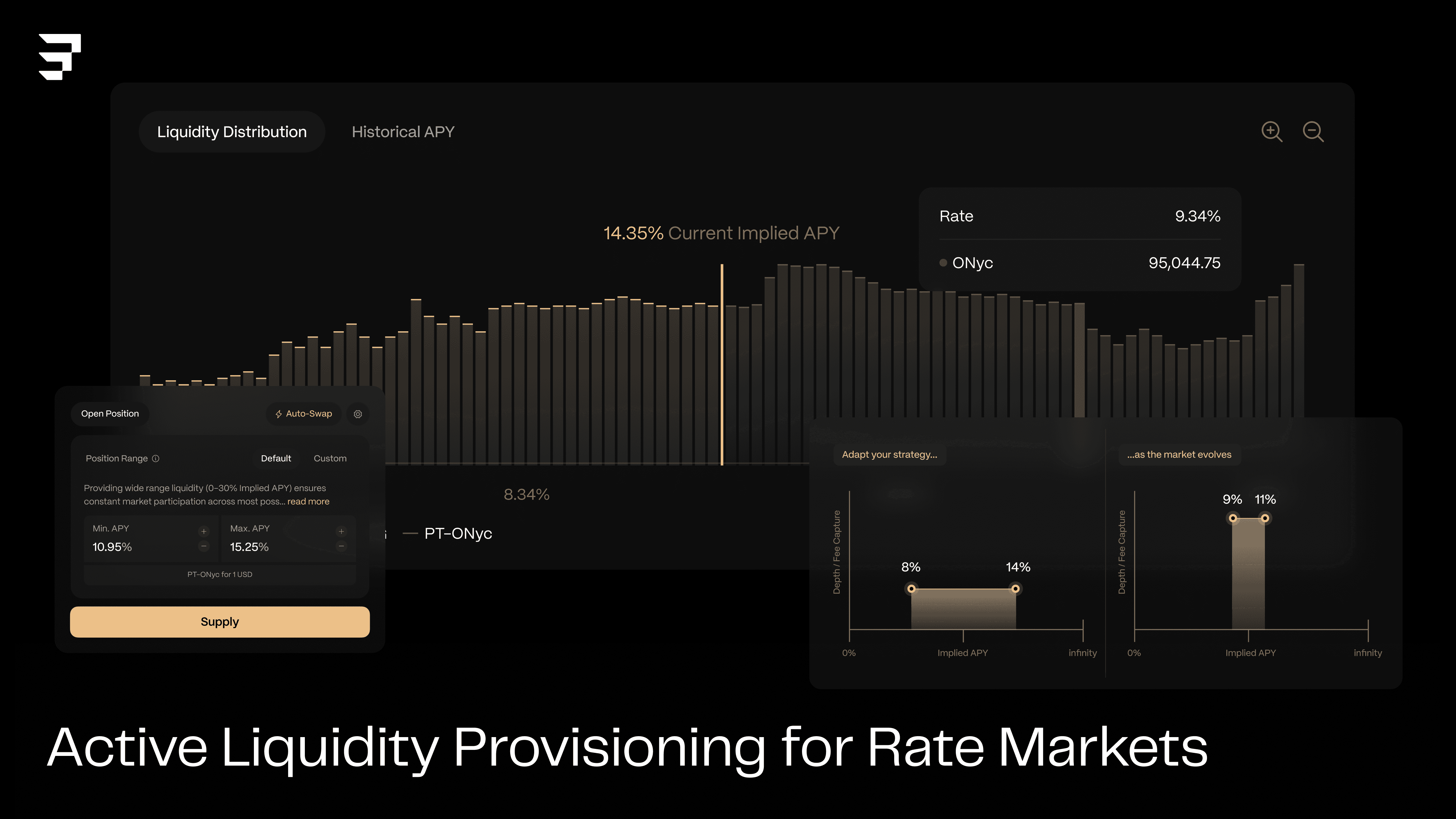
The active-liquidity interface below makes the design intent visible: liquidity can be positioned across a selected implied-APY range. It is therefore an active market-making decision about where rates may trade.
This creates a three-way dependency:
| If this participant is missing or weak… | What deteriorates |
|---|---|
| Yield issuers and viable underlying assets | There is little credible yield exposure to list and trade. |
| Rate takers with genuine hedging, income, or yield views | There is insufficient demand for PT/YT positions and weak rate discovery. |
| Liquidity providers and market makers | Spreads widen, price impact rises, and institutions may be unable to execute or exit at scale. |
For institutional sales, this leads to a more accurate claim than “Exponent offers yield.” A stronger statement is:
Exponent provides rate-market infrastructure for yield-bearing Solana assets: issuers can bring yield sources to market, allocators can choose fixed-principal or variable-yield exposure for defined maturities, and liquidity providers can make those exposures executable.
That sentence also identifies the operational challenge. The exchange’s utility depends not solely on the attractiveness of the underlying yield, but on the depth, quality, and resilience of liquidity in each maturity market.
What Exponent is—and is not
The institutional framing becomes clearer through boundaries.
| Exponent is | Exponent is not |
|---|---|
| A Solana-based infrastructure layer for fixed-maturity yield markets | The source of the underlying staking, lending, credit, or RWA yield |
| A venue for exchanging PT and YT rate exposure | A blanket guarantee that a displayed implied APY will be realized |
| A mechanism for market-driven implied-rate discovery | Merely a passive yield aggregator |
| An exchange layer supported by CLMM liquidity and an order book | A conventional pooled lending market where depositors fund borrowers directly |
| Infrastructure that can support managed strategies through Strategy Vaults | A substitute for diligence on the issuer, underlying asset, liquidity, or protocol controls |
This does not mean Exponent is free of protocol or market risk. It means risk must be assigned to the correct layer:
- Underlying-yield risk belongs primarily to the underlying asset and its issuer or protocol.
- Rate risk is taken by PT and YT holders, especially if they trade before maturity.
- Liquidity and inventory risk is materially borne by LPs and market makers.
- Issuance, settlement, and exchange-infrastructure risk relates to Exponent’s own contracts, controls, and operations.
The later risk and diligence modules will turn these labels into a concrete diligence process. For now, the important discipline is not to blur “yield source,” “traded yield claim,” and “execution liquidity” into one undifferentiated product.
Key takeaways
Exponent’s role is to make future yield from Solana yield-bearing assets separable, tradable, and priceable over defined maturities.
- Yield issuers provide the underlying asset and its native source of yield; Exponent does not manufacture that yield.
- Rate takers use PT or YT to lock a fixed return in underlying units, hedge variable yield, or seek exposure to yield that exceeds the implied rate.
- Liquidity providers and market makers supply executable PT/YT liquidity, earn trading fees, and take active inventory and rate-management risk.
- Exponent Core creates and settles the maturity-specific claims; the Rate CLMM and Rate Order Book provide the exchange layer where those claims trade.
- The implied rate is a market price for future yield exposure, not a guaranteed forecast of what the underlying asset will earn.
- Institutional usefulness depends on all three sides of the market: credible yield sources, genuine rate demand, and sufficiently deep liquidity.
Next, you will map Exponent’s Yield Markets, Rate CLMM, Rate Order Book, Strategy Vaults, and risk-tranching products into one integrated product architecture.
Can't find a good explanation? Sign up and we'll make it for you
Sign up