
Hello. In the previous lesson, you built a sensible self-directed progression system for skills that are already within your physiotherapist’s approved boundaries: change one variable, preserve movement quality, and observe both immediate and next-day response.
This final lesson addresses a different kind of progression. Faster movement, impact, and pivoting are not simply “harder balance exercises.” They change the demands on the knee substantially, often combining load, speed, braking, uncertainty, and rotation. They therefore require a clearance-gated plan: a shared plan in which you, your physiotherapist, and—later, if relevant—your judo coach agree what must be true before each new category of movement is introduced.
The aim is not to create a calendar promising that you will run, pivot, or return to judo by a particular date. It is to create a decision process that helps you arrive there as safely and confidently as your recovery permits.
Why a calendar is not enough
A rehabilitation timeline can be useful for planning appointments and setting expectations, but time alone cannot show whether a knee is ready for a new demand. Two people at the same number of weeks after an injury may differ substantially in swelling, range of motion, strength, balance, walking pattern, confidence, and ability to tolerate training.
For that reason, a good return plan uses criteria, not dates alone. Think of each new activity category as a project stage gate:
- You prepare the necessary capacities.
- A clinician assesses the relevant evidence.
- You receive permission to trial a defined new demand.
- You monitor the response.
- You either consolidate, modify, or return to preparation.
The gate is not a test of toughness. It is a risk-management decision: is the expected benefit of adding this demand greater than the present risk, given the evidence we have?
The “Return to Sport Continuum” below gives a useful broad map. Rehabilitation continues throughout the process; it does not end the first time you attend a class or practise a familiar movement.
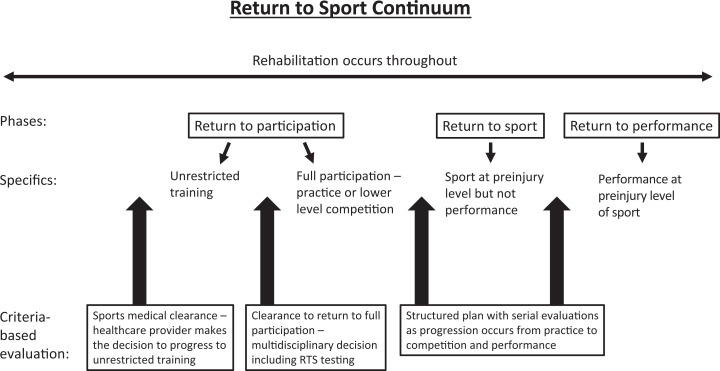
The important distinction is between three outcomes:
- Return to participation: you are physically active and may do modified training, but are not yet ready for the full demands of judo.
- Return to sport: you have resumed judo in some recognisable form, but perhaps with restrictions on pace, partners, throws, falls, or sparring.
- Return to performance: you can participate at the level you personally want, with the control, confidence, and tolerance needed for that level.
For your goal, “return to sport” may initially mean attending a class, practising approved footwork and upper-body technique, and observing or doing selected drills—not immediately resuming free practice.
[PDF] Criteria‑Based Return to Sport Decision‑Making Following Lateral ...
This research article concerns ankle sprain rather than knee injury, so its clinical tests and timelines are not a prescription for you. Its broader framework is valuable: return to sport is a continuum, and decisions should combine physical function, movement quality, sport demands, fatigue, and psychological readiness.
In Section 4.2.2, “Defining the RTS Continuum,” read the three stages. Notice that training at a lower level can be a successful and useful stage without yet being full return to sport. Then, in Section 4.2.3, under “Functional and Sport-Specific Performance Tests,” read the rationale for testing. Focus on the distinction between the result of a task and the strategy used to achieve it. Finally, in the subsection “Psychological and Psychosocial Factors,” read the readiness discussion. Treat confidence neither as proof of physical readiness nor as something to dismiss: it is one part of the decision.
Define the demands before deciding readiness
“Faster movement” is too vague to clear safely. Before you ask for clearance, define the actual movement category. Each has a different combination of load and coordination demands.
| Movement category | What changes | Why it needs separate clearance |
|---|---|---|
| Faster controlled stepping | Foot placement and weight transfer occur more quickly, while direction remains planned. | Less time is available to correct alignment or balance. |
| Acceleration and deceleration | You must build speed and then absorb force to stop. | Braking can place high demand on knee control even without a jump. |
| Impact | Walking changes to hopping, jogging, running, jumping, or landing. | The leg must repeatedly absorb forces higher than walking forces. |
| Change of direction | You move from one direction to another, initially with several deliberate steps. | Lateral control and braking demands increase. |
| Pivoting or cutting | The body changes direction around a planted or partly planted foot. | Rotation and side-to-side force combine; this is currently outside your approved practice. |
| Judo-specific interaction | You respond to another person’s grip, motion, resistance, and unpredictability. | Attention is divided, timing is less predictable, and falls or twisting may occur. |
A practical rule is:
Never assume that success in one category clears the next.
For instance, you may be able to walk briskly with good control but not yet be ready for jogging. You may be able to jog in a straight line but not yet be ready to decelerate sharply, turn, or react to a training partner. Each added feature changes the problem your knee and nervous system must solve.
This is particularly relevant for judo. A controlled forward step in a quiet room is a useful foundation. A quick response to a partner pulling or changing direction is a much more complex task: it adds speed, divided attention, external force, and potentially rotation.
What a clearance gate should contain
A useful gate combines four types of evidence. The exact tests and thresholds must come from your clinician and depend on the diagnosis, treatment, and stage of healing.
1. Clinical status
Your clinician determines whether the knee is sufficiently settled for the next demand. Depending on the injury, this may include:
- appropriate range of motion;
- no concerning swelling or joint irritation;
- pain that is absent or within an agreed, acceptable range;
- adequate healing and tissue tolerance;
- no episodes of giving way, locking, catching, or unexpected buckling.
2. Capacity and control
The relevant question is not merely “Can I do it once?” It is whether you can control the building blocks that precede the new demand.
Examples include:
- a symmetrical, comfortable walking pattern;
- clinician-assessed strength and side-to-side capacity;
- controlled single-leg or supported balance where appropriate;
- ability to step, squat, or descend a step with the knee tracking appropriately;
- controlled stopping and weight acceptance;
- sufficient endurance that technique does not rapidly deteriorate.
3. Exposure-specific performance
Before a new activity becomes routine, it should be tested in a simpler and more predictable form.
For example, before unpredictable judo movement, a clinician might first assess how you manage planned, low-speed direction changes. Before a full return to class, you may need to show that you can tolerate selected drills at a defined intensity and volume without an adverse response.
The quality of the movement matters alongside the score. A person can complete a task while holding their breath, stiffening excessively, shifting away from the recovering side, or twisting the foot to avoid loading the knee. Completion alone is not sufficient evidence of readiness.
4. Tolerance and psychological readiness
A new demand is not genuinely tolerated until the response remains acceptable afterward. Monitor:
- symptoms during the session;
- symptoms later that day;
- the next-morning response;
- any swelling, stiffness, or change in walking;
- confidence in the affected leg;
- fear that causes protective, rushed, or avoidant movement.
Confidence should be realistic rather than forced. You do not need to feel fearless before practising a new skill. You do need enough confidence to attend to the task, follow the plan, and stop rather than push through an unsafe situation.
Use protocols as models, not as personal prescriptions
Rehabilitation protocols often list concrete gates such as range of motion, strength symmetry, balance performance, gait quality, and absence of swelling before impact or sport-specific work. This illustrates an important principle: clinicians commonly require evidence of lower-level control before introducing higher-load activity.
However, do not copy thresholds from a protocol written for another injury. The following example is specifically for people recovering from patellar or quadriceps tendon repair. It may not match your diagnosis, surgery status, current programme, or safe timetable.
Rehabilitation Protocol for Patella/Quad Tendon Repairs
Massachusetts General Brigham’s protocol is an example of criteria-based rehabilitation for a specific surgical population. Read it to see how a protocol links new activities to observable prerequisites, not to obtain targets for your own knee.
In Phase III, “Late Post-Op,” locate the “Criteria to Progress” box and read the transition criteria. Notice the mix of strength, balance, walking, and stair control. Then in Phase IV, “Transitional,” read the paragraph beginning the running prerequisites. The key lesson is the structure: verify baseline function, introduce a defined demand, and monitor response. Your physiotherapist should decide which criteria, if any, apply to you.
A protocol’s numerical thresholds are clinical tools, not universal entry tickets. In addition, the unaffected leg is not always a perfect benchmark, especially if both sides are deconditioned or if you had movement limitations before the injury. Your physiotherapist can interpret any comparison in context.
Your clearance-gated progression map
Use the following map as a document to take to your physiotherapist. It is intentionally conservative and does not authorise any movement by itself. “Clearance” means explicit agreement from the clinician managing your rehabilitation.
| Gate | Proposed next category | What you and the clinician agree first | What is trialled after clearance | What allows consolidation |
|---|---|---|---|---|
| 0. Current foundation | Continue approved low-impact practice | Current restrictions, symptom rules, and movement-quality criteria | Walking, swimming, cycling, supported balance, weight shifts, and controlled non-pivot stepping as already approved | Stable symptoms and improving control within the current programme |
| 1. Faster planned movement | Slightly quicker, predictable stepping or stopping | Exact directions, speed range, support needs, dose, and whether lateral movement remains permitted | A pre-agreed drill with no impact or pivot | Quality remains intact; no increase in symptoms during, later that day, or next morning |
| 2. Impact preparation | Preparation for impact, not impact itself | Clinician’s prerequisites for loading, strength, balance, and deceleration control | Specific preparatory exercises selected by the clinician | Preparation is tolerated across repeated sessions |
| 3. First impact exposure | A defined low-dose impact activity, if appropriate | Exact activity, surface, footwear, volume, rest, and symptom limits | The smallest agreed exposure, with no added speed or direction change | The knee remains calm and movement remains controlled over repeated exposures |
| 4. Braking and direction change | Faster stopping and planned multi-step changes of direction | Whether the knee can tolerate braking, lateral load, and progressively less predictable tasks | Deliberate changes of direction without an unplanned pivot | Controlled alignment, confidence, and good next-day response |
| 5. Pivoting and turning | Clinician-approved turns, cuts, or judo footwork involving rotation | Specific pivot mechanics, range, pace, environment, and supervision | The simplest, most predictable version before any reactive drill | Repeated control without pain, instability, or symptom flare |
| 6. Modified judo participation | Restricted class involvement | Permitted drills, prohibited drills, partner selection, breakfall status, intensity, and stop rules | Technical practice with predictable partners and constraints | You tolerate class demands and meet agreed criteria for the next form of participation |
The order may change. For example, your clinician might permit a particular low-impact change-of-direction exercise before any jogging, or may postpone pivoting much longer than other skills. The map is a framework for discussion, not a rigid ladder.
At every gate, maintain the one-variable rule from the previous lesson. If you have just added impact, do not also add faster speed, longer duration, a harder surface, or unpredictable cues. First learn how the knee responds to that single new category.
Prepare for the physiotherapy conversation
Bring concise observations rather than a vague request to “get back to normal.” This makes shared decision-making easier and helps your physiotherapist tailor the next stage.
Use this short briefing format:
| Topic | What to bring or ask |
|---|---|
| Current status | “These are the tasks I can do now, my movement-quality observations, and my next-day symptom response.” |
| Specific goal | “My next goal is to reintroduce faster planned stepping,” or “I eventually want to return to modified judo classes.” |
| Exact demand | Ask what speed, direction, impact, or rotation is included—and what remains excluded. |
| Readiness criteria | Ask: “What would you need to see before clearing this? Which measures matter most in my case?” |
| First dose | Ask for a written or clearly stated starting dose: task, surface, repetitions or duration, rest, frequency, and supervision. |
| Response rule | Ask what amount and duration of pain, stiffness, swelling, or fatigue means continue, reduce, stop, or contact the clinic. |
| Reassessment date | Agree when to review the trial rather than progressing indefinitely on your own. |
It can also help to ask: “What movement quality would tell you that I am compensating?” That question connects your coordination work directly to rehabilitation. You already know how to observe breathing, knee-to-toe alignment, quiet foot placement, and the ability to pause. Your clinician can add diagnosis-specific signs.
A cautious route back toward judo
Returning to judo need not be all or nothing. It can be decomposed into progressively more demanding forms of participation, each requiring its own discussion and clearance.
A possible long-term sequence is:
- Connection without lower-limb risk: attend, observe, learn terminology, and practise permitted upper-body or seated technical elements if your club and clinician agree.
- Solo technical foundations: clinician-approved stance, posture, grip-position rehearsal, and non-pivot foot placement.
- Cooperative, predictable partner drills: selected low-intensity drills with an informed partner who follows the agreed constraints.
- More variable technical practice: only after clearance for the relevant stepping, turning, and reaction demands.
- Breakfalls, throws, and resistance: separately cleared, because falls, receiving force, and resisting a partner are distinct demands.
- Randori or free practice: the last category, because it combines speed, pivots, reactions, fatigue, and unpredictability.
At each stage, the coach has a practical safety role. They can help select a reliable partner, limit the drill, enforce the constraints, and stop the session if the pace becomes unsuitable. But the coach does not replace the clinician’s medical clearance; the clinician does not replace the coach’s understanding of what a judo drill actually demands. Your own observations complete the picture.
Key takeaways
A clearance-gated progression is a structured agreement, not a timetable. Before adding faster movement, impact, pivoting, or judo-specific practice, define the exact demand and seek clinician clearance based on clinical status, physical capacity, movement quality, tolerance, and confidence.
Keep the stages separate. Success with low-impact stepping does not automatically clear jogging; success with straight-line jogging does not automatically clear braking, cutting, turning, or partner-based judo. Introduce one new demand at a time, use a small agreed dose, and monitor both the session and next-day response.
You now have a durable framework for continuing beyond this course: maintain the coordination practices that support everyday confidence, use periodic reassessment, and treat every later return-to-sport stage as a collaborative, evidence-informed decision.
Can't find a good explanation? Sign up and we'll make it for you
Sign up