
Welcome to the next lesson in our exploration of the Unmoved Mover argument and its critiques.
In our last session, we delved into David Hume's powerful skeptical assault on causation. We saw how he argued that our belief in a necessary connection between cause and effect is not founded on reason or experience, but on a psychological habit of mind. Hume concluded that we have no rational basis for believing in causal powers inherent in the world, a conclusion that strikes at the very heart of Aristotle's argument.
Today, we turn to Immanuel Kant (1724-1804), a philosopher who was so profoundly shaken by Hume's argument that he claimed it "first interrupted my dogmatic slumber." Kant sought to rescue science and reason from Hume's skepticism, but he did so at a significant cost for traditional metaphysics.
Our learning outcome is to explain Immanuel Kant's critique regarding the application of the category of causality beyond the realm of possible experience. You'll see how Kant both agrees with Hume's premise—that necessity is not found in experience—and radically disagrees with his conclusion, ultimately erecting a firewall that protects empirical science but declares arguments like Aristotle's out of bounds.
Your background in statistical modeling, where the distinction between a model of reality and reality-in-itself is a practical and theoretical concern, provides a strong parallel to Kant's central philosophical move.
1. Kant's "Copernican Revolution"
Hume had shown that if all our knowledge comes from passively received experiences, we cannot account for the necessity we attribute to causal laws. Kant's revolutionary idea was to flip this on its head: what if the mind is not a passive recipient, but an active constructor of its experience?
Instead of our concepts conforming to objects, Kant proposed that objects must conform to our concepts for us to experience them at all.
Kant's Transcendental Idealism
To understand this fundamental shift, let's watch a segment from a lecture by Professor Daniel Bonevac. He explains Kant's 'Copernican Revolution' and how it reframes the entire problem of knowledge inherited from rationalists and empiricists like Hume.
Please watch from 02:10 to 07:30. Focus on how Kant proposes to combine insights from both rationalism and empiricism by suggesting that the mind itself provides the universal and necessary structures for our knowledge of the world.
This leads to the cornerstone of Kant's philosophy: Transcendental Idealism. He makes a crucial distinction:
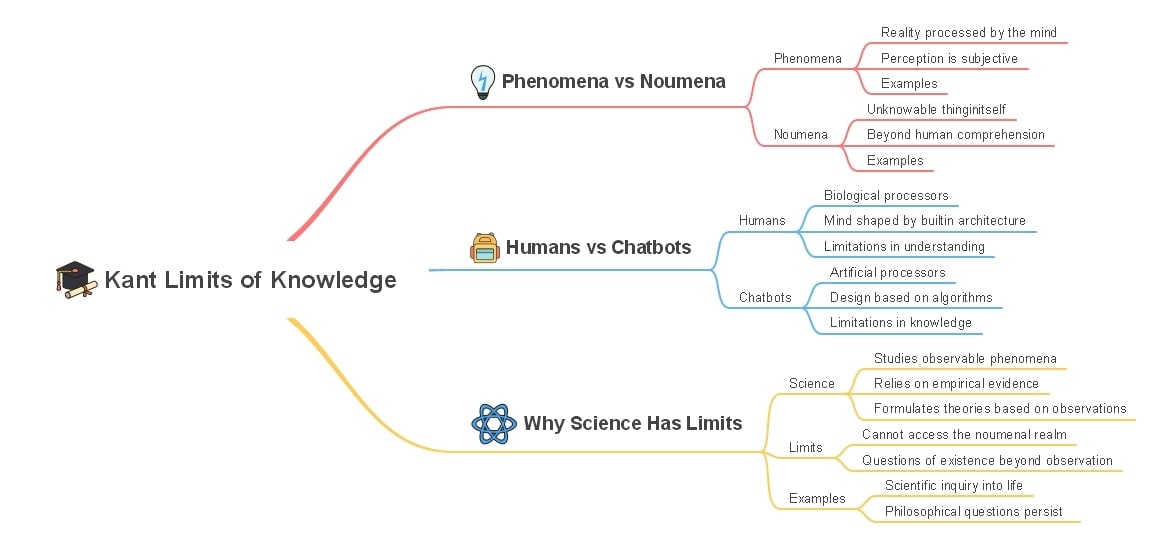
- Phenomena: The world as it appears to us, after being processed and structured by the innate rules of our mind. This is the world of experience, the world of science.
- Noumena (or the Thing-in-itself): The world as it might be independent of our minds. This realm is, by definition, unknowable to us. We can acknowledge it must exist as the source of the raw data of our senses, but we can say nothing about its structure or properties.
The relationship is like a camera. The noumenon is whatever is out there. The camera's lens, sensor, and internal processing software (the mind's structures) determine the final photograph (the phenomenon). We can study the properties of our photographs and the workings of our camera in great detail, but we can never see what's "out there" except through the camera.
2. Causality as a Condition of Experience
So, where does this leave Hume's problem of causality? Kant's answer is that causality is not something we learn from experience; it's one of the mind's pre-installed "rules" or "concepts" that makes objective experience possible in the first place. He calls these innate concepts the Categories of the Understanding.
Kant's Transcendental Idealism
Let's continue with the Bonevac video, which uses a helpful projector analogy and explicitly addresses the limits this new framework places on our knowledge.
Please watch from 12:45 to 23:29. Pay close attention to: The analogy of the mind as a projector, which actively structures what appears on the screen of experience. The crucial conclusion: while this allows for universal and necessary knowledge (synthetic a priori truths) about the phenomenal world, it tells us nothing about the noumenal world (the 'input' to the projector). Things like God, freedom, and the soul lie beyond the screen of experience.
To put it in the context of our last lesson:
- Hume looked for the "necessary connection" in the world and couldn't find it.
- Kant agrees it's not in the world of raw sensation. Instead, it's a rule our Understanding uses to stitch raw sensory data into a coherent, objective timeline.
For Kant, the proposition "Every event has a cause" is a synthetic a priori judgment.
- It is synthetic because the concept of "cause" is not contained within the concept of "event." (Hume was right about this).
- It is a priori because it's not derived from experience; rather, it is a precondition for having a coherent experience of a world of objects in time. Without this rule, our perceptions would be what Kant calls a "rhapsody of perceptions," a subjective dream-like flow with no objective order.
This masterfully "solves" Hume's problem of induction. The necessity and universality of causal laws don't come from an impossible leap of inductive reasoning. They come from the fact that our minds are hard-wired to organize the world causally. The laws of science are necessary because they describe the very structure of any possible experience we could have.
But this solution comes at a price.
3. The Transgression of Reason
The Categories, including causality, are like software designed to run on a specific type of file: sensory data from the phenomenal world. What happens when we try to use them on files they weren't designed for, like concepts about the noumenal realm?
This is where Kant introduces another key distinction, this time within the mind itself:
- The Understanding (Verstand): The faculty that applies the Categories (like causality) to sensory input to construct the world of phenomena. Its job is to organize and unify what we experience.
- Reason (Vernunft): A higher faculty that is not content with the conditioned, piecemeal knowledge provided by the Understanding. Reason's defining drive is to seek unity and completeness, to find the unconditioned ground or ultimate explanation for everything.
This is a natural, even noble, human impulse. It's the drive that pushes a physicist to seek a grand unified theory, and it's the drive that pushed Aristotle to seek an Unmoved Mover.
The problem arises when Reason, in its quest for the unconditioned, takes the tools of the Understanding (like causality) and tries to apply them beyond their legitimate domain—beyond the boundary of all possible experience. Kant calls this a transcendental illusion.
Kant's Critique of Pure Reason - Video 45: Introduction to the Dialectic
This next series of clips from a lecture by Victor Gijsbers explains this crucial part of Kant's critique. He introduces the 'Transcendental Dialectic,' the part of Kant's work dedicated to exposing the errors of Reason when it oversteps its bounds.
Please watch from the beginning to 10:16, and then from 12:59 to 27:58. (You can skip the short segment from 10:16 to 12:59). (0:01-10:16): Focus on the distinction between the Understanding and Reason, and the concept of 'transcendental illusion' as an unavoidable error that arises from Reason's very nature. (12:59-27:58): This part explains that Reason's function is to unify knowledge under principles. Pay close attention to how this drive pushes Reason to seek the 'unconditioned'—for example, not just the cause of this event, but the ultimate cause of everything. The video concludes by showing that taking this subjective need of reason for an objective principle about reality is the fundamental mistake.
The Gijsbers video makes the central point clear: Reason's demand for an unconditioned cause is a subjective principle of our own cognitive architecture, a rule for how to organize our thoughts to achieve maximal unity. The transcendental illusion consists in mistaking this subjective demand for an objective principle about reality itself.
4. The Critique of the Argument for a First Cause
We can now apply this framework directly to the Aristotelian argument.
- The argument observes motion and change in the phenomenal world.
- It applies the principle "whatever is moved is moved by another" (a causal principle).
- It follows this causal chain beyond the world of experience to posit a being—the Unmoved Mover—that is itself uncaused and is not an object of possible experience (i.e., is noumenal).
From a Kantian perspective, this is a textbook case of transcendental illusion. The argument takes the category of causality, whose only legitimate function is to structure the relationship between appearances within experience, and illegitimately extends it beyond experience to make a claim about a noumenal entity.
We can think the concept of an uncaused cause—Reason's drive for the unconditioned forces this "Idea" upon us. But we can never know such a thing, because knowledge, for Kant, requires the synthesis of a concept (from the Understanding) and a sensory intuition. The Unmoved Mover, by its very nature, can never be given in a sensory intuition.
These lecture notes provide a concise summary of Kant's position and how it directly applies to arguments for a first cause like Aristotle's.
Please read the sections that directly address the limits of knowledge. Start with the paragraph beginning 'Experience, according to Kant, is restricted...' Then read section '2. Aristotelian', which explains Kant's objection to inferring from experience to something beyond it. Finally, read the section on God, which starts 'The final object of metaphysics is God.' These sections crystallize how Kant's entire system invalidates arguments for entities that transcend experience.
Conclusion
Kant's critique is one of the most significant challenges to classical metaphysics. He doesn't say Aristotle's argument is based on a false premise in the way an empiricist might. Instead, he argues it's a category error—a fundamental misuse of the concepts of human reason.
Key Takeaways:
- Copernican Revolution: Objects conform to the mind's a priori structures. This creates a distinction between the knowable phenomenal world and the unknowable noumenal world.
- Causality Vindicated, but Limited: Causality is an a priori Category of the Understanding, a necessary condition for objective experience. This saves it from Hume's skepticism.
- The Limit of Knowledge: Because causality is a structure for organizing phenomena, its application is strictly limited to the realm of possible experience.
- Transcendental Illusion: The faculty of Reason naturally seeks an "unconditioned" first cause, but in doing so, it pushes the category of causality beyond its legitimate bounds, leading to an unavoidable but contentless illusion.
- The Fate of the Unmoved Mover: Arguments for a first cause (like Aristotle's Unmoved Mover) are ruled out not because they are empirically false, but because they represent an illegitimate "transcendent" use of reason. We can't know if a First Cause exists, nor can we know that it doesn't. The question is simply beyond the limits of human cognition.
In our next lesson, we will jump forward to the 20th century to consider a very different kind of challenge from the philosopher Bertrand Russell. Instead of Kant's elaborate system, Russell offers a more direct and arguably more radical response: why do we need an explanation for the universe at all? He proposes we can simply accept the universe as a "brute fact," a position that cuts the Aristotelian argument off at its root.
Can't find a good explanation? Sign up and we'll make it for you
Sign up