
Hello. In the previous lesson, you used generics to make API contracts explicit: a repository could accept only the correct entity and identifier types, and wildcards expressed whether a collection produces or consumes values.
This lesson shifts from what types may flow through an API to how a collection of typed objects can be transformed. You will use lambdas and streams to express common backend operations such as selecting transactions, extracting fields for a response, sorting results, and collecting them into a new list. Equally important for an interview, you will learn when a loop is the more readable engineering choice.
From a collection to a result
A Collection stores elements. A stream does not replace that collection or own a second copy of its data; it defines a pipeline for processing elements from a source.
Consider a small immutable domain model:
import java.math.BigDecimal;
import java.time.LocalDate;

enum TransactionType {
    GROCERY,
    ELECTRONICS,
    BOOKS
}

public record Transaction(
        long id,
        TransactionType type,
        BigDecimal amount,
        LocalDate date
) {
}
Suppose an endpoint needs the IDs of grocery transactions, ordered by amount from highest to lowest:
import java.util.Comparator;
import java.util.List;

List<Long> ids = transactions.stream()
        .filter(transaction -> transaction.type() == TransactionType.GROCERY)
        .sorted(Comparator.comparing(Transaction::amount).reversed())
        .map(Transaction::id)
        .toList();
Read that code as a sentence:
Start with the transactions, retain grocery transactions, order them by descending amount, extract each ID, and produce a list.
That is the core benefit of a well-written stream pipeline: it describes the desired transformation rather than exposing every control-flow detail required to carry it out.
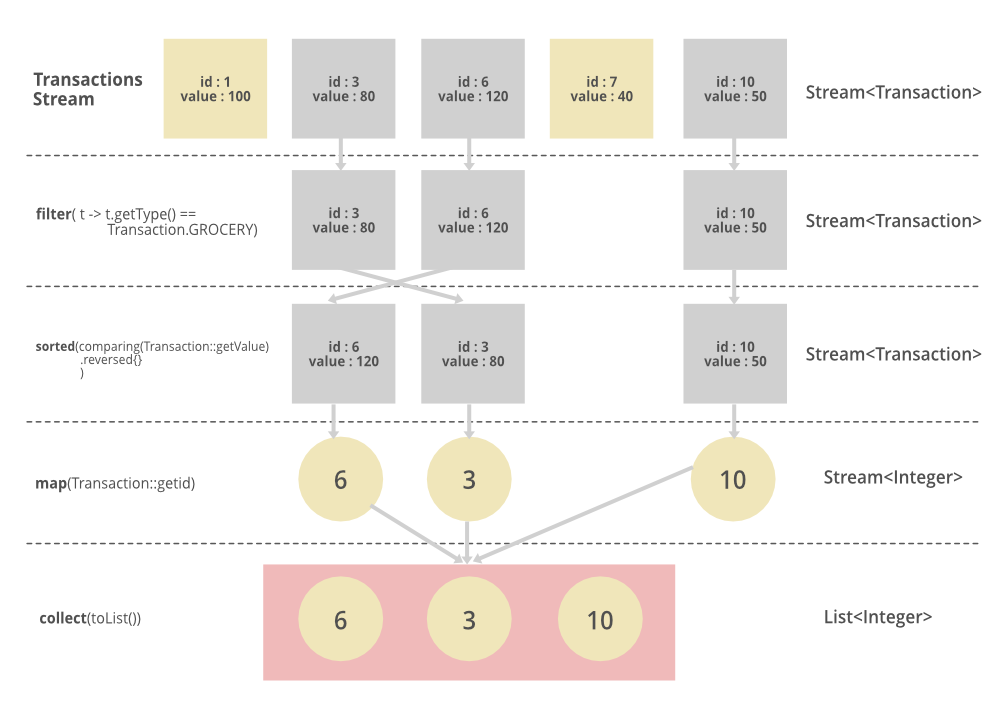
The pipeline has three structural parts:
| Part | In the example | Role |
|---|---|---|
| Source | transactions.stream() | Supplies elements to process. |
| Intermediate operations | filter, sorted, map | Describe transformations and return another stream. |
| Terminal operation | toList() | Starts processing and produces a non-stream result. |
The types flowing through the pipeline make its behavior precise:
List<Transaction>
Stream<Transaction>
Stream<Transaction>
Stream<Transaction>
Stream<Long>
List<Long>
filter and sorted keep the element type as Transaction. map(Transaction::id) changes the element type to Long. Finally, toList() materializes the processed elements as a List<Long>.
Watch this short sequence from Java Streams Crash Course: Everything You Need to Know by camelCase. It compares a loop with a simple filtering pipeline, then introduces stream stages, map, and sorted.
Java Streams Crash Course: Everything You Need to Know
Watch this to establish the vocabulary of a stream pipeline and see a direct loop-versus-stream comparison before applying the same reasoning to backend-style domain objects.
Begin with the filter example, which implements the same selection with a loop and with filter(...).toList(). Then watch pipeline mechanics for the distinction between intermediate and terminal operations. Finish with mapping and sorting, focusing on why map can change the element type while sorted requires a comparator unless the element type is naturally comparable.
Lambdas describe the behavior supplied to an operation
A lambda expression is a compact way to provide behavior where Java expects a functional interface: an interface with one abstract method.
For example, filter expects a Predicate<T>. A predicate takes a value and returns a boolean:
transaction -> transaction.type() == TransactionType.GROCERY
For each Transaction, this expression answers: “Should this transaction remain in the stream?”
map expects a Function<T, R>. It converts one value into another:
transaction -> transaction.id()
Here the function converts a Transaction into its long ID, which is boxed to Long when used in a Stream<Long>.
A lambda has the general shape:
parameter -> expression
When its logic needs multiple statements, use braces and an explicit return:
transaction -> {
    BigDecimal discounted = transaction.amount()
            .multiply(new BigDecimal("0.90"));

    return discounted;
}
In ordinary transformation code, prefer the expression form when it remains clear. A large lambda body inside a stream tends to hide business logic. Extracting that logic into a named method is usually clearer:
private boolean isReportable(Transaction transaction) {
    return transaction.amount().compareTo(new BigDecimal("100.00")) >= 0
            && transaction.type() != TransactionType.BOOKS;
}
List<Transaction> reportable = transactions.stream()
        .filter(this::isReportable)
        .toList();
Method references: concise only when they remain readable
A method reference is shorthand for a lambda that only calls an existing method.
transaction -> transaction.id()
can become:
Transaction::id
Likewise:
transaction -> transaction.amount()
can become:
Transaction::amount
This is why the earlier sorting expression reads well:
.sorted(Comparator.comparing(Transaction::amount).reversed())
Use a method reference when the named method communicates the operation. Do not compress code merely because Java permits it. A named predicate such as this::isReportable is clearer than a long compound condition embedded in a pipeline.
A lambda can capture a local variable, as in this threshold filter:
BigDecimal threshold = new BigDecimal("100.00");

List<Transaction> expensive = transactions.stream()
        .filter(transaction -> transaction.amount().compareTo(threshold) > 0)
        .toList();
The captured local variable must be final or effectively final: it cannot be reassigned after initialization. This restriction avoids ambiguity about changing local state while the lambda is used.
The essential transformations: filter, map, sort, and collect
The most useful way to distinguish stream operations is to ask what they do to the sequence.
filter: select elements
filter retains elements for which its predicate is true.
List<Transaction> groceries = transactions.stream()
        .filter(transaction -> transaction.type() == TransactionType.GROCERY)
        .toList();
A filter changes the number of elements but does not transform the surviving elements themselves. The result still contains Transaction objects.
Multiple filters are often clearer than one dense boolean condition because each can state one business rule:
List<Transaction> recentLargeGroceries = transactions.stream()
        .filter(transaction -> transaction.type() == TransactionType.GROCERY)
        .filter(transaction -> transaction.date().isAfter(LocalDate.now().minusDays(30)))
        .filter(transaction -> transaction.amount().compareTo(new BigDecimal("100.00")) >= 0)
        .toList();
Whether to combine or separate conditions is a readability decision. If each condition has a distinct business meaning, separate filters often make the pipeline easier to scan.
map: transform every element
map applies a function to each input element. Unlike filtering, mapping normally preserves the number of elements while changing their values or types.
List<BigDecimal> amounts = transactions.stream()
        .map(Transaction::amount)
        .toList();
This starts with Transaction values and produces BigDecimal values.
For an API response, mapping from domain objects to DTOs is especially common:
public record TransactionSummary(
        long id,
        BigDecimal amount
) {
}
List<TransactionSummary> summaries = transactions.stream()
        .filter(transaction -> transaction.type() == TransactionType.GROCERY)
        .map(transaction -> new TransactionSummary(
                transaction.id(),
                transaction.amount()
        ))
        .toList();
This reinforces an important backend boundary: persistence entities or domain objects do not have to become the JSON contract. A pipeline can make the conversion explicit.
sorted: order elements
sorted returns a stream whose elements appear in a requested order.
List<Transaction> byAscendingAmount = transactions.stream()
        .sorted(Comparator.comparing(Transaction::amount))
        .toList();
For descending order:
List<Transaction> byDescendingAmount = transactions.stream()
        .sorted(Comparator.comparing(Transaction::amount).reversed())
        .toList();
Unlike List.sort(...), this does not mutate the original transactions list. It creates a stream view with a sorting instruction, and the terminal operation produces a separate result list.
There is a performance nuance worth stating accurately in an interview. Many stream stages can process an element through the pipeline without creating an intermediate collection. But sorted is a stateful operation: it must inspect the relevant elements before it can know which comes first, so it may need buffering. Streams help express a pipeline cleanly; they do not make sorting free.
toList: materialize the result
toList() is a terminal operation. It triggers processing and returns a list containing the pipeline’s output.
List<Long> ids = transactions.stream()
        .map(Transaction::id)
        .toList();
On current Java versions, Stream.toList() returns an unmodifiable list. That is often desirable for a result that should not be changed accidentally:
// ids.add(999L); // UnsupportedOperationException at runtime
If subsequent code must add or remove elements, make that mutability intentional, for example by copying into an ArrayList:
List<Long> mutableIds = new ArrayList<>(
        transactions.stream()
                .map(Transaction::id)
                .toList()
);
Avoid using forEach to manually add stream results to an external mutable list:
List<Long> ids = new ArrayList<>();

transactions.stream()
        .map(Transaction::id)
        .forEach(ids::add);
It is more verbose than toList(), spreads mutation outside the pipeline, and becomes unsafe if someone later makes the stream parallel. Collecting directly expresses the real intent.
Laziness, terminal operations, and single use
Intermediate operations such as filter, map, and sorted build the pipeline, but they generally do not process data immediately. Processing begins at a terminal operation such as toList(), count(), forEach(), or anyMatch().
var highValueIds = transactions.stream()
        .filter(transaction -> transaction.amount()
                .compareTo(new BigDecimal("1000.00")) > 0)
        .map(Transaction::id);

// No transaction has necessarily been processed yet.

List<Long> result = highValueIds.toList();
// The terminal operation now consumes the source.
This is lazy evaluation. It prevents useless work when no result is requested and can permit short-circuiting for suitable terminal operations. For example, anyMatch can stop as soon as it finds a match:
boolean hasLargeGrocery = transactions.stream()
        .anyMatch(transaction ->
                transaction.type() == TransactionType.GROCERY
                        && transaction.amount()
                                .compareTo(new BigDecimal("1000.00")) > 0
        );
A stream is also single-use. Once a terminal operation consumes it, create a new stream if you need another result:
var stream = transactions.stream();

List<Transaction> groceries = stream
        .filter(transaction -> transaction.type() == TransactionType.GROCERY)
        .toList();

// long count = stream.count(); // IllegalStateException
The original transactions collection remains reusable. The restriction applies to the particular Stream instance, not to its source.
Read the Oracle Java tutorial’s Aggregate Operations lesson for the formal pipeline model and its explanation of why streams are processing abstractions rather than storage containers.
Lesson: Aggregate Operations (The Java™ Tutorials > Collections)
Read Oracle’s “Aggregate Operations” tutorial to consolidate the stream pipeline vocabulary, internal iteration, lazy execution, and the reason stream operations avoid ordinary intermediate collections.
In the “Pipelines and Streams” section, read the pipeline model through the explanation of source and intermediate operations. Continue in that section with the filter explanation, noting that a predicate selects elements rather than changing them. Then read the “Differences Between Aggregate Operations and Iterators” section, especially its discussion of internal versus external iteration. In “Optimizing the Map-Filter-Reduce Algorithm,” locate the explanation beginning the lazy pipeline property. Finish with the subsections “Creating a Pipeline with Intermediate Operations” and “Computing a Result with a Terminal Operation,” focusing on the distinction between building a pipeline and consuming it.
When a stream is clearer, and when a loop is clearer
Streams are not a replacement for loops. They are a tool for a particular kind of work: a transformation of a collection where each stage can be described as a clean operation on values.
A stream is usually a strong choice when the code is fundamentally:
- selecting records with criteria;
- converting one representation into another;
- sorting, counting, or aggregating data;
- collecting a derived result;
- composed mostly of pure operations with no externally visible side effects.
For example, the intent is unusually direct here:
List<String> customerEmails = customers.stream()
        .filter(Customer::marketingOptIn)
        .map(Customer::email)
        .sorted()
        .toList();
A loop is often clearer when the work is fundamentally about control flow or changing state. Common signals include:
- several branches with
continue,break, or earlyreturn; - index-based work or in-place updates;
- a result that depends on mutable state accumulated across iterations;
- per-item exception handling and recovery;
- logging, network calls, database writes, or other side effects;
- a pipeline that would require deeply nested lambdas to express honestly.
Consider processing externally supplied records. Each record must be validated, invalid records must be reported, and valid ones must be sent onward:
List<Transaction> accepted = new ArrayList<>();
List<String> errors = new ArrayList<>();

for (Transaction transaction : incomingTransactions) {
    try {
        validate(transaction);
        accepted.add(transaction);
    } catch (IllegalArgumentException exception) {
        errors.add("Transaction " + transaction.id()
                + " rejected: " + exception.getMessage());
    }
}
A stream version is possible, but it would either hide exception handling inside a lambda, mutate accepted and errors from forEach, or introduce a custom result type. In this form, the loop makes the control flow and the two outcomes visible.
Similarly, if the task updates elements in place based on their positions, a loop is more honest:
for (int index = 0; index < prices.size(); index++) {
    BigDecimal price = prices.get(index);

    if (price.signum() < 0) {
        prices.set(index, BigDecimal.ZERO);
    }
}
Trying to force index-aware mutation into a stream usually obscures the actual operation.
Performance is a constraint, not a reflexive answer
It is reasonable to say that a simple loop can be faster in a hot path, especially over primitive arrays or when allocation and boxing matter. A stream also has pipeline machinery and may allocate more objects in some forms.
But “loops are faster” is not a complete engineering decision. In ordinary Spring application code, network latency, database queries, serialization, and remote calls often dominate the cost of a small in-memory transformation. Start with the clearest correct implementation, measure a demonstrated bottleneck, then optimize if needed.
Also, streams are not automatically parallel. Calling stream() creates a sequential stream. Parallel streams have ordering, shared-state, thread-pool, and blocking-I/O considerations that deserve a separate design discussion; they are not a default server-side performance switch.
A useful decision rule is:
Use a stream when it makes the transformation read like a data-processing specification. Use a loop when the main story is control flow, mutation, or per-element recovery.
Explain streams in an interview
Avoid stopping at “streams provide functional programming.” A stronger explanation connects the concept to a concrete transformation and acknowledges its boundary.
A Java stream is a single-use pipeline for processing data from a source such as a collection. It does not store the collection’s elements itself. I compose intermediate operations such as
filter,map, andsorted, then a terminal operation such astoListconsumes the pipeline and produces a result. For example, for a transaction response I could filter grocery transactions, sort them by amount, map each transaction to a response DTO or ID, and collect the result into a list.filterchanges which elements continue, whereasmaptransforms each element and may change the type.
If asked why streams are lazy:
Intermediate operations describe the pipeline but do not generally traverse the source immediately. A terminal operation triggers traversal. This avoids constructing ordinary intermediate collections for a chain of transformations, and operations such as
anyMatchcan stop as soon as the answer is known. Stateful operations such as sorting are an important caveat because they may need to buffer elements.
If asked whether streams should replace loops:
No. Streams are best for declarative, mostly side-effect-free transformations. I prefer a loop when the logic has complex branching, index manipulation, mutable state, detailed error handling, or side effects such as external calls. The deciding criterion is clarity and correctness first; I measure performance before making a hot-path optimization.
Key takeaways
- A stream is a single-use processing pipeline over a source; a collection is a reusable structure that stores data.
- A pipeline has a source, zero or more intermediate operations, and a terminal operation.
filterselects elements and preserves their type;maptransforms elements and can change their type.- Lambdas supply behavior through functional interfaces such as
PredicateandFunction; method references are useful when they improve readability. - Intermediate operations are generally lazy. A terminal operation such as
toList,count, oranyMatchstarts processing. Stream.toList()produces an unmodifiable result list on current Java versions.- Prefer streams for clear data transformations; prefer loops for complicated control flow, mutation, per-item recovery, and side effects.
- Do not treat streams or parallel streams as automatic performance improvements.
Next, you will model failures with Java exceptions while preserving diagnostic information—an essential counterpart to clean collection processing in backend code.
Can't find a good explanation? Sign up and we'll make it for you
Sign up