
Welcome. This final module shifts from product and risk understanding to the practical work of acquiring and retaining institutional capital. In this lesson, you will build a target-account map: a prioritized, evidence-based view of which organizations Exponent should pursue, why each could care about on-chain yield markets, what route to market is realistic, and what would disqualify the opportunity.
The aim is not a generic database of crypto firms. It is a decision tool for allocating sales time. For an Institutional Sales Lead, the central question is: which accounts have both a plausible need for Exponent’s products and the operational ability to act on that need?
Start with the product and market signals
A useful map begins with a clear, current product thesis. Exponent’s own announcement describes its intended role as infrastructure for on-chain portfolio construction: serving both asset issuers seeking distribution and participants seeking to express crypto-rate views, construct portfolios, and manage yield-market risk. Treat this as company positioning, then confirm the live product set, liquidity, supported assets, and operational requirements during diligence.
Exponent Raises $5 Million, Led by Multicoin Capital
Read Exponent’s announcement to identify the institutional personas and product capabilities that should anchor account selection.
Read the complete announcement beginning with the v2 rationale. Focus on three stated audiences: asset issuers, funds and managers, and traders. Note that the on-chain order book and Strategy Vaults are presented as v2 capabilities; verify their current production status before using them in a client conversation.
A second input is market structure. The relevant opportunity is not “institutions” as one homogeneous category. Crypto-native hedge funds, traditional alternatives managers, market makers, protocol treasuries, and wealth channels differ sharply in mandate, investment committee process, execution needs, and tolerance for direct on-chain activity.
[PDF] Annual Global Crypto Hedge Fund Report 2025 - Cayman Finance
Read the selected excerpts from Cayman Finance’s report to form evidence-based hypotheses about which investor segments are active in digital assets and yield strategies.
On the PDF’s pages 16–17, in the section “How investors allocate to digital assets,” read the paragraph that concludes with the investor-base shift. The important implication is that family-office capital remains important, while institutional gatekeepers increasingly raise the diligence bar. Then read pages 7–8, “1. Traditional hedge funds and digital assets,” from the traditional-fund profile. Focus on strategy types, current crypto exposure, motivations, and derivatives use. On pages 12–13, “2. Crypto Hedge Funds,” read from the crypto-fund profile. Pay particular attention to the prevalence of multi-strategy and market-neutral mandates, Solana exposure, and the priority placed on yield generation. Finally, on page 10 under “Hedge funds exploring DeFi,” read the DeFi adoption passage. Separate expressed interest in DeFi from actual readiness to deploy capital.
The report offers useful directional evidence, not a universal addressable-market estimate. Its surveyed crypto hedge funds have an average AUM of US$132 million; 73% report yield or reward generation as a priority, and 73% report Solana holdings. Those figures make crypto-native funds a credible early segment for a Solana yield venue. They do not prove that every Solana-holding fund is ready to use a fixed-maturity yield exchange.
Traditional hedge funds are a different motion. The report says 55% of surveyed traditional hedge funds had crypto exposure in 2025 and 43% of crypto-exposed funds planned to expand into DeFi over the following three years. Their likely entry point is not necessarily a broad “DeFi allocation.” It may be a limited, risk-defined pilot around fixed-rate exposure, relative value, or a liquid, operationally controlled strategy.
Institutional ownership data can help form another hypothesis, but it must be interpreted carefully.
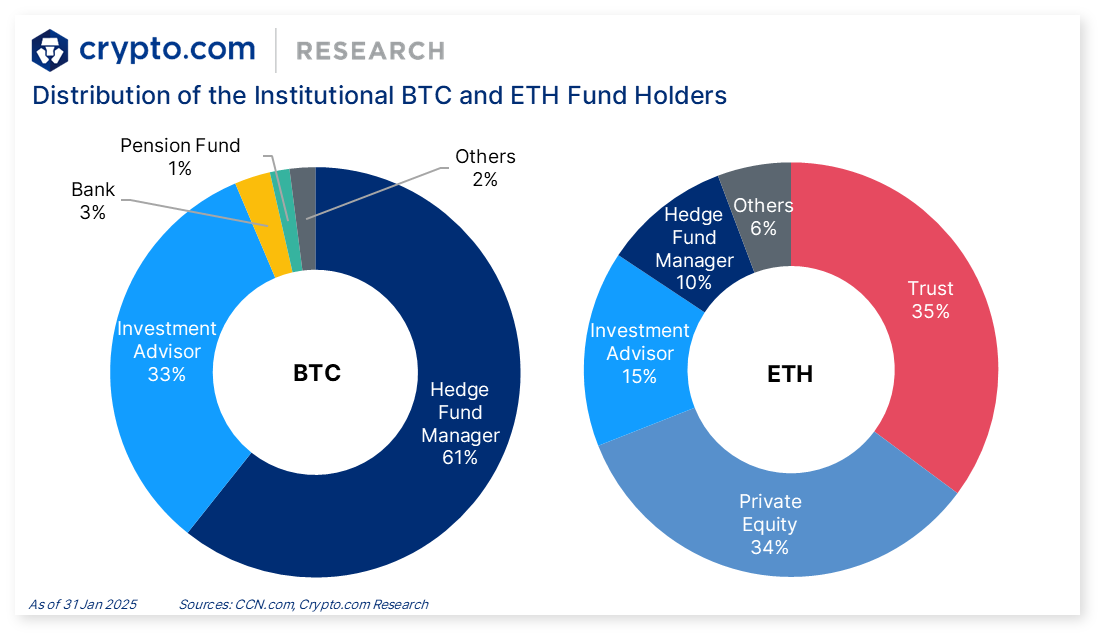
The chart is useful for one narrow purpose: it warns against treating “institutional crypto” as synonymous with hedge funds. It does not measure Exponent demand, Solana familiarity, deployable capital, or suitability for on-chain rate products. In a target map, such data belongs in the market rationale column, never in the account qualification column.
What a target-account map actually contains
A target-account map has five layers:
- Segment — the economic and operational category, such as crypto hedge funds or corporate treasuries.
- Named account universe — specific legal entities or firms within that segment.
- Buying group — the people whose incentives and approvals determine progress.
- Opportunity hypothesis — the specific problem Exponent may solve for that account.
- Evidence and next action — what is known, what is assumed, what would disqualify the account, and the immediate path to verify it.
This distinction prevents a common sales error: confusing a broad market narrative with a qualified prospect. “Market makers need liquidity venues” is a market narrative. “This market maker already makes two-sided markets in Solana assets, has a mandate to deploy inventory to rate markets, and can operate through an approved custody and wallet workflow” is an account hypothesis.
A target account is normally the legal entity that can allocate capital, provide liquidity, distribute a product, or bring a strategic asset relationship. A channel is an intermediary with access to end capital. For example:
- A crypto fund can be a direct allocating account.
- A market maker can be both a strategic liquidity account and an execution partner.
- A multi-family office can be a channel to several underlying families.
- A registered adviser or private-bank platform can be a wealth channel, subject to product, jurisdictional, and suitability constraints.
- An individual HNW investor is usually not an efficient direct-account priority for an institutional sales function unless an approved channel and compliance process already exist.
The buying group should also change by segment. A crypto fund’s portfolio manager may originate the trade while operations and risk approve wallets and controls. At a traditional manager, an alternatives PM may sponsor a pilot, but legal, compliance, operational due diligence, and investment committee approval can determine the timeline. For a market maker, the economic buyer may be a head of trading, while the practical gatekeeper is the person responsible for infrastructure and capital allocation.
Segment the market by job to be done
Exponent should not use one pitch across every account type. The same yield market can be a hedge, a fixed-income instrument, an execution venue, a liquidity business, or a treasury-management tool depending on the client.
| Segment | Primary account hypothesis | Likely Exponent role | Strong qualification evidence | Typical blocker |
|---|---|---|---|---|
| Crypto-native funds | The fund seeks yield, relative-value alpha, or rate exposure beyond directional token beta. | Principal-token position, yield-token expression, rate trade, strategy allocation, or liquidity provision. | Active Solana exposure; documented yield or market-neutral mandate; on-chain execution capability. | No maturity-risk budget, insufficient liquidity needs, or mandate limited to liquid centralized instruments. |
| Traditional asset managers | The manager seeks a controlled digital-asset pilot, diversification, or a defined-return strategy. | Limited fixed-maturity or manager-led strategy allocation, often after operational approval. | Existing crypto program, digital-assets team, derivatives or alternatives capability, institutional custody. | Legal, custody, valuation, tax, or committee constraints outweigh expected return. |
| Market makers | The firm can monetize execution and liquidity expertise in rate markets. | Rate Order Book participation, Rate CLMM liquidity, block execution, and inventory management. | Solana market-making presence, quantitative pricing stack, balance-sheet capacity, appetite for new venue liquidity. | Thin market depth, unclear inventory economics, integration cost, or lack of risk limits for PT/YT inventory. |
| Protocol and corporate treasuries | Treasury capital has known future liabilities and needs yield without simply maximizing headline APY. | Maturity-matched principal-token exposure, yield diversification, or risk-defined strategies. | Stablecoin or SOL-denominated reserves; treasury policy; known runway or grant schedule; multisig governance process. | Governance inertia, short liquidity horizon, or policy prohibiting smart-contract deployment. |
| Family offices and multi-family offices | The office seeks differentiated yield exposure, often through a specialist manager or approved platform. | Allocations through a fund, vault manager, or curated strategy rather than direct protocol use. | Existing digital-asset allocation; professional investment staff; external manager relationships; clear risk budget. | Sparse in-house operations, bespoke legal needs, and low tolerance for direct on-chain complexity. |
| HNW and wealth channels | A platform wants a compliant way to offer differentiated digital-asset yield exposure to eligible clients. | Distribution partnership, educational flow, or manager-led product access. | Approved digital-asset product shelf; adviser education capability; eligibility and suitability controls. | Retail-distribution restrictions, fragmented client service, and high compliance burden. |
1. Crypto-native funds: the core early-adopter segment
This segment deserves early attention because it combines familiarity with on-chain venues, a higher probability of Solana exposure, and established use of yield generation. Within it, avoid treating all “crypto funds” alike.
The best subsegments are likely to be:
- Market-neutral and relative-value funds that can compare implied fixed rates, realized yield, funding costs, and cross-venue execution.
- Multi-strategy funds with a dedicated yield sleeve or flexibility to allocate among staking, lending, basis, and rate opportunities.
- Directional funds with idle collateral or long-term SOL exposure that may need portfolio income, though their willingness to lock capital must be verified.
- Specialist DeFi managers that can understand the instrument but may already have strong preferences for competing liquidity venues.
The initial conversation should begin with their current yield stack: which assets they hold, how they earn yield today, whether they are willing to take maturity risk, and what return must compensate for liquidity and smart-contract exposure. Do not begin with a protocol feature list.
2. Traditional asset managers: separate readiness from brand recognition
“Traditional asset manager” is an umbrella label, not a segment. A large long-only manager with no digital-assets capability may have more AUM than a crypto hedge fund but be a materially weaker prospect. A better first focus is:
- traditional hedge funds already trading digital assets;
- macro, relative-value, credit, and multi-strategy managers with a defined alternatives process;
- managers using external crypto specialists;
- asset managers operating tokenized-fund or digital-asset initiatives.
The report’s evidence suggests derivatives, diversification, and market-neutral alpha are meaningful motivations among crypto-investing traditional hedge funds. That creates a bridge to rate markets. However, the bridge stops at operational reality: a principal token is not a conventional government bill, and a fixed maturity does not remove underlying-asset, smart-contract, liquidity, custody, valuation, or legal risk.
For this segment, the sales motion is often pilot design plus diligence orchestration. The prospect may need a position-size proposal, liquidity analysis, custody workflow, valuation approach, counterparty framing, audit materials, and an escalation path before discussing a larger allocation.
3. Market makers: treat liquidity supply as a distinct account motion
Market makers should appear on the map even when they are not natural end investors. Their contribution may be deeper books, tighter execution, more credible price discovery, and confidence for allocators. A successful relationship depends on whether the venue can support their business model, not simply on whether they like the protocol.
A market-maker account hypothesis should specify:
- which yield markets and maturities are relevant;
- whether the firm can quote both sides consistently;
- how it will finance or hedge principal-token and yield-token inventory;
- expected fee, incentive, and adverse-selection economics;
- operational requirements for APIs, settlement, custody, and monitoring;
- a minimum viable liquidity and volume threshold.
This is a partnership conversation with commercial and market-structure dimensions. It should be owned differently from an allocator conversation, even if the same firm may also hold inventory as an investment.
4. Treasuries: distinguish protocol treasury from corporate treasury
A protocol treasury may hold volatile native tokens, stablecoins, and governance-controlled reserves. It can have a natural interest in diversifying its yield sources, but decisions may be slow because they require governance approvals, multisig execution, and transparent risk communication.
A corporate or digital-asset treasury may care more about runway preservation, liability matching, and controlled income. It may be attractive only when the asset denomination, maturity profile, reporting method, and legal framework fit its treasury policy.
The most promising signal is not “large treasury balance.” It is a visible mismatch between idle liquid reserves and known future cash needs, combined with an approved ability to deploy capital on-chain. A treasury with a large balance but a 30-day liquidity requirement may be a poor fit for fixed-maturity exposure.
5. Family offices and HNW channels: pursue leverage, not scattered tickets
Family offices remain an important source of crypto capital, as the report indicates. But direct outreach to many individual families can consume substantial time relative to deployable, retained capital. Prioritize institutions that create distribution leverage:
- multi-family offices with professional investment teams;
- specialist digital-asset advisers;
- fund platforms and feeder structures;
- private-wealth channels with existing digital-asset controls;
- external managers already serving family-office clients.
For these channels, education, reporting, and risk communication matter as much as yield. The correct objective may be to build a credible pathway for a sophisticated allocator rather than to pursue immediate direct protocol adoption. Any prospecting and distribution approach must remain consistent with applicable securities, fund-marketing, solicitation, and client-suitability requirements.
Prioritize accounts with a score and hard disqualifiers
A map becomes operational when it forces trade-offs. Use a weighted score from 0 to 5 for each account, but do not let a high score override a hard risk or compliance failure.
One practical scoring model is:
Where:
- is mandate fit: does the stated strategy support rate trading, yield, or liquidity provision?
- is capital potential: is there a credible deployable allocation, not merely large reported AUM?
- is operational readiness: custody, wallet policy, signing authority, accounting, and risk operations.
- is liquidity contribution: can the account improve market depth, execution, or strategic distribution?
- is strategic fit: Solana presence, issuer relationships, brand credibility, or manager-distribution potential.
- is access: warm path, existing relationship, relevant event, or identifiable decision maker.
Use the score to organize work into tiers:
| Tier | Meaning | Recommended treatment |
|---|---|---|
| A | High fit, clear route to decision maker, few unresolved gating issues. | Build an account plan, identify the buying group, and seek a discovery meeting. |
| B | Plausible fit, but one or two material assumptions remain unverified. | Run targeted research and qualification before investing senior sales or solutions resources. |
| C | Strategic name but weak current readiness or unclear use case. | Maintain light-touch market education and watch for a trigger event. |
| Disqualify or defer | Mandate, liquidity, legal, custody, or risk constraints make action unrealistic now. | Record the reason, set a review date only if a credible trigger could change it. |
Hard disqualifiers should be explicit. Examples include a prohibition on smart-contract interaction, no approved digital-asset custody route, liquidity needs shorter than the relevant maturity horizon, inability to value or account for the position, or a mandate that permits only centralized exchange-traded instruments. A disqualified account is not a failed prospect; it is protected sales capacity.
Build the first account map
Use a spreadsheet or CRM view with the following fields. The map is deliberately structured to expose uncertainty rather than hide it.
| Field | What to record |
|---|---|
| Account and legal entity | Exact firm name, relevant fund or treasury vehicle, domicile where known. |
| Segment and subsegment | For example, crypto hedge fund, market-neutral; or multi-family office, digital-assets allocation team. |
| Capital role | Allocator, liquidity provider, issuer partner, distributor, or a combination. |
| Investment mandate | Assets, strategies, return objective, liquidity limits, leverage constraints, and benchmark where available. |
| Exponent hypothesis | One sentence describing the prospective use case, not a generic product description. |
| Evidence | Public strategy statements, past activity, disclosed holdings, relationship intelligence, or qualified conversation notes. |
| Buying group | Investment sponsor, trading lead, operations, risk, compliance, legal, and final approver. |
| Operational readiness | Custody model, wallet control, transaction approvals, reporting needs, and DeFi policy. |
| Key risks and objections | Smart-contract risk, underlying yield-source risk, liquidity, valuation, Solana operations, or regulatory treatment. |
| Trigger event | New fund launch, Solana allocation, idle stablecoin balance, yield compression elsewhere, new mandate, or liquidity program. |
| Priority score and tier | Score by the model above, plus any hard disqualifier. |
| Next action | A specific information-gathering or relationship action with an owner and date. |
The Exponent hypothesis is the most important field. It should be falsifiable. Compare:
- Weak: “Large crypto fund that may want Exponent.”
- Strong: “Market-neutral fund with SOL and liquid-staking exposure may use fixed-maturity principal tokens to lock a portion of expected yield; fit depends on approved Solana custody and capacity to exit before maturity if needed.”
The stronger version identifies a use case, a likely benefit, and the facts that could disprove the fit.
A compact starting map may contain only 20 to 30 accounts, but it should span all six categories in the learning outcome. Populate it asymmetrically: crypto-native funds, market makers, and on-chain treasuries may initially occupy more of the A and B tiers, while traditional managers and wealth channels may be fewer, more relationship-led, and longer-cycle. That is a strategic choice, not a judgment on their importance.
Turn research into account-specific action
For each account, research should answer a small set of commercially decisive questions:
-
Can they take the risk?
Determine whether their mandate permits digital assets, DeFi, maturity exposure, and the relevant asset denomination. -
Do they have a reason now?
Look for a yield need, rate view, idle balance, new fund launch, Solana expansion, issuer relationship, or market-making initiative. -
Can they execute?
Verify custody, wallets, approvals, operational due diligence, accounting, tax, and legal requirements. -
Can Exponent serve the need better than the status quo?
The alternatives may include staking, lending, centralized-exchange derivatives, OTC execution, competing yield venues, or simply holding cash. -
What does success look like?
It may be a pilot allocation, a quoted liquidity commitment, an issuer-distribution partnership, or completion of a diligence package. “Introductory call completed” is not a business outcome.
For this first version, create one sentence of evidence and one next action for every A- and B-tier account. If the evidence is only an inference, label it as such. A disciplined map makes it easy to say, “We do not know yet,” and then assigns the shortest path to finding out.
Key takeaways
A target-account map is a capital-acquisition instrument, not a contact list. It organizes the market by economic role, mandate, operational readiness, access, and strategic value.
For Exponent, the most credible early targets are likely to include crypto-native funds with yield or market-neutral mandates, Solana-capable market makers, and treasuries with a genuine maturity-matching or reserve-yield need. Traditional asset managers and family-office or HNW channels can be valuable, but often require a longer, diligence-led route to deployment.
Use industry data to form segment hypotheses, use protocol materials to define the product thesis, and use account-specific evidence to qualify each opportunity. Keep hard disqualifiers visible so that large brand names do not absorb effort without a viable path to capital.
Next, you will convert this map into pipeline stages with evidence-based entry and exit criteria, from initial sourcing through retained funded capital.
Can't find a good explanation? Sign up and we'll make it for you
Sign up