
Good to see you again. In the previous lesson, the key habit was convert to moles before comparing quantities. You used that to find atom ratios in empirical formulae. The same habit now unlocks reacting-mass calculations: a balanced equation gives a ratio in moles, not in grams.
This lesson completes the core Year 12 stoichiometry method. You will calculate the mass of one substance from another and, when two reactant amounts are given, identify the reactant that runs out first—the limiting reactant. These are method marks: a clear sequence of labelled calculations is much safer than trying to do a calculation in one step.
The central idea: equations give mole ratios
Consider the Haber process equation:
The coefficients state that:
They do not state a mass ratio. In fact, the masses are very different:
- of has a mass of
- of has a mass of
- of has a mass of
So you must never use the equation coefficients to convert directly between masses.
The reliable route is:
In shorthand:
The two equations you need are:
Here, is amount in moles, is mass in grams, and is relative formula mass.
A dependable layout for reacting-mass questions
Read or watch the following explanation before tackling the worked example. It reinforces why moles sit between any two quantities in a chemical equation.
Reacting Masses In 15 Minutes | A Level Chemistry
Watch “Reacting Masses In 15 Minutes” by LajoyDoesChemistry for a concise model of the mass–moles–ratio–moles–mass method, including a fully set-out calculation.
Watch the method for the reason reacting-mass questions always pass through moles. Then watch the calcium example. Focus on how each number is labelled with its substance and unit, and on using the equation’s coefficients only after the first mole calculation.
Use a vertical calculation layout. Every time you write a mole value, include the substance:
not merely:
Unlabelled numbers make it difficult to spot whether you have applied the ratio to the correct substance.
The generic conversion between substances is:
The order of the fraction matters. Take the coefficient belonging to the substance you want, divided by the coefficient belonging to the substance you have.
Worked example: one reactant, one product
Question: What mass of calcium chloride is formed when of calcium reacts completely with excess hydrochloric acid?
“Excess hydrochloric acid” means there is enough hydrochloric acid available to react with all the calcium. Therefore calcium determines the amount of product.
Step 1: Convert the given mass to moles
Step 2: Apply the mole ratio
From the balanced equation:
Therefore:
Step 3: Convert moles of the target into mass
To three significant figures:
Although this example has a ratio, do not skip the ratio step in your written working. In an exam, showing it demonstrates that you know why the moles remain unchanged.
Use coefficients, not subscripts
One of the easiest errors is mixing up a coefficient with a subscript.
In:
the mole ratio of aluminium to aluminium chloride is:
which simplifies to:
But the in is not part of the mole ratio. It tells you that each formula unit of aluminium chloride contains three chloride ions. It is used when calculating :
A useful distinction is:
| Feature | What it tells you | Used for |
|---|---|---|
| Coefficient, e.g. | Number of moles reacting | Mole ratios |
| Subscript, e.g. | Atoms/ions in one formula unit | Calculating |
The Chemrevise notes give a compact version of this same process, including the key reminder that balancing numbers are not included in .
1.24 Calculations and Chemical Reactions
Read the first two pages of N. Goalby’s Chemrevise notes to consolidate the three-step reacting-mass method and see a concise worked example.
On page 1, under “Converting quantities between different substances using a balanced equation,” begin at the mole-ratio explanation. Then continue into the “Reacting Mass Questions” example on page 2. Track the sequence from sodium hydrogencarbonate mass to carbon dioxide mass, and note the warning that coefficients do not alter M_r.
What “limiting reactant” really means
A reaction can only continue while it has enough of every reactant in the required mole ratio. The limiting reactant is the reactant that is completely used up first. It limits the maximum amount of product that can form.
The other reactant is in excess, so some remains after the reaction.
For:
the required ratio is:
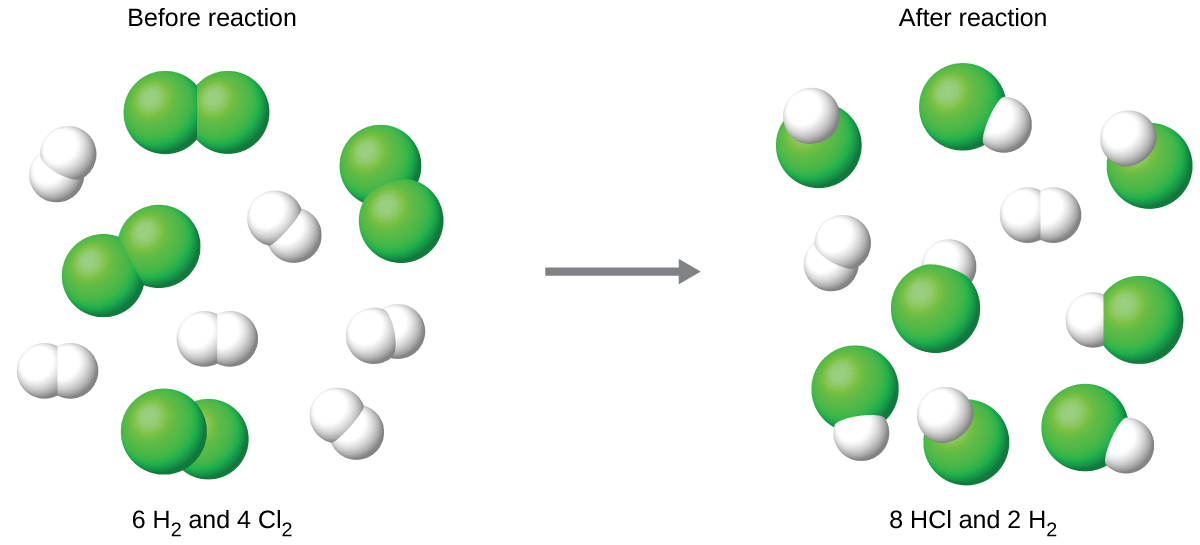
The diagram is simple, but exam questions hide the same idea behind masses. You cannot identify the limiting reactant by choosing the smaller mass or even the smaller number of moles. You must compare the available mole amounts against the balanced-equation ratio.
For example, of aluminium and of hydrochloric acid may look as though aluminium is “smaller.” But if the equation requires three moles of hydrochloric acid per mole of aluminium, then the hydrochloric acid may run out first.
Two sound methods for identifying the limiting reactant
Suppose a question gives amounts of two reactants.
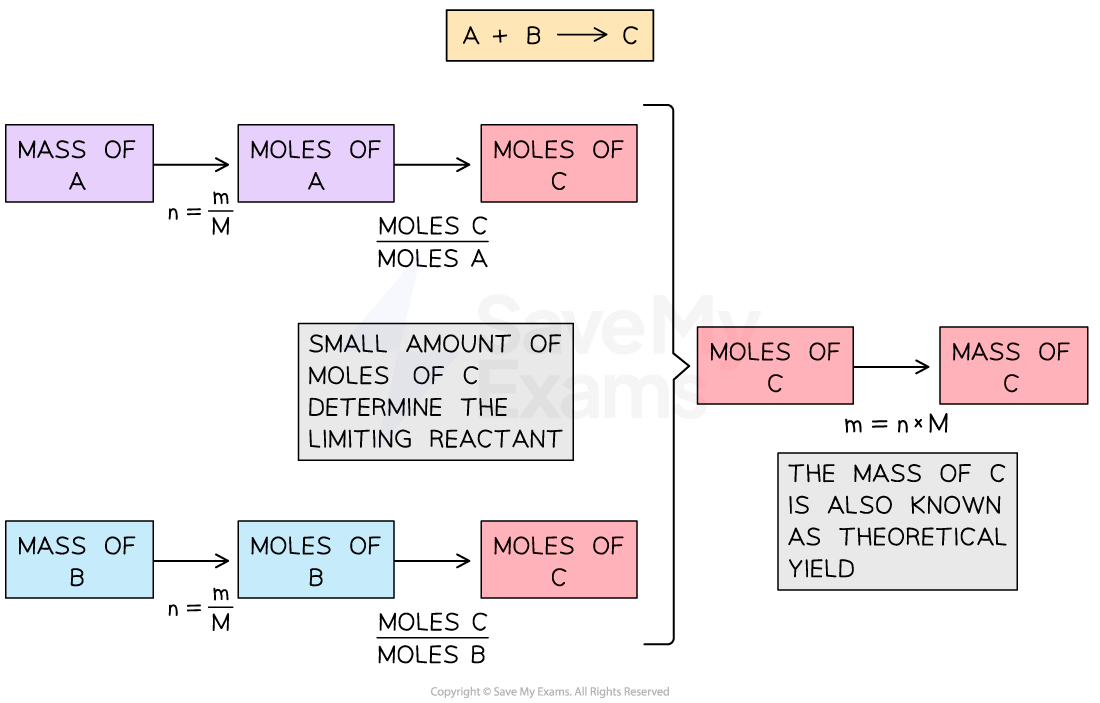
Method 1: Work out how much product each reactant could make
- Convert both given masses to moles.
- Use each reactant separately to calculate the moles of the same product.
- The reactant producing the smaller amount of product is limiting.
This is usually the most reliable exam method because it directly answers the real question: which reactant permits less product to form?
Method 2: Compare what is available with what is required
- Convert both masses to moles.
- Take the amount of one reactant.
- Use the equation ratio to calculate how much of the other reactant it needs.
- Compare the amount required with the amount actually available.
If there is not enough available, that second reactant is limiting.
Both methods are valid. Method 1 is often less confusing when equation coefficients are awkward.
The following flowchart summarises Method 1.
Worked example: limiting reactant and maximum product mass
Question: of aluminium reacts with of hydrochloric acid.
Identify the limiting reactant and calculate the maximum mass of aluminium chloride formed.
Step 1: Convert both reactant masses to moles
For aluminium:
For hydrochloric acid:
Step 2: Calculate possible product from each reactant
The equation gives:
So aluminium could form:
The equation also gives:
So hydrochloric acid could form:
Compare the two possible product amounts:
| Starting reactant | Possible amount of |
|---|---|
| Aluminium | |
| Hydrochloric acid |
Hydrochloric acid makes less product, so:
Aluminium is in excess.
Step 3: Use the limiting reactant’s product amount
The maximum amount of product is therefore:
Calculate the product’s formula mass:
Then calculate mass:
To three significant figures:
The phrase maximum mass is important. It means the calculation assumes the reaction goes to completion with no experimental losses. Later, percentage yield will compare this theoretical maximum with the mass actually obtained.
Writing a clear limiting-reactant conclusion
Do not simply write “HCl is limiting.” Support it with the comparison that proves it:
of aluminium could form of aluminium chloride, whereas of hydrochloric acid can form only . Therefore, hydrochloric acid is the limiting reactant.
That sentence makes your reasoning visible and protects method marks.
Chemrevise’s limiting-reactant example uses a different reaction but exactly this logic: calculate both reactant amounts, compare their required ratio, then continue using only the reactant that limits the reaction.
1.24 Calculations and Chemical Reactions
Read N. Goalby’s Chemrevise worked titanium example to reinforce the limiting/excess vocabulary and the calculation of a theoretical maximum.
On page 3, under “Limiting and excess reactants,” start with the limiting-reactant explanation and titanium example. Focus especially on the comparison between the sodium amount required and the amount actually present. Do not attempt the solution questions yet; use them later as timed consolidation.
Common calculation traps
Before moving on, check your working against these errors.
| Common error | Why it fails | Correction |
|---|---|---|
| Converting directly from one mass to another | Equation coefficients are mole ratios, not mass ratios. | Always convert mass to moles first. |
| Using an unbalanced equation | The mole ratio is wrong. | Check balancing before starting calculations. |
| Including coefficients in | A coefficient tells you the number of moles, not the mass of one mole. | Calculate from the formula only. |
| Selecting the reactant with the lower mass as limiting | A lower mass can still represent more moles. | Convert both reactants to moles and compare using the ratio. |
| Calculating product using the excess reactant | This predicts product that cannot form once the limiting reactant runs out. | Use only the limiting reactant for the final product calculation. |
| Rounding during intermediate steps | Early rounding can shift the final answer. | Keep calculator figures until the final line. |
| Missing units or substance labels | It obscures the calculation and risks using a number incorrectly. | Label values as or , with a formula. |
For your error log, separate mistakes into: moles conversion, ratio direction, , limiting-reactant identification, and significant figures. That will tell you what to target when you revisit mole calculations.
Key takeaways
A balanced symbol equation gives a ratio in moles. For a mass-to-mass calculation, use:
When amounts of two reactants are given:
- Convert both to moles.
- Use the balanced equation to determine how much product each could form.
- The reactant that forms the smaller amount of product is the limiting reactant.
- Use the limiting reactant to calculate the maximum, or theoretical, product mass.
The next module extends the same mole-ratio method into solutions, beginning with concentration and volume calculations using:
Can't find a good explanation? Sign up and we'll make it for you
Sign up