
Hello, and welcome to the first lesson in your Level 2 Chemistry preparation. This first module builds the bonding language that sits underneath much of AS91164: later, you will use these particle models to explain conductivity, melting point, hardness, solubility, and structure–property relationships at Excellence level.
Today’s goal is to distinguish ionic, covalent, and metallic bonding precisely. The key is not just remembering “transfer,” “share,” and “sea of electrons.” You need to identify the particles present and state the exact electrostatic attraction that holds those particles together.
The central idea: bonding is electrostatic attraction
All three primary bond types involve electrostatic attraction: attraction between particles with opposite charges.
Electrons have a negative charge. Atomic nuclei are positive because they contain protons. Ions are charged particles formed when atoms gain or lose electrons.
The important difference is which charged particles are attracting one another.
Chemical Bonding Explained | Ionic, Covalent and Metallic | GCSE Chemistry
Watch “Chemical Bonding Explained | Ionic, Covalent and Metallic | GCSE Chemistry” from Science Workshop for a compact visual overview of all three bonding models. Focus on the distinction between the electron movement or sharing process and the electrostatic attraction that is the bond itself.
Watch ionic bonding, especially the moment after electron transfer when positive and negative ions attract. Then watch covalent bonding to see why a shared electron pair is attracted to both nuclei. Finish with metallic bonding, noting that the electrons belong to the whole lattice rather than to one atom.
A useful exam habit is to separate two ideas:
- How the particles form — electrons may be transferred, shared, or delocalised.
- What the bond is — the electrostatic attraction between particular oppositely charged particles.
For example, in ionic bonding, electron transfer creates ions, but the ionic bond is the attraction between those ions.
Ionic bonding: attraction between oppositely charged ions
Ionic bonding usually occurs when a metal reacts with a non-metal. Metals tend to lose outer-shell electrons; non-metals tend to gain them.
Consider sodium chloride, .
- A sodium atom loses one electron and becomes a positive sodium ion, .
- A chlorine atom gains that electron and becomes a negative chloride ion, .
- The oppositely charged ions attract.
The precise definition is:
An ionic bond is the strong electrostatic attraction between oppositely charged ions.
Notice what must be in a full answer:
- positive ions
- negative ions
- strong electrostatic attraction
Do not define ionic bonding merely as “an electron transfer.” Transfer is essential because it creates the ions, but it is not the force holding the compound together.
Ionic substances are lattices, not isolated pairs
A formula such as gives the simplest ratio of ions: one for every . In a crystal of salt, however, there are enormous numbers of ions arranged in a repeating three-dimensional pattern called a giant ionic lattice.
Each positive ion is attracted to surrounding negative ions, and each negative ion is attracted to surrounding positive ions. The whole lattice is held together by many electrostatic attractions.
For magnesium oxide, :
- magnesium loses two electrons to form ;
- oxygen gains two electrons to form ;
- the bond is the electrostatic attraction between and ions.
A stronger Excellence-style sentence would be:
Magnesium oxide contains a giant lattice of and ions. Strong electrostatic attractions act between the oppositely charged ions throughout the lattice.
The phrase throughout the lattice shows that you understand this is a continuous structure, not one separate -to- pair.
Covalent bonding: attraction involving shared electrons and nuclei
Covalent bonding usually occurs between non-metal atoms. Instead of one atom completely giving an electron to another, the atoms share electrons.
In a hydrogen molecule, , each hydrogen atom contributes one electron. The two electrons form a shared pair between the nuclei.
The complete particle-level explanation is:
A covalent bond is the electrostatic attraction between a shared pair of electrons and the positively charged nuclei of the bonded atoms.
This wording matters. The shared electron pair is negative, and it is attracted to both positive nuclei. That attraction holds the atoms together.
For hydrogen chloride, :
- hydrogen and chlorine are both non-metals;
- they share one pair of electrons;
- the shared pair is attracted to both the hydrogen nucleus and the chlorine nucleus.
For water, , oxygen shares one electron pair with each hydrogen atom. Therefore, water has two covalent bonds.
Sharing does not mean “each atom owns half”
A shared pair sits in the region between the nuclei and is attracted to both nuclei. This is why it creates a bond.
At this stage, you can use this short definition in an exam:
A covalent bond is a shared pair of electrons.
But if a question asks you to describe the electrostatic attraction, extend it:
A covalent bond is the electrostatic attraction between a shared pair of electrons and the positive nuclei of two non-metal atoms.
We will soon learn to draw those shared pairs in Lewis structures.
Metallic bonding: positive metal ions and delocalised electrons
Metallic bonding occurs in a pure metal such as copper, iron, magnesium, or aluminium.
Metal atoms contribute their outer-shell electrons to the whole metal structure. These electrons are delocalised, meaning they are not fixed to one particular atom or one particular bond. They can move through the entire metal lattice.
What remains is:
- a regular lattice of positive metal ions;
- a “sea” of mobile, negatively charged delocalised electrons.
The metallic bond is:
The strong electrostatic attraction between positive metal ions and delocalised electrons.
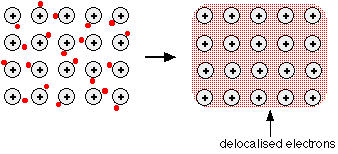
The diagram is a model, so do not picture electrons as red dots frozen in place. The key idea is that the electrons are mobile and spread across the metal structure.
A strong answer for copper would be:
Copper consists of a giant lattice of positive copper ions surrounded by delocalised electrons. Strong electrostatic attraction between the positive ions and the negatively charged delocalised electrons holds the metal lattice together.
Be careful not to call the delocalised electrons “negative ions.” An electron is a negatively charged particle, but it is not an ion.
One comparison table to learn well
| Bond type | Typical elements | Main particles present | Electrostatic attraction that is the bond |
|---|---|---|---|
| Ionic | Metal + non-metal | Positive ions and negative ions | Between oppositely charged ions |
| Covalent | Non-metal + non-metal | Positive nuclei and shared electron pair(s) | Between shared electrons and both positive nuclei |
| Metallic | Metal atoms only | Positive metal ions and delocalised electrons | Between positive metal ions and delocalised electrons |
The first two columns can help you make a quick initial prediction from a formula:
- , , and : metal plus non-metal, so use the ionic model.
- , , and : non-metals only, so use the covalent model.
- , , and : pure metals, so use the metallic model.
This is a reliable Level 2 starting rule. In every case, confirm your answer by naming the particles and attraction—not just by naming the elements.
Avoiding the most common exam errors
1. Calling electron transfer “the ionic bond”
Incomplete: “An ionic bond is when electrons transfer from sodium to chlorine.”
Better: “An electron transfers from sodium to chlorine, forming and ions. Ionic bonding is the strong electrostatic attraction between the oppositely charged ions.”
2. Forgetting the nuclei in covalent bonding
Incomplete: “A covalent bond is electrons being shared.”
Better: “A covalent bond involves a shared pair of electrons that is electrostatically attracted to the positive nuclei of both atoms.”
3. Treating metallic bonding as ionic bonding
Both involve electrostatic attraction, but the negative particles differ:
- In ionic bonding, the attraction is between positive ions and negative ions.
- In metallic bonding, the attraction is between positive metal ions and delocalised electrons.
4. Saying a metal has “free negative ions”
Metals have delocalised electrons, not negative ions. The metal ions are positive and occupy fixed positions in the lattice; the electrons can move through the structure.
Turning knowledge into an Excellence-level explanation
For this topic, a dependable writing structure is:
- Name the bonding type and structure.
- Identify the particles.
- State the exact electrostatic attraction.
For example, if asked to explain bonding in sodium chloride:
Sodium chloride has ionic bonding and forms a giant ionic lattice. Sodium atoms lose electrons to form ions, while chlorine atoms gain electrons to form ions. Strong electrostatic attractions between the oppositely charged ions hold the lattice together.
For oxygen gas:
Oxygen contains covalent bonds. Each pair of oxygen atoms shares electron pairs, and the shared electrons are electrostatically attracted to both positive oxygen nuclei.
For iron metal:
Iron has metallic bonding. It consists of a lattice of positive iron ions and delocalised electrons. Strong electrostatic attraction between the positive ions and the delocalised electrons holds the metal together.
The difference between a basic response and a high-quality response is usually the precision of the particles and attraction.
Key takeaways
- Ionic bonding: strong electrostatic attraction between positive and negative ions in a giant ionic lattice.
- Covalent bonding: electrostatic attraction between shared electron pairs and the positive nuclei of bonded atoms.
- Metallic bonding: strong electrostatic attraction between positive metal ions and delocalised electrons in a metal lattice.
- Electron transfer, electron sharing, and electron delocalisation explain how the relevant particles arise. The bond itself is the resulting electrostatic attraction.
Next, you will use valence electrons to predict how many bonds common non-metal atoms form. That will give you the rules needed to start drawing Lewis structures accurately.
Can't find a good explanation? Sign up and we'll make it for you
Sign up