
Hello. Last lesson established the bond-capacity pattern for common non-metals:
You also saw that nitrogen, oxygen, and halogens retain lone pairs after making their usual number of bonds. This lesson turns that knowledge into a reliable drawing method. By the end, you should be able to draw a complete Lewis structure for simple neutral molecules that contain only single bonds, including all lone pairs.
A Lewis structure is more than a displayed formula: it accounts for the molecule’s valence electrons. That makes it a useful starting point for later questions on molecular shape, polarity, and intermolecular attractions.
What a Lewis structure shows
A Lewis structure shows:
- atoms, written as element symbols;
- single covalent bonds, shown by a line;
- lone pairs, shown as pairs of dots.
One line represents one shared pair of electrons, so it represents two electrons:
The electrons in a bond are counted by both bonded atoms. A lone pair belongs to just one atom and is not shared.
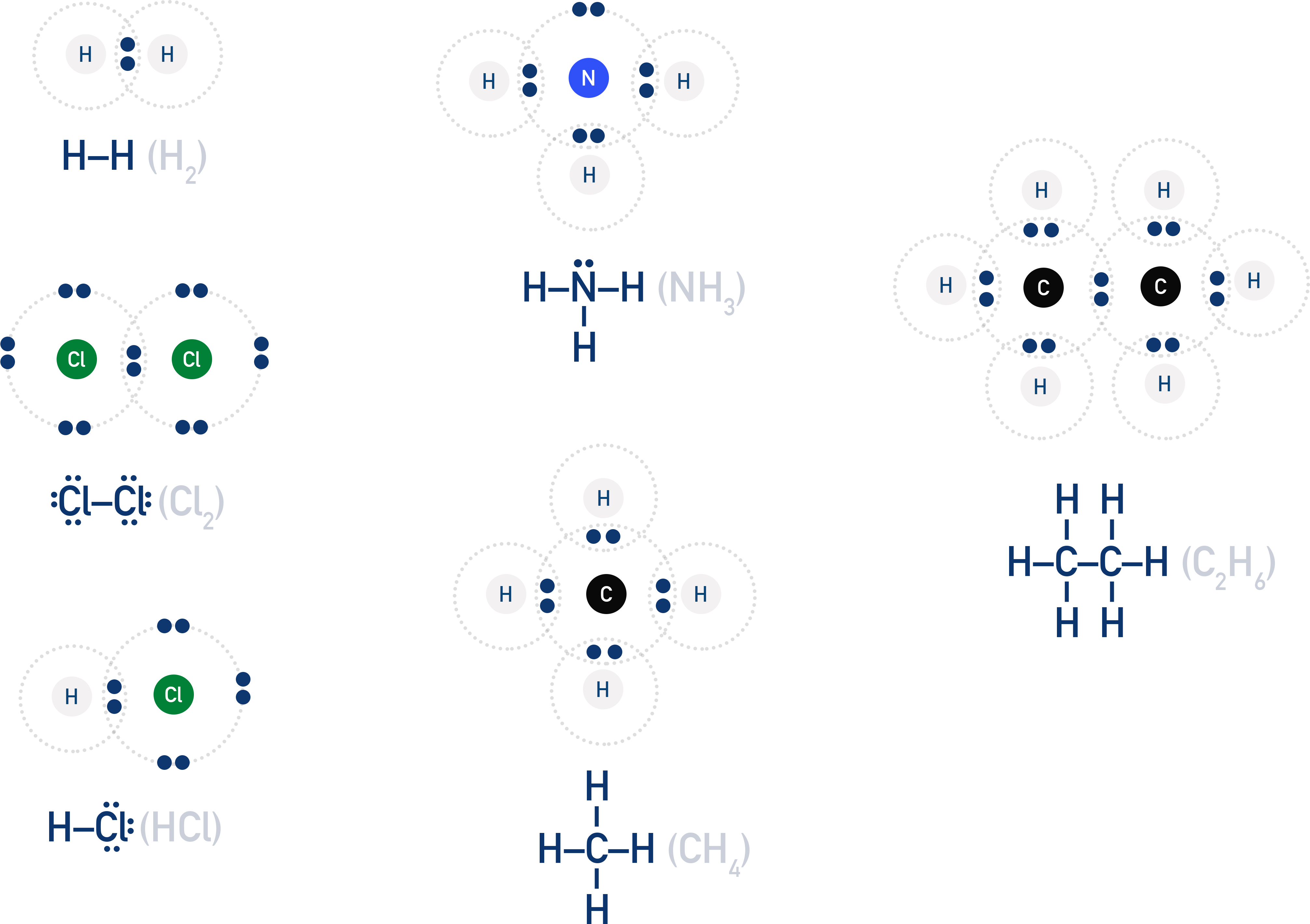
For example, hydrogen chloride has one bond and three lone pairs on chlorine:
  ..
H-Cl..
  ..
The position of lone pairs on paper is not important. You could draw chlorine’s three lone pairs above, below, and to one side, as long as there are three pairs in total.
A Lewis structure is not intended to show the exact three-dimensional shape of a molecule. It shows electron arrangement and which atoms are bonded; molecular shape comes later.
How to Draw Lewis Structures: Five Easy Steps
Watch How to Draw Lewis Structures: Five Easy Steps by Wayne Breslyn (Dr. B.) for a compact demonstration of the electron-counting method. It reinforces the two habits that prevent most errors: count the total electrons first, and remember that hydrogen is always an outside atom.
Watch in sequence. Start with electron counting, using water as the example. Then watch choosing the centre, paying particular attention to why hydrogen is never central. Finish with the HCl structure, where the remaining electrons become chlorine lone pairs.
The single-bond Lewis-structure method
For today’s molecules, use this seven-step routine every time. The method is slightly more deliberate than simply using the usual bond numbers, but it gives you a way to prove that every electron has been placed correctly.
1. Count all valence electrons
Add the valence electrons contributed by every atom in the formula.
For water, :
For ammonia, :
For hydrogen chloride, :
This total is your electron budget. You must use exactly that many electrons in the final structure: no more and no fewer.
2. Choose a central atom, when needed
For a molecule with more than two atoms:
- Hydrogen is never the central atom because it makes only one bond.
- Halogens such as and are usually outside atoms because they also usually make only one bond.
- Carbon is commonly central; nitrogen or oxygen may be central when they are the only non-hydrogen atoms available.
For , oxygen is central. For , nitrogen is central. For , carbon is central.
For a two-atom molecule such as or , there is no central atom.
3. Draw the skeleton using single bonds
Connect the central atom to each outside atom with a single line. Each line uses two electrons.
For water:
H-O-H
There are two single bonds, so the skeleton has used:
4. Subtract the bonding electrons
Water began with eight valence electrons. Its two bonds used four:
Those four remaining electrons must be drawn as two lone pairs.
5. Complete outer atoms first
Give each outside non-hydrogen atom enough electrons for an octet. Hydrogen is different: one bond already gives hydrogen its full duet of two electrons.
In , hydrogen is already complete after the bond. Chlorine needs three lone pairs in addition to that bond, giving it eight electrons around it.
6. Put any remaining electrons on the central atom
For simple single-bond molecules, the remaining electrons normally become lone pairs on the central atom.
- In , the remaining two electrons form one lone pair on nitrogen.
- In , the remaining four electrons form two lone pairs on oxygen.
- In , no electrons remain after four bonds, so carbon has no lone pairs.
7. Check the finished structure
Use three checks:
- Electron-budget check: Have you used the exact total number of valence electrons?
- Outer-shell check: Does each hydrogen have two electrons, and does each other common atom have eight?
- Bond-pattern check: Does each atom match its usual bonding pattern?
For today’s common neutral molecules:
| Atom | Usual pattern in a Lewis structure |
|---|---|
| 1 bond, no lone pairs | |
| 4 bonds, no lone pairs | |
| 3 bonds, 1 lone pair | |
| 2 bonds, 2 lone pairs | |
| , , , | 1 bond, 3 lone pairs |
Worked example: water
Let’s apply the whole method to .
Count the electrons
Water contains eight valence electrons in total.
Draw the single-bond skeleton
Oxygen is central:
H-O-H
Two bonds use four electrons.
Place the remaining electrons
There are four electrons left. Hydrogen cannot receive lone pairs because its first shell is already full with its one bond. Put both pairs on oxygen:
  ..
H-O-H
  ..
Check it
- Total electrons: two bonds contain four electrons, and two lone pairs contain four electrons. Total .
- Each H has one bond, so each has two electrons.
- Oxygen has two bonding pairs and two lone pairs: eight electrons around oxygen.
- Oxygen has its expected pattern: two bonds and two lone pairs.
This is the complete Lewis structure for water.
Recognising common complete structures
Once the counting method is secure, the common patterns become quick to draw.
Ammonia,
Total valence electrons:
Three bonds use six electrons, leaving one lone pair on nitrogen:
  ..
H-N-H
  |
  H
Nitrogen has three bonds and one lone pair. Each hydrogen has one bond.
Methane,
Total valence electrons:
Four bonds use all eight electrons:
  H
  |
H-C-H
  |
  H
Carbon has four single bonds and no lone pairs.
Chlorine,
Total valence electrons:
One bond uses two electrons. The remaining 12 electrons make three lone pairs on each chlorine atom.
Each chlorine therefore has:
- one bond;
- three lone pairs;
- eight electrons around it.
This matches the halogen pattern exactly.
7.3 Lewis Symbols and Structures - Chemistry 2e
Read the relevant parts of OpenStax Chemistry 2e, “Lewis Symbols and Structures,” to consolidate the meaning of a single bond, a lone pair, and the general structure-drawing procedure. The text includes later material on multiple bonds and ions; those are deliberately not part of today’s target.
First, in the subsection “Lewis Structures,” read the chlorine example. Focus on how one shared pair becomes a single bond and how the other electron pairs are lone pairs. Then find the subsection “Writing Lewis Structures with the Octet Rule.” Read steps 1 to 4. For this lesson, stop before the following step about rearranging electrons into multiple bonds; that is the focus of the next lesson.
Common errors that cost marks
Drawing a displayed formula instead of a Lewis structure
Writing
correctly shows water’s two bonds, but it is incomplete as a Lewis structure because oxygen’s two lone pairs are missing.
A complete Lewis structure must show both bonding pairs and non-bonding pairs.
Forgetting that a line contains two electrons
A single bond is not one electron. It is a shared pair, so each line counts as two electrons in the total electron budget.
For , three lines account for six electrons, and nitrogen’s lone pair accounts for the remaining two electrons.
Giving hydrogen an octet
Hydrogen follows the duet rule. It is complete with one single bond, which provides two electrons around hydrogen. Never add lone pairs to hydrogen in these simple molecules.
Omitting lone pairs on halogens
A halogen atom with one bond needs three lone pairs. In , chlorine is not complete until all three lone pairs are included.
Adding brackets or a charge to a neutral molecule
Today’s structures are neutral molecules, so do not add square brackets or an overall charge. Brackets and charges will become essential when you draw polyatomic ions in a later lesson.
Forcing a single-bond structure when the electron count says otherwise
Some molecules cannot be completed using only single bonds. Do not invent extra electrons or ignore an incomplete octet. The next lesson will show how double and triple bonds solve that problem.
Key takeaways
A complete Lewis structure for a simple neutral molecule should:
- use the correct total number of valence electrons;
- show every single bond as one line, representing two shared electrons;
- show all lone pairs as pairs of dots;
- give hydrogen a duet and common non-metals an octet;
- match the familiar patterns: has four bonds, has three bonds plus one lone pair, has two bonds plus two lone pairs, and halogens have one bond plus three lone pairs.
For every structure, treat the total valence-electron count as a final audit. It is the most dependable way to catch missing lone pairs.
Next, you will extend this method to molecules that need double or triple bonds to give all relevant atoms complete outer shells.
Can't find a good explanation? Sign up and we'll make it for you
Sign up