
Classifying Errors in Mixed WJEC Science Answers
Hello. This first module is about turning marked work into a practical route to higher-tier marks. A wrong answer is not just “something to revise”: it usually shows a specific kind of gap. Once you can name that gap accurately, your correction becomes much more useful.
Today you will learn to compare an answer with a WJEC mark scheme and label the main reason for each lost mark as a knowledge, command-word, calculation, or evidence error. This feedback routine will carry into the Biology, Chemistry, and Physics sections that follow.
Read the question before you read the mark scheme
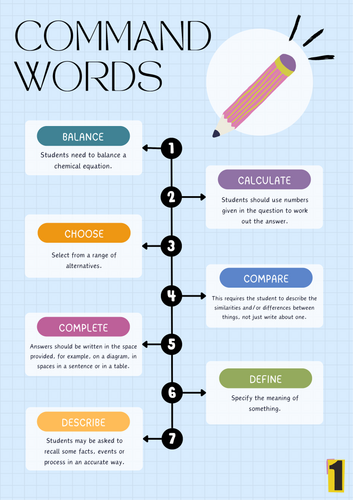
Start by treating the command word as part of the question, not as decoration. It tells you what kind of answer the examiner is looking for.
How to answer 6 mark questions in GCSE Science
Watch the short command-word sections of How to answer 6 mark questions in GCSE Science from Science Revision Channel. It gives a useful distinction between describing, explaining, and comparing—three instructions that are often confused in exam answers.
Watch describe and explain first. Notice that a description says what is observed or what happens, whereas an explanation gives a reason or mechanism. Then watch compare questions and note that a comparison needs points about both items, including similarities where relevant.
A quick command-word guide:
| If the question says… | Your answer should mainly do this | Common mistake |
|---|---|---|
| State / identify | Give the required fact, name, or value directly. | Writing something vague rather than the exact term. |
| Describe | Report a pattern, feature, or change. | Explaining why without saying what the pattern actually is. |
| Explain | Give a scientific reason, often linking cause and effect. | Giving a fact with no “because” link. |
| Compare | Refer to both things and make linked similarities and/or differences. | Writing several facts about only one thing. |
| Evaluate | Use evidence, limitations, and a supported judgement where required. | Giving an opinion without using the information supplied. |
| Calculate | Select values, show a sensible method, give a correct answer and unit. | Correct arithmetic but a missing or incorrect unit. |
| Complete | Put the requested information into the exact space, table, equation, or diagram. | Giving a related answer in the wrong form. |
A science answer can contain correct facts and still lose marks if it does not carry out the command word. That is why “I knew it really” is sometimes true—but does not yet earn the mark.
The four error categories
When you compare your answer with a mark scheme, do not simply copy the correct wording. Diagnose what went wrong.
1. Knowledge error
A knowledge error means the scientific fact, definition, process, term, or relationship was missing or incorrect.
For example, in the yeast investigation, the independent variable is the concentration of glucose solution and the dependent variable is the number of bubbles. If an answer swaps those around, the main issue is knowledge of experimental variables.
Feedback annotation
Knowledge error: You identified the variables incorrectly. The factor deliberately changed is glucose concentration; bubbles are what is measured.
Correction: Independent variable: glucose concentration. Dependent variable: number of bubbles.
Revision target: Independent, dependent, and control variables.
A useful test is: Would I have gained the mark if the question had been worded differently? If the answer is no because the scientific idea itself is wrong or absent, label it knowledge.
2. Command-word error
A command-word error occurs when you know relevant science, but answer the wrong task.
Imagine a question asks you to describe the relationship between temperature change and time. An answer such as:
“The reaction is exothermic, so it gets hotter.”
may contain relevant science, but it does not describe the pattern in the data. A description needs something like:
“The temperature change increases at first, reaches a maximum, and then decreases.”
The first response gives a general explanation. The second response does what describe asks.
Feedback annotation
Command-word error: You explained why an exothermic reaction heats up instead of describing the trend over time.
Correction: State the observed change first; only explain if the question asks for an explanation.
Exam habit: Underline the command word before writing.
This category is especially important on higher-tier questions with two instructions, such as “describe and explain” or “evaluate using the data.” Meeting only one instruction can cap the marks available.
3. Calculation error
A calculation error means that you had the right mathematical task but made an error in substitution, arithmetic, units, rounding, or processing the result.
The Unit 7 sample materials use:
If the mean temperature is and the start temperature is , then:
Writing would be a calculation error because the values have been combined incorrectly.
However, be precise when labelling mistakes:
- Using the correct equation but making an arithmetic slip is a calculation error.
- Choosing an equation for the wrong physical quantity is usually a knowledge error about equations.
- Obtaining the correct number but omitting the unit can still be logged as a calculation/presentation error, because the final answer is incomplete.
Feedback annotation
Calculation error: Correct values identified, but the operation should be subtraction, not addition.
Correction: .
Exam habit: Write the substitution line before using the calculator, then check whether the answer is a sensible size.
4. Evidence error
An evidence error happens when the answer makes a claim about results, a graph, or a table without using the relevant data correctly. This includes:
- quoting the wrong value;
- ignoring a value that weakens the claim;
- saying “the results prove” something when they do not;
- failing to support a conclusion when the question or mark scheme requires evidence.
This will be central in the next Biology lesson, where you will need to make conclusions from unfamiliar data.
The key distinction is this:
- A knowledge error is getting the scientific idea wrong.
- An evidence error is misreading, misusing, or failing to use the results provided.
Do not assume every graph-description question needs numerical quotations. Follow the wording of the question and the mark scheme. But if the question says “use the data,” “evaluate,” “support your answer,” or gives marks for a data comparison, numbers and units matter.
A worked WJEC marking example
Now use an official WJEC enquiry question and its mark scheme. The scientific context is chemistry, but the feedback method works across all three sciences.
WJEC GCSE The Sciences (Double Award) Unit 7
Open the WJEC sample assessment materials and look at a question where evidence, rather than extra factual recall, determines the marks.
Go to Unit 7b, Task B, page 39, Question 2(e). Read the iron-results question, especially the three iron temperature rises: 11\,^{\circ}\mathrm{C}, 15\,^{\circ}\mathrm{C}, and 19\,^{\circ}\mathrm{C}. Before checking the mark scheme, decide whether 11\,^{\circ}\mathrm{C} must be anomalous and write a one- or two-sentence reason.
A weak student answer might be:
“I agree. is the lowest result, so it must be anomalous.”
The response sounds plausible, but “lowest” does not automatically mean “anomalous.” Look at the spacing:
- is four degrees below .
- is four degrees above .
The readings are evenly spread. There is no single point that clearly stands apart from the other two.
WJEC GCSE The Sciences (Double Award) Unit 7
Now compare your reasoning with the official marking criteria. The purpose is not to copy its wording, but to identify exactly what evidence earns each mark.
In the Unit 7b Task B mark scheme on page 60, find Question 2(e)(ii). Read the anomaly criteria. Notice the two parts: use the numerical pattern, then make a justified conclusion about whether any result can definitely be called anomalous.
A high-mark answer could be:
“I do not agree that must be anomalous. It is four degrees below , but is also four degrees above . The results are equally spread, so any of them could be anomalous.”
How to classify the weak answer
| What the answer did | What the mark scheme required | Main error type | Useful correction |
|---|---|---|---|
| It noticed that was the lowest value. | It required a comparison of the spread of all three results. | Evidence | Compare each result with the others before claiming an anomaly. |
| It said the value “must” be anomalous. | It accepted that any result could be anomalous because the spread is even. | Evidence | Use cautious conclusions that match the data. |
This is not mainly a knowledge error. The student may know what an anomaly is. They lost marks because their conclusion was not properly supported by the results.
A reliable feedback-and-correction routine
Use this routine whenever you finish a past-paper question.
-
Mark the question in a different colour. Read the question again, then read each mark-scheme point separately.
-
Award marks honestly. If the mark scheme says “any two,” check whether you gave two distinct valid points. If it requires an explanation, a bare statement is usually not enough.
-
Underline the exact gap. Do not write only “wrong.” For example:
- “I used ‘precision’ when the question asked about ‘accuracy’.”
- “I gave an explanation instead of describing the graph.”
- “I did not include units.”
- “My conclusion did not use the values in the table.”
-
Choose one primary label. Use knowledge, command word, calculation, or evidence. If two categories overlap, choose the first cause of the lost mark and optionally add a secondary note.
-
Write a corrected answer from memory. Read the mark scheme, close or cover it, then write your own full-mark response. This matters more than copying.
-
Write a prevention rule. Keep it short and reusable, such as:
- “For compare: mention both items.”
- “For a calculation: equation, substitute, answer, unit.”
- “For conclusions from data: claim, data, conclusion.”
- “For explain: use a scientific cause-and-effect link.”
Use an error log like this:
| Question | Mark lost because… | Primary type | Corrected response | Prevention rule |
|---|---|---|---|---|
| Unit 7b 2(e)(ii) | I called the lowest value anomalous without comparing all readings. | Evidence | The readings are equally spread around . | Check every value before identifying an anomaly. |
A mark scheme does not require you to reproduce its exact sentence. WJEC mark schemes often allow alternatives, signalled by wording such as “accept,” “any,” or “or words to that effect.” Your job is to include the required scientific meaning, evidence, method, or calculation—not to guess a magic phrase.
Final checklist before correcting an answer
When a mark is missing, ask these questions in order:
-
Did I know the science?
If not, it is probably a knowledge error. -
Did I answer the command word?
If not, it is probably a command-word error. -
Was there a numerical, equation, unit, or arithmetic mistake?
If so, it is probably a calculation error. -
Did I support my claim with the correct graph, table, or experimental evidence?
If not, it is probably an evidence error.
The most valuable part of feedback is the corrected answer you produce afterwards. A page of mistakes becomes useful revision only when each mistake has a label, a repair, and a rule for next time.
You can now separate four common reasons for losing marks and use a WJEC mark scheme to justify your judgement. Remember: correct science can still lose marks through a missed command word, weak evidence, or an incomplete calculation.
Next, you will focus on Biology evidence questions: drawing a conclusion from an unfamiliar graph or table and supporting it with two correctly quoted pieces of data.
Can't find a good explanation? Sign up and we'll make it for you
Sign up