
IELTS General Training: Paper Structure, Timing, and Answer Rules
Hello, and welcome to your IELTS General Training preparation course. This first module establishes the practical baseline: before improving any skill, you need to know exactly what happens in the test room, where the time limits are tight, and which “small” answer-rule errors can cost marks.
IELTS General Training assesses four skills: Listening, Reading, Writing, and Speaking. Listening and Speaking are the same for General Training and Academic candidates; Reading and Writing are the papers designed specifically for General Training purposes such as everyday life, work, training, and migration.
By the end of this lesson, you should be able to describe every paper confidently: its structure, timing, and the answer rules that matter from the first practice test onward.
The whole test: a working map
The four skills receive separate band scores from 0 to 9, and these are combined into an overall band score. Your goal of Band 7 to 8 therefore requires reliable performance across all four papers; an excellent essay cannot fully compensate for weak Listening, for example.
For General Training at an official test centre, Listening, Reading, and Writing are taken in one sitting, in that order. Speaking may happen on the same day or on a nearby date, depending on the test centre.
Understand the IELTS test format: The ultimate guide | TakeIELTS Preparation
Watch "Understand the IELTS test format: The ultimate guide" from TakeIELTS Official for a concise orientation to the four skills, score reporting, and paper versus computer delivery.
Watch the overview to establish the four-skill structure and the individual and overall band scores. Then watch test delivery, focusing on the practical difference between paper and computer IELTS: paper candidates transfer answers to official answer sheets, while computer candidates type answers into the system. For General Training, take note that Speaking remains a live interview with an examiner.
Here is the basic structure to memorize:
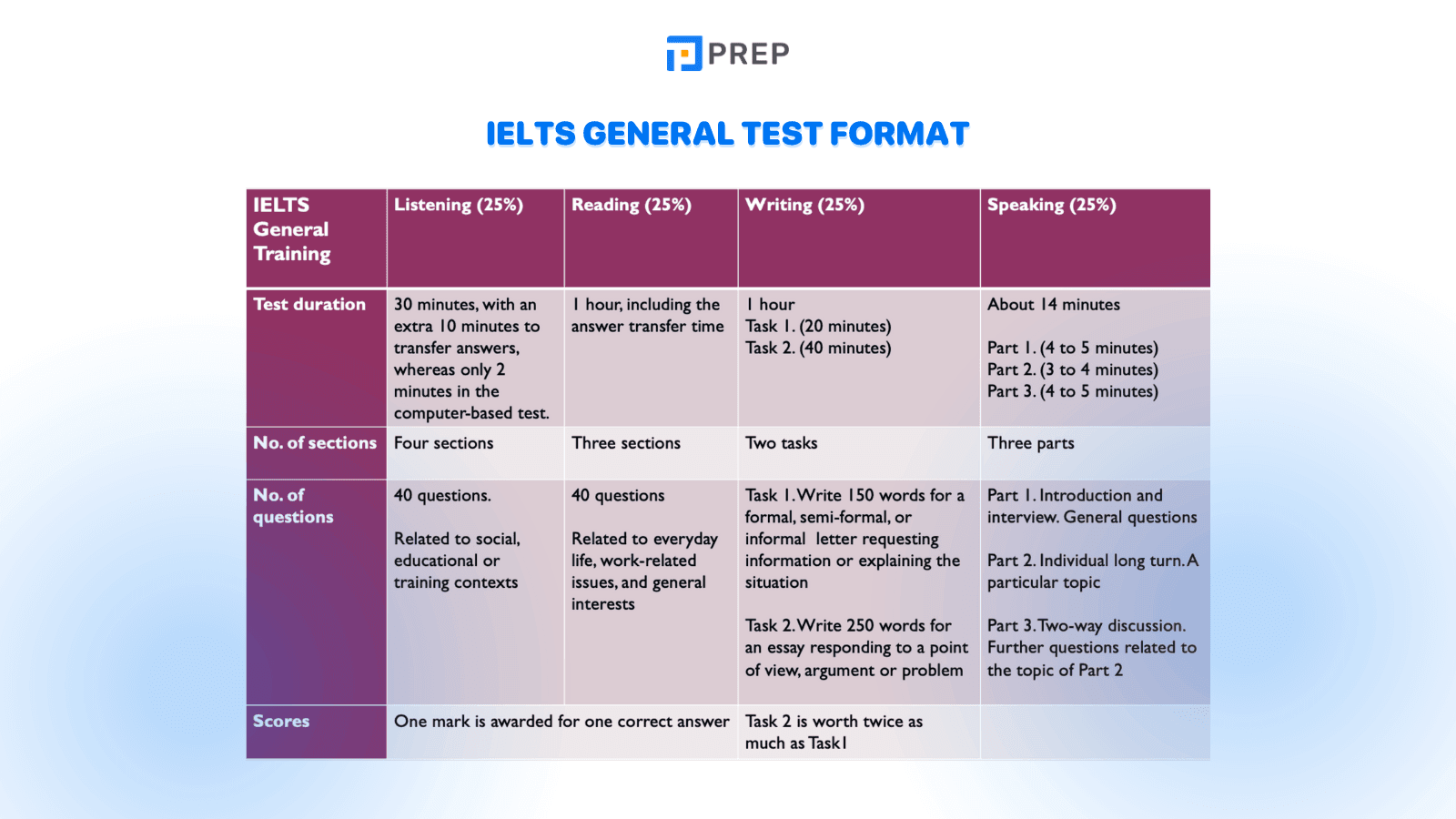
| Paper | Main structure | Time | Questions or tasks |
|---|---|---|---|
| Listening | 4 parts | about 30 minutes, plus checking or transfer time depending on delivery | 40 questions |
| Reading | 3 sections, increasing in difficulty | 60 minutes, including answer transfer | 40 questions |
| Writing | Task 1 letter and Task 2 essay | 60 minutes | 2 tasks |
| Speaking | Interview, individual talk, discussion | 11 to 14 minutes | 3 parts |
A useful distinction is between content rules and answer rules:
- Content rules tell you what the task requires: for example, a letter, an essay, or a short answer taken from a recording.
- Answer rules tell you how your response must be written: the exact number of words, a letter such as A or B, the required spelling, or the transfer deadline.
At Band 7 or 8, answer rules should be automatic. Losing a mark because you wrote three words when the instruction permitted two is entirely preventable.
Listening: one recording, one opportunity
Listening contains four parts of ten questions each, for a total of 40 questions. The recording is played once only, and the questions follow the order of the information you hear. In practical terms, if you miss Question 6, do not continue searching mentally for its answer while Questions 7 and 8 are being played. Mark what you can, rejoin the recording immediately, and protect later marks.
The four parts move through two broad contexts:
| Part | Speakers and context |
|---|---|
| 1 | A conversation between two people in an everyday social situation, such as arranging accommodation or travel |
| 2 | One speaker giving information in an everyday social situation, such as a talk about local facilities |
| 3 | A discussion in an education or training context, often between students and sometimes a tutor |
| 4 | One speaker giving an academic-style talk or lecture |
You may hear several accent varieties, including British, Australian, New Zealand, and North American English. This does not mean you need to imitate these accents. It means you must focus on meaning, not on expecting one familiar pronunciation.
IELTS | IELTS General Training: Listening test format
Read the official IELTS Listening format guide to fix the test structure and the rules that govern multiple choice, matching, labelling, and completion answers.
Begin with the opening section, “What’s in the IELTS Listening paper?”, and read from the four-part structure. Continue into the following paragraph beginning “Parts 3 and 4 deal” for the educational contexts, one-play rule, accents, and the official summary. Then, under “Types of question,” read the explanations of multiple choice, plan/map/diagram labelling, form/note/table/flow-chart completion, sentence completion, and short-answer questions. Focus especially on the word-limit rule, which appears in the completion-task descriptions. Notice that the permitted number of words can change from one task to another.
Listening answer rules
The main rule is simple: the instructions control the answer.
If the question says NO MORE THAN TWO WORDS AND/OR A NUMBER, all of these may be possible in principle:
Friday15 May24 pounds
But an answer with three words, even if the meaning is correct, receives no mark. Read “AND/OR” literally: you may use words, a number, or both, but never exceed the maximum given.
Also remember:
- For multiple choice or matching, write the requested letter or letters, not the full words from an option unless the instructions explicitly tell you otherwise.
- For completion answers, use the wording from the recording. Do not change the grammar to make it fit what you expected.
- Check spelling. A wrong spelling can lose the mark.
- Hyphenated terms count as one word in IELTS instructions. Contractions are not tested as answers.
- Each correct answer is worth one mark. There is no penalty for an incorrect answer, so never leave an answer blank merely because you are uncertain.
Paper versus computer Listening: on paper, the recording lasts about 30 minutes and you receive an additional 10 minutes to transfer answers to the answer sheet. On computer, you enter answers as you listen and receive approximately two minutes at the end to check them. The skill is the same, but the final-minute routine differs.
Reading: three sections, but no extra transfer time
General Training Reading has three sections, 40 questions, and 60 minutes total. The sections generally become more difficult.
| Section | Typical material | Core demand |
|---|---|---|
| 1 | Notices, advertisements, timetables, and practical information | Locate concrete details efficiently |
| 2 | Workplace texts, such as job descriptions, contracts, and staff-training material | Understand rules, duties, and conditions |
| 3 | One longer, more complex general-interest text | Follow ideas, details, and arguments across a sustained text |
Unlike Listening, Reading gives no extra answer-transfer time. The 60 minutes includes reading, answering, checking, and, for paper IELTS, writing all answers on the answer sheet. A strong default pacing plan is approximately 15 minutes for Section 1, then about 20 to 22 minutes each for Sections 2 and 3, with a few minutes protected for final checking. You will refine this plan later in the course.
IELTS | IELTS General Training format: Reading
Read the official IELTS Reading guide for the exact three-section structure, the transfer-time rule, and the most important instructions attached to common question types.
In “What’s in the IELTS General Training Reading section?”, read the section overview. Then read the paragraph beginning “You will need to transfer your answers” through the summary; focus on the fact that transfer time must fit inside the 60 minutes. Next, under “Types of question,” scan the descriptions of multiple choice, True/False/Not Given, Yes/No/Not Given, matching tasks, and completion tasks. Read the True False Not given rule. For sentence completion, summary completion, diagram labels, and short answers, focus on the repeated word-limit instruction and the warning that spelling and grammar affect accuracy.
Reading answer rules
Reading has a larger range of question types, but the same discipline applies: answer what the question asks, not what seems generally true.
For True / False / Not Given:
- True: the statement agrees with information in the text.
- False: the text states the opposite or contradicts it.
- Not Given: the text does not tell you enough to decide.
For Yes / No / Not Given, the logic is the same, but the target is the writer’s view or claim rather than a factual statement. Do not use your own background knowledge. IELTS is testing your reading of that particular text.
For word-completion and short-answer tasks:
- Circle the word limit before you search.
- Find the relevant location in the text.
- Copy only the required word or words.
- Count them before transferring your answer.
- Check spelling and grammar.
A common loss of marks comes from adding a harmless-looking extra word. If the answer key is local library and the instruction is “NO MORE THAN TWO WORDS,” writing the local library is wrong because it has three words. The test rewards precise compliance, not fuller phrasing.
Writing: two tasks, one shared clock
Writing lasts 60 minutes and consists of two written responses. Both must be completed; Task 2 is worth twice as much as Task 1 in the Writing score.
| Task | General Training requirement | Minimum length | Sensible time target |
|---|---|---|---|
| Task 1 | Write a letter responding to a situation and its bullet points | 150 words | about 20 minutes |
| Task 2 | Write an essay responding to a point of view, argument, or problem | 250 words | about 40 minutes |
In General Training Task 1, the letter may be formal, semi-formal, or informal, depending on the recipient and purpose. Task 2 is an essay and is broadly the same task type used in Academic IELTS.
Understand the IELTS test format: The ultimate guide | TakeIELTS Preparation
Return to TakeIELTS Official’s format guide for the Writing overview. It clearly contrasts General Training Task 1 with Academic Task 1 and explains the time and length requirements.
Watch the Writing format. Focus on the 20-minute and 40-minute split, the two minimum word counts, and the fact that General Training Task 1 is a letter. Note especially that Task 2 carries double the weight of Task 1.
Writing answer rules
Writing has no single “correct answer,” but it has non-negotiable requirements.
- Meet the minimum word count: at least 150 words for Task 1 and at least 250 for Task 2.
- In Task 1, address every bullet point in the prompt.
- In Task 2, answer every part of the question. A two-part question needs two answers.
- Write full connected prose, not notes or a list of ideas.
- Use the appropriate letter format and tone in Task 1.
- Use the answer booklet on paper IELTS or type directly into the response area on computer IELTS.
Writing much more than necessary is not automatically better. It can create extra grammar errors and consume time needed for Task 2. For now, treat the official word counts as a floor, not as a target to exceed dramatically.
Speaking: a live, structured conversation
Speaking lasts 11 to 14 minutes and is conducted with an examiner. Even if you take computer IELTS, the Speaking test is still a live interview with an examiner.
Understand the IELTS test format: The ultimate guide | TakeIELTS Preparation
Watch the Speaking section of TakeIELTS Official’s guide to see the three-part conversation structure and the timing of the cue-card task.
Watch the Speaking format. Focus on the change in demand across the three parts: personal questions, an individual long turn after one minute of preparation, and a broader discussion connected to the Part 2 topic.
The three parts are:
-
Part 1: Interview
About 4 to 5 minutes. The examiner asks familiar questions about daily life, such as work, study, home, interests, or routines. -
Part 2: Individual long turn
You receive a task card and have one minute to prepare. You then speak for one to two minutes on the topic. The examiner may ask one brief follow-up question. -
Part 3: Two-way discussion
About 4 to 5 minutes. The examiner asks broader, more abstract questions related to the Part 2 theme.
Speaking answer rules
Speaking is not a quiz with fixed factual answers. The examiner is assessing how well you communicate in English. Still, the format creates practical rules:
- Answer the examiner’s actual question; do not deliver a memorized speech that ignores it.
- In Part 1, give a direct answer and add a relevant reason or detail.
- In Part 2, use the one-minute preparation time to make brief notes, then speak until the examiner stops you.
- In Part 3, develop opinions with explanation and examples rather than giving one-sentence replies.
- If the examiner interrupts, stop politely. An interruption often means the time limit has been reached, not that your answer was poor.
The scoring criteria for Writing and Speaking will be unpacked in the next lesson. For today, the key point is that speaking format rewards controlled, relevant communication, not rehearsed performance.
Your test-day rule card
Before every task, pause briefly and ask:
- What must I produce? A letter, essay, letter choice, number, phrase, or spoken response?
- What is the limit? Time, word count, number of choices, or number of words?
- Where must the answer go? Paper answer sheet, computer field, Writing booklet, or spoken response?
- What must I check? Spelling, grammar, word count, transfer, or completeness?
The format itself is now clear:
- Listening: 4 parts, 40 questions, played once; guard word limits and use the right transfer routine.
- Reading: 3 sections, 40 questions, 60 minutes including transfer; do not lose marks through extra words, incorrect spelling, or confusion between False and Not Given.
- Writing: 2 tasks in 60 minutes; write a 150-word minimum letter and a 250-word minimum essay, giving Task 2 roughly twice the time.
- Speaking: 3 parts in 11 to 14 minutes; progress from personal answers to a prepared long turn and then a wider discussion.
Next, we will examine the four assessment criteria used to score IELTS Writing and Speaking. Knowing the format prevents avoidable mistakes; knowing the criteria tells you what a Band 7 to 8 performance actually needs to demonstrate.
Can't find a good explanation? Sign up and we'll make it for you
Sign up