
Hello — having mapped the UK’s institutions in the previous lesson, you now need to use that map in the way the Life in the UK Test often demands: identify the principle at stake, distinguish a right from a responsibility, and choose the appropriate civic or legal route.
This is a pass-first, scenario-focused lesson. By the end, you should be able to handle questions about voting, equality, the rule of law, criminal versus civil disputes, and constructive ways to take part in local and national life. Plan for about 30 minutes, including the two short video segments.
1. The civic lens: five principles, not five slogans
The test presents the UK as a democracy built on shared civic principles. Learn the words, but more importantly learn what each would mean in a situation.
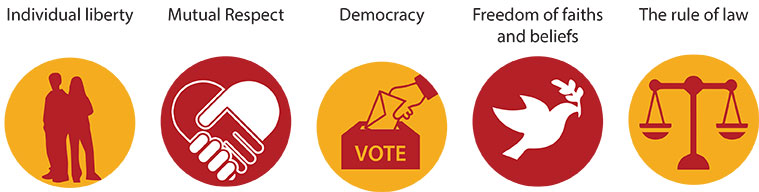
| Principle | In practical terms | Exam-safe interpretation |
|---|---|---|
| Democracy | People have a say through elections and representation. | Vote if eligible; engage with elected representatives; accept lawful electoral outcomes. |
| Rule of law | Laws apply to everyone, and courts operate independently. | Nobody is above the law; obey the law even when a practice may be accepted elsewhere. |
| Individual liberty | People can make personal choices and express views within the law. | Your freedom does not include harming, threatening, or denying others’ rights. |
| Mutual respect and tolerance | People with different backgrounds, beliefs, and identities should be treated fairly. | You do not have to agree with another person’s views or faith, but you must respect their right to hold them. |
| Freedom of faith and belief | People may practise a religion, change religion, hold no religion, or hold other beliefs. | Discrimination or hostility based on faith or belief conflicts with equality and mutual respect. |
A useful distinction is that community participation is not a substitute for tolerance. It is a related civic responsibility: improving the place where you live through volunteering, voting, serving when called upon, joining groups, or contributing to a local institution.
A fast scenario method
When a test question gives you a short story, make four checks:
- What area is this? Democracy, rights, law, or community participation?
- Whose right or responsibility is involved?
- Is this criminal law, a civil dispute, or a political/local issue?
- Which lawful route fits? Vote, contact an MP or councillor, seek advice, use a civil process, or contact police where there is crime or immediate danger.
This prevents a common trap: choosing an action that sounds active but uses the wrong institution. An MP cannot personally decide a neighbour dispute; police do not resolve every disagreement; and disagreement with a religious or political view is not itself a reason to silence someone.
2. Democracy in action: voting is local, secret, and representative
A UK general election is not a direct election for Prime Minister. You vote for one candidate to be MP for your constituency. The candidate with the highest number of votes wins that seat under first past the post. Across the country, the party able to command the confidence of most MPs in the House of Commons usually forms the Government.
Life in the UK Test 2025 | Chapter 5: The UK Government, the Law & Your Role Explained
Watch “Life in the UK Test 2025 | Chapter 5: The UK Government, the Law & Your Role Explained” from Tea Break Academy for a visual walkthrough of voter eligibility, registration, polling stations, and postal voting.
In the section on voter eligibility and registration, watch the voting process. Focus on the sequence: eligibility, being on the electoral register, receiving a poll card, completing a ballot in private, and using a postal vote when needed.
For test purposes, retain these core election facts:
- At a general election, each constituency elects one MP.
- You must be registered to vote before you can vote.
- General-election eligibility includes being aged 18 or over and meeting the relevant nationality requirements. British, Irish, and qualifying Commonwealth citizens may vote if registered.
- A poll card tells you where and when to vote. It is useful information, not a ballot.
- The ballot is secret. No partner, employer, campaigner, or family member has the right to decide your vote.
- You may vote in person, by post, or in some circumstances by proxy.
- If an MP dies or resigns, that constituency holds a by-election.
Apply the facts, rather than reciting them
| Situation | Best interpretation |
|---|---|
| A candidate wins with 38% of votes in the constituency; no one has over 50%. | The candidate still wins the seat: first past the post means the candidate with the most votes wins. |
| A campaigner asks whom you voted for. | You may tell them if you wish, but the vote is secret and the choice is yours. |
| A resident wants a different national policy on housing. | They can vote, contact their MP, join or support a political party, or work with a pressure group. |
| A resident wants a bin collection problem resolved on their street. | Start with the local council or councillor, since waste services are a local-government matter. |
| An MP has left office midway through a Parliament. | A by-election may be held in that MP’s constituency; there is no need to elect every MP again. |
The wider point is democratic participation. Voting matters, but it is not the only route. You can contact your MP, attend an MP’s local advice session, respond to consultations, campaign peacefully, join a political party, or support a pressure group. A pressure group seeks to influence policy around a cause; it does not need to be a political party seeking to form a government.
3. Rights, equality, and responsibilities: freedom with boundaries
UK civic life combines individual rights with duties towards other people. The Human Rights Act 1998 gave effect in UK law to rights in the European Convention on Human Rights. For the test, the important idea is not a long legal list; it is the principle that public authorities and courts must respect fundamental rights, including rights connected to life, liberty, a fair trial, thought, conscience, religion, and expression.
Rights are meaningful because they apply to people whose views, religion, ethnicity, disability, gender, age, or sexual orientation may differ from your own. Equality does not require people to be identical. It requires fair treatment and protection against unlawful discrimination.
At the same time, rights do not give someone a licence to harm others. A person may express an opinion, but not make threats or commit hate crimes. A person may practise a religion, but not compel another person into marriage. Individual liberty works within the rule of law.
Life in the UK Test 2025 | Chapter 5: The UK Government, the Law & Your Role Explained
Use four short parts of the same Tea Break Academy video to connect legal duties, protected rights, and practical community participation. Treat its examples as revision prompts; the scenario rules below are the key material to retain.
First, in “Respecting the law,” watch law categories for the criminal-versus-civil distinction. Then watch rights and equality in “Core principles,” followed by civic duties in “Your place in society.” Finally, in “Engaging in volunteer work,” watch participation routes: jury service, school involvement, school governors, political activity, and volunteering.
A compact way to organise rights and responsibilities is below.
| Rights and protections | Corresponding civic responsibilities |
|---|---|
| Be treated fairly and protected from discrimination. | Treat others fairly regardless of background, belief, sex, disability, age, race, or sexual orientation. |
| Freedom of thought, conscience, religion, and expression. | Respect other people’s lawful freedoms and do not use freedom as a cover for abuse, threats, or hate crime. |
| A fair and independent legal process. | Obey the law and cooperate with legal processes, including jury service if summoned and eligible. |
| Democratic participation. | Register and vote if eligible; engage honestly and peacefully in public life. |
| Public services supported by taxation. | Pay the taxes and National Insurance contributions that apply to you. |
Other high-yield responsibilities include supporting yourself and dependants where possible, caring for the environment, and helping others. In exam questions, the most civic-minded answer is usually the one that is lawful, proportionate, respectful of others, and routed through the right public body.
4. The rule of law: classify the problem before choosing a response
The previous lesson established that Parliament makes laws and the Government administers them. Here, add the judiciary: judges interpret law and ensure fair trials independently of Government. This independence is part of the rule of law.
For test scenarios, start with one decisive distinction.
| Criminal law | Civil law |
|---|---|
| Concerns offences against the law and public safety. | Resolves disputes between individuals or organisations. |
| Examples: carrying weapons unlawfully, drug offences, hate crimes, selling tobacco or alcohol to under-18s. | Examples: consumer disputes, employment disputes, debt, contracts, housing and landlord-tenant disagreements. |
| Police may investigate; criminal courts determine guilt and sentence. | A court or tribunal may decide responsibility, compensation, or another remedy. |
Do not confuse “serious” with “criminal.” A disputed unpaid bill can be stressful and expensive, but it is usually a civil matter. Conversely, violence, threats, unlawful weapons, or hate crime may be criminal even if they occur between people who know one another.
Some basic rules particularly associated with the handbook are worth recognising:
- Domestic abuse is a serious crime; it is not a private matter beyond the law.
- Forced marriage is illegal. An arranged marriage is lawful only when both people freely consent.
- Female genital mutilation, including taking someone abroad for it, is illegal.
- Smoking is prohibited in enclosed public places and workplaces.
- It is illegal to buy alcohol for someone under 18, subject to limited exceptions set out in law.
- If someone attempts to draw a person into extremism or terrorism, the appropriate response is to report the concern to the police.
Scenario decoder: choosing the lawful channel
| Scenario | Classification | Appropriate response |
|---|---|---|
| A shop sells a faulty laptop and refuses a refund. | Civil/consumer dispute | Use consumer-rights advice and the appropriate civil route; it is not normally a police matter. |
| A landlord refuses to return a deposit after a tenancy dispute. | Civil/housing dispute | Seek housing or legal advice and use the relevant dispute process. |
| A colleague is repeatedly abused because of their religion or ethnicity. | Potential discrimination and potentially a hate crime | Record concerns, use workplace processes where appropriate, and report criminal conduct to police. |
| A relative says a young adult must marry someone against their wishes. | Forced marriage; criminal conduct | Seek urgent help and protection through police and specialist support. |
| A person complains that police acted improperly. | Accountability of public authority | Make a complaint through the police complaints process; police are also subject to the law. |
| Someone advocates a policy you strongly dislike. | Democratic disagreement | Challenge it peacefully: debate, campaign, vote, contact representatives, or join a group. Disagreement alone is not a crime. |
The test often rewards the answer that preserves both safety and due process. Taking personal revenge, using threats, or assuming the police should settle a civil disagreement will be wrong options.
5. Community participation: citizenship beyond the ballot box
Participation can operate at several scales. In product terms, think of it as selecting the right level of intervention: address a neighbourhood service locally, national policy through parliamentary representation, and a shared concern through collective action.
| Route | When it fits |
|---|---|
| Contact a councillor or local council | Local services: waste, planning, local roads, libraries, housing services, neighbourhood concerns. |
| Contact an MP | A national-policy issue, a concern about government departments, or a matter where parliamentary representation is relevant. |
| Join a political party or campaign group | You want to support a platform, influence policy, canvass, or campaign during elections. |
| Volunteer | You want to contribute practical time to a charity, local service, school, museum, hospital, youth project, environmental group, or community organisation. |
| Become a school governor | You want to help set a school’s strategic direction and hold its leadership accountable. Governors must be at least 18. |
| Serve when called | Eligible people on the electoral register may be selected for jury service, which supports fair trials. |
| Become a magistrate, special constable, or community representative | You want a sustained public-service role, subject to the relevant selection process. |
Community participation is voluntary in many forms, but it is not trivial. It is one way democratic societies turn broad values such as mutual respect and responsibility into daily practice.
One-minute recall card
Before moving on, reconstruct these six lines from memory:
- Democracy: elect representatives; vote is secret.
- Rule of law: everyone is subject to law; courts are independent.
- Individual liberty: personal freedom within the law and with respect for others.
- Mutual respect and tolerance: different beliefs and identities receive fair treatment.
- Criminal versus civil: offences versus disputes between people or organisations.
- Participation: vote, contact representatives, join campaigns, volunteer, serve the community.
Key takeaways
The Life in the UK Test is likely to frame civic knowledge as a short scenario. Your reliable approach is to identify the principle involved, classify the issue correctly, and choose the lawful and democratic route.
Remember these contrasts:
- Freedom of belief does not require agreement; it requires respect for lawful differences.
- Individual liberty operates within the rights and safety of others.
- Criminal law concerns offences; civil law settles disputes.
- A councillor/local council is usually the first route for local services; an MP represents constituents at national level.
- Voting, volunteering, jury service, school governance, and peaceful campaigning are all routes to active civic participation.
Next, you will shift from learning individual topics to timed Life in the UK Test practice, using the facts and distinctions from the whole course under exam conditions.
Can't find a good explanation? Sign up and we'll make it for you
Sign up