
Hello! Welcome to our first lesson in this new module on the functions and benefits of sleep.
In our last module, we built a complete blueprint of a night's sleep. We saw how the architecture of sleep is dynamic, with the first half of the night dominated by physically restorative deep sleep (N3) and the second half dominated by the mentally active state of REM sleep.
Today, we'll start answering the question, "Why is this architecture so important?" We'll explore one of sleep's most critical roles. The learning outcome for this lesson is to explain the role of sleep in memory consolidation and learning. You'll discover that sleep isn't just a passive state of rest; it's an active and essential process for how we acquire knowledge and skills.
Sleep's Indispensable Role: Before and After Learning
It might be tempting to think of learning as something that happens exclusively when we are awake and studying. However, research has revealed that sleep plays a crucial two-part role: it prepares the brain to learn new things, and it solidifies those new things into lasting memories afterward.
To begin, let's watch a segment from a keynote address by Dr. Matthew Walker, a prominent sleep scientist. He clearly explains this dual role.
Why Sleep?: Matthew Walker's CNS 2019 Keynote
In this clip from 'Why Sleep?: Matthew Walker's CNS 2019 Keynote', Dr. Walker presents compelling evidence for why sleep is necessary both before and after learning.
Please watch the segment from 07:07 to 10:44. Pay close attention to the 'dry sponge' analogy and the experiment he describes, which reveals the consequences of sleep deprivation on the ability to form new memories.
As Dr. Walker explains, there are two key concepts:
- Sleep Before Learning: Sleep prepares the brain to acquire new information. Without sleep, the hippocampus—a brain region critical for forming new memories, acting like the brain's informational "inbox"—effectively shuts down. New information can't be "saved" and is essentially lost.
- Sleep After Learning: Sleep processes the information you acquired during the day and commits it to long-term storage, a process called memory consolidation.
This process of consolidation is what prevents us from forgetting what we've learned.
What is Memory Consolidation?
Let's explore the idea of consolidation more deeply. Without it, new information is fragile and easily forgotten.
The benefits of a good night's sleep - Shai Marcu
This short animated video from TED-Ed, 'The benefits of a good night's sleep', provides an excellent overview of memory consolidation, starting with a classic psychological finding.
Watch from 01:23 to 03:28. This segment explains the 'forgetting curve,' defines memory consolidation, and introduces the key brain structures involved, particularly the hippocampus.
Memory consolidation is more than just moving information from a short-term to a long-term "box." A more precise way to think about it is as a process where the brain:
- Stabilizes a memory trace after its initial acquisition.
- Sorts through the day's experiences, deciding what is important to keep.
- Integrates the new memory with your existing networks of knowledge.
This happens most effectively during sleep.
How Sleep Consolidates Memories: The Brain's Night Shift
So, how does the brain accomplish this complex task? The process involves a remarkable dialogue between different brain regions during specific sleep stages.
For a deeper dive into the mechanisms, the following article provides a fantastic summary of the science.
The article 'Sleep Melds Memories' from Harvard Medicine Magazine offers a comprehensive look at the research behind sleep-dependent memory consolidation.
Please read the first three sections of the article, ending just before the sub-heading 'Core memory'. This will give you the historical context and a clear definition of consolidation and the types of memory sleep helps process.
The article highlights that sleep is essential for consolidating both:
- Declarative memories: Things you can consciously recall, like facts, figures, and personal events.
- Implicit (or procedural) memories: Things you do without conscious thought, like riding a bike or playing a musical instrument.
This is where the sleep architecture we learned about in the last module becomes crucial. Different stages of sleep appear to specialize in consolidating different types of memories.
The Hippocampus-to-Cortex Transfer in Deep Sleep
As we've learned, declarative memories are initially encoded in the hippocampus. For long-term storage, they must be transferred to the cerebral cortex, the brain's vast outer layer. This transfer is a key feature of deep NREM sleep (Stage N3).
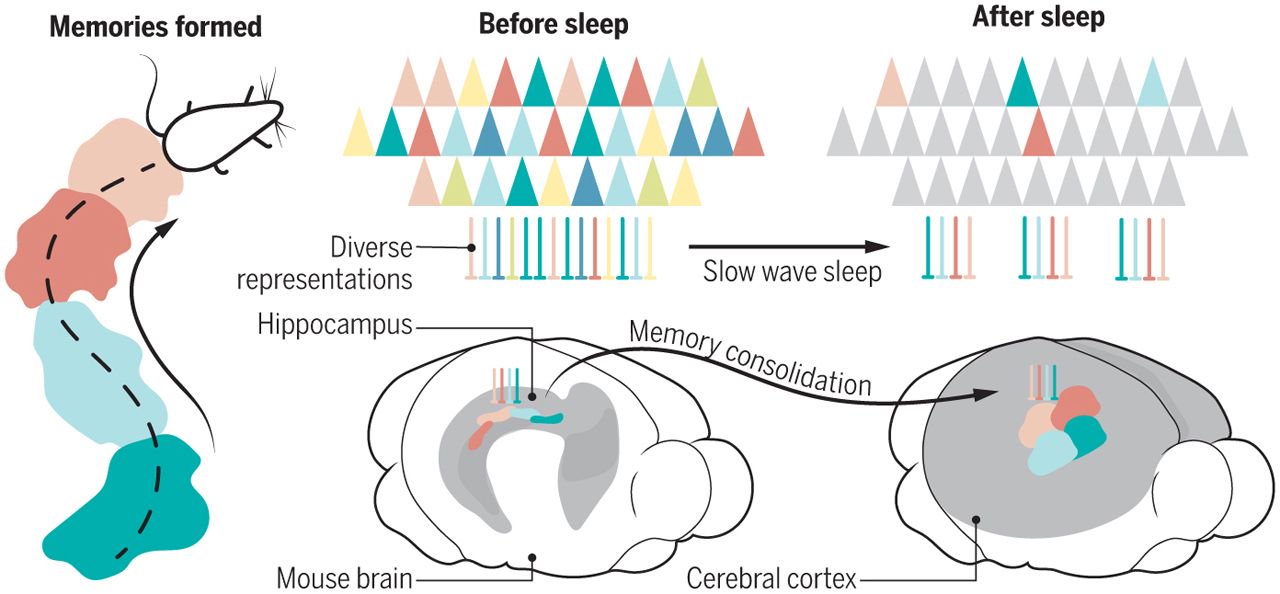
This process isn't just a simple file transfer. It's a carefully choreographed symphony of neural activity.
Let's return to the Harvard article 'Sleep Melds Memories' to understand the specific electrical signals involved.
Read the section titled 'Sleep sleuths'. It describes a triad of brain signals—slow waves, sleep spindles, and hippocampal ripples—that work together during NREM sleep to move memories to the cortex.
To summarize this elegant mechanism during NREM sleep:
- The cortex produces large, rolling slow waves.
- At the peak of these waves, the thalamus generates brief, powerful bursts of activity called sleep spindles.
- These spindles appear to open a communication channel, allowing the hippocampus to send out sharp-wave ripples—the memory information packets—to be stored in the cortex.
The Role of REM Sleep
While deep sleep is critical for facts and knowledge, REM sleep plays a vital role in other types of learning.
The benefits of a good night's sleep - Shai Marcu
The TED-Ed video we watched earlier makes a clear distinction between the roles of NREM and REM sleep.
Please watch the segment from 03:39 to 04:53. Focus on which type of memory is associated with slow-wave sleep versus REM sleep.
As the video and other research suggest:
- NREM (Slow-Wave) Sleep is primarily for consolidating declarative memory (facts, knowledge). This makes sense, as N3 sleep dominates the first half of the night, allowing the brain to prioritize processing the day's events.
- REM Sleep is crucial for consolidating procedural memory (motor skills), enhancing creativity, and processing emotional memories. This helps explain why REM periods get longer in the second half of the night, as the brain shifts its focus to integrating skills and emotional experiences.
Test your understanding!
A pianist is practicing a new, technically difficult piece of music for several hours. A student is spending the same amount of time memorizing historical dates for an exam.
To maximize their learning, which part of the night's sleep is arguably more critical for the pianist versus the student? Why?
Show answer
- The pianist, who is learning a complex motor skill (procedural memory), would benefit most from the long periods of REM sleep that dominate the second half of the night.
- The student, who is memorizing facts (declarative memory), would rely more heavily on the deep NREM sleep (N3) that is most abundant in the first half of the night.
This shows how a full night's sleep is necessary to consolidate all types of learning.
From Unconscious Processing to Conscious Practice
We have seen that sleep is an incredibly intelligent, unconscious process for managing memory. This provides a fascinating point of contrast for our course's ultimate goal, which is to explore the intersection of sleep science and Jain philosophy.
Your interest in Acharya Mahapragya's teachings on Preksha Dhyaan relates directly to this. While sleep automatically and unconsciously consolidates memory, meditation is a method for bringing conscious awareness and control to mental processes. Interestingly, science is beginning to validate the cognitive benefits of these ancient practices. For example, a study on Preksha Dhyaan found that its techniques significantly improved short-term memory and attention in college students.
This parallel raises a central question we will return to throughout this course: What is the fundamental difference between the brain’s automatic, unconscious housekeeping during sleep and the deliberate, conscious refinement of the mind through meditation? Understanding the mechanics of memory consolidation during sleep provides the essential scientific foundation for exploring that very question later on.
Conclusion
In this lesson, we've unpacked the vital role that sleep plays in learning and memory. Far from being a waste of time, sleep is a critical period of intense neural activity that solidifies our daytime experiences into lasting knowledge and skills.
Key Takeaways:
- Sleep is essential both before learning (to prepare the hippocampus) and after learning (to consolidate memories).
- Memory consolidation is the process by which fragile, short-term memories are stabilized and integrated into long-term storage in the cortex.
- Sleep architecture is optimized for memory: NREM deep sleep, dominant early in the night, is crucial for consolidating declarative memories (facts).
- REM sleep, dominant late in the night, is essential for consolidating procedural memories (skills) and emotional experiences.
- The consolidation of declarative memory involves a coordinated dialogue between the cortex, thalamus, and hippocampus, marked by slow waves, sleep spindles, and sharp-wave ripples.
Preview of the Next Lesson:
Memory is just one of sleep's many benefits. In our next lesson, we will shift our focus from the brain's software to its hardware. We'll explore how sleep supports physical restoration and cellular repair, and we'll introduce a remarkable discovery known as the glymphatic system—the brain's unique "waste clearance" process that runs almost exclusively during sleep.