
Welcome back. In the last lesson, you substituted known values into formulas carefully, preserving negative signs, powers, and units. This lesson reverses the perspective: instead of putting numbers into a formula, you will rearrange the formula itself so that the quantity you need is alone.
This is a core Mathematics Standard skill. It appears in motion, measurement, financial mathematics, and science formulas. By the end, you should be able to make a requested variable the subject, including when the formula contains brackets, fractions, powers, or the target variable on both sides.
The subject and the balance rule
The subject of a formula is the variable isolated on one side of the equals sign. In
the subject is . If a question asks you to make the subject, the final answer must have the form
—not a numerical answer.
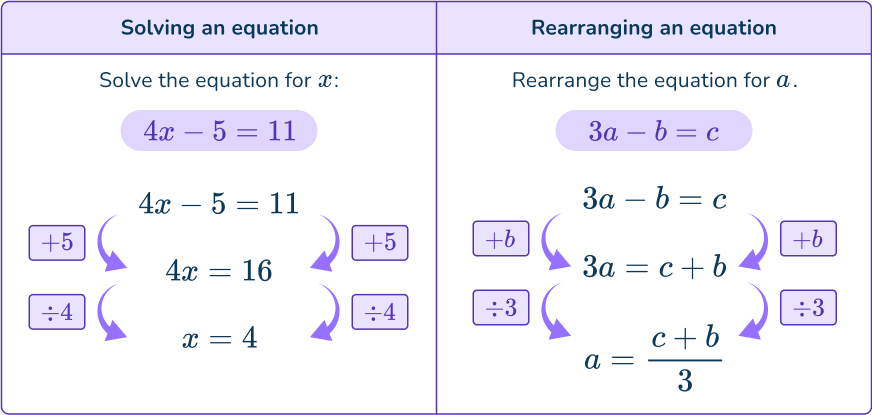
The method resembles solving an equation, but every letter remains a variable. The rule that keeps the formula true is:
Whatever operation you perform on one side of the equation, perform exactly the same operation on the other side.
Do not think that terms “move across the equals sign and change sign.” Instead, describe the actual operation: subtract from both sides, divide both sides by , and so on. This protects you from errors in more complicated formulas.
1.04 Changing the subject of a formula | Year 11 Maths | NSW Mathematics Standard 11 - 2020 Edition
Read Mathspace’s “Changing the subject of a formula.” It establishes the meaning of “subject” and models the same balanced-equation method used in this lesson.
In the “Lesson” section, begin with the introductory explanation. Then work through “Worked examples,” especially Examples 1 and 2: the average-speed formula shows multiplication and division, while the straight-line equation shows how to remove an added term before dividing. Read Example 3 as a preview of handling a squared variable. Keep track of the operation performed on both sides at every line.
Undo operations in reverse order
Suppose a movement formula is
where is final velocity, is initial velocity, is acceleration, and is time. Make the subject.
The is first multiplied by , but the term also has added to it. To isolate , undo the operations in the reverse order:
- Remove the added by subtracting from both sides.
- Remove multiplication by by dividing both sides by .
Write the subject on the left:
The fraction bar is essential. It tells us that the entire expression is divided by .
A common incorrect answer is:
This divides only by , which is not the same operation.
A reliable rearrangement routine
For most formulas:
- Circle the requested subject in the question.
- Identify the operations attached to it.
- Undo the outside operation first, using its inverse on both sides.
- Continue until the target variable is alone.
- Rewrite the final line with the subject on the left.
- Check that brackets and fraction bars include every required term.
For , the operations affecting are: multiplication by , then addition of . Working backwards gives subtraction, then division.
Brackets prevent fraction errors
Consider the linear formula
Make the subject.
First remove :
Then divide both sides by :
Therefore,
The subtraction must happen before division. If you write
you have divided only the , not the full left-hand side.
The same issue arises when multiplying. Suppose
and is required as the subject.
Now multiply both sides by :
Thus,
You may expand this as
but leaving the answer as is already correct and often makes the original structure clearer.
GCSE Maths - How to Rearrange Formulas (2026/27 exams)
Watch Cognito’s “GCSE Maths - How to Rearrange Formulas.” These opening examples give a compact visual demonstration of isolating a variable and treating an entire expression correctly when multiplying or dividing.
Watch the core idea for the definition of isolation. Then watch the first example, focusing on why y-4 must stay together over 3. Continue with division by three and a bracket example. Finish with the final example, noticing how multiplication applies to every term inside brackets.
Products and fractions in practical formulas
Many formulas contain several variables multiplied together. Treat the whole product as one object.
For average speed,
where is speed, is distance, and is time.
To make the subject, multiply both sides by :
so
To make the subject, instead divide both sides by :
That layout is awkward. A clearer approach begins by recognising that equals divided by , then multiplying both sides by :
Finally divide by :
The formula makes practical sense: time equals distance divided by speed.
Rearranging a percentage formula
In the previous lesson, you used simple interest:
where is interest, is the principal, is the annual percentage rate, and is time in years.
If a question gives the interest, rate, and time, but asks for the principal , first remove the division by :
Then divide by the entire product :
Writing would mean “divide by , then multiply by ,” so it is different. A denominator containing more than one factor needs clear grouping.
In real contexts, division also assumes that the divisor is not zero. For example, is only meaningful if .
When the target variable is squared
Some formulas require one final inverse operation involving a power. The kinetic-energy formula is:
To make the subject, first isolate .
Multiply by :
Divide by :
Finally, take the square root:
In this context, represents speed, so the non-negative square root is used.
In purely algebraic situations, if a variable can be positive or negative and you reach
then both values may be possible:
The context decides whether both solutions make sense. A speed, length, or radius cannot be negative; an unrestricted algebraic variable can be.
A useful checkpoint: never take the square root until the squared term is isolated. For example,
does not give
because must be divided out, not multiplied in.
When the variable appears on both sides
Sometimes the target variable occurs in more than one term. The aim is to collect all of those terms on one side before factorising.
Rearrange the following formula to make the subject:
Add to both sides so that both -terms are on the left:
Both terms contain , so factorise:
Now divide by :
The key algebra step is:
You cannot “cancel” from , because cancellation works with factors across a whole product or fraction, not with terms joined by addition.
This result assumes
because division by zero is undefined.
Check the rearrangement, not just the appearance
A final formula can look plausible while still being wrong. A quick check uses substitution.
From
we obtained
Take . The original formula gives:
Now use in the rearranged formula:
Both formulas agree, which supports the rearrangement.
You can also use units as a check in contextual questions. From
if distance is in metres and speed is in metres per second, the units become:
So the rearranged formula produces time in seconds, as it should.
In an exam, show enough lines for the marker to follow your logic. A strong response usually includes the original formula, at least one intermediate balanced step, and the final formula with the requested subject on the left.
Key takeaways
Rearranging a formula means producing an equivalent formula with a different variable isolated as the subject. The essential habits are:
- perform the same operation on both sides;
- undo operations in reverse order;
- divide or multiply the whole expression, using brackets or a fraction bar;
- factorise when the subject appears in more than one term;
- isolate a squared term before taking a square root;
- use the context to decide whether a negative square-root solution is possible;
- verify with a numerical substitution or a units check when time allows.
Next, you will apply formulas in a financial setting by calculating gross earnings from hourly wages, overtime, piecework, and commission.
Can't find a good explanation? Sign up and we'll make it for you
Sign up