
Welcome back. Last lesson dealt with two-dimensional measurement: perimeter measures an outside distance, area measures a flat region, and the trapezoidal rule estimates an irregular area. This lesson extends that same careful unit logic into three dimensions.
You will learn to distinguish surface area, volume, capacity, and mass; choose the right formula for prisms and cylinders; convert safely between cubic units and litres; and solve mixed practical problems. These are often high-value exam questions because the calculation is usually straightforward once the quantity and units are correctly identified.
Four quantities that sound similar but answer different questions
Before choosing a formula, decide what the question is actually asking for.
| Quantity | What it measures | Typical context | Common units |
|---|---|---|---|
| Surface area | Total area of the outside faces | Paint, wrapping, metal sheet | , |
| Volume | Space occupied by a three-dimensional object | Concrete, sand, a solid block | , |
| Capacity | Volume a container can hold internally | Water tank, bottle, pool | , , |
| Mass | Amount of matter | Weight of contents or material | , , |
A useful interpretation rule is:
- If you are covering an object, use surface area.
- If you are filling an object, use volume or capacity.
- If you are finding how heavy a known volume of material is, use density and mass.
The units themselves offer a built-in check:
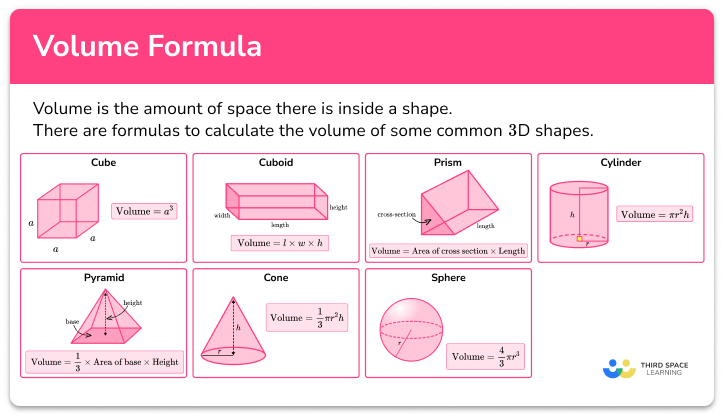
Volume: build from a cross-section
A prism has the same cross-section all the way along its length. A rectangular box, triangular prism, and trapezoidal prism are all prisms.
For every right prism:
where is the length of the prism.
For a rectangular prism, the cross-section is a rectangle, so this becomes:
For a cylinder, the cross-section is a circle:
Here, is the radius and is the perpendicular height.
Volume and Surface Area of Prism - GCSE Maths
Watch Volume and Surface Area of Prism – GCSE Maths from 1st Class Maths. It clearly links a prism’s constant cross-section to both its volume and its surface area.
Start with what makes a prism to establish the meaning of a uniform cross-section. Then watch prism volume, pausing briefly for the triangular, trapezoidal, and compound cross-section examples. Finish with prism surface area to see how every exposed face is accounted for.
Worked example: volume of a triangular prism
A triangular prism has a triangular cross-section with base , perpendicular height , and prism length .
First find the cross-sectional area:
Now multiply by the prism length:
The volume is:
The intermediate area is in . Multiplying it by a length in produces , which is a useful way to check that the answer is genuinely a volume.
For a compound prism, find the cross-sectional area by splitting it into familiar two-dimensional shapes, just as you did in the previous lesson, then multiply the total cross-sectional area by the prism length.
Surface area: count exposed faces, not dimensions
Surface area is the total area of every exposed outer face. Unlike volume, it is not about filling the object; it is about the material needed to cover it.
For a rectangular prism:
This works because there are three pairs of matching rectangular faces.
For any right prism, an efficient general formula is:
where is the perimeter of the cross-section. The first part counts the two ends; the second part represents the rectangular faces around the sides.
For a closed cylinder:
The two terms are the circular ends. The term is the curved side.
Read Mathspace’s explanation of a cylinder net. It shows why the curved surface becomes a rectangle and makes the cylinder formula easier to adapt in exam questions.
In the “Cylinders” section, read from the net explanation. Focus on the rectangle’s dimensions: its height is the cylinder height, while its width is the circle’s circumference, 2\pi r.
Open containers: do not include faces that are missing
Questions often describe a cylinder as open, open at one end, or open at the top. In those cases, the missing circular face must not be counted.
For an open-top cylindrical container:
There is one circular base and one curved surface, but no lid.
For composite solids, a joined face is internal rather than exposed. Do not count it in the final surface area. This is a common source of over-counting.
Worked example: material for an open cylindrical container
A container is open at the top, with radius and height . Find the area of material needed.
The base has area:
The curved side has area:
So the total material area is:
Notice that the answer uses square units, even though the object itself is three-dimensional.
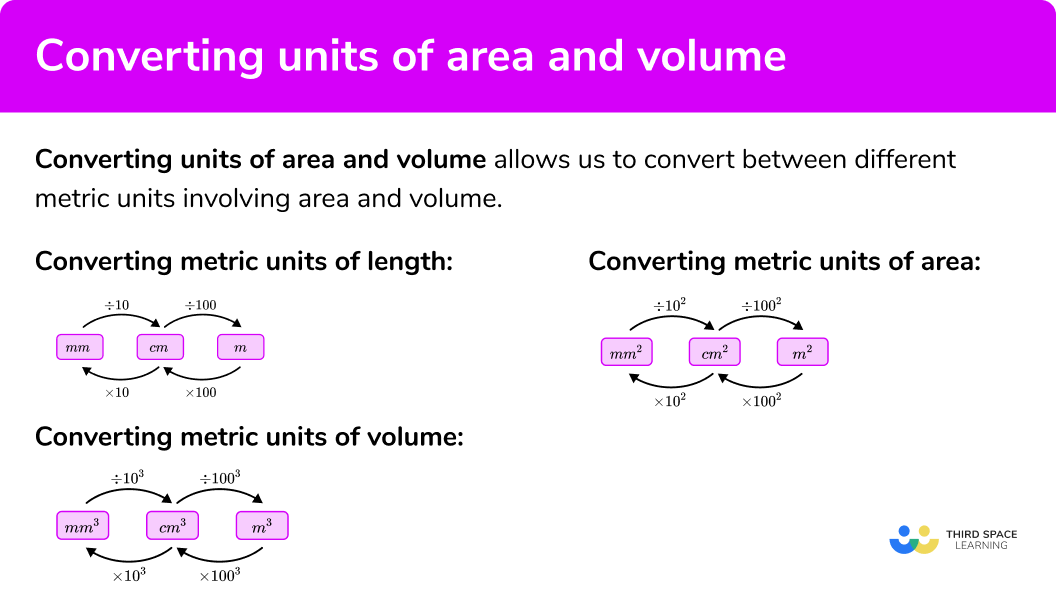
Unit conversion: why square and cubic units change so quickly
A factor of applies when converting metres to centimetres:
But area uses two dimensions:
And volume uses three dimensions:
That exponent is not decoration. It determines the conversion factor.
For capacity, memorise these exact relationships:
So a volume of , for example, has a capacity of:
or:
💯 The Conversion from Volume to Capacity Explained with Clear Examples.
Watch The Conversion from Volume to Capacity Explained with Clear Examples from iitutor.com. It reinforces the direct links between cubic centimetres, millilitres, litres, and cubic metres.
Watch the conversion foundations for the relationships 1\text{ cm}^3=1\text{ mL} and 1000\text{ mL}=1\text{ L}. Then skip to cubic millimetres to see why cubic conversions require factors of 1000.
Two conversion checks
Convert to :
Convert to litres:
The first conversion uses because it is area. The second uses because .
Mass and density: connecting “how much space” to “how heavy”
Mass questions often supply a material’s density. Density tells you the mass in each unit of volume.
where:
- is mass;
- is density;
- is volume.
The units must match. For example:
- density in requires volume in , giving mass in ;
- density in requires volume in , giving mass in .
Do not automatically treat as . That is approximately true for water under ordinary conditions, but not for oil, concrete, syrup, fuel, or most other materials.
Integrated worked example: surface area, volume, capacity, and mass
A thin-walled sealed cylindrical container has radius and height . It is filled with a liquid of density .
1. Find the external surface area
2. Find the volume and capacity
Because :
3. Find the mass of liquid
The volume is already in , matching the density units:
So the liquid’s mass is:
In a full exam response, label each part clearly. This prevents a correct volume result from being mistaken for the requested mass or capacity.
Working backwards from volume
Some questions give a volume or capacity and ask for an unknown dimension. Start with the relevant formula, substitute known values, then rearrange.
For example, an aquarium has internal length , width , and capacity . Find its internal depth.
Convert the capacity first:
Use the rectangular-prism formula:
The aquarium depth is:
Read Mathspace’s short guide on reversing surface-area and volume formulas. It is particularly useful for questions where a tank, box, or prism has one missing measurement.
In “Dimensions from surface area or volume,” read the formula overview, noting that the unknown dimension is isolated only after known values are substituted. Then read “Example 2” from the prism example. Focus on how volume is converted into an equation before division isolates the depth.
Exam routine for three-dimensional measurement
Use this sequence before calculating:
- Underline what is required: surface area, volume, capacity, mass, or an unknown dimension.
- Choose a formula that matches both the solid and the required quantity.
- Check dimensions: use radius rather than diameter in circle formulas, and perpendicular height where required.
- Convert units before calculation if they do not match.
- Account for the physical object: open top, missing face, internal capacity, hollow section, or joined solids.
- Round only at the end unless instructed otherwise.
- Write a final answer with the correct unit.
A quick plausibility check is also valuable: if a tank is described in litres but you produce square metres, you have likely calculated surface area instead of capacity.
Key takeaways
Surface area measures the exposed outside of a solid and uses square units. Volume measures three-dimensional space and uses cubic units. Capacity is the internal volume of a container, usually expressed in millilitres or litres.
For prisms:
For cylinders:
The key conversion facts are:
Finally, when density is provided, connect mass and volume using:
Next, the course moves into data analysis: identifying data types and choosing sampling methods that produce useful, fair conclusions.
Can't find a good explanation? Sign up and we'll make it for you
Sign up