
Welcome back. In the previous lesson, you built a decision rule for attempt now, defer, or skip. Quantitative Aptitude can become a reliable source of early marks only if the setup becomes almost automatic; otherwise, a seemingly simple percentage or average question can consume several minutes through avoidable interpretation errors.
This lesson develops a compact toolkit for percentages, ratios, averages, and mixtures. These are not isolated chapters: each concerns a quantity relative to a meaningful total. By the end, you should be able to choose the right representation quickly, solve standard GATE-level forms, and check whether an answer is even plausible before committing to it.
One underlying principle: preserve the quantity that matters
Many aptitude errors occur because a percentage, ratio, or average is treated as a decorative number rather than a statement about a whole.
- A percentage states a part out of a particular whole.
- A ratio compares quantities in common units.
- An average is total quantity divided by number of observations.
- A mixture preserves the amount of each component, even when the total amount changes.
Before calculating, write a short label beside every number:
| Number given | Ask yourself |
|---|---|
| Forty percent of what total? | |
| Four and three units of what comparable quantity? | |
| Average | What is the total: average times how many? |
| sugar solution | Ten percent of the final solution is sugar mass |
That small discipline directly addresses a common GATE mistake: applying a percentage to the wrong base.
For a timed question, use this setup routine:
- Identify the requested quantity: count, percentage, ratio, mean, cost, or concentration.
- Identify the total or base against which each percentage is measured.
- Translate ratios into variables with a common multiplier, such as and .
- Prefer totals over averages, and component amounts over mixture labels.
- Perform a range check before finalizing.
If the representation is clear within the first read, these are strong Pass 1 questions under the strategy from the previous lesson.
Percentages: the base is the denominator
A percentage is a fraction with denominator :
The important phrase is not “percent”; it is “of the original quantity” or “of the new quantity.”
Fast percentage anchors
Build calculations from simple fraction equivalents rather than multiplying mechanically.
| Percentage | Fraction |
|---|---|
For example, to calculate of , use :
This is not a trick to memorize. It is flexible decomposition: choose a nearby percentage whose fraction is easy.
#2 | Percentages & Fractions | General Aptitude | COMPLETE COURSE GATE 2024 | Christy Varghese
In “Percentages & Fractions” from Christy’s Classes, the instructor demonstrates how to decompose a percentage into manageable parts instead of treating every problem as long multiplication. Watch it to sharpen the mental arithmetic that supports faster GATE setups.
In the segment beginning with the 23\% of 1200 example, watch percentage breakdown. Focus on why 10\% and 1\% are useful anchor values, then reproduce the reasoning once without writing every multiplication step.
Percentage increase: compare with the old value
If a value changes from to , the percentage increase is:
The denominator is the old value, because the question asks how large the change is relative to where you started.
Suppose a fiscal deficit is of GDP in one year. GDP is indexed as , so the actual deficit is . In the next year, GDP rises by , becoming , and the deficit is of this new GDP:
The actual deficit changed from to , so:
Notice the distinction:
- The deficit rate changed from to : an increase of 1 percentage point.
- The actual deficit changed from to : an increase of .
These are different statements. “Percentage points” compare rates directly; “percentage increase” compares a change to an original value.
Successive changes multiply, not add
An increase of followed by a decrease of does not restore the original value.
Take a convenient base of :
The final value is , so the net result is a decrease.
In general, if changes are and , with a decrease represented by a negative value, the overall multiplier is:
For fixed expenditure, this logic is especially useful. If price rises by , consumption must be multiplied by:
So consumption must fall by , not .
Ratios: values are scaled, not equal to the displayed parts
A ratio does not mean the two quantities are literally and . It means they are proportional to and . Write:
The multiplier carries the actual scale.
A mixed ratio-and-percentage problem
Suppose the ratio of boys to girls taking an exam is . The overall pass percentage is , and the pass percentage among girls is . Find the pass percentage among boys.
Let the number of boys and girls be:
Total candidates:
Total students who passed:
Girls who passed:
Therefore boys who passed:
The pass percentage among boys is:
The structure matters more than the arithmetic:
- Turn the ratio into counts.
- Convert overall percentages into actual totals.
- Subtract the known subgroup contribution.
- Divide by the correct subgroup total.
A frequent error is to calculate of the entire . The applies only to the girls, whose count is .
GATE 2023 General Aptitude Practice Questions | Ratio, Average and Allegations | BYJU'S GATE
“GATE 2023 General Aptitude Practice Questions | Ratio, Average and Allegations” from BYJU'S Exam Prep GATE & ESE works through the high-yield link among ratios, totals, weighted averages, and mixtures. Use the selected portions as a model for organizing data before calculation.
First watch ratio and pass rates, a GATE-style example that combines group ratio and pass percentages. Later, watch weighted averages to see why group sizes cannot be ignored. After studying the mixture method below, return for alligation ratio, where a known mixture mean is used to infer the quantity ratio.
Combining ratios safely
If you are given:
and
make the shared quantity equal in both forms. The least common multiple of and is :
Therefore:
Do not combine ratios merely by writing . The two appearances of would represent different numbers of parts.
Averages: convert immediately to totals
The average of values is:
For GATE problems, the more useful rearrangement is:
Averages themselves usually do not add meaningfully; totals do.
Adding or replacing one observation
Suppose the average score of students is . One score of was entered incorrectly; the actual score was . Find the corrected average.
Original total:
Corrected total:
Corrected average:
The count remains , so only the total needs repair.
A clean way to prevent sign errors is to say the correction aloud:
Remove the incorrect value; add the correct value.
If a value was recorded as instead of , the total was short by . Add ; do not subtract it.
Weighted averages
If two groups have different sizes, their combined average is not the simple average of their two averages. It is a weighted average:
Suppose students have average score , and students have average score .
A useful range check follows immediately:
The combined average must lie between the two group averages. It should be closer to because the group with average is larger.
This is the same mathematical idea used in price mixtures and concentration problems: values are weighted by their quantities.
Mixtures: track components, not labels
A mixture question is a weighted-average question in which the average may be price per kilogram, percentage concentration, purity, or some other per-unit measure.
The most reliable method is component balance:
For a sugar solution, the conserved component is sugar. For a milk-and-water mixture, track milk and water separately. For two rice types, track cost.
Adding a pure component
Consider kg of a sugar solution. How much pure sugar should be added to make the concentration ?
Initially, sugar present is:
Let kg of pure sugar be added. The sugar amount becomes , and the total mixture mass becomes . The target concentration gives:
The key detail is that adding pure sugar changes both numerator and denominator. Treating the final total as kg would be the central mistake.
Alligation: a shortcut derived from weighted average
Alligation is useful when two values are mixed to obtain a known mean and the question asks for the ratio of quantities. It is not a separate law; it is simply weighted-average algebra arranged efficiently.
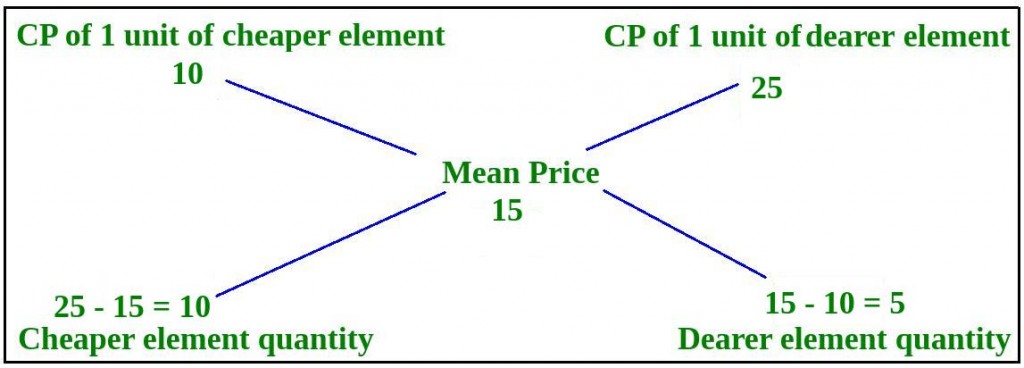
Suppose an item costing per unit and another costing per unit are mixed to obtain a mean cost of per unit. Let the quantities be and , respectively.
The weighted-average equation is:
Multiplying through:
The alligation shortcut reaches the same result:
The direction is easy to reverse under pressure, so use a conceptual check:
- The mean is closer to than to .
- Therefore, the cheaper item must be present in the larger quantity.
- A ratio passes that check.
For lower value , higher value , and mean , where:
the ratio is:
Alligation should not be used blindly. It applies only after confirming that the two component values and the mean are measured in compatible units: for example, cost per kg with cost per kg, or concentration percentage with concentration percentage.
Common traps and a final verification pass
Most errors in this topic are interpretation or calculation errors, not difficult mathematics. Before submitting a numerical answer, run a ten-second check.
| Topic | Typical error | Verification |
|---|---|---|
| Percentage change | Dividing by new value instead of old value | “Increase relative to what I started with?” |
| Successive change | Adding percentage changes directly | Use multipliers such as and |
| Ratio | Treating as literal quantities | Write and |
| Group percentage | Applying subgroup rate to total population | Mark the subgroup beside every percentage |
| Average | Averaging averages without weights | Reconstruct totals first |
| Mixture | Forgetting that added material changes total amount | Track component and total separately |
| Alligation | Reversing quantity ratio | Mean closer to a component means that component is less abundant |
For your error log, create one compact entry whenever you miss a General Aptitude question:
- Representation error: wrong total, wrong group, or incorrect ratio scaling.
- Method error: chose unweighted average instead of weighted average, or used alligation when component balance was needed.
- Calculation error: correct equation, incorrect arithmetic.
- Decision error: a direct setup was available, but you deferred it unnecessarily.
This distinction matters. A question missed due to “ of the wrong group” needs a different repair from a question missed due to multiplication.
Key takeaways
Percentages, ratios, averages, and mixtures are unified by one habit: identify the whole and preserve the relevant total.
- Use fraction equivalents and decomposition to compute percentages quickly.
- For percentage increase, compare the change with the original value.
- Represent ratios with a common scale factor such as .
- Convert averages to totals before combining, adding, or correcting values.
- Use weighted averages whenever group sizes differ.
- In mixtures, track the amount of the component being conserved.
- Use alligation as a shortcut for two-component weighted-average ratio problems, then verify that the larger quantity corresponds to the component closer to the mean.
In the next lesson, you will apply the same representation-first approach to work-rate, speed-distance-time, and basic scheduling problems.
Can't find a good explanation? Sign up and we'll make it for you
Sign up