
Hello. This first module turns your mocks into feedback that can actually raise your GATE score. With roughly four months remaining, a mock score around the 36–40 range is useful diagnostic data—not a verdict. The important question after every test is not merely which questions were wrong?, but at exactly which point did my reasoning or test-taking process fail?
This lesson gives you a five-category system for doing that: concept, interpretation, calculation, carelessness, and decision errors. By the end, you should be able to inspect a wrong, skipped, slow, or lucky question and label the error precisely enough to choose the right repair.
A mock is valuable only after analysis
A mock tests two things at once:
- Your subject knowledge across DS, Algorithms, DBMS, CN, COA, and the rest of the GATE syllabus.
- Your ability to retrieve and use that knowledge accurately under a three-hour constraint.
That distinction matters. A question may be wrong because you do not understand cache mapping, but it may also be wrong because you understood it and used instead of when computing an index. These need entirely different fixes.
Similarly, a correct answer is not always evidence of mastery. You may have:
- guessed an MCQ correctly,
- spent eight minutes on a question that should have been deferred,
- selected an answer while uncertain about an MSQ option,
- used a fragile method that happened to work once.
The GATE-focused review in the following video is worth watching before you begin logging mistakes. It separates skipped questions, careless errors, conceptual gaps, and risky guessing. Notice especially that review should include selected correct answers, not just wrong ones.
Analyse Mock Tests This Way to Improve Your Marks in GATE
“Analyse Mock Tests This Way to Improve Your Marks in GATE” by Anjali Chauhan gives a practical first pass for reviewing skipped and incorrect questions.
Watch skipped questions to distinguish forgotten theory from an inability to start a problem. Then watch careless slips for examples such as misreading a condition or entering an answer incorrectly. Finish with concept and guessing, focusing on why blind MCQ guesses and unaddressed conceptual gaps must be recorded even when they do not immediately change your score.
A useful principle for the entire course is:
Classify error events, not merely questions.
One DBMS question may expose two errors: you may not remember the lossless-join condition and spend seven minutes refusing to leave the question. The first is a concept error; the second is a decision error. If you log only “DBMS wrong,” you lose the information needed to improve.
The five error categories
Use the following definitions consistently. They are deliberately based on the first point where a correct solution path became wrong.
| Error type | What failed? | Typical evidence | Appropriate repair direction |
|---|---|---|---|
| Concept | The required rule, definition, condition, or mechanism was unknown, forgotten, or believed incorrectly. | You cannot explain the governing idea without seeing the solution. | Targeted concept review, then varied problems. |
| Interpretation | You solved a different task from the one asked because you misread or misrepresented the prompt. | You missed “NOT,” “minimum,” “all correct options,” a unit, an input condition, or the requested quantity. | Better question annotation and a deliberate “what is asked?” check. |
| Calculation | Your concept and plan were valid, but arithmetic, algebra, tracing, or symbolic manipulation broke. | A particular numerical or algebraic step is invalid. | Written intermediate steps and an independent verification habit. |
| Carelessness | You had the needed knowledge and a valid result, but an avoidable execution slip caused failure. | Wrong option clicked, answer copied incorrectly, sign omitted while transferring work, or a known check skipped. | A specific process safeguard, not more theory. |
| Decision | Your test-time choice was strategically poor. | Blind MCQ guess, excessive time on one question, changing a correct answer without evidence, or skipping an accessible question. | Better attempt, defer, and review rules. |
The categories overlap at the level of causes. Rushing, fatigue, or anxiety may contribute to several of them. Still, make the visible error type specific. For example:
- “I was careless” is too vague.
- “I read minimum as maximum” is an interpretation error, with “rushing” noted as a contributor.
- “I wrote ” is a calculation error, with “mental arithmetic under time pressure” as a contributor.
- “My scratch work had option B, but I marked option C” is carelessness, with “no final transfer check” as a contributor.
This precision is what makes an error log actionable.
How to tell the categories apart
1. Concept errors: the governing idea was missing or wrong
A concept error is not simply “I could not solve it quickly.” It means that, at the moment the problem demanded a principle, your understanding was absent, incomplete, or incorrect.
Consider a COA cache question. In a direct-mapped cache with lines, you calculate a memory block’s cache-line index using “block number modulo .” The central rule is wrong: the index is based on modulo . This is a concept error.
Other examples:
- In CN, you think a router forwards frames based on a MAC address rather than packets based on an IP routing decision.
- In DBMS, you stop computing an attribute closure after one functional-dependency pass because you do not know closure must be expanded until no new attributes can be added.
- In Algorithms, you apply Dijkstra’s algorithm to a graph containing a negative-weight edge because you do not know the algorithm’s assumption.
- In TOC, you treat an NFA as if it must choose only one transition rather than tracking reachable states.
A concept error may be a forgotten fact rather than something never learned. For logging purposes, both count as concept failures because the knowledge was not reliably retrievable during the test.
Diagnostic question: Before reading the official solution, can I state the exact rule and its conditions? If not, label it concept.
A special case is worth noting: if you know the rule but cannot turn it into a solution approach, record it primarily as concept, and write “application gap” in the notes. The repair needs varied practice, not just rereading notes.
2. Interpretation errors: the task changed in your head
Interpretation errors occur before the real solving begins. The mathematical or technical work may be flawless, but it answers the wrong question.
For example, a CN subnetting question asks for the number of usable host addresses in a subnet. You correctly compute total addresses but submit 64 rather than 62. If you know the network and broadcast addresses are reserved, the issue is not subnetting knowledge. You gave the wrong requested quantity: interpretation.
Common GATE interpretation triggers include:
- “Which of the following is not true?”
- “Select all correct options” in an MSQ.
- “At least,” “at most,” “exactly,” “only if,” and “unless.”
- A question asking for an asymptotic upper bound when you derive a tight bound.
- A NAT question specifying rounding or a required number of decimal places.
- A code-tracing question asking for a value after the third iteration, while you trace to loop termination.
- A DBMS question asking for a candidate key, while you identify a superkey that is not minimal.
Use a short pre-solution restatement in your rough work:
Asked: ___
Given: ___
Output form: MCQ / MSQ / NAT, with required unit or condition ___
This takes seconds and is especially valuable on wording-heavy aptitude, DBMS, CN, and Theory of Computation questions.
Diagnostic question: If the key qualifier had been highlighted, would I probably have solved it correctly? If yes, label it interpretation.
3. Calculation errors: the plan was sound, the execution was not
A calculation error happens after you have selected the correct concept and correct approach. The break occurs in arithmetic, algebra, counting, bit manipulation, or a trace.
Examples:
- You correctly expand a recurrence level by level but add incorrectly.
- In a page-table calculation, you correctly identify the page offset bits but subtract bit counts incorrectly.
- In Boolean algebra, you make an invalid simplification after setting up the expression properly.
- In probability, you use Bayes’ rule correctly but multiply two probabilities incorrectly.
- In a graph algorithm trace, you correctly use Dijkstra’s algorithm but update a distance value with an arithmetic mistake.
A calculation error is often recoverable through a compact check:
- Estimate the magnitude or sign.
- Recompute only the vulnerable line independently.
- Check whether a probability lies in .
- Check whether a count exceeds the total possible objects.
- Check whether a cache-set number is within its valid range.
- For code, make a small trace table rather than holding state changes in memory.
Do not label every numerical wrong answer “calculation.” If the wrong formula caused the arithmetic, the primary error was concept, not calculation.
Diagnostic question: Was my chosen formula, invariant, or algorithm correct before the first incorrect numerical step? If yes, label it calculation.
4. Carelessness: a known correct path was lost through an execution slip
Carelessness is not a personality trait. It is an identifiable failure of process.
The clearest test is this: you had enough knowledge, chose a sensible method, and may even have reached the right answer on paper—but an avoidable slip occurred.
Examples:
- Your scratch work identifies option C, but you click option D.
- You derive the correct NAT answer but enter despite the stated precision requirement.
- In a C trace, you correctly track an array index for several steps but accidentally copy the previous row’s value.
- You prove that an FD does not hold, then choose the option claiming it does because you reverse the truth value during marking.
- You omit a minus sign while transferring an expression from one line to the next.
The repair must be matched to the slip:
| Recurring slip | Process safeguard |
|---|---|
| Wrong option marked | Circle or write the selected option on rough work before clicking. |
| Sign or bit errors | Box negative signs and write fixed-width binary groups. |
| NAT transcription errors | Perform a final “scratch value versus entered value” comparison. |
| Lost state during a trace | Use a table with one row per iteration or instruction. |
| Ignored a condition | Underline or box the condition before beginning. |
The important distinction is that more theory alone will not solve this category. You need a repeatable physical or written check.
Diagnostic question: Could I have caught this in under 20 seconds by comparing my work with the question or submitted answer? If yes, it is likely carelessness.
5. Decision errors: the test-time choice cost marks or time
A decision error concerns resource allocation: time, attention, and risk. In GATE, this is particularly important because MCQ negative marking means an unsupported attempt can reduce the score.
Examples:
- Spending nine minutes on a difficult COA pipeline-hazard problem, then leaving three straightforward questions unseen.
- Making a blind MCQ guess despite being unable to eliminate any option.
- Skipping a familiar DS stack-trace question because it looked lengthy, then discovering it required only a few routine operations.
- Changing an initially correct answer without finding a concrete flaw in your original reasoning.
- Continuing to solve a question after noticing that you cannot identify the relevant topic or first step.
A decision error can occur even when the final response is correct. Suppose you eventually solve a hard dynamic-programming question in ten minutes. You gained its marks, but the decision may still be poor if it prevented you from attempting easier questions later. Log it as:
- Outcome: correct
- Error event: decision
- Evidence: 10 minutes spent; routine questions remained unattempted
- Rule to test next mock: defer after a defined threshold unless a clear path exists
The next lesson will develop a formal attempt/defer/skip rule. For now, classify the event rather than trying to solve the strategy problem all at once.
Diagnostic question: If I had made a different choice about attempting, continuing, guessing, changing, or deferring, would my expected score or available time probably have improved? If yes, log a decision error.
A practical classification sequence
Do not begin by reading the official explanation. First preserve evidence of your own thinking: your selected answer, time spent, confidence, rough work, and reason for skipping or choosing an option. Otherwise, the solution can make every question look obvious in hindsight.
Use this sequence for each high-value review candidate: every wrong or skipped question, every incorrect attempt with negative marking, and every correct answer that was guessed, uncertain, or unusually slow.
- Restate the task. What exactly was asked? What constraint, unit, output type, or keyword mattered?
- Re-solve it without the solution. Take it untimed but use only the knowledge you should have had in the mock.
- Locate the first break. Was the task misunderstood, the principle missing, a computation invalid, or a correct result mishandled?
- Inspect the test-time choice. Was too much time spent? Was the attempt justified? Was it changed or guessed?
- Only then consult the explanation. Compare the intended method with yours and record the smallest useful takeaway.
This second video explains why such question-level “micro analysis” cannot be done by the test platform alone. The platform knows your time and answer; only you can reconstruct why your approach failed.
How to Analyse Your Test Series Attempt
In “How to Analyse Your Test Series Attempt,” Exergic explains the difference between score reports and personal error diagnosis.
Watch micro analysis. Focus on the distinction among conceptual, computational, careless, and technique errors, and on the recommendation to record both the root cause and a specific improvement for each question.
Build an error log that captures causes, not just topics
The spreadsheet template below is a useful starting point because it records date, question type, error type, and notes. For GATE analysis, add time, confidence, and a one-line causal explanation. Those fields help you distinguish a genuine weak topic from an exam-execution problem.
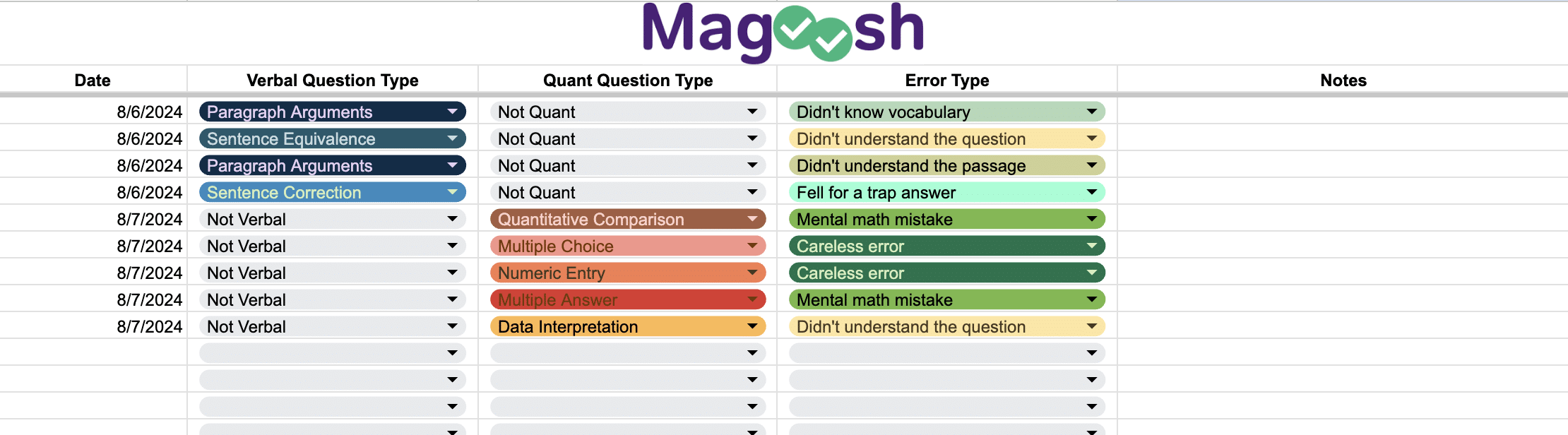
A compact GATE version can use these columns:
| Field | What to record |
|---|---|
| Test and question ID | For example: FLT-3, Q42 |
| Subject and topic | COA—direct-mapped cache; DBMS—attribute closure |
| Outcome | Wrong, blank, correct-but-uncertain, correct-but-slow |
| Time and confidence | Actual time; high, medium, or low confidence |
| Primary error type | Concept, interpretation, calculation, carelessness, or decision |
| Evidence | The exact false rule, missed word, bad step, slip, or strategic choice |
| Contributor | Rushing, weak revision, anxiety, incomplete rough work, etc. |
| Repair seed | One concrete action, without scheduling it yet |
Here are examples of useful versus useless notes:
| Weak note | Useful note |
|---|---|
| “CN weak” | “Concept: confused ARP with DNS; revise roles and trace one local-network request.” |
| “Silly error” | “Carelessness: scratch showed option B; clicked C. Write selected option beside final result before submitting.” |
| “Need more DAA practice” | “Interpretation: derived worst-case complexity when question asked best-case. Box requested bound before solving.” |
| “Calculation mistake” | “Calculation: correct recurrence expansion, but summed geometric series incorrectly. Verify final sum using first and limiting terms.” |
| “Time management” | “Decision: spent 7:40 on a low-confidence MCQ with no elimination. Defer when no first step emerges.” |
For the first few mocks, do not try to log all 65 questions in maximal detail. Start with the highest-value items:
- all negatively marked MCQs,
- all skipped questions that you later find were solvable,
- questions consuming unusually high time,
- all wrong answers in weak subjects such as Digital Logic, COA, CN, TOC, and Compiler Design,
- correct answers that were guesses or low-confidence attempts.
That gives you enough data to find patterns without turning mock review into unfocused note-taking.
A final self-check before assigning a label
When uncertain, run this counterfactual test:
- If the relevant rule were written on a card, could I solve it? If yes, probably concept.
- If the key phrase in the prompt were highlighted, could I solve it? If yes, probably interpretation.
- If I redid only the arithmetic or trace slowly, would the answer change? If yes, calculation.
- If I compared scratch work and the submitted response, would the slip appear? If yes, carelessness.
- If I had deferred, skipped, or avoided guessing, would time or expected marks improve? If yes, decision.
Do not force every question into only one label when the evidence shows multiple failures. Log the main score error and separately note any decision cost. For example:
Q42, COA cache, wrong, 6:50, low confidence
Concept: did not know direct-mapped index uses block number modulo number of lines.
Decision: continued for six minutes despite no reliable formula.
Repair seed: review mapping formula and practice a short cache set; use a defer rule when the governing relation is unavailable.
Key takeaways
A useful mock review identifies why each score-relevant event occurred:
- Concept means the required principle was not reliably available.
- Interpretation means you solved the wrong task or missed a condition.
- Calculation means a valid plan failed in arithmetic, algebra, or tracing.
- Carelessness means a known correct path was lost through an avoidable slip.
- Decision means an attempt, time-allocation, guessing, deferral, or answer-changing choice was strategically poor.
Record concrete evidence rather than vague labels such as “silly mistake” or “weak topic.” A question can contain more than one error event, especially a subject error plus a time-management decision.
In the next lesson, you will turn this log into a spaced active-recall and reattempt schedule so that the same errors are tested again at the right intervals rather than merely recorded.
Can't find a good explanation? Sign up and we'll make it for you
Sign up