
Good to see you. You now have the evidence behind a consequential recommendation: under the modeled -event-per-second attack peak and a three-day replay requirement, a retained event log scored ahead of direct delivery and a conventional durable work queue. The ADR records that decision; the weighted matrix makes the trade-offs inspectable.
This final lesson in the module turns that analysis into the communication expected of a principal architect: a concise recommendation that lets business stakeholders decide whether to fund and sponsor the work, while giving engineering stakeholders enough evidence to trust the direction and challenge its assumptions productively. By the end, you should be able to deliver a five-minute recommendation with a clear ask, an honest trade-off, and an evidence-based rollout plan.
A five-minute recommendation is a decision instrument
A five-minute architecture presentation is not a compressed design review. It has a narrower job: help a group make a specific decision.
For the telemetry-ingestion decision, the decision is not “Do we like event streaming?” It is:
Approve a retained event log as the durable ingestion backbone, subject to a time-boxed validation pilot and named operational ownership.
That sentence contains four things a recommendation needs:
- A choice — a retained event log.
- The scope — the ingestion backbone, rather than every part of the platform.
- Conditions — validation before irreversible commitment.
- An ask — approval and ownership, not merely passive feedback.
Business and engineering stakeholders need different evidence, but they should hear the same recommendation. Tailoring means changing the order, language, and level of detail; it does not mean maintaining two incompatible versions of reality.
| Audience | Primary decision | What they need to hear first | Supporting evidence |
|---|---|---|---|
| Product or business leader | Is this outcome worth the investment and risk? | Detection continuity, roadmap capability, cost of inaction, delivery plan | Alternatives considered, success metrics, investment range when known |
| Engineering leader | Can we deliver this without derailing commitments? | Scope, phased plan, owners, delivery and operational risk | Pilot boundaries, dependencies, staffing implications |
| SRE and security | Can we operate and secure it safely? | Operational burden, data protection, failure handling, ownership | Retention policy, access controls, lag monitoring, recovery tests |
| Backend and detection engineers | Is the design technically sound? | Invariants, interfaces, throughput, replay semantics, known limitations | Capacity model, ADR, detailed container diagram, benchmark plan |
The opening minute should work even if the meeting is cut short. Lead with the recommendation, the business consequence, and the decision you need. Do not open with a vendor name, a Kafka cluster diagram, or a tour of network boundaries.
How to Present a Cloud Architecture to Executives
Watch “How to Present a Cloud Architecture to Executives” from Go Cloud Architects for a useful presentation arc: start with the business problem, show options and trade-offs, make a recommendation, and explicitly request a decision.
In the section beginning around 7:52, watch the presentation arc. Focus on the distinction between explaining technology and presenting a business case, especially the treatment of urgency, alternatives, accepted compromises, and the final ask. Apply the structure, not the cloud-specific examples, to the event-ingestion recommendation.
Prepare before you make slides
A good five-minute talk is the visible tip of a structured decision process. The Architecture Decision Canvas is useful preparation because it forces the speaker to make stakeholder roles, decision drivers, risks, options, and consequences explicit before deciding what belongs in the presentation.
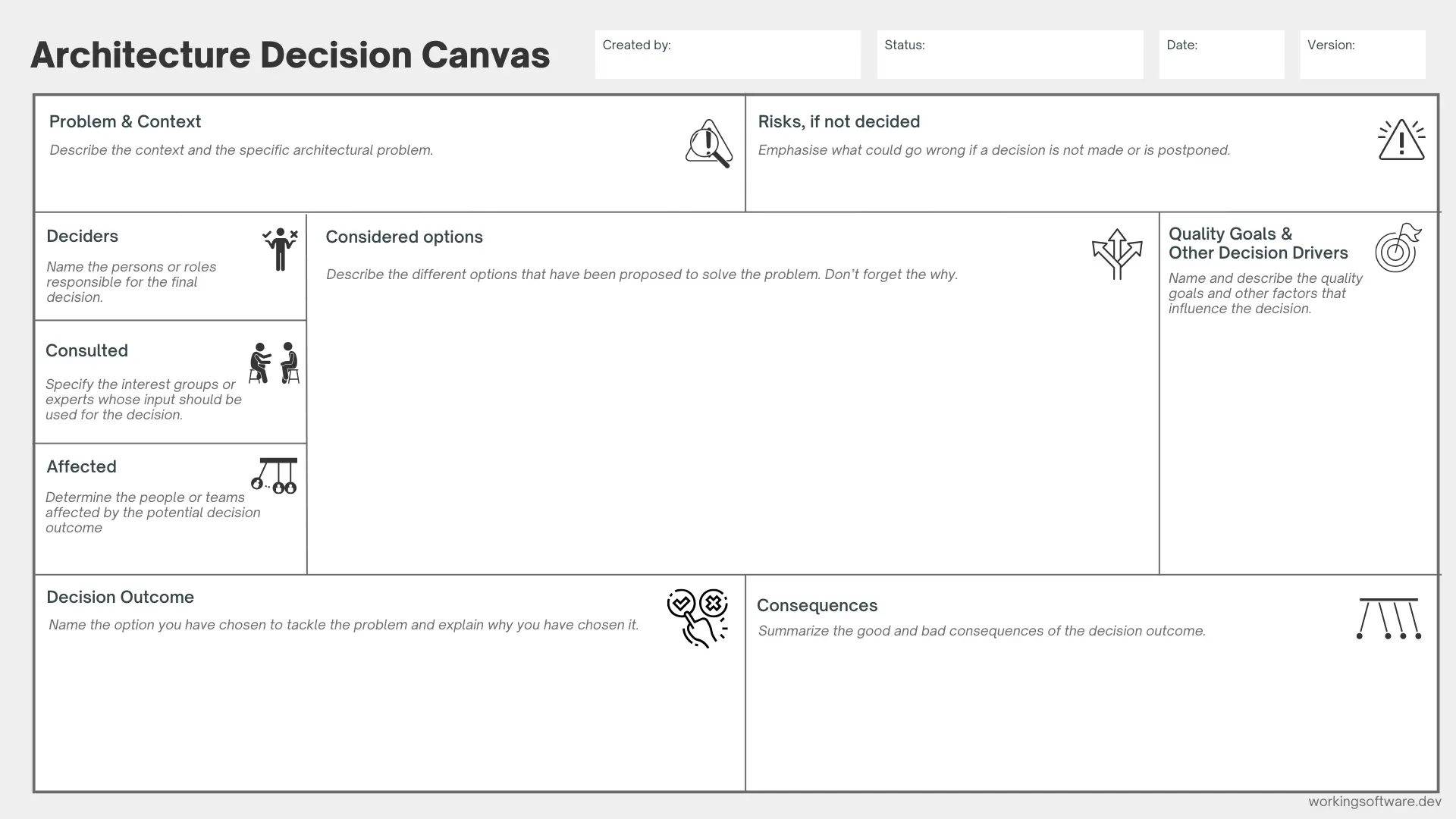
For this decision, a compact preparation canvas might contain the following.
| Canvas area | Prepared content for the telemetry decision |
|---|---|
| Problem and context | The platform must preserve normalized security telemetry during a -event-per-second attack burst, tolerate Detection Worker disruption, and support controlled replay for three days. |
| Deciders | Engineering leadership approves delivery priority and ownership; product leadership confirms the detection and replay value; security and SRE approve operating conditions. |
| Consulted | Detection Engineering, backend engineering, SRE, Security, and FinOps or platform-cost ownership. |
| Quality drivers | Durable burst isolation, replay, independently evolving consumers, acceptable detection latency, and manageable operational burden. |
| Options considered | Direct delivery, acknowledgement-based durable queue, retained event log. |
| Decision outcome | Adopt a retained event log, conditional on validation of ingest capacity, replay safety, access controls, and operating model. |
| Consequences | Stronger recovery and replay capability, in exchange for retained-data cost, partitioning, authorization, monitoring, and incident-response obligations. |
| Risk if postponed | Collection and detection remain more tightly coupled; recovery from worker disruption or a detection defect becomes weaker and more manual. |
This canvas prevents two common presentation failures:
- technology-first framing, where the audience learns what you want to deploy before learning why a decision is needed;
- stakeholder omission, where a technically sound choice becomes unworkable because no one owns retention, access reviews, on-call response, or cost controls.
Separate facts, assumptions, and validations
Principal-level communication makes uncertainty visible without sounding indecisive. Use three labels in your preparation notes:
| Label | Example | How to say it aloud |
|---|---|---|
| Planning assumption | Peak intake is normalized events per second; replay horizon is three days. | “Our current capacity model assumes…” |
| Decision evidence | The retained log scored , compared with for the queue and for direct delivery. | “Against the agreed criteria, it was the strongest fit because…” |
| Validation required | Exact sustained throughput, storage cost, operational burden, and end-to-end latency remain to be measured. | “We will validate this in the pilot before scaling production use.” |
Do not turn an assumption into a fact merely to make the recommendation sound more certain. Conversely, do not use uncertainty as a reason to avoid a recommendation. State what is known, what is assumed, and what will settle the remaining uncertainty.
Use one architecture visual at the right altitude
Your earlier system-context and container diagrams are not just documentation artifacts. They are presentation tools, provided you use the appropriate level of zoom.
A business-oriented audience does not need a box for every service, database, topic, or authentication component. It needs to understand how the architecture protects a product outcome:
- telemetry continues to be accepted while downstream detection is slowed or restarted;
- detection can resume from a known position;
- a verified defect can be corrected through bounded replay;
- access to retained security telemetry is controlled and auditable.
An engineering audience needs the additional explanation: normalized events are appended to a partitioned retained log; Detection Workers consume independently and persist processing position; authorized replay is a controlled operational workflow rather than an ad hoc database export.
The underlying architecture has not changed. The explanatory layer has.
Visualising software architecture with the C4 model - Simon Brown, Agile on the Beach 2019
Watch Simon Brown’s “Visualising software architecture with the C4 model” from Agile on the Beach for practical advice on diagrams that can stand on their own rather than requiring a long verbal decoding.
In the practical diagram guidance section, watch standalone diagrams. Focus on precise titles, clear element names, brief descriptions inside boxes, and avoiding unexplained internal acronyms. Apply this to the one diagram you will show in the briefing.
The one-diagram rule
For this recommendation, use one simplified container-level diagram in the core five-minute briefing. It should show only:
- telemetry connectors;
- the retained event log;
- Detection Workers;
- an optional enrichment or future analytics consumer;
- the security analyst or investigation workflow, if it clarifies why replay matters;
- the trust or system boundary.
Write short functional descriptions inside the important boxes. For example:
- Retained Event Log — “Stores normalized telemetry for three days; enables independent consumers and controlled replay.”
- Detection Workers — “Score behavior and persist consumer position; may be restarted without losing retained input.”
Keep technologies in a subtitle or appendix. “Partitioned retained event log” communicates the architectural property. A specific product name becomes relevant only when someone asks about procurement, cloud mapping, operational capability, or implementation constraints.
Do not show the full weighted matrix on the main slide. It is evidence, not the story. State its conclusion in one sentence and place the complete matrix in backup material.
A five-minute briefing structure
Use four slides or four visual states. The table gives time budgets; do not attempt to narrate every line of a dense deck.
| Time | Slide purpose | What to say |
|---|---|---|
| – | Recommendation and ask | State the decision, why it matters, and what approval is needed. |
| – | Problem and urgency | Connect attack-peak durability and replay requirements to detection continuity and customer trust. |
| – | Options and rationale | Show that direct delivery and a durable queue were considered; explain why the retained log better fits the highest-weighted needs. |
| – | Architecture in outcome language | Use the simplified diagram to explain decoupling, recovery, and controlled replay. |
| – | Trade-offs and safeguards | Name the operational, cost, and security obligations. Show how the pilot addresses them. |
| – | Plan, success criteria, and ask | Request approval for the pilot, decision owners, and the review checkpoint. |
A worked speaking script
Adapt this script to your natural voice. It is deliberately specific about known design decisions and deliberately conditional about facts that have not yet been measured.
Recommendation and ask
I recommend that we adopt a retained, partitioned event log as the durable ingestion backbone for behavioral detection. I am asking for approval to run a time-boxed validation pilot, with named ownership from Detection Engineering, SRE, and Security.Problem and urgency
Our capacity model requires the platform to accept normalized telemetry during a modeled attack peak of events per second. Detection Workers can slow, restart, or require reprocessing after a defect. If collection is tightly coupled to live detection, those events are harder to preserve and recovery becomes operationally fragile. A three-day controlled replay capability is therefore a product and recovery requirement, not an implementation preference.Options and rationale
We compared direct delivery, a durable acknowledgement-based queue, and a retained event log. Direct delivery is simplest and has the lowest hop latency, but it makes worker availability part of the ingestion critical path. A durable queue improves buffering, but offers weaker support for independent consumers and broad replay after acknowledgement. The retained log scored highest because it directly supports durable burst isolation, independently evolving consumers, and controlled reprocessing.Architecture and outcome
Telemetry connectors append normalized events to the retained log. Detection Workers consume independently, persist their progress, and can recover without requiring connectors to resend historical input. Authorized downstream consumers can evolve separately, and a defect can be corrected through a bounded replay workflow rather than through an emergency reconstruction of missing telemetry.Trade-offs and safeguards
This is not the lowest-complexity option. We accept retained-storage cost and new obligations for partitioning, workload authorization, lag monitoring, retention enforcement, and replay safety. The pilot will validate sustained ingest at the modeled peak, the three-day replay workflow, tenant-aware access controls, operating runbooks, and the end-to-end detection-latency objective.Close
If the pilot meets those criteria, we will return with measured capacity, cost, and operational evidence for production rollout. The decision requested today is approval to proceed with that pilot and confirmation of the operational owners.
Notice the different lenses embedded in the same script:
- The first, second, and final paragraphs speak primarily to business value, resilience, and governance.
- The middle paragraphs give engineers the decision boundaries and technical rationale.
- The trade-off paragraph protects credibility with both groups. A recommendation that names no downside is usually heard as advocacy rather than analysis.
Make the ask operationally complete
“Any questions?” is not a decision request. End with a request that has a clear owner, scope, and next checkpoint.
For this scenario, the ask can be framed as:
Approve a pilot of the retained-log ingestion path. Assign Detection Engineering, SRE, and Security owners. Review the production decision when the pilot demonstrates modeled-peak ingest, safe three-day replay, authorized access, defined on-call procedures, and measured cost and latency.
This makes the recommendation reversible at the right point. You are not asking the organization to buy an irreversible platform commitment on the basis of a diagram. You are asking it to fund learning that will either confirm the decision or reveal a constraint early.
Keep the following evidence ready in backup slides or linked artifacts:
- the ADR and its explicit consequences;
- the full weighted trade-off matrix and score rationale;
- the capacity model behind the -event-per-second assumption;
- a detailed C4 container diagram;
- pilot acceptance criteria and ownership;
- open questions, including operational cost and exact latency targets.
If challenged by engineering, do not repeat the executive narrative at greater volume. Move to the relevant artifact. If challenged by business stakeholders on cost or delivery impact, state the bounds that are known and identify the pilot measure that resolves the unknown. Never invent precision during the meeting.
Rehearse for clarity, not memorization
Use a timer and rehearse the briefing aloud three times.
- First pass: completeness. Confirm that the recommendation, alternatives, downside, validation plan, and explicit ask all appear.
- Second pass: business language. Remove unexplained product names, internal acronyms, and implementation details that do not alter the decision.
- Third pass: engineering credibility. Check that each major claim has a visible basis: a scenario, capacity assumption, trade-off result, or planned validation.
A useful self-review standard is this: a product leader should be able to repeat why the investment matters and what decision is needed; an engineer should be able to repeat what property is being chosen, what was rejected, and how the major risks will be validated.
Prepare concise responses to predictable questions:
| Likely question | Credible response |
|---|---|
| “Why not start with the cheaper direct path?” | “It is cheaper and lower latency, but it does not meet the replay and worker-recovery requirements as strongly. Choosing it would mean explicitly accepting that limitation or building separate recovery mechanisms.” |
| “Why is a queue not sufficient?” | “It is a viable alternative for buffering. Under the current requirements, acknowledged-message lifecycle and independent consumer replay are weaker fits. If a specific queue product provides the needed retained replay semantics, we should redefine and rescore that option.” |
| “How much will this cost?” | “We do not yet have a measured operating-cost estimate. The pilot will produce storage, throughput, and operational data before a production commitment. The architecture decision is conditional on that evidence fitting the agreed cost envelope.” |
| “What could go wrong?” | “The main risks are operational complexity, retained-data access control, and unsafe replay. The pilot acceptance criteria directly test those risks and establish named owners and runbooks.” |
Key takeaways
A principal-level architecture recommendation is a concise, decision-oriented narrative backed by deeper evidence.
- Lead with a clear recommendation and a specific ask.
- Translate technical properties into outcomes: continuity of detection, controlled recovery, reduced exposure, and delivery capability.
- Tailor the ordering and detail for the audience without changing the underlying decision or hiding costs.
- Use one diagram at the correct level of abstraction; keep detailed models and matrices as evidence for discussion.
- State the options considered, the trade-off accepted, and the conditions that validate the decision.
- Distinguish assumptions, evidence, and unknowns rather than manufacturing certainty.
- End with named owners, measurable pilot criteria, and a review point.
This completes the Principal-Level Architecture Framing module. Next, you will move into threat modeling and security requirements: identifying assets, actors, entry points, and trust boundaries in a backend data-flow diagram.
Can't find a good explanation? Sign up and we'll make it for you
Sign up