
Hello. This opening lesson establishes the calculation discipline that supports every later Quant topic: reading an expression exactly as written, controlling negative signs, and treating fractions as structured objects rather than a blur of symbols. For entrance-exam work, this is not “basic” in the dismissible sense; it is where preventable errors in algebra, arithmetic, and short-answer questions begin.
By the end of this lesson, you should be able to simplify expressions involving brackets, powers, signed numbers, multiplication or division, and fraction bars while keeping your working compact and auditable.
One hierarchy, applied carefully
An expression is a mathematical quantity such as or . It has no equals sign. To simplify it means performing every operation that can be performed, without changing its value.
The usual priority rule is often remembered as PEMDAS:
- Grouping symbols: parentheses, brackets, braces, and fraction bars
- Exponents
- Multiplication and division, from left to right
- Addition and subtraction, from left to right
The last two lines are where rushed work commonly fails. Multiplication does not always come before division; they have equal priority. Likewise, addition does not always come before subtraction.
For instance,
must be evaluated from left to right:
It is not . Parentheses would be required to give that meaning.
Similarly,
Work vertically, changing only the part you have evaluated on each line. This makes sign errors visible before they become final answers.
Order of operations with fractions and exponents | 6th grade | Khan Academy
Watch Khan Academy’s “Order of operations with fractions and exponents.” It models the exact reading habit needed for expressions with a fraction bar: simplify the complete numerator and denominator before treating the bar as division.
Watch the priority rule for the overall hierarchy. Then watch the grouped fraction, noticing that multiplication inside the numerator and denominator is completed before addition. Finish with the final reduction, where the completed fraction is incorporated into the rest of the expression.
2.1 Use the Language of Algebra - Prealgebra 2e
Read OpenStax’s concise explanation of the order of operations, then use its examples to reinforce the principle that equal-priority operations are performed left to right.
In the subsection “Simplify Expressions Using the Order of Operations,” read from the opening explanation through Example 2.12. Begin with the reason for a fixed order. Pay special attention to the explanation that multiplication and division share a priority level; read the left to right rule. In Example 2.11, observe how the innermost grouping is completed before moving outward.
Grouping is broader than parentheses
A fraction bar is a powerful grouping symbol. In
the whole top line is the numerator, and the whole bottom line is the denominator. You do not divide only the last number on top by the denominator.
Handle it in layers:
A useful scan before calculating is:
- What is the outermost structure?
- Which parts are grouped?
- Where are the exponents?
- Which operations will be done left to right?
This takes only a few seconds and is faster than repairing a careless solution.
Signs: treat a negative sign as part of the number
The sign rules for multiplication and division are compact:
| Signs of the two factors or terms | Sign of product or quotient |
|---|---|
| Same signs | Positive |
| Different signs | Negative |
So:
For several factors, count the negative signs:
- An even number of negative factors gives a positive product.
- An odd number of negative factors gives a negative product.
- Any product containing is .
For addition and subtraction, the most reliable habit is to preserve parentheses around negative quantities:
The expression means “subtract the number ,” which is equivalent to adding its opposite, .
3.4 Multiply and Divide Integers - Prealgebra 2e | OpenStax
Use this short OpenStax section to make sign decisions automatic before applying them inside longer expressions.
Read the subsection “Multiplication of Signed Numbers” from its opening explanation through Example 3.48. Focus on the sign pattern, then check it against the worked examples. Next read “Divide Integers” through Example 3.50. Notice that division follows the same sign logic.
A vital distinction: negative base versus negative result
Exponents are evaluated before a leading negative sign unless parentheses make the negative part of the base.
But:
The parentheses change the base from to . With an odd exponent, the sign remains negative:
In timed work, circle or mentally mark the base before evaluating any power. The difference between and is a classic one-mark trap.
Fractions: complete each level before reducing
A fraction means division:
The denominator may never equal zero. A negative sign may be written in any one of three equivalent positions:
When simplifying a fraction, cancel only common factors, never pieces separated by addition or subtraction.
This is valid:
because is a factor of the entire numerator.
This is not valid:
The numerator is a sum, not a product with as a common factor.
For a simple algebraic fraction:
If fractions are multiplied, reduce common factors first when possible, then multiply numerators and denominators. If they are divided, multiply by the reciprocal of the divisor:
For this lesson’s larger expressions, however, the main rule is simpler: evaluate the numerator completely, evaluate the denominator completely, then divide and reduce.
A complete exam-style simplification
Consider:
First evaluate the exponent inside the parentheses:
Then complete the parenthesis:
Now multiply in both numerator and denominator:
Handle the subtraction of a negative number:
Finally divide:
Notice what prevented errors:
- was calculated before .
- The quantity stayed parenthesized when multiplied by .
- The numerator and denominator were independently simplified.
- The negative sign in the final fraction was handled only after both parts were complete.
The Order of Operations with Fraction Bar Worksheet gives a useful progression from basic fraction-bar grouping to signs, powers, and implied multiplication.
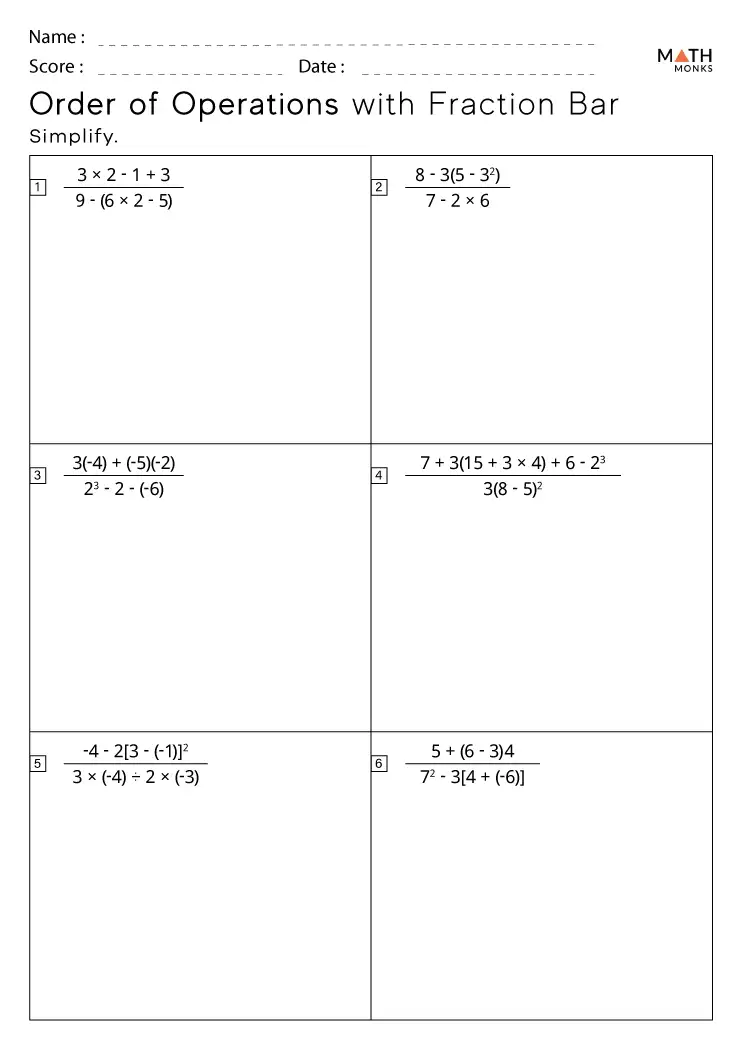
Its fifth expression illustrates both a squared grouped quantity and left-to-right division:
Start with the innermost grouping:
Evaluate the power:
Finish the numerator:
Now simplify the denominator strictly from left to right:
Therefore,
A common wrong denominator here is obtained by multiplying and first. That silently changes the expression by inventing grouping that was never written.
A compact routine for test conditions
For any numerical or algebraic expression, use this routine:
- Mark the structure. Identify fraction bars, brackets, parentheses, and exponent bases.
- Work from the inside outward. Finish inner grouping before outer grouping.
- Apply powers. Check whether a minus sign lies inside or outside the exponent’s base.
- Process multiplication and division left to right.
- Process addition and subtraction left to right.
- For a fraction bar, finish its numerator and denominator before the final division.
- Reduce only common factors. Do not cancel across a plus or minus sign.
- Do a two-second verification. Check the final sign, denominator, and whether the fraction is fully reduced.
The aim is not to write maximum working. It is to write the fewest lines that still reveal the operation order and protect you from an avoidable sign error.
You now have the three foundations of expression simplification: priority of operations, disciplined sign handling, and fraction-bar grouping. In the next lesson, the focus shifts from evaluating a given expression to translating verbal relationships into algebraic expressions and one-variable equations—the point where words become mathematical structure.
Can't find a good explanation? Sign up and we'll make it for you
Sign up