
Welcome back. The preceding lesson established the induced transition rates and, crucially, the Einstein-coefficient relation
That relation means that comparing the total populations and is not always enough to tell whether a resonant field will be attenuated or amplified. In this lesson, the goal is to make the degeneracy-corrected inversion test automatic: given populations and degeneracies, classify the transition as absorptive, transparent, or inverted.
The result is local to a specified optical transition. A medium may be inverted on one transition while being absorptive on another, and inversion alone is not yet the same thing as a laser oscillating; cavity feedback and losses enter later. But inversion is the essential material condition for stimulated optical gain.
Population lives in levels; transitions begin in substates
A reported level population such as is usually the total number density in an energy manifold. If the upper manifold contains degenerate substates, and those substates are equally populated, then the number density in any one upper substate is
Likewise, the population per lower substate is
Degeneracy can arise from, for example, unresolved angular-momentum projections, spin states, or closely spaced Stark or Zeeman sublevels. The key point is statistical: a manifold with more substates can hold a larger total population without any individual substate being unusually occupied.
This is why the phrase population inversion has a precise meaning:
The upper laser level must have a greater population per available state than the lower laser level.
The Oxford lecture notes give the compact statement of this criterion and contrast it with the thermal Boltzmann distribution.
[PDF] Laser Physics for Paper B3
Read the University of Oxford lecture notes’ Section 1.2, “Conditions for gain,” to connect the Einstein-rate comparison with the degeneracy-corrected definition of inversion.
Read the complete Section 1.2, beginning with its comparison of stimulated-emission and absorption rates and ending with the Boltzmann-equilibrium discussion. In particular, follow the passage beginning the thermal comparison. Focus on why a positive-temperature thermal distribution cannot invert the populations per state.
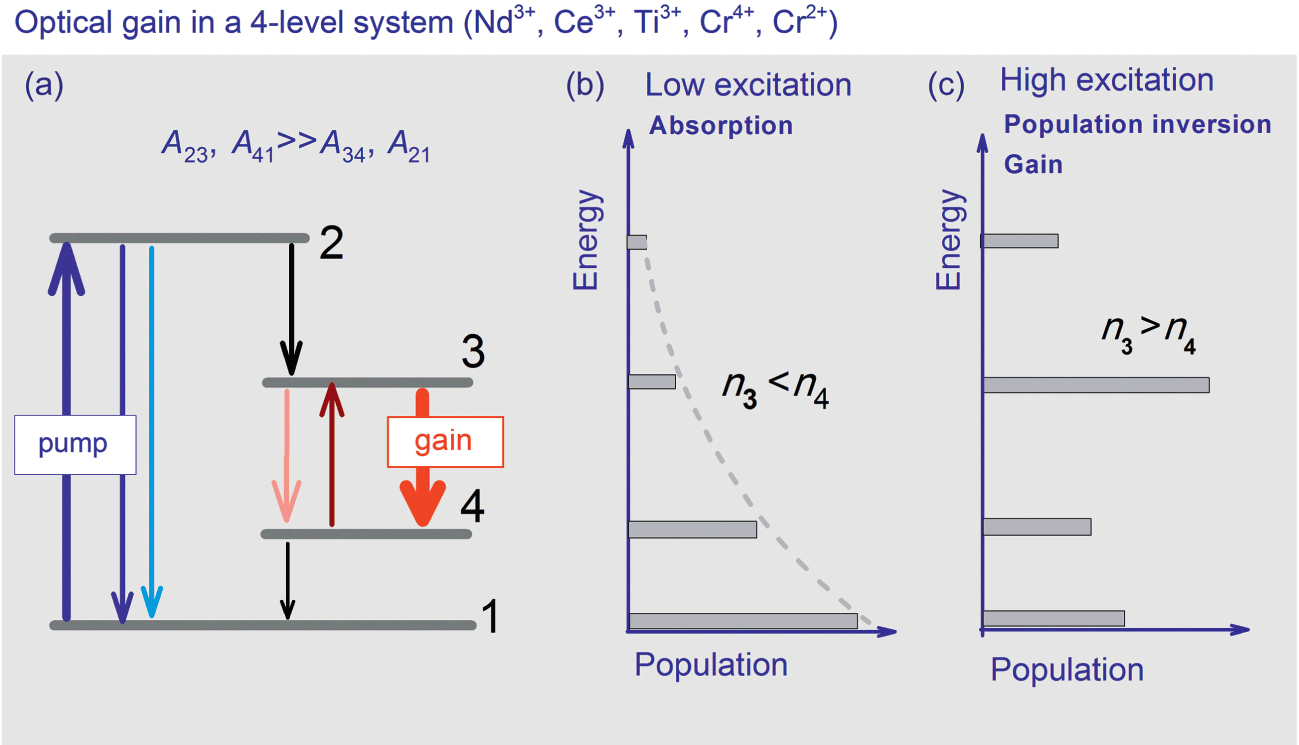
A useful visual distinction appears in the four-level optical-gain diagram below. Its high-excitation panel labels gain by comparing and ; that simple comparison presumes equal effective degeneracies. When the degeneracies differ, replace it with the population-per-substate comparison developed here.
Deriving the correct inversion criterion
For radiation resonant with the transition, the ensemble rates are
Here is the appropriate resonant spectral energy density. For the present question, its precise magnitude does not matter: it multiplies both rates and cannot change which one is larger.
Optical gain requires stimulated emission to exceed absorption:
Substituting the rates gives
Using
and cancelling the positive factors and , gives
Dividing each side by produces the form to remember:
This is the population-inversion condition for the transition from level 2 to level 1.
The complete classification is:
| Degeneracy-corrected population comparison | Induced response at the transition | Classification |
|---|---|---|
| Stimulated emission exceeds absorption | Population inversion; positive stimulated gain | |
| Stimulated emission balances absorption | Transparency | |
| Absorption exceeds stimulated emission | Absorption |
It is useful to define a degeneracy-corrected inversion density,
Its sign alone gives the answer:
Later, when gain is expressed in terms of stimulated-emission and absorption cross sections, this same quantity controls the sign of the small-signal gain coefficient.
Three examples that expose the role of degeneracy
Example 1: equal degeneracies
Suppose
Because the degeneracies are equal, the normalization changes neither comparison:
Therefore,
The transition is inverted. In this special case, the familiar shorthand happens to be valid.
Example 2: more total population in the upper level, but no inversion
Now take
At first glance, the upper level looks favorable because
But there are twice as many upper substates. The relevant populations are
Thus,
The medium is still absorptive on this transition. The upper manifold contains more atoms in total, but not enough atoms per substate to overcome absorption.
Equivalently, the threshold upper-level population would have been
The actual population lies below that transparency threshold.
Example 3: fewer total upper-level atoms, yet inversion
Finally, reverse the degeneracy advantage:
This time,
Nevertheless,
Hence,
The transition is inverted even though fewer atoms occupy the upper manifold in total. Its smaller degeneracy means that each upper substate is, on average, more populated than each lower substate.
A reliable procedure for any population data
When given a candidate laser transition, use this short procedure.
-
Identify the two manifolds participating in the optical transition.
Label the lower laser level and upper laser level . Ignore populations in other levels unless they affect the stated or . -
Confirm what the quoted populations mean.
Usually and are totals over all substates in the respective manifolds. -
Identify the corresponding degeneracies.
Use and for those same manifolds. Do not mix a population summed over several substates with a degeneracy referring to only one. -
Compute population per substate.
-
Compare the two quantities.
The sign ofclassifies the transition as gain, transparency, or loss.
Two compact alternatives are often faster:
for inversion, or
These forms are equivalent, but the population-per-substate form is usually safest conceptually.
Thermal equilibrium and the need for pumping
At positive temperature, thermal equilibrium imposes
For , the exponent is negative, so
Therefore,
in ordinary thermal equilibrium. A material at equilibrium is absorptive on an upward optical transition, even if a large upper-level degeneracy makes its total appear substantial.
A laser must therefore be driven out of thermal equilibrium by pumping and relaxation processes. The central engineering task of a laser medium is not merely to put population into an excited manifold, but to create and maintain
One final qualification matters in real media. The simple division by assumes the degenerate substates are equally populated, as occurs when collisions, relaxation, or averaging over an isotropic ensemble redistribute population efficiently. Strongly polarized pumping, magnetic fields, or slow sublevel mixing can produce unequal magnetic-sublevel populations. Then the relevant absorption and emission rates must be calculated by resolving the individual substates and allowed polarization-dependent transitions, rather than by applying a single degeneracy factor.
Takeaways
Population inversion is a statement about a specified transition, not simply about whether an excited level holds more particles overall. The correct test is
where is the total population of level , and is the number of relevant degenerate substates.
Remember the three outcomes:
- Upper population per substate larger: inversion and stimulated gain.
- Equal populations per substate: transparency.
- Lower population per substate larger: absorption.
Next, we will turn from population balance to spectral structure: homogeneous and inhomogeneous broadening, and how different physical mechanisms shape a laser transition’s linewidth.
Can't find a good explanation? Sign up and we'll make it for you
Sign up