Establishing a Baseline for Reading, Writing, and Research Habits
Hello, and welcome. This course begins before craft technique, novel planning, or productivity systems. Its first task is simpler and more useful: to see your current relationship with prose reading, informal writing, and research clearly enough to work with reality rather than with guilt, aspiration, or comparison.
A baseline is not an assessment of whether you are “doing enough.” It is a provisional description of what has recently been possible, attempted, avoided, interrupted, enjoyed, or left alone. Since time available is not the same as usable energy, focus, privacy, or emotional room, this description will give later lessons something concrete to adapt to.
By the end of this lesson, you will have a short, private baseline covering all three areas: prose reading, informal writing, and research. It can be messy, incomplete, written partly in another language, or made from bullet points. Its job is to be accurate enough to help—not impressive enough to perform for anyone.
A baseline is a map, not a verdict
Imagine trying to plan a journey while refusing to look at the terrain. You might make a demanding route because it looks sensible on paper, then blame yourself when the route turns out to include steep hills, closed roads, or bad weather. A baseline is the map-reading stage. It does not decide what you should be able to do.
For this course, current contact means any real interaction with an activity during a recent period, including a small or unfinished interaction.
| Area | Counts as contact | Does not have to count as contact |
|---|---|---|
| Prose reading | Reading pages of a novel, a short story, an article, an essay, or a nonfiction passage; opening a book and reading a paragraph; rereading a familiar passage | Finishing a book, understanding every word, reading every day |
| Informal writing | Notes, fragments, descriptions, private reflections, messages you chose to write, ideas, copied quotations with a response, partial scenes, writing in any language | Producing polished prose, writing about the novel, sharing work |
| Research | Searching a question, watching or reading material to learn something, saving a source, making a note, comparing two pieces of information | Reaching a final answer, conducting exhaustive research, using the result in the novel |
Visual storytelling can belong in the background of your baseline too. Films, television, manga, and other media are not substitutes for prose reading if the aim is to build a prose-reading relationship, but they may reveal genuine interests, preferred genres, emotional limits, or times when stories are more accessible. You might note them under adjacent story contact, without pretending they are the same activity.
A baseline may contain statements such as:
- “I read several pages of an ebook late at night, then stopped because I could not follow the sentences.”
- “I have not read fiction recently, but I sometimes read short online articles.”
- “I write messages and occasional notes, but opening a blank document for personal writing feels exposing.”
- “I often search questions related to my novel, then end up with many tabs and no note.”
- “I cannot remember any recent research contact.”
- “I currently do not have enough privacy or concentration for these activities most days.”
None of these statements is an excuse, a diagnosis, or a confession. They are usable observations.
A statement such as “I am lazy” is not usable because it compresses many possible events into a moral label. “I opened a story twice this week, scrolled for a minute, and switched to video” is usable because it describes what happened. Later lessons can help you consider whether attention, access, pressure, fatigue, environmental disruption, or ordinary avoidance played a role. Today, you do not need to decide.
Observation first; interpretation later
A useful baseline has two layers:
- What happened: actions, materials, context, and sequence.
- What it was like: ease, strain, interest, confusion, pressure, relief, or after-effects.
The first layer does not need to be emotionally neutral in the sense of pretending you felt nothing. It is neutral because it separates experience from verdict.
For example:
| Judgment-heavy wording | Observation-based wording |
|---|---|
| “I never read.” | “In the last few weeks, I remember reading subtitles and online posts, but no sustained prose reading.” |
| “My English is too bad for novels.” | “When I tried an English novel, I looked up several words on the first page and lost the thread of the scene.” |
| “I cannot write anything.” | “I wrote two novel notes, then deleted one because I disliked it. I have not kept a separate place for fragments.” |
| “I waste time researching.” | “I searched for information about a setting question, opened several sources, and stopped before recording what I found.” |
| “I should be more disciplined.” | “I sometimes think about reading in the evening, but the book is not nearby and my attention is often already used.” |
The right-hand column may still contain uncertainty. That is fine. “I do not know” is often more accurate than an explanation invented under pressure.
The distinction between a personal journal and a learning log can help here. A journal may include reactions and reflections; a log documents what happened in a process. Your baseline may use either voice, but begin with the documentary layer.
Reflective Journals and Learning Logs - Northern Illinois University
Read the “Types of Reflections” section from Northern Illinois University to see the difference between reporting an observation and immediately explaining or judging it.
In “Types of Reflections,” read the subsection “Observations.” Start with the definition of observation, then read the italicized example immediately after it. Notice that the example reports a visible situation before the later subsections introduce questions, speculation, or self-awareness. For your baseline, use this observation-first order; deeper interpretation can wait.
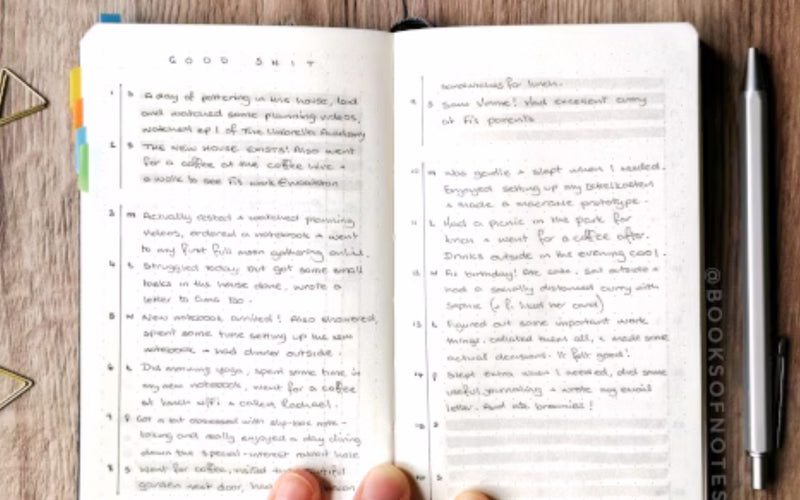
A personal notebook does not need to look like a formal record. It can be handwritten, uneven, crossed out, and selective.
Keep the scope small enough to begin
The blank page becomes intimidating when it seems to ask, “Explain your whole life, your illness, your ambitions, and why you have not written your novel.” It is not asking that.
A narrower starting point is both easier and more honest: What contact have I had with this one activity during a recent period? A concrete detail gives you something to write from. It might be the name of an app you opened, a page you remember, the chair where you tried to read, a document you avoided opening, or a question you searched.
How to Journal Like Haruki Murakami
Watch “How to Journal Like Haruki Murakami” by Sam Mas for a practical argument for beginning with ordinary external details rather than trying to produce a deep or important reflection.
Watch ordinary particulars, where the video describes a log-like approach built from simple facts such as weather, activities, and physical state. Then watch narrowing the subject, which explains why shrinking a broad topic into one concrete object or event can make writing possible. Apply the principle to your baseline: start with one remembered instance, not an explanation of your entire reading or writing history.
You are not required to uncover a hidden truth through this exercise. If a reflection arises naturally, you may include it. If not, facts alone are enough.
For example, this is a complete and useful writing note:
Tuesday evening. I opened a document titled “ideas,” read two old notes, and closed it. I felt tense when I saw the novel title, but writing a note about the rain outside felt easier.
It contains no conclusion about talent, commitment, or future. Yet it already tells us something practical: project-related material and neutral material may currently feel different.
Reading and concentration are real forms of exertion
Prose reading is not “restful” in exactly the same way for everyone. It may be restorative, absorbing, tiring, frustrating, or all of these at different times. Reading in a third language can add an extra layer of cognitive work, particularly if a text has unfamiliar vocabulary, dense sentences, or cultural references. Research can also be demanding: searching, judging sources, holding questions in mind, and deciding when to stop all require attention.
That does not mean you should assume every difficult moment has one cause, or that you should diagnose yourself from a log. It only means your baseline should include the possibility that concentration and mental effort have costs.
PACING for Chronic Fatigue/Myalgic Encephalomyelitis. How I manage my energy. ME/CFS Spoonie
This optional short clip from “PACING for Chronic Fatigue/Myalgic Encephalomyelitis” by Elinor Brown offers a personal account of why cognitive activities may need to be considered alongside physical demands. It is not medical guidance and does not determine what your own condition requires.
If it feels relevant and you have video capacity, watch cognitive energy. Focus only on the idea that reading, concentration, and emotionally intense media can draw on available mental bandwidth. Use that idea as a prompt for observation, not as a rule: record how an activity affected you rather than assuming it will affect you the same way every time.
A baseline can therefore include a short after-effect note:
- “Reading was pleasant, but I felt mentally full afterward.”
- “I could focus on a familiar article but not on new fiction.”
- “Searching for a research answer made me curious rather than depleted.”
- “I stopped after opening the book; I do not know why.”
- “The writing itself was fine, but choosing a topic felt difficult.”
These are observations across time, not fixed traits. The point is to notice the difference between having time and having usable attention, without treating either as a moral issue.
Your first private baseline
Choose a recent time window that you can remember without straining: perhaps the last week, the last two weeks, or simply “recently.” If memory is patchy, write that. The baseline is not invalid because it is incomplete.
You may do this in a notebook, phone note, document, voice-to-text file, or mixed-language format. You do not need to preserve private content from messages, journals, or your novel. Describe categories and circumstances, not secrets.
Use the following template. One line per section is sufficient on a low-capacity day. More detail is optional, not superior.
Baseline period:
For example: “The last two weeks,” “Since the beginning of this month,” or “What I can remember recently.”Prose reading:
- What prose, if any, did I open or read?
- In what format: paper, phone, ebook, website, audio with text, other?
- What happened when I tried?
- What was the immediate effect, if I remember?
Informal writing:
- What kinds of writing have I done, if any? Notes, messages, ideas, fragments, lists, reflections, project material?
- Was there a place where I could write privately?
- What felt easy, neutral, difficult, or emotionally loaded?
Research:
- Have I looked up questions, saved sources, watched explanatory material, or made notes?
- What kinds of questions pull my attention?
- Did I tend to stop after finding information, keep searching, or not begin?
Conditions worth noting:
- Device or format used
- Privacy and noise
- Language difficulty or visual comfort
- Time of day only if it is genuinely noticeable
- Attention, physical state, mood, interruptions, or competing demands
One thing that currently makes contact easier, if known:
For example: “Short texts,” “writing by hand,” “a familiar genre,” “quiet,” “using my first language for notes,” or “I do not know yet.”One area that is currently uncertain or difficult:
State this as a fact, not a self-judgment.
A minimal baseline might look like this:
Baseline period: What I remember from the last two weeks.
Prose reading: I read online articles on my phone. I opened a novel once but did not get past the first page. I remember feeling distracted.
Informal writing: I wrote messages and a few notes for my novel. I have no separate place for unfinished writing.
Research: I searched two questions related to my setting and saved links, but did not make notes.
Conditions: Phone reading is easiest to start, though my eyes get tired. Privacy varies.
Easier: Short material with an immediate topic.
Uncertain: I do not know whether fiction is difficult because of language, concentration, the book itself, or pressure.
Notice what this baseline does not do:
- It does not set a daily reading target.
- It does not demand that writing and research happen alongside reading.
- It does not turn a lack of contact into failure.
- It does not decide the cause of every obstacle.
- It does not ask you to disclose your novel idea or personal history.
- It does not commit you to a permanent system.
If completing all sections feels too much today, write only the heading and one factual line for each area:
Reading: no recent prose contact I remember.
Writing: messages and one private note.
Research: several searches, no saved notes.
That is a real baseline. You may return and add detail later, but you do not need to “make up” for anything.
What counts as finished
Your first baseline is finished when it includes:
- a rough recent time period;
- one factual statement about prose reading;
- one factual statement about informal writing;
- one factual statement about research;
- at least one condition, uncertainty, or after-effect that seems relevant.
For any category with no contact, “none that I remember” is the correct entry. A blank area can also be information, but writing that absence explicitly often makes the baseline easier to use later.
Put a date on the note if that is easy. Then leave it alone. Do not immediately redesign your life around it. The next lessons will help you identify capacity more carefully and reduce practical friction one piece at a time.
A sustainable practice begins with accurate attention, not with forcing consistency. Your baseline records the relationship as it exists now: perhaps thin, interrupted, tentative, or more present in certain forms than you expected. That relationship is still something you can work with.
In the next lesson, you will define your own observable signs of low, moderate, high, and no-activity capacity. The goal will not be to label days as good or bad, but to recognize which kinds of contact, rest, or non-activity are realistic under changing conditions.
Can't find a good explanation? Sign up and we'll make it for you
Sign up