
Welcome back. In the previous lesson, you defined the boundary of a proposed change: what Release 1 includes, what it deliberately excludes, and which uncertainties belong in assumptions or open points rather than hidden commitments.
The next discipline is to justify every in-scope requirement. A requirement should not exist merely because someone requested it or because a team can build it. It should be traceable to a business objective and to evidence that will show whether the intended outcome was achieved. This lesson develops that connection using the expense-claim visibility case: from a business problem, to an objective, to measurable success indicators, to individual requirements.
By the end, you will be able to create a practical objective-to-requirement trace record that can be maintained in Excel, Confluence, Jira-linked documentation, or a requirements-management tool.
From a scope boundary to a value chain
Scope answers: What are we committing to deliver?
Traceability adds two further questions:
- Why is each requirement included?
- How will the organisation know whether the change succeeded?
A useful chain has four levels:
| Level | Purpose | Expense-claim example |
|---|---|---|
| Business problem | Describes the current pain, supported by evidence. | Finance receives frequent employee enquiries about claim status. |
| Business objective | States the desired business result. | Reduce avoidable claim-status enquiries to Finance. |
| Success indicator or KPI | Defines how progress toward the objective is measured. | Claim-status enquiries per 100 submitted claims each month. |
| Requirement | Specifies a capability or condition that contributes to the result. | Employees can view the current status of their own submitted claims. |
These are related, but they are not interchangeable.
A requirement such as “display claim status” is a solution commitment. It does not say how much business improvement is expected, when it should happen, or how success will be measured. Conversely, “reduce enquiries” is an outcome statement; it does not tell developers, testers, or designers what must be delivered.
For a requirement to be well justified, you should be able to state its contribution in plain language:
Employees need direct access to accurate claim status because lack of visibility is causing avoidable contacts to Finance. Providing this information in a self-service portal is expected to reduce status-related enquiries.
The word expected matters. A requirement is a reasoned intervention, not proof of causation. A decrease in enquiries may also be affected by claim volume, policy changes, seasonal expense patterns, or a Finance communications campaign. That is why an analyst records the expected relationship and measures the result after release rather than claiming certainty.
What is Requirements Traceability? Business Anaysis Live!
Watch “What is Requirements Traceability?” from the International Institute of Business Analysis (IIBA). It gives a concise explanation of tracing both upward to business objectives and downward to delivery and testing.
Watch the definition to see how requirement IDs connect objectives, solution needs, and validation. Then watch the scope discussion, focusing on the warning sign created by requirements that cannot be linked to a higher-level need. The final segment explains why this remains useful when work is split into small agile stories.
The upward view is particularly important during discovery. If a proposed requirement cannot be connected to an approved objective, several explanations are possible:
- it is a valuable idea for a later release, but outside the current scope;
- it addresses an objective that has not yet been documented;
- it is a technical or compliance need that requires its own explicit objective or rationale; or
- it is scope creep.
Do not assume that every stakeholder request is invalid merely because it lacks a link. Treat the missing link as an analysis prompt: Which business objective, risk, policy, or obligation does this serve?
Write objectives that can guide decisions
A vague objective cannot support useful traceability.
| Vague objective | Why it is weak | Decision-ready objective |
|---|---|---|
| Improve expense claims. | No defined problem, baseline, target, or time period. | Reduce avoidable employee claim-status enquiries to Finance by within three months of Release 1. |
| Make users happier. | “Happier” is subjective and lacks a measurement method. | Achieve a minimum favourable response to the post-release claim-status experience survey within three months. |
| Secure the portal. | Does not define the desired risk-control outcome. | Prevent unauthorised users from accessing another employee’s claim information throughout the Release 1 operating period. |
A practical objective normally identifies:
- the outcome to improve, reduce, protect, or enable;
- the affected population or process;
- a target;
- a time horizon; and
- ideally, a baseline or an agreed method for establishing one.
For the claim-status case, assume discovery provided these baseline facts:
- Finance received claim-status enquiries in the previous month.
- There were submitted claims during that month.
- Interviews and ticket categorisation suggest that most enquiries concern status visibility, not incorrect payment calculations.
- The proposed portal will serve active employees using the existing corporate sign-on system.
The team can define an operational KPI:
The baseline is:
So the current baseline is 30 status enquiries per 100 submitted claims. A reduction means a target of no more than 21 enquiries per 100 submitted claims after the agreed adoption period.
Using a rate rather than only the raw number of enquiries matters. If claim submissions fall sharply, enquiries might decline even if the portal creates no benefit. Normalising the metric by claim volume makes the indicator more meaningful.
Measures that prove different things
Do not confuse delivery completion, system quality, adoption, and business outcome. All can be useful, but they answer different questions.
| Measure type | Example | What it tells you |
|---|---|---|
| Delivery measure | Portal released to production on the planned date | Whether the team delivered the change |
| Requirement verification measure | of approved test cases for claim-status viewing pass | Whether the specified capability works as defined |
| Adoption measure | of employees with a new claim view its status online within 30 days | Whether intended users are using the capability |
| Business-outcome KPI | Status enquiries per 100 submitted claims decrease from 30 to 21 or below | Whether the business problem is improving |
| Guardrail measure | Zero confirmed incidents of cross-employee claim access | Whether improvement was achieved without unacceptable harm |
A released feature can pass every test and still fail to deliver business value. For example, employees may not know the portal exists, the statuses may be confusing, or the data may not be refreshed quickly enough to replace a call to Finance.
For that reason, trace high-value requirements to both:
- the business objective they support; and
- the indicator that will be reviewed after release.
Trace requirements in both directions
Traceability is not merely a spreadsheet populated at the end of a project. It is a navigable set of relationships.
- Backward traceability starts with a requirement and asks: Which business objective, stakeholder need, policy, risk, or decision caused this to exist?
- Forward traceability starts with an objective or requirement and asks: Which delivered capability, user story, acceptance criteria, test evidence, and outcome measure demonstrate that it was addressed?
A simple traceability view can therefore answer two essential questions:
- Starting with the objective: Have we identified sufficient requirements to make the intended outcome possible?
- Starting with a requirement: Can we defend why this item belongs in the release?
The Requirements Traceability Matrix article introduces this direct connection between objectives, requirements, deliverables, verification, and validation.
Requirements Traceability Matrix | Excel Template FREE Download
Read this short guide from Stakeholdermap to see the core purpose and minimum fields of a Requirements Traceability Matrix. Focus on the distinction between documenting the requirement itself and documenting its business objective, verification approach, and validation evidence.
Begin with the opening explanation, from the direct objective link. Then, in “The contents of the Requirements Traceability Matrix,” read from the “Requirement ID” discussion through the “Validation” discussion: start at the core fields. Notice that verification checks satisfactory completion, while validation can include UAT, milestones, or achievement of a KPI. Finally, read the closing paragraph beginning “These templates are made in Excel” for the suggestion to connect requirements to relevant test cases.
The template in the reading is deliberately broad. For early discovery, use a lightweight version rather than trying to build an exhaustive delivery matrix immediately. The important thing is to establish the critical links while decisions are still being made.
A traceability relationship is not always one-to-one
Avoid forcing artificial simplicity.
- One objective can need several requirements. Reducing enquiries may require status display, accessible sign-on, understandable status labels, and sufficiently current information.
- One requirement can support more than one objective. Role-based access may support both privacy protection and reduced Finance handling of access-related requests.
- A requirement can depend on another requirement or external capability. For example, claim-status display may depend on status data being available from the expense-management system.
- A requirement may support a mandatory policy or risk-control objective rather than a revenue, cost, or customer-experience objective.
What must be avoided is a vague relationship such as “supports business goals.” The objective ID and the rationale should make the connection reviewable.
Worked example: claim-status visibility
Here is a compact traceability view for the Release 1 scope defined in the previous lesson.
Business objectives and indicators
| ID | Business objective | Success indicator | Baseline and target | Measurement owner |
|---|---|---|---|---|
| BO-01 | Reduce avoidable employee claim-status enquiries to Finance by within three months of Release 1. | Monthly status enquiries per 100 submitted claims | Baseline: 30. Target: 21 or fewer. | Finance Operations Manager |
| BO-02 | Protect employee claim information from unauthorised access during Release 1 operation. | Confirmed unauthorised cross-employee access incidents | Baseline: 0. Target: 0. | Information Security Owner |
| BO-03 | Enable employees to obtain a current claim decision without contacting Finance. | Percentage of eligible claim users who view a claim online within 30 days of submission | Baseline: not applicable before release. Target: . | Product Owner |
Notice the difference between BO-01 and BO-03. BO-01 is the primary operational outcome. BO-03 is an adoption indicator that helps explain the result. If enquiries do not decline, the team can determine whether the problem was low adoption or whether employees used the portal but still found it insufficient.
Requirement-to-objective mapping
| Requirement ID | Proposed requirement | Linked objective(s) | Contribution rationale | Verification evidence |
|---|---|---|---|---|
| FR-01 | The portal shall allow an authenticated active employee to view the status of their own submitted expense claims. | BO-01, BO-03 | Direct self-service access gives employees an alternative to contacting Finance. | Functional test cases showing an eligible employee can locate and view their own claim. |
| FR-02 | The portal shall display submission, manager-approval, Finance-review, rejection, and payment-confirmation statuses for each available claim. | BO-01, BO-03 | Status stages answer the most frequent enquiry types identified in ticket analysis. | Tests for each status; UAT scenario confirming users can interpret each displayed status. |
| FR-03 | The portal shall show the rejection reason when that reason is available from the expense-management system. | BO-01 | Employees can resolve a common reason for contacting Finance without a separate enquiry. | Test using a rejected claim with a source-system rejection reason. |
| FR-04 | The portal shall restrict a user to viewing only their own claim data. | BO-02 | Prevents exposure of personal claim and payment information. | Positive and negative authorization tests; security review evidence. |
| FR-05 | The portal shall show payment confirmation received from payroll for paid claims. | BO-01 | Resolves a frequent question: whether the approved claim has been paid. | Integration test with a payment-confirmation record and UAT scenario. |
This table is not yet a complete requirements specification. It does, however, make each proposed item defensible.
For example, FR-04 may not itself reduce Finance enquiries, but it has a clear link to BO-02. Do not incorrectly force it under BO-01 simply because BO-01 is the initiative’s most visible outcome. Security, privacy, regulatory, and operational-resilience needs deserve explicit objectives of their own.
Now consider a suggested new request:
“Send employees an email every time a claim changes status.”
This request may plausibly support BO-01, because proactive alerts could reduce status enquiries. Yet it was explicitly out of scope for the browser-based Release 1. Traceability therefore produces an important conclusion:
A link to a business objective is necessary for inclusion, but it is not sufficient.
The request still needs to be checked against the approved scope, delivery constraints, dependencies, user evidence, and later prioritisation decision. A traceable request can be valuable and still be deferred.
Test results are evidence of delivery, not proof of business value
The Current iteration quality widget below shows several requirements or user stories with failed-test counts and pass rates.
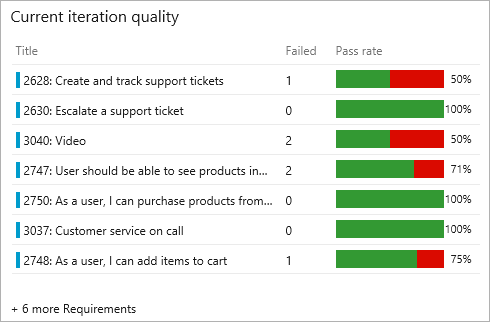
This kind of view is useful because it supports questions such as:
- Which requirement has failing tests?
- Is a story ready for UAT or release?
- Where is delivery risk concentrated in the current iteration?
However, a pass rate for a story only confirms that the implemented behaviour passed its defined tests. It does not by itself show that call volume reduced, users adopted the feature, or a business target was met.
Keep these evidence types separate:
| Question | Appropriate evidence |
|---|---|
| Did we build the required behaviour? | Test results, review evidence, acceptance-criteria results |
| Is the requirement working in the intended user scenario? | UAT evidence, observed workflow completion, stakeholder acceptance |
| Did the change achieve its intended business result? | KPI data measured over the agreed post-release period |
A strong analyst can explain all three without overstating what any one report proves.
Build a practical objective-to-requirement trace record
For the current phase, create a table in Excel or a Confluence page with one row per requirement. Jira issue links can be added later, but do not rely on issue hierarchy alone to preserve the business rationale.
Use these columns:
| Column | What to record |
|---|---|
| Requirement ID | A stable identifier, such as FR-01 or NFR-03 |
| Requirement summary | A concise, testable statement |
| Requirement source | Stakeholder, policy, discovery workshop, ticket analysis, or other evidence |
| Scope status | In scope, deferred, proposed change, or out of scope |
| Objective ID | The explicit business, compliance, risk, or service objective supported |
| Success indicator ID | The KPI or measurable indicator relevant to the objective |
| Contribution rationale | One or two sentences explaining the expected mechanism of value |
| Verification approach | Test, review, demonstration, inspection, or UAT evidence |
| Requirement owner and status | Person accountable for clarification and current lifecycle state |
A disciplined workflow is:
- Confirm the objective. Use evidence from discovery, not only a stakeholder’s preferred solution.
- Define the success indicator. Record the formula, data source, baseline, target, review window, and accountable owner.
- Assign a stable ID to each proposed requirement. Do not use row numbers that will change when items are reordered.
- Link each requirement to its primary objective. Add a secondary objective only where there is a genuine, explainable relationship.
- Write the contribution rationale. State how the capability is expected to influence the indicator or protect the objective.
- Record how the requirement itself will be verified. Requirement verification is distinct from post-release KPI measurement.
- Review the links with the relevant business and technical stakeholders. They should agree on both the reason for the requirement and the measurement plan.
A useful quality review
Before baselining the trace record, inspect it from both directions.
Start with each objective:
- Is there an explicit owner for the KPI?
- Are the baseline, target, calculation, data source, and timing defined?
- Do the linked requirements collectively make the objective achievable?
- Is a critical enabling requirement missing?
Then start with each requirement:
- Does it link to a real approved objective, policy, risk, or obligation?
- Is the stated contribution plausible and supported by discovery evidence?
- Is it inside the scope boundary?
- Can the requirement be verified independently?
- Does its objective or indicator need revision because the requirement revealed a gap in the original analysis?
This review is especially valuable when a long backlog accumulates after stakeholder workshops. A cluster of unlinked requirements is not automatically wrong, but it is a clear signal to investigate early rather than discovering uncontrolled scope growth during delivery.
A short working artifact for your portfolio case
Using the expense-claim example or your own service-fulfilment case, create a one-page Objective-to-Requirement Trace Table.
Include:
- two business objectives;
- one outcome KPI and one guardrail or adoption indicator for each objective;
- a baseline or a documented plan to establish it;
- four to six requirements;
- an objective ID and contribution rationale for every requirement; and
- one proposed request that is traceable to an objective but deferred because it sits outside the current scope.
Keep the language evidence-based. For instance, write “ticket categorisation indicates that payment-confirmation questions are frequent” rather than “users will definitely stop calling Finance.” This distinction demonstrates mature analysis in a job interview or portfolio review.
Key takeaways
Traceability connects delivery work to intended value.
- A business objective states the measurable result the organisation seeks; a requirement states a capability or condition expected to contribute to that result.
- A meaningful success indicator needs a clear calculation, data source, baseline, target, measurement period, and accountable owner.
- Trace requirements upward to justify their inclusion and downward to show how objectives will be implemented, verified, and evaluated.
- Delivery metrics, test results, adoption measures, and business-outcome KPIs provide different kinds of evidence. None should be mistaken for the others.
- A requirement’s alignment with an objective does not automatically place it in the current release. Scope, constraints, dependencies, and delivery priorities still apply.
- A lightweight trace table created during discovery becomes a strong foundation for later story, test-case, and change-impact traceability.
Next, you will prioritize the now-justified requirements using MoSCoW, defending which requirements are essential to the release outcome and which should be deferred.
Can't find a good explanation? Sign up and we'll make it for you
Sign up