
Hello. In the previous lesson, you learned that enzymes control the rate of biochemical reactions and that temperature, pH, and substrate concentration can affect enzyme activity. Photosynthesis and cellular respiration are both long, enzyme-controlled pathways; this lesson focuses on their big-picture inputs, outputs, locations, and purposes rather than every intermediate reaction.
By the end, you should be able to compare the processes precisely in an exam response, including an important distinction: photosynthesis stores energy in sugars, while cellular respiration releases energy from sugars and captures some in ATP for immediate cellular work.
The big energy-and-matter picture
Living things need a usable supply of energy for processes such as active transport, growth, repair, movement, and synthesising molecules. ATP is the cell’s immediate usable energy carrier, but organisms cannot obtain most of their ATP directly from sunlight or food without chemical reactions.
At the overall level, the two processes can be represented as:
This is photosynthesis. Carbon dioxide and water are used to build glucose, with light energy being stored as chemical energy in the bonds of the sugar.
This is aerobic cellular respiration. Glucose is broken down in the presence of oxygen. Some released energy is captured in ATP; the remaining energy is released as heat.
The products of one process are broadly the reactants of the other. However, they are not simply the same reaction run backwards. They use different enzyme-controlled pathways, occur in different cell structures, and serve different biological roles.
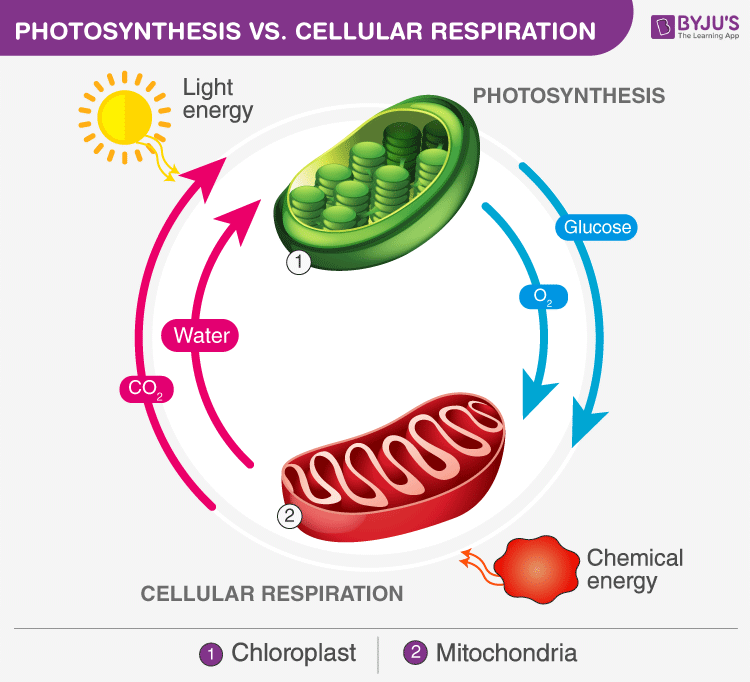
A useful way to avoid confusion is to separate matter from energy:
| What is being tracked? | Photosynthesis | Cellular respiration |
|---|---|---|
| Carbon | Carbon dioxide becomes part of glucose and other organic molecules | Carbon in glucose is released as carbon dioxide |
| Oxygen | Oxygen is released as a product | Oxygen is used as a reactant |
| Water | Water is used as a reactant | Water is produced |
| Energy | Light energy is stored in glucose | Chemical energy in glucose is released and transferred to ATP, with heat also released |
Energy does not cycle in exactly the same way as matter. Light energy enters ecosystems, is stored temporarily in organic molecules, and is ultimately released as heat during metabolism.
A visual overview of the two pathways
Watch these selected parts of “Photosynthesis and Respiration” by Bozeman Science to establish the locations and main stages. The video goes slightly beyond the depth required for this outcome, so focus on the overall inputs, outputs, and compartments rather than trying to memorise every electron carrier.
Photosynthesis and Respiration
“Photosynthesis and Respiration” by Bozeman Science gives a compact visual comparison of the two processes, including where their major stages occur in chloroplasts and mitochondria.
First watch photosynthesis locations. Focus on the distinction between thylakoid membranes and the stroma, and connect each area to its broad role. Then watch respiration locations. Track glucose, oxygen, carbon dioxide, water, and ATP as the explanation moves from glycolysis to the mitochondrion.
Photosynthesis: using light to build sugars
Photosynthesis occurs in photosynthetic organisms, including plants, algae, and some bacteria. In plants, it mainly occurs in the chloroplasts of green tissues, especially leaf mesophyll cells.
Its central role is to:
- convert light energy into chemical energy stored in sugars;
- make organic molecules from inorganic carbon dioxide;
- provide food and biomass for the photosynthetic organism; and
- release oxygen that can be used in aerobic respiration.
The overall inputs are carbon dioxide, water, and light energy. Its major overall outputs are glucose and oxygen.
Within a chloroplast, there are two main locations to know:
| Stage of photosynthesis | Cellular location | Main role |
|---|---|---|
| Light-dependent reactions | Thylakoid membranes | Absorb light energy, split water, release oxygen, and make temporary energy carriers |
| Calvin cycle | Stroma | Use carbon dioxide and the temporary energy carriers to build carbohydrate molecules |
The thylakoid membranes contain chlorophyll, the pigment that absorbs light. Water is used during the light-dependent reactions, and oxygen is released.
The stroma is the fluid around the thylakoids. Here, carbon dioxide is fixed into organic molecules and eventually contributes to sugars such as glucose.
Two details make exam answers stronger:
- The oxygen released in photosynthesis comes from water.
- The carbon in glucose comes from carbon dioxide.
Photosynthesis does make ATP during its light-dependent stage, but that ATP is used within the chloroplast to help construct sugars. Therefore, in an overall equation, ATP is not listed as the final useful product of photosynthesis. The major energy-storage product is glucose.
Cellular respiration: transferring energy from glucose to ATP
Cellular respiration is the process through which cells release chemical energy stored in glucose and transfer some of it into ATP. ATP can then power cellular work, including muscle contraction, active transport across membranes, protein synthesis, and cell division.
In eukaryotic cells carrying out aerobic respiration, the process occurs in both the cytosol and the mitochondria.
Learn: An introduction to cellular respiration (article) | Khan Academy
This Khan Academy article gives the most useful overview of cellular respiration for this lesson: its energy role, its major cellular locations, and its relationship with photosynthesis.
Begin in “All organisms need energy.” Read the overview to identify what respiration does with energy from food. Next, in “Cellular respiration involves three major stages,” read the three stages. Focus on matching each stage to its location rather than memorising every intermediate molecule. Finally, in “Comparing photosynthesis and cellular respiration,” read the reciprocal relationship and compare the gas exchange of the two processes.
The major stages and locations are:
| Stage of cellular respiration | Cellular location | Main outcome |
|---|---|---|
| Glycolysis | Cytosol | Glucose is partly broken down into pyruvate; a small amount of ATP is made |
| Citric acid cycle | Mitochondrial matrix | Carbon-containing molecules are broken down further; carbon dioxide is released |
| Electron transport chain | Inner mitochondrial membrane, including cristae | Oxygen is used to form water; most ATP is produced |
The folds of the inner mitochondrial membrane are called cristae. They increase membrane surface area, providing more space for the proteins involved in ATP production.
The overall inputs of aerobic respiration are glucose and oxygen. Its outputs are carbon dioxide, water, ATP, and heat.
A key biological point is that cells do not “create” energy during respiration. Instead, the chemical energy stored in glucose is transferred into ATP, a form that can be used more directly by the cell.
Compare the processes directly
For a comparison question, do not write a full paragraph about photosynthesis and then a separate full paragraph about respiration. Instead, make paired comparisons.
| Feature | Photosynthesis | Aerobic cellular respiration |
|---|---|---|
| Overall purpose | Stores light energy as chemical energy in glucose | Releases chemical energy from glucose and transfers some to ATP |
| Main location | Chloroplasts | Cytosol and mitochondria |
| Key internal locations | Thylakoid membranes and stroma | Cytosol, mitochondrial matrix, and inner mitochondrial membrane |
| Main inputs | Carbon dioxide, water, light energy | Glucose and oxygen |
| Main outputs | Glucose and oxygen | Carbon dioxide, water, ATP, and heat |
| Role in carbon cycling | Fixes inorganic carbon dioxide into organic molecules | Releases carbon dioxide from organic molecules |
| Role in oxygen cycling | Adds oxygen to the environment | Removes oxygen from the environment |
| Organisms | Photosynthetic organisms, such as plants and algae | Most organisms, including plants, animals, fungi, and many microorganisms |
The final row corrects one of the most common misconceptions:
Plants do not only photosynthesise. Plants also carry out cellular respiration.
A green leaf cell can contain both chloroplasts and mitochondria. During daylight, it may be carrying out both processes at once. At night, photosynthesis stops because light is unavailable, but cellular respiration continues because the plant’s cells still need ATP.
Similarities—and the limit of the “opposites” idea
Photosynthesis and respiration have important similarities:
- Both are multi-step, enzyme-controlled processes.
- Both involve electron transfers.
- Both use membrane-associated proteins to help generate ATP.
- Both are essential to the movement of matter and energy through living systems.
Yet calling them “opposites” is only useful at the level of their overall equations. It becomes misleading if it implies that respiration literally reverses every photosynthetic reaction.
For example, photosynthesis uses light energy to raise electrons to a higher-energy state and ultimately store that energy in sugars. Cellular respiration gradually transfers energy from glucose to ATP through a different series of reactions. Their compartments are different, their enzymes are different, and their energy roles are opposite in direction:
- Photosynthesis is mainly an energy-storing process.
- Cellular respiration is mainly an energy-releasing and ATP-producing process.
Building an exam-quality comparison
For a question such as “Compare photosynthesis and cellular respiration,” aim to include four paired points:
- Location: chloroplasts versus cytosol and mitochondria.
- Inputs and outputs: carbon dioxide, water, and light versus glucose and oxygen.
- Energy role: storage in glucose versus release and capture in ATP.
- Biological connection: the products of one broadly supply the reactants of the other.
A strong response could read:
Photosynthesis occurs in chloroplasts, with light-dependent reactions occurring in thylakoid membranes and carbon fixation occurring in the stroma. It uses carbon dioxide, water, and light energy to produce glucose and oxygen, storing energy in the chemical bonds of glucose. In contrast, aerobic cellular respiration begins in the cytosol and continues in mitochondria, including the matrix and inner mitochondrial membrane. It uses glucose and oxygen to produce carbon dioxide, water, and ATP. Thus, photosynthesis stores energy and fixes carbon into organic molecules, whereas cellular respiration releases energy from organic molecules for immediate cellular use.
Notice that this response compares each feature and explains the biological significance; it does not merely copy two chemical equations.
Common errors to avoid
| Error | Correction |
|---|---|
| “Photosynthesis makes energy.” | It converts light energy into chemical energy stored in glucose. |
| “Respiration creates energy.” | It transfers chemical energy from glucose into ATP and releases heat. |
| “Only animals carry out cellular respiration.” | Plants also respire continuously to make ATP. |
| “Cellular respiration occurs only in mitochondria.” | Glycolysis occurs in the cytosol; later aerobic stages occur in mitochondria. |
| “Photosynthesis occurs in every plant cell.” | It occurs in cells with chloroplasts, especially green leaf cells. |
| “The processes are exact reverses.” | Their overall equations are near-opposites, but their pathways and cellular locations differ. |
| “Oxygen is made from carbon dioxide.” | The oxygen released during photosynthesis comes from water. |
Key takeaways
- Photosynthesis occurs in chloroplasts and uses carbon dioxide, water, and light energy to produce glucose and oxygen. Its role is to store energy and build organic molecules.
- Cellular respiration occurs in the cytosol and mitochondria and uses glucose and oxygen to produce carbon dioxide, water, ATP, and heat. Its role is to provide usable ATP for cells.
- The products of one process broadly become the reactants of the other, linking the carbon and oxygen cycles.
- Plants carry out both photosynthesis and cellular respiration.
- In an exam comparison, pair each point directly: location, inputs, outputs, energy role, and biological significance.
Next, you will move from processes within a cell to how specialised cells organise into tissues, organs, and organ systems in multicellular organisms.
Can't find a good explanation? Sign up and we'll make it for you
Sign up