
Hello. In the previous lesson, you learned that diffusion, osmosis, and active transport move substances across selectively permeable cell membranes. This lesson adds an essential constraint: even when a substance can cross a membrane, the cell must have enough membrane surface available to exchange materials quickly enough for its internal volume.
By the end of this lesson, you should be able to calculate or compare surface-area-to-volume ratios and use them to predict how efficiently a cell can take in nutrients and oxygen, remove wastes such as carbon dioxide, and maintain suitable internal conditions.
Exchange happens at the surface, but demand comes from the volume
A cell’s surface area is the area of its cell membrane exposed to the environment. This membrane is where substances enter and leave:
- oxygen and nutrients enter;
- carbon dioxide and other wastes leave;
- water moves by osmosis;
- ions and some molecules move through membrane proteins.
A cell’s volume is the amount of living material inside the membrane. Its cytoplasm contains organelles and is where many metabolic reactions occur. More volume generally means:
- more cells processes needing oxygen and nutrients;
- more waste products being made;
- a greater demand for exchange across the membrane.
This creates the central biological relationship:
Surface area provides the space for exchange, while volume creates the demand for exchange.
A cell with a high surface-area-to-volume ratio, usually written as SA:V, has a large amount of membrane available for each unit of cytoplasm. It can exchange substances relatively efficiently. A cell with a low SA:V ratio has less membrane available for each unit of cytoplasm, so it may struggle to obtain enough materials and remove wastes quickly enough.
The short Cognito video gives a clear visual overview before we work through the calculations.
GCSE Biology - Surface Area to Volume Ratio (2026/27 exams)
Watch “GCSE Biology – Surface Area to Volume Ratio” from Cognito. It connects cell exchange to the mathematical pattern that volume increases faster than surface area.
Watch the biological problem to link membrane exchange with a cell’s internal needs. Then watch the cube model, pausing when each cube’s surface area and volume are calculated. Finish with the organism application, focusing on why large organisms need specialised exchange surfaces and transport systems.
Why growing cells become less efficient
Imagine a cube-shaped cell with side length .
Its surface area is:
Its volume is:
So its surface-area-to-volume ratio is:
The simplified result, , makes the pattern clear: as side length increases, the ratio decreases.
| Cube side length | Surface area | Volume | SA:V ratio |
|---|---|---|---|
When the cube’s side length doubles from to :
- surface area increases from to , so it becomes four times larger;
- volume increases from to , so it becomes eight times larger;
- the SA:V ratio falls from to .
The larger cube does have more total surface area. However, it has even more internal volume to supply. This is the common exam trap: a large cell may have a larger surface area but still have a lower SA:V ratio and less efficient exchange relative to its needs.
For a sphere, a common model for animal cells, the same principle applies:
Again, increasing radius reduces SA:V.
Linking the ratio to diffusion and cell survival
A high SA:V ratio improves the efficiency of exchange because there is more membrane across which diffusion, osmosis, facilitated diffusion, and active transport can occur.
If two cells are in the same environment, with similar concentration gradients and membrane properties, the cell with the higher SA:V ratio can generally:
- absorb nutrients more rapidly;
- take in oxygen more effectively for cellular respiration;
- remove carbon dioxide and other metabolic wastes more effectively;
- exchange heat with its surroundings more easily.
The key phrase is relative to its volume. A high ratio does not guarantee that every substance will move quickly: diffusion rate also depends on concentration gradient, temperature, membrane permeability, and diffusion distance. But SA:V tells you whether the amount of membrane is likely to be sufficient for the amount of cytoplasm it serves.
Read the short RMIT Learning Lab explanation to consolidate the biological consequences of the ratio.
Surface area to volume ratio - Learning Lab - RMIT University
Read “Surface area to volume ratio” from RMIT Learning Lab. It explains why a high SA:V ratio improves uptake, waste removal, and gas exchange, then shows how cells increase surface area when they need high rates of absorption.
In the section “Effect of surface area to volume ratio on cell function,” read the explanation of efficient exchange. Focus on connecting each function—nutrient uptake, waste removal, and gas exchange—to the cell membrane. Then, in “Effect of surface area to volume ratio on cell size,” read the explanation of microvilli. Notice the two solutions to the SA:V problem: remaining small and increasing membrane surface area through folding.
Predicting exchange efficiency from data
When an exam question gives dimensions or a table of surface areas and volumes, use this method:
- Calculate the ratio by dividing surface area by volume.
- Compare the ratios, not only the total surface areas.
- Identify the higher ratio.
- Link it to membrane exchange.
- State the biological consequence: faster uptake of needed substances and/or more effective waste removal.
For example, compare two cube-shaped cells.
| Cell | Side length | SA:V calculation | SA:V ratio |
|---|---|---|---|
| A | |||
| B |
Cell B has a greater total surface area, but Cell A has the greater SA:V ratio. Therefore, Cell A would exchange substances with its environment more efficiently relative to its internal volume.
A strong exam-style explanation would be:
Cell A would exchange substances more efficiently because it has a higher surface-area-to-volume ratio. It has more cell membrane available per unit of cytoplasm, allowing faster uptake of nutrients and oxygen and more effective removal of wastes by diffusion.
Notice what makes this answer strong:
- it makes a clear comparison;
- it uses the calculated ratio as evidence;
- it connects surface area to the cell membrane;
- it explains exchange using appropriate biological terms.
Avoid vague statements such as “Cell A is better because it is smaller.” Small size matters because it usually creates a higher SA:V ratio and shorter diffusion distances.
How cells and organisms overcome the SA:V problem
Cells cannot keep increasing in size indefinitely. If a cell becomes too large, its volume and metabolic demand rise faster than the membrane area available for exchange. Several adaptations reduce this problem.
1. Cell division
One solution is for a large cell to divide into smaller cells. The total volume stays the same, but the total surface area increases.
For instance, one cube with side length has:
If it is divided into eight separate cubes of side length , their combined volume is still:
But their combined surface area becomes:
Dividing cells therefore increases the membrane surface available for exchange.
2. Long, thin, or flattened shapes
A thin cell has a relatively large surface area compared with its volume. It also reduces diffusion distance, because substances do not have to travel as far to reach the centre.
Red blood cells are thin and biconcave, helping oxygen diffuse into and out of them rapidly. Root hair cells have long projections that increase the membrane area in contact with soil water and mineral ions.
3. Folded membranes and microvilli
Cells with high absorption demands often have folded membranes. Each fold increases surface area without greatly increasing volume.
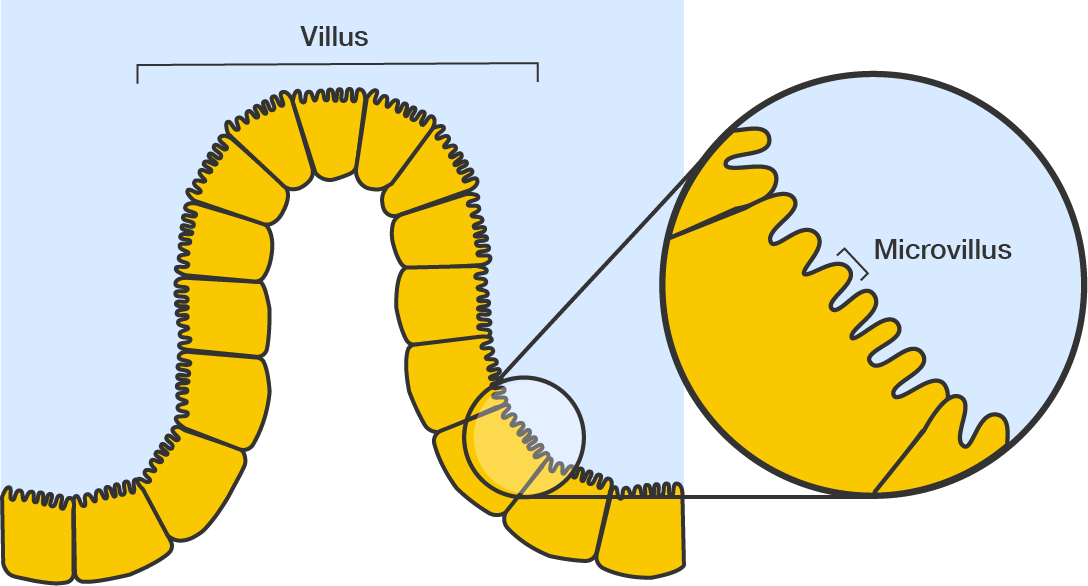
In the small intestine:
- villi are folds of the intestinal lining;
- microvilli are much smaller projections on the surface of individual epithelial cells;
- both increase surface area for nutrient absorption;
- capillaries near the surface transport absorbed nutrients away, helping maintain concentration gradients.
This is a useful distinction for Biology responses. A villus is not a single cell; it is a larger tissue-level projection. Microvilli are membrane projections on individual cells.
4. Specialised exchange surfaces and transport systems
Single-celled organisms can often exchange all necessary substances directly across their cell membrane because they are small and have high SA:V ratios.
Multicellular organisms are much larger, so diffusion from the external surface to every body cell would be far too slow. They need specialised exchange surfaces and internal transport systems:
| Exchange surface | Main exchanged substances | Surface-area adaptation |
|---|---|---|
| Alveoli in lungs | Oxygen and carbon dioxide | Many tiny alveoli create a large total area |
| Small intestine | Digested nutrients | Villi and microvilli increase area |
| Root hairs in plants | Water and mineral ions | Long projections increase root surface area |
| Leaves | Carbon dioxide and oxygen | Broad, thin lamina provides large area and short diffusion distance |
You will examine several of these systems in more depth in the next Biology module. For now, connect each adaptation to the same central principle: increasing surface area and reducing diffusion distance makes exchange more efficient.
A concise response structure for SA:V questions
For a question asking you to predict exchange efficiency, use this structure:
[Name the cell or structure] has a higher/lower surface-area-to-volume ratio than [comparison]. Therefore, it has more/less membrane surface available per unit of volume for exchange with the environment. This allows faster/slower uptake of [named substance] and more/less effective removal of [named waste].
For a question about a cell growing larger:
As the cell increases in size, its volume increases faster than its surface area, so its surface-area-to-volume ratio decreases. There is less membrane surface available per unit of cytoplasm, reducing the efficiency of diffusion and exchange. The cell may divide or develop adaptations such as folds or microvilli to increase its surface area.
Key takeaways
- Surface area is the amount of cell membrane available for exchange; volume represents the amount of cytoplasm that needs materials and produces wastes.
- As cell size increases, volume increases faster than surface area, so SA:V decreases.
- A high SA:V ratio predicts efficient exchange of nutrients, gases, water, and wastes between a cell and its environment.
- A low SA:V ratio makes exchange less efficient relative to the cell’s metabolic needs.
- Cells overcome SA:V limitations by remaining small, dividing, becoming thin or elongated, or developing membrane folds such as microvilli.
- In exam responses, compare ratios, then explicitly link a higher ratio to more membrane per unit volume and more efficient exchange.
Next, you will investigate enzymes and predict how temperature, pH, and substrate concentration affect enzyme-controlled reactions.
Can't find a good explanation? Sign up and we'll make it for you
Sign up