Hello! Let's dive into the world of high-performance gradient boosting.
Introduction
In our last lesson, you implemented AdaBoost and Gradient Boosting Machines (GBMs) from first principles. This gave you a foundational understanding of boosting's core mechanism: building an ensemble of weak learners sequentially, with each new model focusing on correcting the errors of its predecessors. You saw how AdaBoost manipulates sample weights and how a generic GBM trains new trees on the residuals (the negative gradient of the loss function).
While building these from scratch is excellent for understanding the theory, in real-world applications, we rely on heavily optimized, feature-rich libraries. This lesson focuses on the "big three" of gradient boosting: XGBoost, LightGBM, and CatBoost. These libraries are the workhorses of modern machine learning for structured (tabular) data, consistently delivering winning performance in competitions and production systems.
Our goal is to apply these high-performance boosting libraries. We will explore their unique architectural differences, understand their respective strengths and weaknesses, and learn the best practices for implementing them to solve complex problems.
1. The Powerhouses of Gradient Boosting: Architectural Differences
XGBoost, LightGBM, and CatBoost are all implementations of gradient boosting, but their internal strategies for building decision trees and handling data differ significantly. These differences have profound impacts on their speed, accuracy, and ease of use.
Let's start with a comprehensive guide that breaks down each library.
XGBoost vs LightGBM vs CatBoost: The Ultimate Guide to Gradient Boosting
The article "XGBoost vs LightGBM vs CatBoost: The Ultimate Guide..." from CreateBytes provides an excellent overview of each library's architecture and a head-to-head comparison. We will use it as a reference throughout this section.
First, quickly read Section 1, "The Foundation: Understanding Gradient Boosting Machines (GBMs)", to refresh the core concepts from our previous lesson.
Now, let's examine the unique characteristics of each library.
XGBoost: The Battle-Tested All-Rounder
XGBoost (Extreme Gradient Boosting) was the library that catapulted gradient boosting to fame. It introduced critical optimizations over the standard GBM framework.
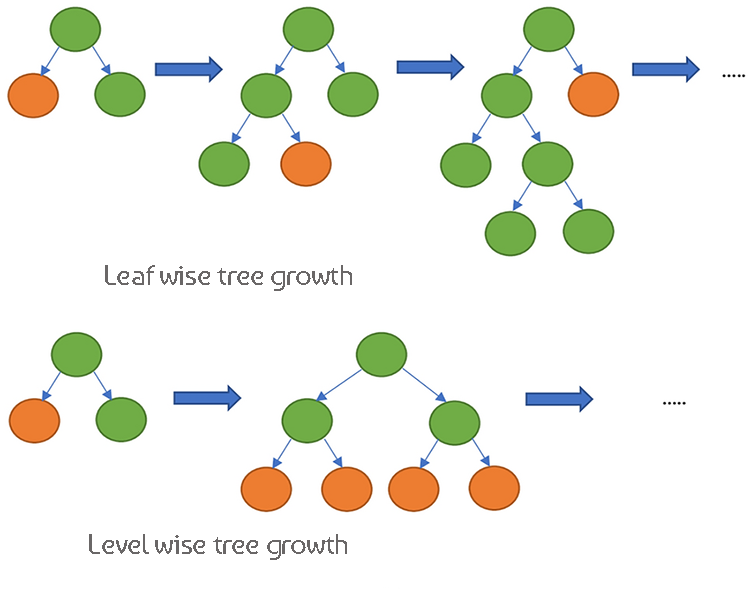
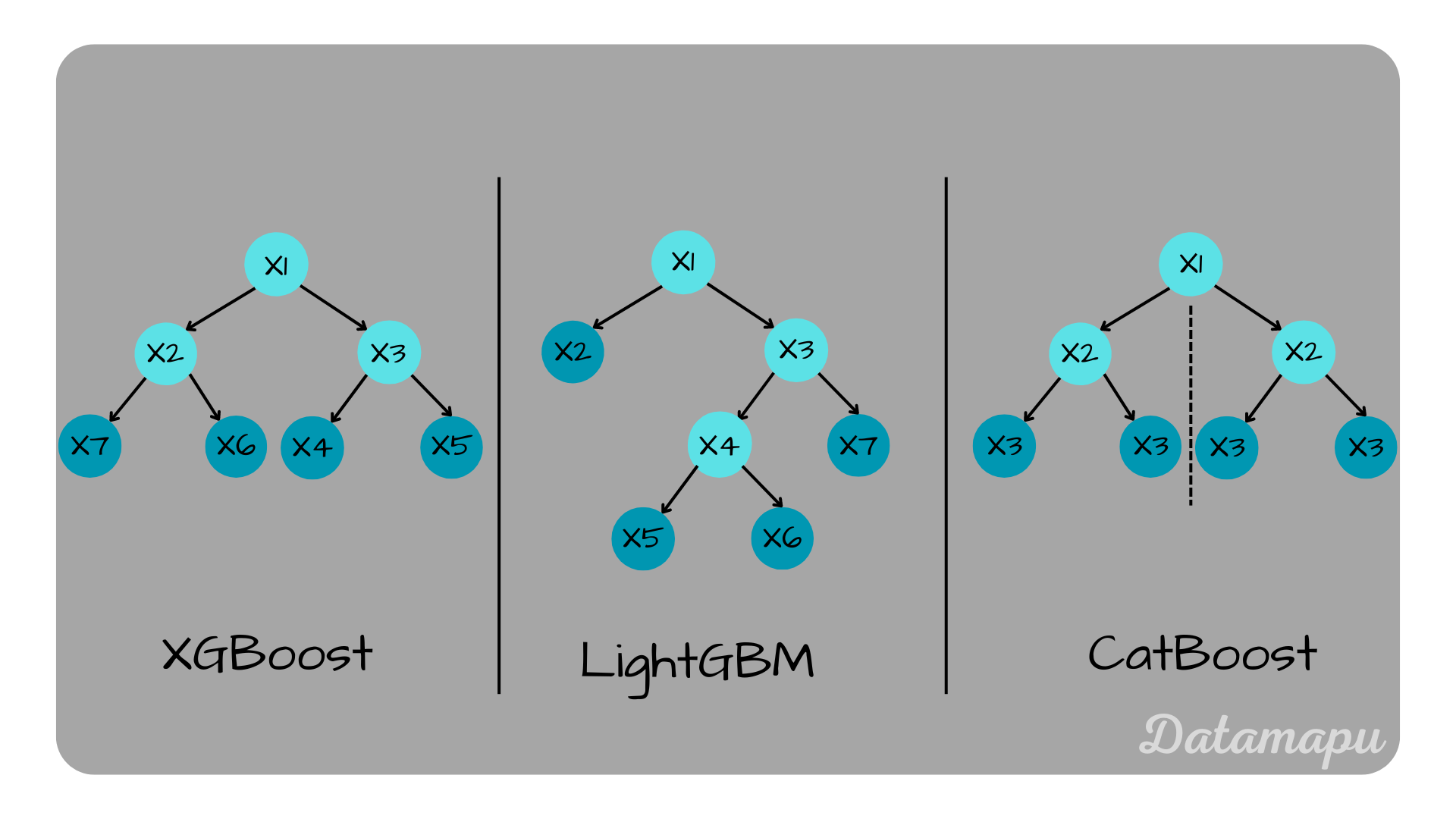
- Tree Growth Strategy: Level-wise (or Depth-wise)
XGBoost grows its trees horizontally. It splits all the nodes at a given depth level before moving on to the next level, creating a balanced, symmetric tree. While thorough, this can be computationally intensive as it evaluates splits that might offer little predictive gain.
- Key Features:
- Regularization: It was the first to build L1 (Lasso) and L2 (Ridge) regularization directly into the objective function, which is a powerful way to control overfitting.
- Handling Missing Values: It has a built-in, learnable mechanism to handle missing data.
- Community & Robustness: As the most mature of the three, it has a massive community and is known for its stability and accuracy.
Read more about XGBoost in Section 2 of the "Ultimate Guide" article.
LightGBM: The Speed Demon
Developed by Microsoft, LightGBM was designed for one primary purpose: to be exceptionally fast and memory-efficient, especially on large datasets.
-
Tree Growth Strategy: Leaf-wise
This is LightGBM's secret weapon. Instead of growing level by level, it finds the single leaf node that will yield the largest reduction in loss when split and grows the tree vertically from there. This converges much faster but carries a risk of creating deep, complex trees that can overfit on smaller datasets. -
Key Features:
- Speed Optimizations: It uses two clever techniques:
- Gradient-based One-Side Sampling (GOSS): Focuses training on data points with large gradients (i.e., those the model is most wrong about) while randomly sampling the rest.
- Exclusive Feature Bundling (EFB): Bundles mutually exclusive features (e.g., sparse features that are rarely non-zero at the same time) to reduce the feature space.
- Categorical Support: It can handle categorical features natively if you convert the columns to the
categorydata type in a Pandas DataFrame, but its approach is simpler than CatBoost's.
- Speed Optimizations: It uses two clever techniques:
You can find a detailed breakdown of LightGBM in Section 3 of the "Ultimate Guide" article.
CatBoost: The Categorical Specialist
Developed by Yandex, CatBoost (Categorical Boosting) was built to address a major pain point in machine learning: handling categorical features effectively and automatically.
- Tree Growth Strategy: Symmetric (Oblivious) Trees
CatBoost builds symmetric trees, where the same splitting criterion (feature and value) is used for all nodes at a given level. This structural constraint acts as a form of regularization, preventing overfitting. It also makes the model architecture simpler, allowing for extremely fast prediction (inference) times.
- Key Features:
- Superior Categorical Handling: This is CatBoost's main advantage. It uses a sophisticated method called Ordered Boosting, a variation of target encoding that avoids the "target leakage" problem, leading to more robust models without manual feature engineering.
- Ease of Use: It is famous for producing excellent results with default hyperparameters, making it very user-friendly and great for establishing a strong baseline quickly.
For more details, read Section 4 of the "Ultimate Guide" article and the "Key features of CatBoost" section in the Neptune.ai article.
2. A Practical Head-to-Head Comparison
Theory is one thing, but seeing these libraries in action provides the best intuition. Let's watch a video that implements and compares all three on the same dataset.
CatBoost Vs XGBoost Vs LightGBM | Catboost Vs XGBoost | Lightgbm vs XGBoost vs CatBoost
This video from Unfold Data Science provides a practical, code-driven comparison of XGBoost, LightGBM, and CatBoost, highlighting their differences in implementation and performance.
Watch the following segments: Tree Creation Differences (01:31 - 04:42): This will visually reinforce the concepts of symmetric (CatBoost), leaf-wise (LightGBM), and depth-wise (XGBoost) tree growth. Categorical Variable Handling (04:42 - 05:48): Observe how each library approaches categorical data—a key differentiator. Python Implementation and Comparison (08:35 - 14:33): Pay close attention to the code snippets and the resulting performance metrics (R-squared and execution time). Notice how fast LightGBM is and how CatBoost's training time and default performance compare.
The video demonstrates a common scenario: with default parameters, LightGBM is often the fastest, while CatBoost can be slower to train but provides strong accuracy. XGBoost requires the most manual preprocessing for categorical data.
Test your understanding!
A colleague is working with a dataset of 10 million rows and is complaining that their XGBoost model is taking hours to train. The dataset has mostly numerical features. Based on what you've learned, what would be your primary recommendation to speed up training, and why?
Show answer
The primary recommendation would be to try LightGBM.
Its leaf-wise growth strategy converges much faster than XGBoost's level-wise growth. Furthermore, its use of GOSS and EFB significantly reduces the amount of data and features that need to be considered at each step, making it highly memory-efficient and fast, especially on large datasets. While CatBoost might also be an option, LightGBM's design is specifically optimized for training speed.
3. Implementation Guide and Best Practices
All three libraries offer a user-friendly, scikit-learn compatible API, making them easy to swap and test. However, to get the most out of them, you need to follow some best practices.
General Workflow and Hyperparameter Tuning
The process generally involves data preparation, model initialization, training with cross-validation, and evaluation. A crucial part of this process is hyperparameter tuning.
XGBoost vs LightGBM vs CatBoost: The Ultimate Guide to Gradient Boosting
Let's return to the "Ultimate Guide" article, which provides an excellent checklist for implementation and discusses common challenges.
Read the following sections carefully: Section 6: "Best Practices for Implementation": Focus on the importance of cross-validation, systematic hyperparameter tuning, and especially early stopping. Section 7: "Common Challenges and Practical Solutions": Understand the strategies for dealing with overfitting, long training times, and model interpretability (using tools like SHAP).
Key Hyperparameters to Tune:
While each library has dozens of parameters, a few have the most impact:
n_estimators(oriterations): The number of trees in the ensemble.learning_rate(oreta): The step size shrinkage, which controls the contribution of each tree. A lower learning rate requires a highern_estimators.max_depth(ordepth): The maximum depth of a tree. Controls model complexity.- Regularization parameters (
lambda/reg_lambda,alpha/reg_alpha): L2 and L1 regularization terms to prevent overfitting.
Early Stopping: This is a vital technique. Instead of guessing the optimal n_estimators, you provide the model with a validation set. The model will then stop training automatically when performance on the validation set stops improving for a specified number of rounds. This saves significant time and prevents overfitting.
A Deeper Look at CatBoost's Practical Features
Because of its unique design, it's worth seeing how some of CatBoost's advanced features are used in practice.
Anna Veronika Dorogush: Mastering gradient boosting with CatBoost | PyData London 2019
To appreciate the design philosophy behind CatBoost, let's watch a few key segments from a talk by one of its creators, Anna Veronika Dorogush. This will give you insights into why it's so robust and easy to use.
Watch the following parts of "Mastering gradient boosting with CatBoost": Key Advantages (07:08 - 09:03): Listen for the three main selling points: categorical feature support, great out-of-the-box performance (good defaults), and model analysis tools. Validation and Overfitting Detection (22:27 - 34:42): This is a fantastic practical demonstration. Pay attention to how a validation set is used, how the training logs are interpreted, how to plot metrics during training, and how the model uses early stopping to find the best iteration and prevent overfitting.
4. Making the Choice: Which Library to Use?
There is no single "best" algorithm. The right choice depends on your specific priorities and dataset characteristics.
Here’s a decision-making framework based on our resources:
-
Choose LightGBM when:
- Priority: Training speed and memory efficiency.
- Dataset: Very large (100,000+ rows), mostly numerical data.
- Caution: Be mindful of its tendency to overfit on smaller datasets. You may need to constrain
max_depthornum_leaves.
-
Choose CatBoost when:
- Priority: Ease of use, robustness, and handling of categorical data.
- Dataset: Contains many meaningful categorical features (e.g., user IDs, product categories, location names).
- Advantage: Excellent performance with default parameters, saving you time on extensive tuning. It's often the best choice for a quick, strong baseline.
-
Choose XGBoost when:
- Priority: Maximum accuracy and a vast ecosystem of support.
- Dataset: A wide variety of problems, especially when you have time for careful tuning and preprocessing.
- Advantage: Its huge community means that tutorials and solutions for almost any problem are readily available.
The Golden Rule: The best practice is to benchmark all three on your specific dataset. A quick run with default parameters will often reveal a clear front-runner, on which you can then focus your hyperparameter tuning efforts.
Conclusion
You have now moved from the theoretical underpinnings of gradient boosting to the practical application of its most powerful implementations. These libraries are essential tools for any AI/ML practitioner working with tabular data.
Key Takeaways:
- XGBoost, LightGBM, and CatBoost are highly optimized GBM libraries with distinct architectural trade-offs.
- XGBoost uses level-wise growth, is robust, and has a large community, but requires manual preprocessing for categorical data.
- LightGBM uses leaf-wise growth, making it exceptionally fast and memory-efficient, but it can overfit on small datasets.
- CatBoost uses symmetric trees and ordered boosting, giving it superior, automated handling of categorical features and great out-of-the-box performance.
- The choice between them depends on your project's priorities: speed (LightGBM), categorical data handling (CatBoost), or all-around robustness (XGBoost).
- Best practices like cross-validation, hyperparameter tuning, and early stopping are crucial for unlocking their full potential.
Preview of the next lesson:
This lesson concludes our module on Classical and Ensemble Learning Algorithms. We've covered a wide range of supervised learning techniques. We will now shift our focus to a different paradigm of machine learning: Unsupervised Learning. In our next lesson, we will start by implementing one of the most fundamental clustering algorithms, K-means, and learn how to partition data without any labels.