
Hello! Welcome back to your course on the Venezuelan crisis.
Introduction
In our last lesson, we analyzed the hard data behind Venezuela's economic implosion, pinpointing how the 2014 global oil price collapse triggered a catastrophic fall in the country's imports and accelerated the decline of its oil production. This set the stage for the hyperinflation and severe shortages that define the crisis.
A logical question follows: faced with a complete economic meltdown that would topple most governments, how did Nicolás Maduro's regime survive and even consolidate its power?
Today's lesson answers that question. Your learning outcome is to describe the primary mechanisms of state control and political power maintenance used by the Maduro government post-2013. We will move from economics to statecraft, examining the toolkit of authoritarian resilience that the regime has employed to maintain its grip on power.
Estimated time to complete: 60 minutes.
1. The Authoritarian Imperative: From Patronage to Coercion
Hugo Chávez, buoyed by high oil prices and personal charisma, could maintain power through a mix of popular support, social spending, and targeted repression—a "competitive authoritarian" model. Nicolás Maduro inherited a different reality: a collapsing economy, dwindling popular support, and a fractious ruling coalition. His survival required a decisive shift towards a more consolidated, repressive authoritarianism.
To understand the pressures that forced this shift, please read the following short text.
Reading (10 minutes):
Please read Political Survival and… Authoritarian Consolidation? The ... (Maduro's Embrace of Autocracy and Key Drivers). This section outlines the three interrelated factors that drove Maduro's embrace of autocracy:
- The collapse of the economy.
- The increasing influence of the domestic and external opposition.
- The instability of his own ruling coalition.
As you read, consider this: How did the lack of oil revenue fundamentally change the "game" of political survival for Maduro compared to Chávez?
In essence, where Chávez could use petrodollars to buy loyalty and fund popular programs, Maduro had to rely on other, harder-edged tools to manage dissent and secure his position. The rest of this lesson will explore what those tools are.
2. The Toolkit of State Control
The Maduro regime's survival rests on a multi-pronged strategy. We can group the primary mechanisms into three categories: neutralizing democratic institutions, deploying widespread repression and social control, and securing the loyalty of the regime's core pillars.
A. Neutralizing Democratic Institutions: "Autocratic Legalism"
One of the most effective strategies has been to maintain the façade of democratic institutions while systematically stripping them of any real power. This is a sophisticated form of control, sometimes called "autocratic legalism."
Reading (10 minutes):
Please read Political Survival and… Authoritarian Consolidation? The ... (Judicial and Legislative Control). Focus on how the regime responded to the opposition's landslide victory in the 2015 legislative elections.
This text describes two key moves:
- Judicial Capture: The pro-government Supreme Court (TSJ) was used to systematically block and ultimately void the powers of the opposition-controlled National Assembly.
- Creating a Parallel Legislature: When the National Assembly proved uncontrollable, the regime simply created a new, all-powerful, and entirely pro-government body—the National Constituent Assembly (ANC)—to supersede it.
This process was not a military coup; it was a slow, deliberate strangulation of democratic checks and balances, using the regime's control of the judiciary as the primary weapon.
What happens to high-level officials who resist this process? The case of Attorney General Luisa Ortega, once a staunch loyalist, is illustrative.
Video (5 minutes):
Watch this segment of the DW Documentary, which details the consequences for Ortega and other rivals who challenged Maduro's consolidation of power.
{15:00 - 17:50}
Ortega's flight into exile demonstrates that institutional capture was paired with purges of any individual who might use their position to challenge the regime.
B. Repression and Social Control
Alongside the legalistic dismantling of democracy, the regime has relied on overt force and surveillance to manage its citizens.
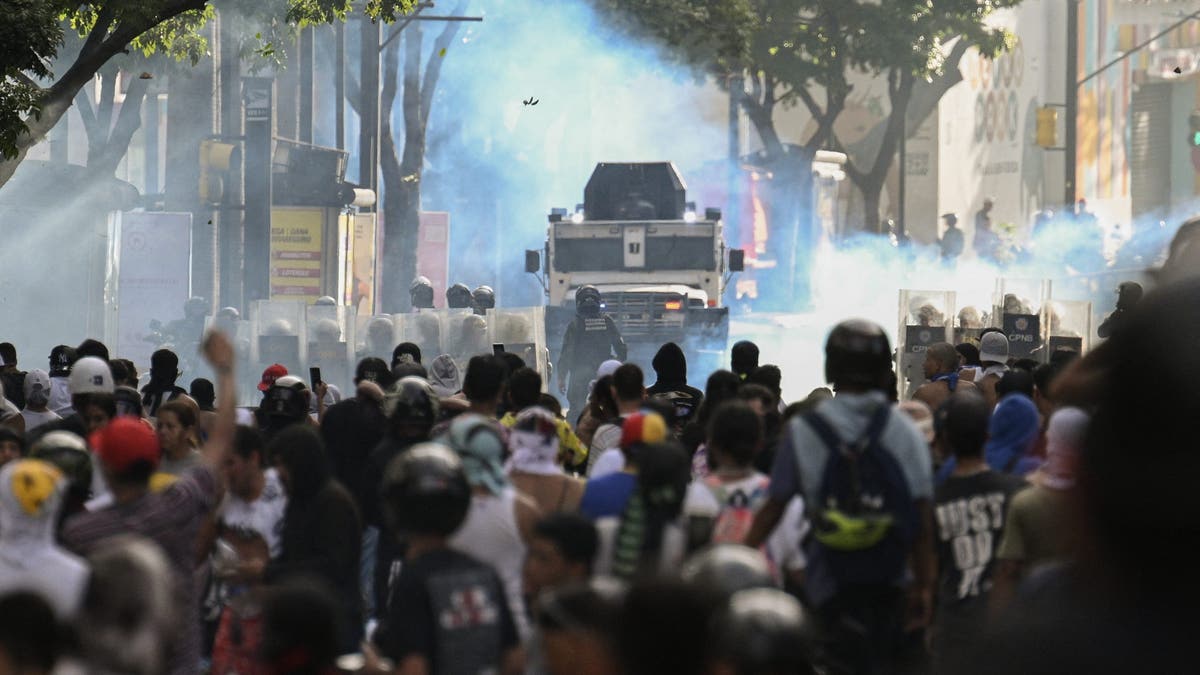
This image from a protest in Caracas shows an armored vehicle from the National Guard deploying a crowd-control agent against demonstrators. It is a stark visual of the state's readiness to use force against public dissent.
Reading (10 minutes):
To understand the pattern of repression, please read A Question of Staying Power: Is the Maduro Regime's ... (Historical Context of Repression). This section provides historical context on how the regime quashed major protest waves in 2014 and 2017, detailing the scale of violence and the use of both state security and armed civilian groups (colectivos).
Beyond street-level violence, the regime has built a sophisticated apparatus for surveillance and intimidation. A former head of the intelligence service (SEBIN) describes its function in his own words.
Video (5 minutes):
Watch this clip where General Manuel Cristopher Figuera, former director of SEBIN, describes his role.
{11:19 - 13:10}
As Figuera explains, the goal was total information dominance, used to monitor, neutralize, and criminalize opponents. This has evolved to include digital tools like the VenApp and public intimidation campaigns like "Operación Tun Tun" (Operation Knock Knock), designed to sow fear and prevent collective action, as mentioned in the CSIS commentary you skimmed earlier.
Finally, control is also exercised through the distribution of scarce resources. Social programs, like the "Great Housing Mission," can be used to foster loyalty, tying access to a basic need—shelter—to political conformity.
Video (5 minutes):
This final clip shows how a government housing project is integrated into the state's propaganda system, making political messaging a part of daily life for residents.
{33:20 - 36:42}
C. Securing the Pillars of the Regime
No authoritarian regime can survive by repression alone. It must secure the loyalty of key power brokers. For Maduro, two pillars are paramount: the military and international allies.

This image shows President Maduro with members of the military high command. The visual proximity and formal setting underscore the military's integral role in supporting and legitimizing the government.
The armed forces are the ultimate guarantor of the regime's survival. Maduro has secured their loyalty not just through ideological appeals, but by:
- Purging potentially disloyal officers.
- Promoting loyalists to key positions.
- Granting the military control over lucrative sectors of the economy, including food importation, mining, and oil services, thereby giving them a direct financial stake in the regime's survival.
The internal security of the armed forces is also critical. As you'll see in this brief reading, this is an area where the regime has received significant external help.
Reading (5 minutes):
Please read the first two paragraphs of the section "The Security Services and the Regime Itself" in A Question of Staying Power: Is the Maduro Regime's ... (Limits of Maduro’s Repression: Security Services and Regime Cohesion). This part highlights the threat of internal dissent and the role of Cuban-built military counterintelligence in policing the armed forces.
Finally, facing international isolation and sanctions from the West, Maduro has cultivated a portfolio of international allies.
Reading (5 minutes):
Please read the section Political Survival and… Authoritarian Consolidation? The ... (Deepening and Organizing Authoritarianism). This text explains how alliances with China, Russia, Iran, and Turkey have provided crucial economic, diplomatic, and strategic support, creating a lifeline that helps the regime withstand Western pressure.
Conclusion
Today, we have mapped out the core strategies that explain the paradox of the Maduro regime's survival amidst total economic failure. It has persisted not by solving the crisis, but by mastering the tools of authoritarian control.
Key Takeaways:
- Shift in Strategy: The collapse in oil revenue forced Maduro's regime to shift from a patronage-based model of control to one reliant on coercion, institutional capture, and targeted loyalties.
- Neutralizing Institutions: The regime systematically dismantled democratic checks and balances by using a captured judiciary to nullify the legislature and purge dissenters.
- A Spectrum of Repression: Power is maintained through a combination of violent suppression of protests, pervasive surveillance by intelligence services, intimidation campaigns, and the use of social programs to enforce political loyalty.
- The Core Pillars: The regime's survival ultimately depends on two pillars: the loyalty of the military, secured through purges and economic incentives, and the economic and diplomatic lifelines provided by international allies like Russia and China.
Preview of the Next Lesson:
Now that we understand the political mechanisms that have allowed the crisis to deepen without a change in government, we will turn our focus to the devastating human cost. In the next lesson, we will explain the humanitarian impact of the economic crisis, examining its effects on critical indicators such as malnutrition and access to essential medicines.
Can't find a good explanation? Sign up and we'll make it for you
Sign up