
Hello! Welcome to the first lesson in our fourth module, "Economic Collapse and Humanitarian Crisis."
In the previous module, we examined the economic policies of the Chávez era, such as price controls, expropriations, and the multi-tiered currency system (CADIVI). These policies, combined with a reliance on oil revenue, created significant economic distortions and vulnerabilities. Now, we will explore how those vulnerabilities tipped over into a full-blown collapse under his successor, Nicolás Maduro.
This lesson will focus on the most dramatic symptom of this collapse: hyperinflation.
Lesson Outcome: Define hyperinflation and create a feedback loop diagram illustrating the 'inflation-devaluation' spiral in the Venezuelan context.
Estimated time: 60 minutes.
1. Defining Hyperinflation: When Money Loses All Meaning
Imagine your money becoming so worthless that people use it for arts and crafts rather than for buying goods. This was the reality in Venezuela.
Hyperinflation in Venezuela Venezuelan migrants in Bogotá selling crafts made of worthless Venezuelan banknotes in November 2019. This image starkly illustrates the complete loss of value of the Venezuelan bolívar during the hyperinflationary period.
Economists have a technical definition for hyperinflation. The most common one, proposed by Phillip Cagan, is a period where the monthly inflation rate exceeds 50%. At that rate, a loaf of bread costing £2 today would cost over £260 in a year's time.
However, hyperinflation is more than just a number. It represents a total loss of faith in a currency and the government that issues it. It fundamentally breaks the normal functioning of an economy.
To get a sense of the sheer scale of this phenomenon in Venezuela, please read the following sections from the Wikipedia article on the topic.
Reading (7-10 minutes):
Please read the following parts of the article Hyperinflation in Venezuela (Definition and Context of Hyperinflation; Escalation of Inflation Rates; Inflation Rate Tables).
- Part 1: Definition and Context of Hyperinflation: Focus on the start date and the list of causes.
- Part 2: Escalation of Inflation Rates: Note the astronomical figures. Don't worry about memorizing them; the goal is to grasp the speed and scale of the price increases.
- Part 5: Inflation Rate Tables: Skim the tables to see the data visually.
As you can see from the reading, Venezuela's inflation didn't just rise; it accelerated at an exponential rate, reaching millions of percent. This wasn't just high inflation; it was a runaway process. To understand how this happens, we need to introduce the concept of a feedback loop.
2. Vicious Cycles: The Engine of Collapse
In your policy analysis studies, you've likely encountered the idea that policies can have unintended consequences that create cycles. Hyperinflation is a textbook example of a "vicious cycle," a type of positive feedback loop where a bad situation progressively worsens itself.
The following short video provides an excellent conceptual overview of feedback loops and vicious cycles.
Video (5 minutes):
Please watch these clips from the video
by the Systems Innovation Network.- 00:39 - 01:50: Introduction to Feedback Loops.
- 04:10 - 05:23: Explanation of Positive Feedback Loops and exponential change.
- 06:16 - 07:11: Definition of a Vicious Cycle, which explicitly uses hyperinflation as the classic example.
The key takeaway is that in a vicious cycle, an initial negative change triggers a response that amplifies the original problem, leading to a downward spiral. The "inflation-devaluation spiral" that crippled Venezuela is exactly this kind of mechanism.
3. Anatomy of the Venezuelan Spiral
Let's build a diagram of Venezuela's hyperinflationary spiral step-by-step. We will connect the policy decisions you've learned about with the economic theory of feedback loops.
Step 1: The Trigger - A Fiscal Crisis
As we've established, the Venezuelan state was heavily dependent on oil revenues to fund its vast social programs, subsidies, and government operations. When global oil prices plummeted in 2014, government income collapsed, but its spending commitments remained. This created a massive budget deficit.
Step 2: The Response - Printing Money
A government can cover a deficit by cutting spending, raising taxes, or borrowing.
- Cutting spending on popular social programs was politically untenable for the Maduro government.
- Raising taxes from a collapsing economy yields little revenue.
- Borrowing from international markets was impossible due to a loss of investor confidence and, later, US sanctions.
This left one main option: forcing the central bank to print new money to pay the government's bills. This is known as monetizing the deficit.
The following resources explain how this policy choice laid the groundwork for and then ignited the hyperinflationary crisis.
Reading & Video (10 minutes):
- First, read these sections from Why did Venezuela's economy collapse? (Bad Macroeconomic Policy (1999-2013); The Collapse: Denial, Emigration and Hyperinflation (2014-Present)). They explain the government's reliance on money printing and how the 2014 oil price shock turned a bad habit into a catastrophic policy.
- Then, watch this short clip from an interview with economist Mark Weisbrot, who directly addresses the role of money printing in Venezuela's crisis.
{07:59 - 09:06}
Step 3: The Spiral Ignites - Inflation and Devaluation
Here is where the feedback loop kicks in.
- Money Printing → Inflation: The government prints vast sums of bolívares. This massive increase in the money supply, chasing a shrinking supply of goods (due to price controls and collapsing production), causes prices to rise rapidly. This is the inflation part of the spiral.
- Inflation → Loss of Confidence: As people see prices rising daily, they realize their money is losing value. They lose all faith in the bolívar as a store of value.
- Loss of Confidence → Devaluation: Everyone tries to dump their rapidly depreciating bolívares in exchange for something that holds its value, primarily US dollars on the black market. This flood of bolívares causes its exchange rate to plummet. This is the devaluation part of the spiral.
- Devaluation → More Inflation: Venezuela was critically dependent on imports for everything from food to machine parts. A devalued bolívar makes these imports vastly more expensive. These higher import costs are passed on to consumers as even higher prices, feeding the inflation.
- Inflation → Bigger Deficit: As prices skyrocket, the government's tax revenues, collected in bolívares, are worth less and less in real terms. To cover the same expenses, the government must now print even more money.
This completes the loop. Each turn of the cycle makes the problem worse, causing the spiral to spin faster and faster.
Step 4: Visualizing the Feedback Loop
Causal loop diagrams, like the ones mentioned in the "Economics Feedback Loops" video, are the perfect tool for visualizing this.
Below is an example of a similar "debt spiral." Notice how the arrows create a self-reinforcing circle.
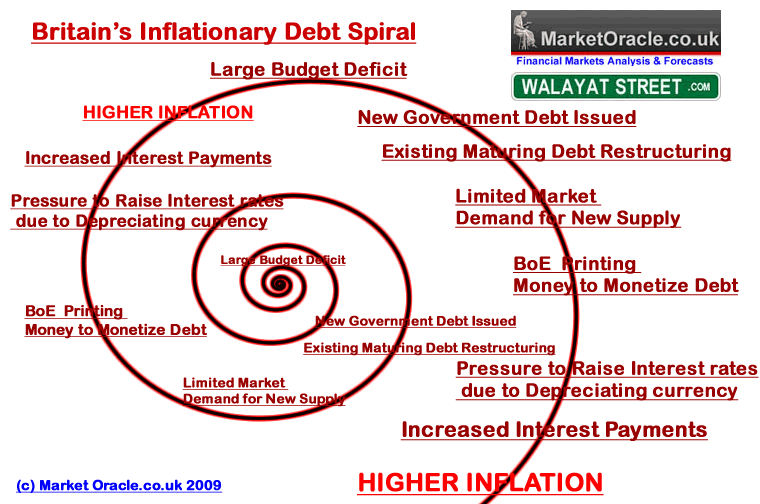 This diagram shows an inflationary debt spiral. While the specific components differ from Venezuela's case (e.g., the role of the Bank of England), the structure is the same: a feedback loop where government actions to solve one problem (the deficit) lead to consequences (inflation, depreciation) that ultimately make the original problem worse.
Your Turn: Create the Diagram
Based on the 5 steps described above, try to sketch your own causal loop diagram for Venezuela's inflation-devaluation spiral. Start with "Large Budget Deficit." What is the immediate government response? What are the consequences of that response? How do those consequences loop back to worsen the original problem?
...
Here is a completed diagram representing the vicious cycle in Venezuela:
[Image of a custom-made diagram showing the Venezuelan Inflation-Devaluation Spiral]
This causal loop diagram illustrates Venezuela's inflation-devaluation spiral. A large budget deficit (1) leads to money printing (2), which causes inflation (3) and a loss of public confidence. This triggers currency devaluation on the black market (4). Devaluation makes imports more expensive, further fueling inflation (Feedback Loop A). At the same time, inflation erodes the real value of government revenue, forcing even more money printing (Feedback Loop B), accelerating the entire vicious cycle.
This diagram clearly shows the two reinforcing feedback loops that drove the hyperinflation:
- Loop A (The Devaluation Channel): Money Printing → Inflation → Devaluation → More Inflation.
- Loop B (The Fiscal Channel): Money Printing → Inflation → Lower Real Government Revenue → More Money Printing.
Conclusion
In this lesson, we have moved from the abstract horror of hyperinflation to a concrete, systems-level understanding of its mechanics.
Key Takeaways:
- Hyperinflation is a period of extreme and accelerating inflation (over 50% per month) that renders a currency virtually worthless and signals a complete loss of faith in the state's economic management.
- Venezuela's hyperinflation was driven by an inflation-devaluation spiral, a vicious feedback loop triggered by the 2014 oil price collapse.
- The core mechanism involved the government printing money to cover massive budget deficits. This led to inflation, which caused a loss of confidence and rapid currency devaluation. The devaluation, in turn, fueled even higher inflation by raising import costs, creating a self-perpetuating crisis.
Preview of the Next Lesson:
Now that we have a conceptual model of the spiral, our next lesson will ground it in hard data. We will analyze charts of Venezuela's oil production, international oil prices, and import levels from 2008-2016 to pinpoint the precise impact of the 2014 oil price collapse and see the spiral's effects in the national economic data.
Can't find a good explanation? Sign up and we'll make it for you
Sign up