
Hello. In the previous lesson, you assessed a GCC’s AI maturity through evidence across strategy, value, governance, capabilities, digital foundations, workforce, and risk. One of the most revealing maturity questions was: who can make which decision, and who is responsible once an AI solution is live?
This lesson turns that question into a practical stakeholder map. You will identify the people and functions needed to select, approve, deliver, and operate an AI initiative; separate decision rights from advisory input; and use a RACI matrix to remove ambiguity. This is a core operating-management capability: many AI initiatives stall not because the model is weak, but because data access, risk approval, supplier decisions, business ownership, and production support have no coordinated owners.
Stakeholder mapping is more than listing attendees
A stakeholder is any individual, role, group, or external party that can affect an AI initiative, is affected by it, supplies a necessary input, or is accountable for its outcome.
For an AI initiative, a stakeholder map must answer more than “Who should join the kick-off meeting?” It should make five things visible:
- Value ownership: Who owns the business outcome and process performance?
- Decision rights: Who can approve funding, data use, design choices, release, and scale?
- Delivery responsibility: Who performs the work of configuring, integrating, testing, and implementing the solution?
- Assurance and challenge: Who can require changes because of security, privacy, legal, fairness, compliance, or architecture concerns?
- Operational ownership: Who monitors the solution, handles incidents, supports users, and decides whether to change, pause, or retire it?
This is especially important in a GCC. The GCC may lead discovery and delivery, but the enterprise business unit may own the customer process, central technology may own the platform, and corporate risk functions may set non-negotiable controls. A useful map therefore reflects the real distribution of authority, not the organization chart.
A stakeholder map is also not a way to make everyone equally responsible. When everyone is invited to approve everything, decisions slow down and accountability disappears. The aim is appropriate involvement at the right point in the lifecycle.
Start with roles, not names
Begin by mapping roles. Names change; decision rights and responsibilities should survive personnel changes. One person may hold several roles in a small pilot, but the roles should still be distinguished.
For a typical GCC AI initiative, the core stakeholder groups are below.
| Stakeholder role | Main interest | Typical contribution |
|---|---|---|
| Executive sponsor | Enterprise priority, investment, material risk, scale | Secures sponsorship, resolves major conflicts, authorizes significant investment or scale decisions |
| Business process owner | Process outcomes, service quality, adoption | Defines the operational problem, success measures, acceptable trade-offs, and process changes |
| GCC AI Operations or Strategy Manager | Portfolio value, coordinated delivery, governance | Orchestrates discovery, stakeholder alignment, delivery reporting, risks, and handover into operations |
| Product or solution owner | Fitness of the AI-enabled solution for users | Turns business needs into requirements; prioritizes enhancements and accepts solution outcomes |
| Frontline users and supervisors | Workflow usability, workload, customer or patient impact | Provide process knowledge, test the workflow, identify exceptions, adopt or reject the changed process |
| Data owner | Appropriate use of a business dataset | Authorizes access and defines permitted use of data within their domain |
| Data steward | Data quality, definitions, lineage, access process | Helps identify trusted sources, metadata, data-quality limitations, and handling rules |
| Technology and architecture lead | Technical fit, integration, resilience, reuse | Assesses architecture, interfaces, identity access, environment readiness, and platform standards |
| AI technical team or vendor | Model, workflow, integration, and technical quality | Builds or configures the solution, documents limitations, fixes defects, and supports technical testing |
| Security, privacy, legal, compliance, and Responsible AI specialists | Protection of people, data, intellectual property, and regulatory obligations | Assess risks, specify controls, challenge unsafe choices, and confirm required evidence |
| Procurement and commercial manager | Supplier value, contract protections, service obligations | Runs sourcing, negotiates contract terms, manages supplier performance and exit provisions |
| Finance or transformation office | Investment discipline and realized value | Challenges assumptions, tracks costs and benefits, and supports funding decisions |
| Service operations or platform operations | Reliable day-to-day operation | Monitors performance, manages access, responds to incidents, and handles support and change procedures |
| Internal audit or independent validation | Independent assurance | Reviews whether required controls, evidence, and governance processes actually operate as intended |
Not every initiative needs a large team from day one. A low-risk internal drafting assistant may not need a formal model-validation function. But any use case involving personal data, healthcare information, financial decisions, customer commitments, or consequential recommendations will require deeper control involvement.
IBM’s lifecycle framing is useful because it shows that stakeholder involvement begins before a technical solution is selected and continues after deployment.
Operationalizing trustworthy AI | IBM
Read IBM’s “Operationalizing trustworthy AI” to see how business, data, technical, validation, and operations roles contribute at different points in an AI lifecycle. It is particularly useful for distinguishing the process owner’s business accountability from the technical and operational work required to run the solution.
In the “Scope and plan” section, read the scope discussion. Focus on why a business stakeholder, data owner, data scientist, and operations lead must jointly define value, KPIs, technical tasks, and relevant constraints. Then, in “Collect and organize,” read the data-access discussion, noting the distinct responsibilities of data owners, stewards, and data consumers. Finish with “Build and test” through “AI governance,” reading the delivery and operations passage. Track where independent validation and the Ops team enter, and why monitoring is a business as well as a technical responsibility.
The key management lesson is simple: the person who builds an AI workflow should not be assumed to own its business consequences; the person who owns business consequences should not be assumed to approve every technical or control decision.
Map stakeholders across four management moments
For practical stakeholder mapping, divide the initiative into four moments:
- Select: Define the problem, assess solution options, evaluate suppliers if relevant, and recommend an investment.
- Approve: Authorize business funding, data access, risk treatment, architecture, contracting, pilot launch, or production release.
- Deliver: Configure or build, integrate, test, train users, and prepare operating procedures.
- Operate: Monitor quality, adoption, cost, and risk; support users; manage incidents and changes; decide whether to scale, modify, pause, or retire the solution.
The following map is a starting point for a GCC-led initiative. Treat it as a design template, not a universal allocation.
| Role | Select | Approve | Deliver | Operate |
|---|---|---|---|---|
| Executive sponsor | Confirms strategic relevance and investment case | Approves material funding, significant risk acceptance, and scale | Removes major cross-functional barriers | Reviews value and major risk performance |
| Business process owner | Defines problem, baseline, KPIs, and user needs | Accepts process design and business readiness | Provides subject-matter experts; leads process change | Owns realized business outcomes and process performance |
| GCC AI Ops / Strategy Manager | Leads intake, assessment, options analysis, and stakeholder map | Prepares evidence for stage-gate decisions | Coordinates plan, risks, dependencies, delivery governance | Runs review cadence; coordinates improvement and escalations |
| Data owner and steward | Identify trusted sources and data constraints | Approve permitted data use and access | Provide data documentation and resolve data issues | Review data-quality changes and access exceptions |
| Architecture and technology | Assess feasibility, integration, platform fit, and service design | Approve exceptions to technical standards where authorized | Configure integration, environments, identity, and resilience controls | Maintain platform, integrations, reliability, and technical changes |
| Security, privacy, legal, compliance, Responsible AI | Identify required assessments and controls | Approve or formally clear relevant risk and compliance requirements | Test controls and review evidence | Investigate issues, update controls, and support audits |
| Procurement and commercial | Assess supplier market and commercial options | Approve contractual route within delegated authority | Negotiate contract and manage vendor commitments | Manage supplier performance, renewals, and exit options |
| AI technical team or vendor | Demonstrates solution capability and limitations | Supplies evidence; does not normally self-approve its work | Builds, configures, documents, fixes, and supports testing | Provides agreed technical support and change delivery |
| Frontline users and supervisors | Explain real workflow, exceptions, and adoption barriers | May provide user acceptance input, not usually formal investment approval | Test, train, refine procedures, and give feedback | Use the tool, flag failures, and provide adoption evidence |
| Service operations | Defines supportability and monitoring needs | Confirms operational readiness where required | Sets up monitoring, support routes, runbooks, and access procedures | Monitors, responds, restores service, and reports incidents |
Two cautions matter here.
First, “approval” is not one decision. A sponsor may approve a pilot budget, while a data owner approves use of a knowledge base, the security lead approves a security exception, procurement approves a supplier contract, and the process owner accepts the redesigned workflow. Calling all of this “AI approval” hides critical dependencies.
Second, control functions are not merely late-stage reviewers. Security, privacy, legal, compliance, and Responsible AI stakeholders should shape requirements early. Otherwise, a team may create an attractive prototype that cannot legally, safely, or practically move into production.
GOV.UK’s procurement guidance makes the same operational point: an AI initiative needs a multidisciplinary team before selection, rather than a technical solution handed to commercial and control functions at the end.
Guidelines for AI procurement - GOV.UK
Read the relevant sections of GOV.UK’s “Guidelines for AI procurement” for a concrete view of multidisciplinary AI delivery and lifecycle governance. Although written for the public sector, the role logic applies well to enterprise and GCC initiatives.
In “1. Preparation and Planning,” read the multidisciplinary-team passage. Note the range of specialist roles and the advice to assess integration feasibility before going to market. Then locate the “Process-based governance and auditability” subsection and read the governance passage. Focus on its three mapping elements: roles involved in governance actions, lifecycle stages requiring intervention, and explicit monitoring, reassessment, and logging protocols.
Design approvals as a set of decision rights
A stakeholder map becomes operational when it identifies which role decides what. In a GCC, clarify these decision rights before delivery starts.
For a typical AI-enabled operational workflow, the decision set may include:
| Decision | Typical accountable role | Stakeholders who must contribute |
|---|---|---|
| Is this a priority business problem worth solving with AI? | Business process owner or executive sponsor | GCC AI Ops, frontline leaders, finance, technology |
| Which solution pattern or vendor should be recommended? | Product or solution owner | GCC AI Ops, architecture, security, procurement, users |
| Can this data be used for this purpose? | Data owner | Data steward, privacy, security, legal, process owner |
| Can the proposed architecture be used? | Architecture authority or designated technology owner | Security, platform operations, technical team, vendor |
| Are risk controls sufficient for a pilot or production use? | Designated risk, compliance, or Responsible AI authority | Privacy, legal, security, process owner, AI Ops |
| Should funding be committed? | Executive sponsor or delegated investment authority | Finance, business owner, GCC AI Ops, procurement |
| Is the changed workflow ready for users? | Business process owner | Frontline supervisors, users, AI Ops, training or change lead |
| Is the service ready for production operation? | Service owner or release authority | Technology, security, operations, process owner |
| Should the solution scale, change, pause, or retire? | Business owner, with appropriate risk and service input | Sponsor, AI Ops, operations, control functions, finance |
The accountable role can vary by enterprise. What matters is that the answer is explicit and documented.
For example, a business owner may be accountable for the decision to scale an AI assistant because they own the service outcome and operational risk. They should not be able to override a privacy prohibition independently. A privacy authority may block use of unapproved personal data, but it does not own whether the support process delivers its expected value. Clear decision rights make this division workable.
Use RACI to turn the map into working accountability
A stakeholder map identifies the relevant ecosystem. A RACI matrix specifies participation for particular activities.
- Responsible: performs the work.
- Accountable: owns the outcome or decision; the final authority.
- Consulted: provides input before the work or decision.
- Informed: receives an update after the fact or at an agreed point.
The distinction between Responsible and Accountable is the one most often lost in project meetings. A delivery manager may be responsible for organizing a pilot, for example, while the process owner remains accountable for whether the process change meets business needs.
RACI explained its simple yet powerful - The most watched RACI matrix video on YouTube
Watch “RACI explained its simple yet powerful” from the RACI channel for a concise explanation of the model and a practical method for building and reviewing a matrix.
Start with role distinctions, which separates responsibility for doing work from accountability for the ultimate decision and defines all four RACI categories. Then watch matrix structure to see how tasks and roles are arranged. Finish with quality checks. Focus on the diagnostic questions: whether every activity has one accountable role, whether any activity has no responsible role, and whether excessive consultation is likely to delay execution.
A useful RACI follows several practical rules:
- Give each decision or deliverable one Accountable role. If several executives need to agree, name the role or forum with final authority and record the others as Consulted.
- Assign at least one Responsible role for every activity.
- Do not use “the AI team” or “the business” as a role. Name a meaningful role such as GCC AI Operations Manager, Customer Support Process Owner, or Enterprise Data Owner.
- Separate related but distinct activities. “Approve the AI solution” is too broad; split it into data access, business funding, architecture, controls, user acceptance, and production release.
- Keep Consulted roles selective. Consultation is active input before a decision, not a courtesy invitation.
- Specify how and when Informed stakeholders receive updates: dashboard, weekly review, monthly governance forum, release notice, or incident alert.
Worked example: AI-assisted support-response drafting
Consider a GCC that proposes an AI assistant to help enterprise support representatives draft responses using approved knowledge articles. The assistant does not send messages autonomously. Representatives review, edit, and send the final response.
This use case appears modest, but it still has multiple owners:
- The Head of Customer Support owns support quality, handling time, and customer experience.
- The GCC AI Operations Manager coordinates assessment, pilot delivery, evidence, and governance.
- The Knowledge Management Lead owns the approved support content.
- The Data Steward documents source quality, permissions, and update processes.
- The Enterprise Architect assesses access, integration with the support platform, and resilience.
- Security and privacy assess information handling, access controls, retention, and supplier risk.
- The Procurement Manager manages commercial evaluation if a third-party tool is selected.
- Support representatives and supervisors test output usefulness, identify failure patterns, and help redesign the workflow.
- The platform operations team monitors availability, access issues, logs, and service tickets after release.
A focused RACI might look like this:
| Activity | Executive sponsor | Process owner | GCC AI Ops | Data owner | Technology / architecture | Risk and control functions | Users / supervisors | Service operations |
|---|---|---|---|---|---|---|---|---|
| Define support problem, baseline, and success criteria | I | A | R | C | C | C | C | I |
| Evaluate solution options and prepare recommendation | I | A | R | C | R | C | C | C |
| Authorize use of the approved knowledge source | I | C | R | A | C | C | I | I |
| Approve pilot funding and scope | A | R | R | I | C | C | I | I |
| Configure workflow and integrate support tools | I | C | A | C | R | C | C | C |
| Conduct user acceptance testing and confirm workflow readiness | I | A | R | I | C | C | R | C |
| Approve production release within the agreed risk boundary | I | A | R | I | R | C | C | R |
| Monitor service, output quality, adoption, and exceptions | I | A | R | C | C | C | R | R |
| Decide whether to scale, redesign, pause, or retire | A | R | R | C | C | C | C | C |
This matrix does not mean the executive sponsor performs no useful work because they are often marked Informed. Their accountability is concentrated on high-consequence decisions: investment, strategic alignment, major risk acceptance, and scale. The process owner, by contrast, remains deeply involved because they own the operational outcome every day.
The matrix should be accompanied by a short governance cadence. The cadence matches the speed and risk of decisions rather than hierarchy for its own sake.
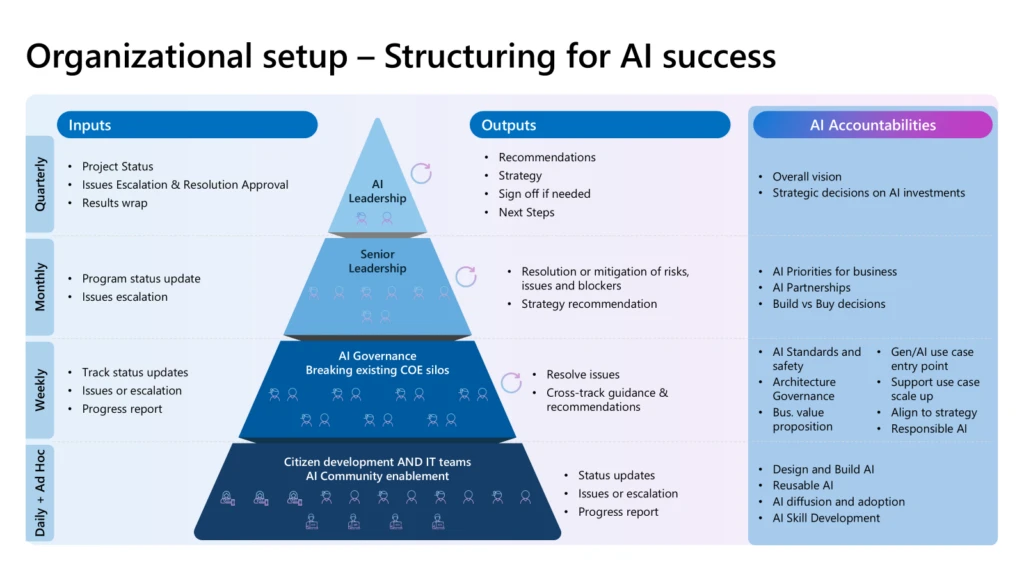
For the support-response example, a proportional cadence could be:
| Cadence | Forum and participants | Purpose |
|---|---|---|
| Daily or as needed during pilot | Delivery team, technical team, support supervisors | Resolve defects, user feedback, data-access issues, and test blockers |
| Weekly | GCC AI Ops, process owner, technology, data, risk representatives | Review pilot progress, output quality, incidents, risk actions, and decision dependencies |
| Monthly | Sponsor, process owner, GCC leadership, finance, key control leads | Review value, adoption, spend, unresolved escalations, and readiness for the next stage |
| At defined stage gates | Relevant decision authorities | Approve pilot launch, production release, scale, significant change, or retirement |
The image’s exact structure is not a universal template. A small internal pilot may need only a weekly working group and one sponsor checkpoint. A healthcare-related or customer-facing system may require more frequent monitoring and formal control approvals. The underlying principle is stable: operational teams surface evidence; governance forums resolve cross-functional trade-offs; senior leaders make strategic and investment decisions.
How to create a stakeholder map in practice
Use the following method when a new AI request enters the GCC.
1. Define the initiative boundary
Write down:
- the operational process affected;
- intended users and people affected;
- AI capability being considered;
- data sources involved;
- whether a vendor, internal platform, or low-code tool is proposed;
- impact if the solution is wrong, unavailable, or misused; and
- the decision currently needed, such as approval to assess, pilot, procure, or scale.
The map for an internal document-summarization assistant will be much smaller than the map for an AI workflow influencing patient communications or customer credit decisions.
2. Identify owners of the critical assets and consequences
Ask the following questions:
- Who owns the process KPI that the initiative claims it will improve?
- Who owns each data source and can authorize its use?
- Who owns the enterprise platform, integration, or identity-access standard?
- Who is accountable for security, privacy, compliance, and Responsible AI requirements?
- Who controls budget and supplier contracting?
- Who will support users after go-live?
- Who is harmed or burdened if the workflow fails?
These questions reveal stakeholders that an initial project team often misses: data owners, frontline supervisors, procurement, service operations, and people directly affected by the workflow.
3. Separate contribution from authority
For each role, record:
- Interest: What outcome, risk, or asset do they care about?
- Contribution: What evidence, expertise, or work do they provide?
- Authority: What can they approve, reject, or escalate?
- Timing: At which lifecycle moment must they be involved?
- Engagement mode: Working team member, consulted specialist, formal approver, governance attendee, or informed audience.
This prevents a common failure: inviting a privacy lead to a workshop, recording that they were “engaged,” but never requesting a formal assessment before data is used.
4. Build and challenge the RACI
Create rows for concrete decisions and deliverables, then assign RACI roles. Review it with the affected leaders rather than treating it as a document produced only by the project manager.
Look specifically for:
- two or more Accountable roles;
- no Responsible role;
- one role carrying an unrealistic number of responsibilities;
- too many Consulted roles;
- a missing owner for data access, production support, incident response, or benefit realization; and
- a vendor implicitly being made accountable for a business decision that only the enterprise can own.
5. Publish the map with the delivery plan
Include the stakeholder map in the initiative charter, business case, or pilot plan. Keep it current when scope changes. A move from internal assistance to customer-facing communication, for example, changes both the affected stakeholders and the required approvals.
For an AI Operations or Strategy Manager, this artifact is also useful interview evidence. It demonstrates that you can manage AI as an operating model—not simply as a tool-selection exercise.
Key takeaways
A credible AI stakeholder map connects roles to lifecycle decisions and operational accountability.
Remember:
- Map roles before names and distinguish business ownership, technical delivery, control oversight, and service operations.
- Treat selection, approval, delivery, and operation as different management moments with different stakeholders.
- Break “AI approval” into precise decisions: business investment, data use, architecture, controls, contract, workflow acceptance, and production release.
- Use a RACI matrix to assign one accountable role, at least one responsible role, and selective consultation for each material activity.
- Include frontline users and service operations early; adoption, exceptions, support, and monitoring are part of delivery, not post-launch afterthoughts.
- Match governance cadence to the initiative’s risk, scope, and decision speed.
In the next lesson, you will use this stakeholder context to write an outcome-based problem statement for an operational challenge: a concise definition of the problem, affected process, measurable impact, and boundaries before jumping to an AI solution.
Can't find a good explanation? Sign up and we'll make it for you
Sign up