
Categorising Year 11 Food Technology Exam Questions by Syllabus Keywords
Hello, and welcome. Food Technology prelims can feel like a huge collection of unrelated terms—food safety, nutrients, culture, gelatinisation, media, storage—but the course becomes much more manageable once you can sort every question into one of three “drawers”:
- Food Availability and Selection
- Food Quality
- Nutrition
This first short module is your survival map. Today’s goal is not to memorise every detail. It is to recognise what an exam question is really asking about, so you know which knowledge to retrieve before you start writing.
The three-drawer map of Preliminary Food Technology
Use this simple distinction:
| Topic area | The central question | Typical focus |
|---|---|---|
| Food Availability and Selection | What food can people access, and why do they choose particular foods? | Supply, access, culture, appetite, income, media, family, location |
| Food Quality | Is the food safe and acceptable, and how do preparation or ingredients change it? | Storage, contamination, spoilage, sensory properties, cooking processes, functional properties |
| Nutrition | What does food do in the body, and does a diet support health? | Nutrients, digestion, dietary needs, healthy eating, diet-related disease |
The course outline confirms these three Preliminary areas and their major subtopics.
Read the Preliminary topic list in Food Technology, a Stage 6 subject outline. It gives you the official-style “big picture” headings that will become your exam sorting system.
On page 54, find the heading “The Preliminary Course.” Read the Preliminary topic list. Notice that Food Availability and Selection contains influences on availability and selection; Food Quality contains safety, sensory characteristics, and functional properties; and Nutrition contains nutrients and optimum diets. Stop before the HSC-course topic list begins.
A useful warning: the three areas connect in real life. For example, a family may choose frozen vegetables because of price and availability; freezing also affects quality; vegetables contribute nutrients to the diet. But an exam question usually has a main focus. Your job is to identify that focus.
Drawer 1: Food Availability and Selection
This area contains two linked ideas.
Food availability: Can people get the food?
Food availability concerns the food supply and access to it. Questions may ask why foods are available, scarce, expensive, imported, seasonal, or easier to obtain in one location than another.
Look for words such as:
- availability, supply, access, distribution, production
- historical events, migration, technology
- political conditions, economic conditions, social conditions
- transport, location, rural, remote, imported, seasonal
- food environment, stores, promotion, price
For example:
“Explain how improved transport technology has influenced food availability in Australia.”
The keyword is availability and the question asks about technology affecting supply and access. Put this in Food Availability and Selection—specifically the availability side.
You would not begin by explaining vitamins or food poisoning. Instead, you would explain the cause-and-effect relationship: improved transport can move food longer distances more efficiently, so consumers may access a wider range of fresh and imported foods.
Food selection: Why does a person choose it?
Food selection is about the decision to eat, buy, avoid, prepare, or prefer a particular food. The cause may come from the person, their relationships, their culture, or their environment.
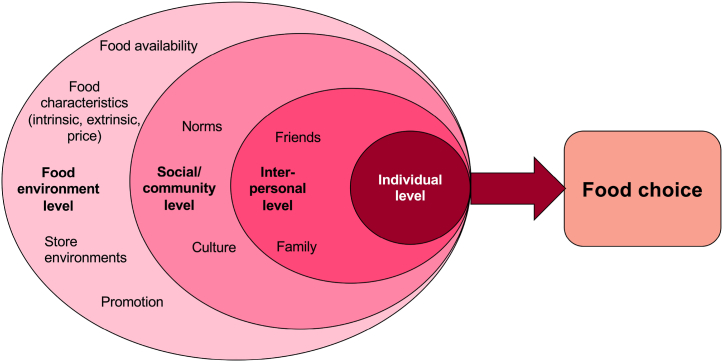
The image is useful because it stops you from treating food choice as merely “personal preference.” A person may like a food, but their choice can also be shaped by what their family cooks, what their peers eat, what is promoted online, what they can afford, and what local shops sell.
Selection keywords commonly include:
| Level of influence | Keywords or ideas you may see |
|---|---|
| Individual | hunger, appetite, satiety, values, beliefs, habits, emotions, past experiences |
| Interpersonal | family, friends, peers |
| Social and cultural | culture, traditions, religion, norms, lifestyle |
| Economic and environmental | income, price, employment, education, media, advertising, location, product availability |
For example:
“Explain how social media may influence teenagers’ food selection.”
This is Food Availability and Selection because the focus is on media influencing choices. A strong answer would explain that repeated online promotion or influencer content can make particular foods appear desirable or fashionable, encouraging teenagers to buy or request them.
The key distinction within this drawer
Ask yourself:
- Is the question mainly asking whether food is obtainable? Think availability.
- Is it mainly asking why someone chooses a food? Think selection.
Sometimes the same factor can be used in either way. Take price:
- “Explain how rising food prices affect access to fresh produce in remote communities.” This emphasises availability/access.
- “Explain how a low income may influence a family’s food choices.” This emphasises selection.
The deciding factor is not the single word price. It is what the question wants you to explain.
Drawer 2: Food Quality
Food Quality is about whether food is safe, appealing, and fit to eat, as well as what happens to food when it is prepared or processed.
A simple way to remember it:
Quality asks what condition the food is in, how safe it is, what it is like to eat, and why cooking changes it.
There are four major clusters.
| Food Quality cluster | What it means | Question clues |
|---|---|---|
| Food safety | Preventing food-borne illness | contamination, bacteria, cross-contamination, temperature danger zone, hygiene |
| Storage and preparation | Keeping food safe and maintaining quality | refrigeration, freezing, storage, thawing, cooking, handling |
| Sensory characteristics | How food is experienced by the senses | appearance, aroma, flavour, texture, colour, crispness |
| Functional properties | How ingredients behave during preparation | gelatinisation, caramelisation, dextrinisation, denaturation, coagulation, aeration, emulsification |
For example:
“Explain why chicken should be stored in the refrigerator and cooked thoroughly.”
This is Food Quality. The question is about safe handling and preventing food-borne illness. Your explanation would focus on controlling bacterial growth through cold storage and using adequate cooking to destroy harmful microorganisms.
Another example:
“Describe the sensory characteristics of a high-quality muffin.”
Again, Food Quality. The response needs sensory vocabulary: an even golden-brown appearance, pleasant baked aroma, soft and light texture, moist crumb, and balanced flavour.
A third example:
“Explain how gelatinisation changes a starch-based sauce.”
This is also Food Quality, but now the focus is a functional property. You would discuss starch absorbing liquid and swelling when heated, causing the sauce to thicken.
A common confusion: “quality” does not only mean “looks nice”
In Food Technology, quality includes sensory appeal, but it also includes safety and functional success.
- A bright, glossy salad may look appealing but be unsafe if contaminated.
- A cake may be safe to eat but poor quality if it is dense rather than aerated.
- A sauce may taste fine but have poor quality if it has separated because its emulsion failed.
If the question is about safety, storage, sensory features, preparation, or cooking changes, start in the Food Quality drawer.
Drawer 3: Nutrition
Nutrition is about nutrients, the human body, dietary requirements, and health outcomes.
Use this anchor question:
What nutrients does the body need, what do they do, and how does a person’s overall diet affect health?
Nutrition keywords include:
- carbohydrates, protein, fats
- vitamins, minerals, water, dietary fibre
- function, food sources, deficiency, excess
- digestion, absorption, energy
- life cycle, adolescence, pregnancy, older adults
- Australian Dietary Guidelines, Australian Guide to Healthy Eating
- balanced diet, nutritional needs, health condition, disease
For example:
“Explain one function of dietary fibre and identify a food source.”
This is clearly Nutrition. The answer needs a body-related function and a food source, such as fibre supporting healthy bowel function and being found in wholegrain cereals, legumes, fruit, and vegetables.
Or:
“Assess the diet of an adolescent using the Australian Guide to Healthy Eating.”
This is Nutrition because it asks you to judge dietary intake against healthy-eating guidance.
Do not confuse a food choice with nutritional adequacy
Consider these two questions:
-
“Explain how religious beliefs may influence a person’s choice to avoid pork.”
This is Food Availability and Selection, because beliefs influence a choice. -
“Assess whether a teenager who avoids meat is meeting their protein and iron needs.”
This is Nutrition, because the focus is nutrient adequacy and health.
The food might be the same, but the question’s focus changes the category.
A fast method for sorting exam questions
When you see a question, do not immediately start writing. Spend a few seconds classifying it.
Step 1: Ignore the directive verb briefly
Words such as identify, describe, explain, discuss, and assess tell you how deeply to answer. They do not usually tell you the topic area.
Instead, first find the important content words.
Step 2: Locate the question’s main noun
Ask what the question is centred on:
-
Access, supply, influences, choice, culture, media, income?
Food Availability and Selection -
Safety, spoilage, storage, sensory features, preparation, functional properties?
Food Quality -
Nutrients, body functions, digestion, dietary needs, health?
Nutrition
Step 3: Say the category to yourself in a full sentence
Try this sentence frame:
“This is mainly a [topic area] question because it asks about [main focus].”
For instance:
- “This is mainly a Food Quality question because it asks about safe storage.”
- “This is mainly a Nutrition question because it asks about the function of protein.”
- “This is mainly a Food Availability and Selection question because it asks why media affects food choices.”
If you can complete that sentence clearly, you are much less likely to write an answer from the wrong part of the course.
Borderline questions: use the “best answer” test
Some questions deliberately use broad words such as food, diet, health, or choice. When keywords alone are not enough, ask:
Which topic area would give me the most direct and specific answer?
Here are common borderline cases.
| Question focus | Best category | Why |
|---|---|---|
| A family chooses takeaway because both parents work late | Food Availability and Selection | Employment and lifestyle influence selection |
| Food is left out for several hours before being served | Food Quality | The issue is safety and bacterial growth |
| A student skips breakfast and cannot meet energy needs | Nutrition | The focus is energy and dietary adequacy |
| A remote town has limited access to fresh food | Food Availability and Selection | The focus is location and availability |
| A cake has a dry, tough texture after overmixing | Food Quality | The focus is sensory and functional quality |
| A diet high in saturated fat contributes to health risk | Nutrition | The focus is the dietary pattern and health outcome |
Notice that Food Availability and Selection is the broadest-sounding title, but it is not the “everything else” category. If the question involves food but asks about contamination, sensory evaluation, nutrients, or digestion, another drawer is more accurate.
Your one-page mental map
Before an exam, reduce the whole Preliminary course to these three prompts:
- Availability and Selection: Can people get it, and why do they choose it?
- Quality: Is it safe, acceptable, and changed appropriately by handling or preparation?
- Nutrition: What does it provide the body, and does the diet support health?
This is not a replacement for learning content. It is the filing system that tells you which content to use.
You now have the first structure for approaching Food Technology questions: identify whether the question concerns food access and choice, food safety and quality, or nutrients and health. When a question seems confusing, return to its central focus rather than trying to recall the entire course at once.
Next, we begin Food Availability and Selection in detail by looking at how historical events, migration, technology, and social, economic, and political conditions have shaped Australia’s food availability.
Can't find a good explanation? Sign up and we'll make it for you
Sign up