
Welcome back. In the previous lesson, you learned that an observable has a definite value only when the wavefunction is an eigenfunction of its operator. For example, a plane wave can have definite momentum, while a standing wave can have definite energy without having definite momentum.
This lesson adds the crucial comparison tool: the commutator. It tells us whether the order of two operator actions matters and, consequently, whether two observables can be assigned definite values in the same quantum state. This will become especially important when atomic states are labelled by several quantum numbers.
Order of operations and the commutator
For two operators and , their commutator is defined as
Operator products act from right to left. Thus,
You first apply to , then apply to the resulting function.
If the two possible orders give the same result for every allowed wavefunction, then
The operators are said to commute, and their observables are called compatible.
If instead
the operators do not commute. Their order matters physically as well as mathematically.
Position and Momentum Operators in Quantum Mechanics
Watch “Position and Momentum Operators in Quantum Mechanics” from Professor Dave Explains for a worked derivation of the most important commutator in introductory quantum mechanics.
Watch the derivation. Follow the two different operator orders carefully, especially the product rule used when the momentum operator differentiates x\psi(x). The surviving term after cancellation is the source of the nonzero commutator.
A commutator is itself an operator. To calculate one for differential operators, apply it to a general test function . If the result is zero for arbitrary , the commutator is the zero operator.
Why commutation decides simultaneous definiteness
Suppose a state has definite values and for observables and . It must then be a simultaneous eigenfunction:
Apply the commutator to that state:
Using the two eigenvalue equations gives
So any simultaneous eigenfunction must satisfy
This produces a powerful diagnostic.
| Commutator result | What it implies |
|---|---|
| The observables are compatible. A common basis of simultaneous eigenfunctions can be chosen. | |
| , where | No nonzero state can be an eigenfunction of both observables. |
| , but is not a nonzero constant times | There is no complete simultaneous eigenbasis. A special shared eigenstate can exist only if the commutator annihilates that particular state. |
Here, is the identity operator: it leaves every wavefunction unchanged.
The first row is the one most often used in chemistry. For Hermitian operators representing observables, commuting means that we can choose states with exact values of both observables. Those joint eigenvalues can then serve as quantum-state labels.
Commutators and Uncertainty Principle
Read “Commutators and Uncertainty Principle” by Kasper Peeters for the mathematical reason commuting observables can share eigenfunctions.
In Section 10.1, begin with the definition of the commutator. Then read the theorem and proof. Focus on the step showing that, when [\hat A,\hat B]=0, applying \hat B to an eigenfunction of \hat A keeps the result inside the same eigenspace of \hat A.
There is one subtlety worth retaining. If an eigenvalue of is nondegenerate, its eigenfunction is unique apart from an overall constant, so commuting must leave that eigenfunction proportional to itself. It is automatically also an eigenfunction of .
For a degenerate eigenvalue, several independent functions share one value of . In that case, can mix functions within that degenerate subspace. But because the two operators commute, we can choose appropriate linear combinations within the subspace that are eigenfunctions of both. This distinction explains an important result from the previous lesson: compatible observables do not mean every eigenstate of one observable automatically has a definite value of the other.
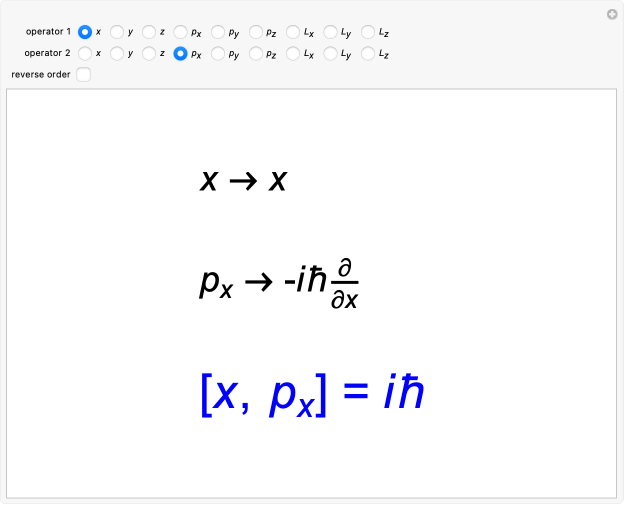
Position and momentum: the canonical noncommuting pair
In one dimension,
To find their commutator, let both operator orders act on an arbitrary differentiable :
The first term is
For the second term, position first produces , and momentum then differentiates that product:
By the product rule,
Therefore,
Subtracting the two operator orders,
The derivative terms cancel:
Because this is true for any suitable ,
or, when the identity operator is understood,
Since is nonzero, no physical state can have both exactly definite position and exactly definite momentum in the same direction.
You can see this without invoking the uncertainty relation. If had both values definite, then the argument above would require
But the canonical commutation relation gives
which cannot equal zero for a nonzero state. Thus, an exact position eigenstate is necessarily a superposition of momentum eigenstates, and an exact momentum eigenstate is necessarily spread over position.
This is the operator basis of the uncertainty relation encountered earlier:
The uncertainty relation concerns spreads in repeated measurements. The commutator supplies the structural reason that the spread cannot vanish for both quantities at once.
Energy and momentum: compatibility depends on the potential
The Hamiltonian for a one-dimensional particle is
Its commutator with momentum is
The derivative is understood as a position-dependent multiplication operator.
This result has a direct physical interpretation:
- If is constant, then . Energy and momentum commute.
- If the potential varies with position, energy and momentum generally do not commute.
For a free particle, , so
A plane wave,
has definite momentum
and definite free-particle energy
It is a simultaneous eigenfunction of and .
This clarifies the standing-wave example from the previous lesson. The state
has a definite free-particle energy but not a definite momentum. That does not contradict the fact that and commute for a free particle. The energy level is degenerate: both and have the same energy. The cosine is a particular superposition within that degenerate energy subspace. Plane waves provide a simultaneous energy-momentum eigenbasis, while the cosine is another valid energy eigenfunction that does not diagonalize momentum.
In an atom, the electron experiences the Coulomb potential, which changes with distance from the nucleus. An atomic energy eigenstate therefore does not generally have a definite linear momentum. Later, angular momentum and energy will instead provide the more useful compatible labels for atomic states.
A dependable commutator workflow
When asked whether two observables can have simultaneous definite values, proceed systematically:
-
Write the two operators precisely.
Distinguish multiplication operators, derivatives, and composite operators such as the Hamiltonian. -
Form the commutator.
-
Apply it to a general test wavefunction if the operators contain derivatives or act in a non-obvious way.
-
Simplify completely.
Apply the product rule whenever a derivative acts on a product. -
Interpret the result.
- Zero means the observables are compatible and may be assigned simultaneous definite values in a common eigenbasis.
- A nonzero constant times means no state has both values definite.
- A more complicated nonzero operator means there is no general common eigenbasis; inspect a proposed state only if the problem specifically asks about one.
-
Keep the claim state-specific.
Commutation guarantees the availability of simultaneous eigenstates. It does not mean that an arbitrary state has definite values of either observable.
Key takeaways
The commutator measures the difference between two orders of operator action:
For observables represented by Hermitian operators:
means the observables are compatible and can be represented by a common set of simultaneous eigenfunctions. A state from that basis has definite values of both observables.
The canonical position-momentum relation is
Because this is nonzero for every nonzero state, position and momentum cannot both be exactly definite.
Finally, compatibility does not imply that every eigenstate of one observable is automatically an eigenstate of the other, particularly when degeneracy is present. It means a basis can be chosen in which both are definite.
Next, the course moves from the operator language to the central equation of quantum chemistry: the time-independent Schrödinger equation for a particle in a specified potential.
Can't find a good explanation? Sign up and we'll make it for you
Sign up