
Welcome to the first module of this course. Before working with Claude or designing prompts, it helps to identify what kind of system you are looking at. “AI” is often used as a catch-all term, but a scripted support bot, a fraud-risk model, and a tool that drafts an email operate in fundamentally different ways.
In this lesson, you will learn to classify systems by their primary decision mechanism and primary output:
- Rule-based software follows human-written instructions.
- Predictive machine learning estimates a value, category, or likelihood from learned patterns in historical data.
- Generative AI produces new content based on patterns learned during training and the current input.
This distinction will guide later decisions about when to use generative AI, how to prompt it, and where human review is essential.
Three systems, three different sources of behavior
Imagine three tools used by an online retailer.
- A returns form accepts an item only if it was purchased within 30 days and is unused.
- A risk service marks a card transaction as likely fraudulent or unlikely fraudulent.
- A writing assistant drafts a personalized apology email for a delayed delivery.
All three take input and produce an output. That similarity can be misleading. The crucial question is:
Where does the system’s behavior come from?
For a rule-based system, it comes from explicitly programmed instructions. For predictive ML, it comes from statistical relationships learned from past examples. For generative AI, it comes from learned patterns used to create a new response, image, code sample, or other content.
1. Rule-based software: people specify the logic
A rule-based system applies conditions chosen in advance by people. Its logic might be written directly in code or stored as business rules:
IF purchase_age <= 30 days
AND item_condition = "unused"
THEN approve_return
ELSE deny_return
The program does not infer this policy from thousands of prior returns. A policy owner, analyst, or developer defines it. Given the same input and the same rules, it should produce the same result.
Rule-based systems are particularly appropriate when:
- the possible situations are well understood;
- the organization needs precise, auditable behavior;
- a policy, regulation, or workflow already defines the answer;
- the cost of an invented or inconsistent response is high.
A calculator, a payroll tax formula, password-validation rules, and a shipping-fee table are all usually rule-based software. They may be useful and sophisticated, but they are not machine learning merely because they automate a decision.
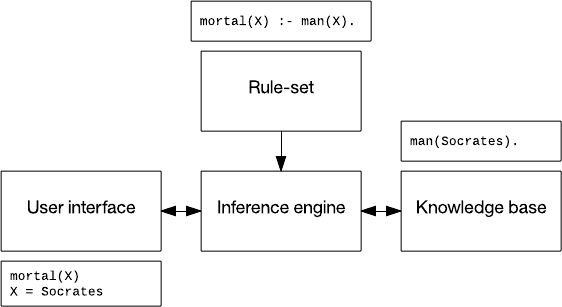
The visual below shows the basic pattern in a classic rule system. The knowledge base holds facts, the rule set holds explicit logic, and an inference engine applies the rules to derive an answer. In the example, the fact that Socrates is a person plus the rule that people are mortal yields the conclusion that Socrates is mortal.
A modern rule-based chatbot follows the same basic idea, even if it has a polished conversational interface. It may recognize terms such as “returns,” “delivery,” or “store hours,” then select a prewritten answer or a step in a decision tree. The wording can seem conversational without being newly composed.
Generative vs Rules-Based Chatbots
Watch IBM Technology’s “Generative vs Rules-Based Chatbots” to see how a rules engine turns recognized user terms into a predefined response. This provides a concrete contrast with the generative chat tools you will use later in the course.
Watch rules and architecture, which explains predefined conditional rules and the main components of a rule-based bot. Then watch the shop example. Notice that the bot retrieves a scripted reply once its conditions are satisfied; it is not composing a new answer from learned language patterns.
A useful diagnostic is this: could a developer inspect a finite set of written conditions and find the intended logic for every routine case? If yes, classify the core decision as rule-based unless the system also contains a learned model.
Predictive machine learning: data supplies the mapping
Some decisions are too variable for a manageable list of rules. Consider card fraud detection. A transaction may be unusual because of location, amount, device, time of day, merchant type, and the customer’s normal behavior. A developer could attempt to write rules for every combination, but this quickly becomes brittle.
A predictive machine-learning model instead learns a relationship from historical examples. During training, it sees input features alongside known outcomes, such as past transactions labeled fraudulent or legitimate. It then learns a mathematical mapping that can estimate the outcome for a new transaction.
Google’s introductory explanation captures the key shift: rather than manually writing every relationship between conditions and outcomes, a model derives useful relationships from data.
Read Google’s “What Is Machine Learning?” for a concise account of training a model from data and for the two predictive forms you will encounter most often: regression and classification.
Begin in the introductory rainfall example at the model definition and example. Focus on the contrast between hand-built atmospheric equations and a model trained on weather data. Then continue in the “Supervised learning” section through the “Classification” subsection, from supervised prediction types. Distinguish a numeric prediction from a category prediction.
For this course, recognize two common predictive outputs:
| Predictive task | Output | Example system |
|---|---|---|
| Regression | A number | Estimate next month’s electricity demand or a home price |
| Classification | A category or probability of a category | Flag a transaction as fraud risk, or label an email spam/not spam |
A classification model may output a probability such as “0.87 probability of churn.” A business rule can then determine the action: perhaps customers above a chosen threshold are referred to a retention team. That later action is rule-based, but the risk score itself comes from predictive ML.
Predictive systems can also learn without labels, for example by grouping similar customers into clusters. For present classification purposes, however, the central pattern is simpler: the system uses learned relationships to estimate a predefined target. The target may be a number, a class, a ranking, or a likelihood.
Predictive vs Generative AI: How They Work and When to Use Each
Watch IBM Technology’s “Predictive vs Generative AI: How They Work and When to Use Each” for the practical difference between forecasting a known target and creating content. The examples will make classification much faster in real workplace scenarios.
Watch the central contrast. Focus on the questions each system answers: predictive AI estimates what is likely to happen, whereas generative AI creates a possible new output. Then watch predictive examples, especially regression, classification, fraud detection, demand forecasting, and predictive maintenance.
Two cautions matter:
- Predictive does not mean certain. A forecast is an estimate, not a guarantee. It can be checked later against reality.
- ML does not mean generative AI. Most models that predict categories, quantities, risk, or demand are not generating new content.
Generative AI: the output is newly created content
Generative AI learns patterns in very large collections of content and uses those patterns to create a fresh output in response to an input. A language model can draft an email, explain a concept, summarize a report, propose code, or produce alternative versions of a lesson. Image models can create a new visual from a textual description.
Unlike a fraud classifier, which chooses between a defined set of outcomes such as “fraud” and “not fraud,” a generative system usually has a vast space of possible acceptable answers. Ask it to write a product description and there is rarely one uniquely correct paragraph.
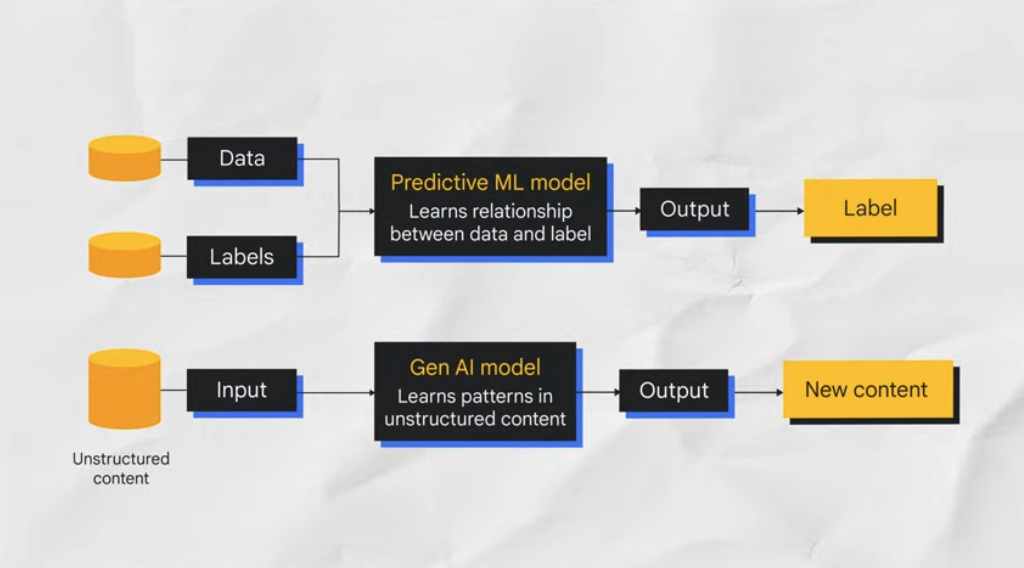
Google’s overview is useful here because it describes generative AI in terms of what it makes and the many possible input and output formats.
Return to Google’s “What Is Machine Learning?” and read its “Generative AI” section. It connects the definition of generative AI to practical text, image, video, code, and audio tasks.
In the “Generative AI” section, read from what generative systems create. Scan the input-to-output examples, then read from patterns and training. Focus on the phrase “new but similar data”: it means the output is not simply selected from a fixed response list.
Common generative AI tasks include:
- drafting, rewriting, translating, or summarizing text;
- producing images, audio, video, or code;
- brainstorming options and explaining material in different styles;
- conversational support where the reply must adapt to the user’s wording and context.
A large language model, such as Claude, technically produces a response piece by piece by estimating likely next tokens. But its system-level purpose is generative: those token choices build a new explanation, draft, conversation, or transformation of supplied material. Therefore, classify an LLM chat assistant as generative AI even though prediction is part of its internal mechanism.
The same input may yield different wording on separate runs, especially when the system is configured for variety. That flexibility is useful for drafting and ideation, but it also means generative output requires review when accuracy, policy, or safety matters.
A practical classification method
When you encounter a real system, do not classify it from branding alone. A product called “AI assistant” might be mostly scripted; an ordinary-looking risk tool might contain a sophisticated predictive model. Instead, use these four questions.
Question 1: Is the logic explicitly written as conditions?
If the essential behavior is “if this condition, then that action,” classify it as rule-based software.
Example: “If the employee has completed training and their manager approves, grant system access.”
Question 2: Was a model trained on historical examples to estimate a defined outcome?
If yes, classify it as predictive ML.
Example: “Using past equipment sensor readings and repair records, estimate the chance that this pump will fail within 14 days.”
The output is a risk score, yes/no class, ranking, or number. It may cause an action, but it does not itself compose a new report or message.
Question 3: Is the central purpose to create content not previously stored as a fixed answer?
If yes, classify it as generative AI.
Example: “Given product specifications and a desired tone, write three versions of a product launch announcement.”
Question 4: Is it a combination?
Many operational systems combine these categories. Classify each significant component, then describe the overall workflow as hybrid.
For example, a customer-retention workflow might:
- use a predictive model to identify customers likely to cancel;
- apply rules that decide which customers are eligible for an offer;
- use generative AI to draft a personalized retention email;
- require a human employee to review and send it.
There is no contradiction in this design. The components address different jobs: forecasting, policy enforcement, and communication. IBM’s predictive-versus-generative video gives a similar example of using a churn prediction to target generated retention messages.
Here is a compact comparison to use in your own classification notes:
| Feature | Rule-based software | Predictive ML | Generative AI |
|---|---|---|---|
| Main source of behavior | Human-written rules | Patterns learned from historical data | Patterns learned from content data |
| Typical question | “Which rule applies?” | “What is likely?” | “What could I create?” |
| Typical output | A fixed decision, action, or scripted response | Number, category, probability, or ranking | New text, image, code, audio, video, or other content |
| Example | Eligibility checker | Churn-risk score | Draft a retention email |
| Main strength | Consistency and auditability | Pattern recognition and forecasting | Flexible, open-ended content creation |
| Main limitation | Brittle outside anticipated cases | Can inherit data errors and uncertainty | Can produce plausible but incorrect content |
Classification traps to avoid
A chatbot is not automatically generative
A bot that maps “opening hours” to a stored sentence about business hours is rule-based. A bot that composes an answer to an unusual, multi-part question in natural language is likely generative. Some chatbots route routine questions to rules and complex questions to an LLM, making the product hybrid.
A generated report is not automatically predictive
A language model can write a report containing numbers, but it is generative if its main role is composing the prose. If a separate demand-forecasting model calculated the numbers, then the workflow includes predictive ML as well.
“Uses data” is not enough to make something ML
A dashboard can retrieve sales figures from a database and calculate totals with formulas. That is conventional software unless it uses a trained model to infer a relationship or prediction from data.
An LLM can perform classification, yet remain a generative model
You might ask Claude to label support tickets as “billing,” “technical,” or “account.” It can generate one of those labels. But if the deployed system uses an LLM as the core model, it is generally still a generative-AI solution applied to a classification task. In contrast, a purpose-built predictive classifier trained specifically on labeled tickets is predictive ML.
For this course, state both the underlying system type and the task it is being used for when ambiguity matters. For example: “This is a generative language model being used to categorize tickets,” rather than simply “this is predictive AI.”
A short professional reasoning template
When you classify a system in conversation, documentation, or a portfolio project, make the reasoning visible:
Classification: Predictive machine learning.
Evidence: It was trained on past labeled transactions and returns a probability that a new transaction is fraudulent.
Why not generative AI: Its primary output is a predefined risk category or score, not newly composed content.
Related components: A rule may determine what action to take when the score exceeds a threshold.
This format prevents vague claims such as “we used AI to make decisions.” It also makes it easier to discuss risks, evaluation, ownership, and suitable human oversight later in the course.
Key takeaways
You can now distinguish three foundational system types:
- Rule-based software applies explicit, human-authored logic. Its behavior is specified in advance.
- Predictive ML learns from past data to estimate a known target such as a price, risk, probability, or category.
- Generative AI creates new content, often with many plausible acceptable outputs.
Classify a system by its core mechanism and purpose, not by whether it has a chat interface or an “AI” label. Real products often combine all three: rules control policies, predictive models identify likely outcomes, and generative AI creates language or other content.
Next, we will look inside a large language model conceptually: how tokens, conversation context, and probability combine to produce a response.
Can't find a good explanation? Sign up and we'll make it for you
Sign up